
February 19, 2026


Generative Engine Optimization (GEO) represents a fundamental shift in how businesses achieve search visibility. But as AI-powered search engines proliferate, a critical question emerges: how do you actually measure GEO success?
Traditional SEO metrics—rankings, clicks, impressions—don't capture AI visibility. When ChatGPT cites your content or Google AI Overviews references your brand, standard analytics tools miss it entirely.
This guide provides the complete framework for GEO measurement, covering the metrics that matter, the tools available in 2026, and practical approaches to building a GEO analytics dashboard that demonstrates ROI.
Traditional search analytics work because clicks create trackable events. When a user clicks your Google result, analytics tools capture the referral source, landing page, and subsequent behavior.
AI search breaks this model in several ways:
Zero-click citations: When ChatGPT or Perplexity cites your content, users often get the information they need without visiting your site. There's no click to track.
Fragmented attribution: AI systems synthesize information from multiple sources. Your brand might be mentioned alongside five competitors in a single response, but you have no visibility into how often this happens.
Platform opacity: AI platforms don't provide publisher analytics dashboards. Unlike Google Search Console, there's no Perplexity Console or ChatGPT Analytics.
Dynamic responses: AI-generated answers vary based on user queries, conversation context, and model updates. The same query can produce different citations across sessions.
According to Meltwater's 2026 analysis of LLM metrics, most organizations lack visibility into how their brand appears in AI-generated responses—a critical blind spot as AI search adoption accelerates.
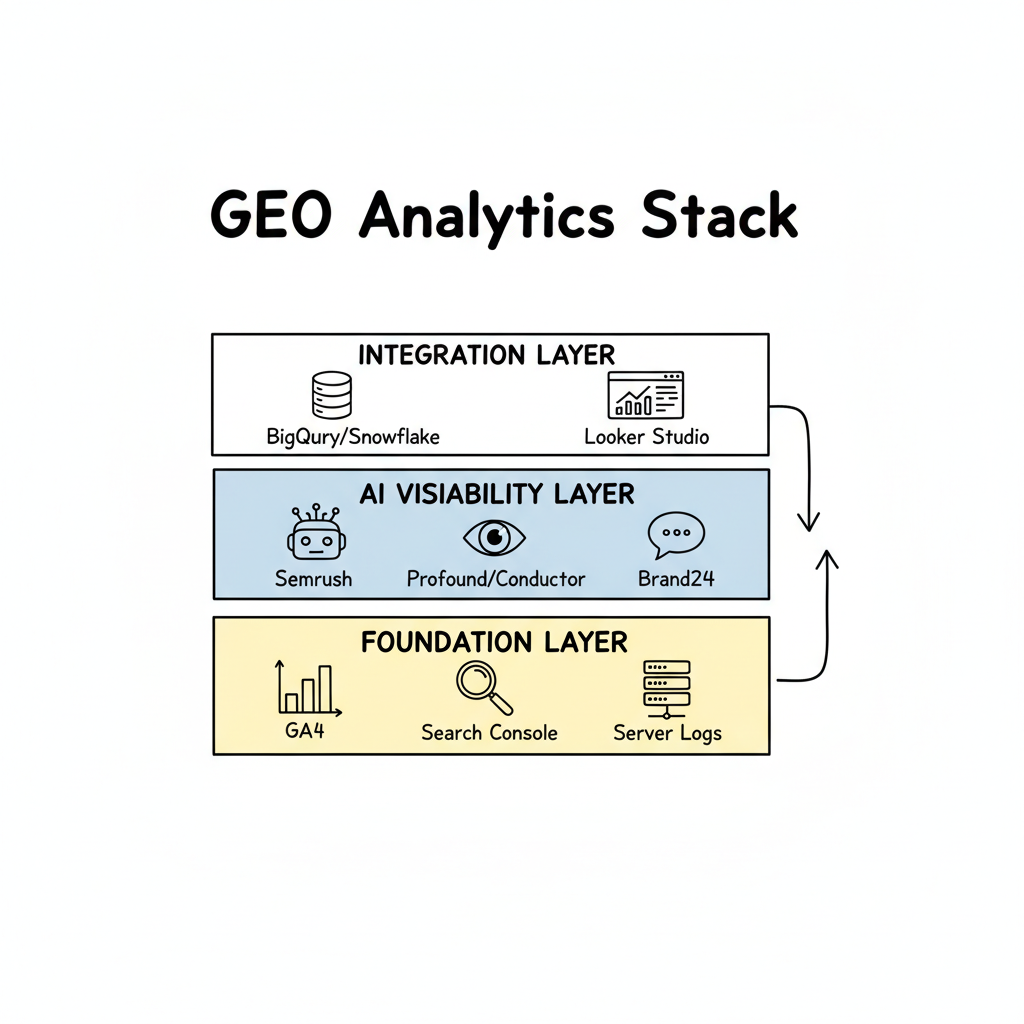
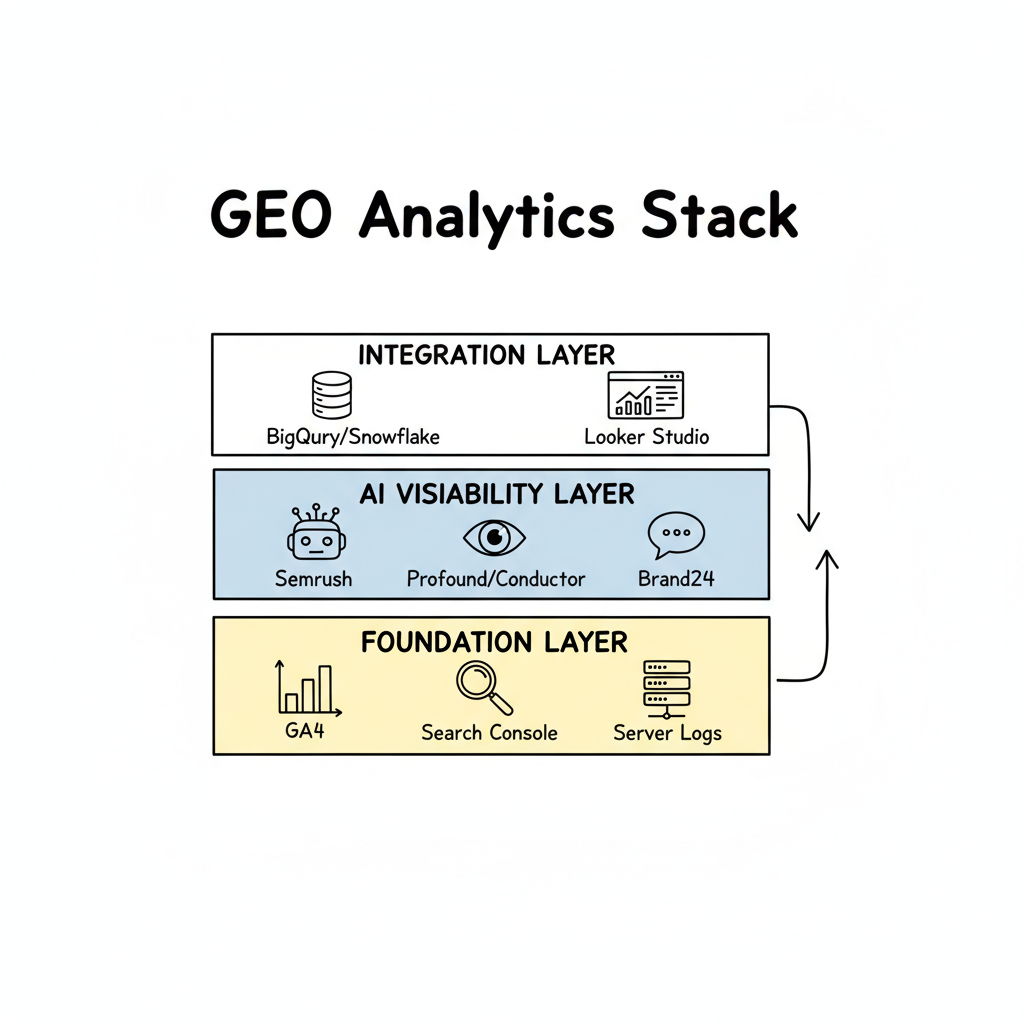
Building a GEO analytics capability requires layering specialized tools on top of your existing analytics infrastructure.
Your GEO stack builds on existing tools:
Add tools specifically designed for AI search tracking:
Connect data sources into a single view:
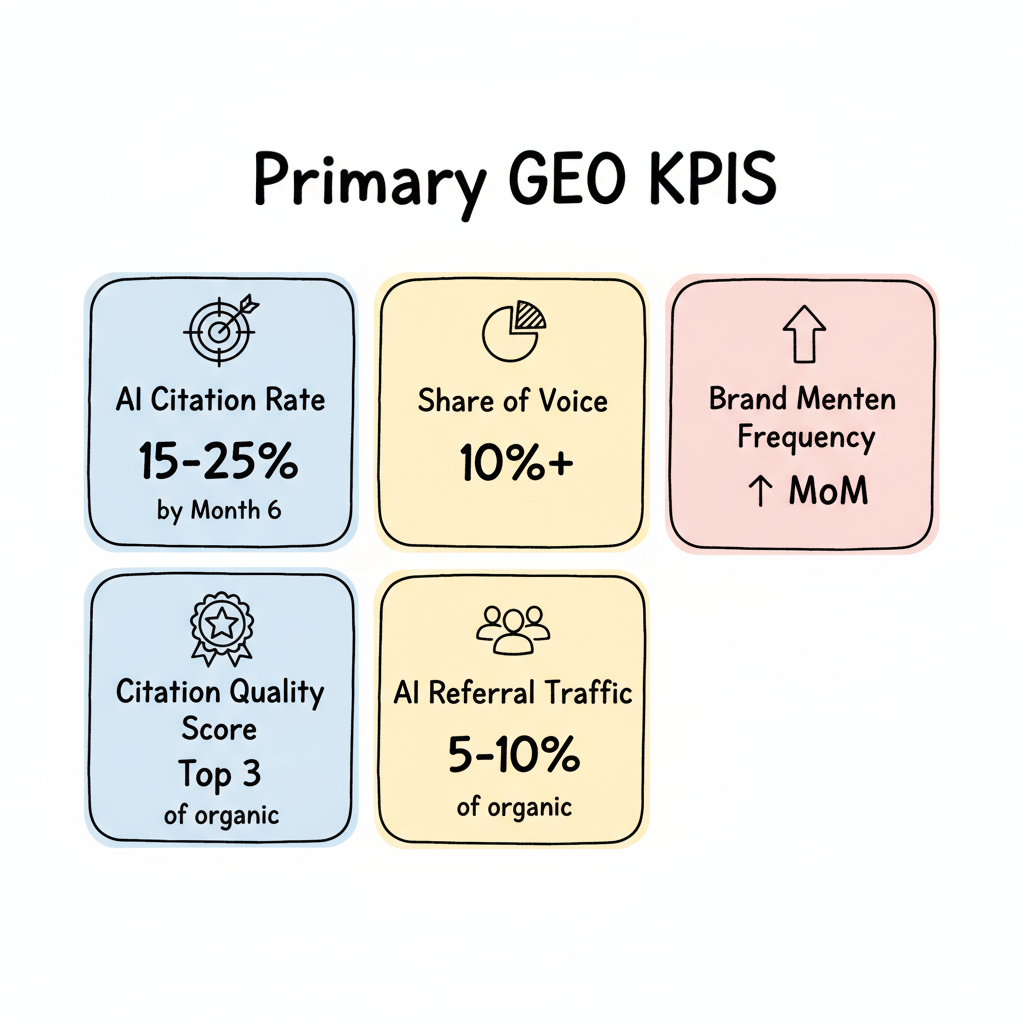
Effective GEO measurement requires tracking metrics across three categories: visibility, engagement, and business impact.
Metric | Definition | Target Benchmark |
AI Citation Rate | % of target queries where you're cited | 15-25% by Month 6 |
Share of Voice (SOV) | Your citations vs. competitors | 10%+ by Month 6 |
Brand Mention Frequency | Times brand appears in AI responses | Growth month-over-month |
Citation Quality Score | Position and prominence of citations | Top 3 sources |
AI Referral Traffic | Visits from AI platform referrals | 5-10% of organic traffic |
Metric | Definition | Why It Matters |
Query Coverage | Topics where you appear in AI responses | Content gap identification |
Sentiment Analysis | Tone of AI mentions about your brand | Reputation management |
Citation Retention | How long citations persist | Content durability |
Cross-Platform Presence | Visibility across ChatGPT, Perplexity, Google | Platform diversification |
According to Conductor's 2026 AEO/GEO Benchmarks Report, organizations with mature GEO programs target 5%+ Share of Voice by Month 3 and 10%+ by Month 6—achievable goals for focused optimization efforts.
Share of Voice (SOV) measures your AI visibility relative to competitors. It's the GEO equivalent of traditional search market share.
The basic SOV formula:
GEO SOV = (Your AI Citations / Total Citations in Category) × 100For practical measurement:
Manual sampling approach:
Automated tracking:
SOV Level | Interpretation | Action |
<5% | Minimal AI visibility | Foundational GEO work needed |
5-15% | Emerging presence | Expand content coverage |
15-30% | Competitive position | Defend and grow |
30%+ | Market leader | Protect and diversify |
Citation frequency tracks how often AI systems reference your content. Unlike SOV (which is relative), citation frequency measures absolute visibility.
AI citations fall into several categories:
Direct citations: AI explicitly names your brand or links to your content
Indirect references: AI uses your content without explicit attribution
Brand mentions: Your brand appears in AI responses
Query-based tracking:
Topic-based tracking:
Not all citations are equal. Weight citations by:
While direct AI referral traffic is limited (most AI interactions don't generate clicks), you can segment and analyze the traffic that does arrive.
In Google Analytics 4:
Navigate to Traffic Acquisition > Session Source to find AI referrals:
In server logs:
Monitor bot traffic from AI systems:
Build GA4 segments to isolate AI-influenced traffic:
Segment 1: Direct AI Referrals
Segment 2: AI-Assisted Journeys
Segment 3: AI-Likely Traffic
Compare AI-referred traffic against other sources:
Metric | AI Referrals | Organic Search | Benchmark |
Bounce Rate | Track | Track | AI should be lower |
Time on Site | Track | Track | AI should be higher |
Pages per Session | Track | Track | AI should be higher |
Conversion Rate | Track | Track | Varies by industry |
AI referral traffic typically shows higher engagement—users who click through from AI responses have strong intent.
Each AI platform requires slightly different tracking approaches.
What you can track:
Limitations:
Best approach:
What you can track:
Advantages:
Best approach:
What you can track:
Google Search Console data: According to industry analysis, Google provides some visibility into AI Overview performance through Search Console, though the data is limited compared to traditional search metrics.
Best approach:
The GEO measurement tool landscape has matured significantly in 2026. Here are the leading options:
Semrush AI Visibility Toolkit
Conductor
Meltwater
Profound
Scrunch AI
AI Product Rankings
Manual tracking spreadsheet
Tool | AI Overview | ChatGPT | Perplexity | Price |
Semrush | Excellent | Good | Good | $249+/mo |
Conductor | Excellent | Good | Good | Custom |
Profound | Good | Excellent | Excellent | $99/mo |
Scrunch AI | Good | Good | Good | $79/mo |
Manual | Basic | Basic | Basic | Free |
A GEO dashboard should provide at-a-glance visibility into AI search performance. Here's what to include:
Section 1: Executive Summary
Section 2: Share of Voice
Section 3: Citation Tracking
Section 4: Traffic Impact
Section 5: Competitive Intelligence
Dashboard Section | Data Source |
SOV Tracking | Semrush, Profound, or manual |
Citation Counts | GEO monitoring tool |
Traffic Data | Google Analytics 4 |
Competitive Data | GEO tool + manual research |
Metric | Recommended Frequency |
SOV | Weekly |
Citations | Weekly |
Traffic | Daily (automated) |
Competitive | Monthly |
Executive Summary | Monthly |
Demonstrating GEO ROI requires connecting visibility metrics to business outcomes.
GEO ROI = ((AI Attribution Revenue - GEO Investment) / GEO Investment) × 100Direct attribution:
AI Referral Traffic × Conversion Rate × Average Order ValueAssisted attribution:
(Total Conversions × AI Assist Rate) × AOV × Attribution Weight (typically 20-40%)Brand lift attribution:
AI Citation Count × Estimated Impression Value × Brand Lift FactorFor a B2B SaaS company:
GEO ROI = (($200,000 - $15,000) / $15,000) × 100 = 1,233%Industry | Typical GEO ROI | Timeline to Positive ROI |
B2B SaaS | 300-500% | 4-6 months |
Professional Services | 250-400% | 5-7 months |
E-commerce | 150-250% | 6-9 months |
Healthcare | 200-350% | 5-8 months |
Industry context matters for GEO benchmarks. AI Overview rates and citation opportunities vary significantly by sector.
According to Conductor's 2026 benchmarks, AI Overview prevalence varies dramatically:
Industry | AI Overview Rate | GEO Priority |
Health Care | 48.75% | Critical |
B2B Technology | 65-70% | Critical |
Insurance | 63% | High |
Financial Services | 32.1% | High |
Jobs & Education | 33.0% | Medium |
E-commerce | 4% | Lower |
B2B Technology:
Professional Services:
E-commerce:
Stage | Timeline | SOV | Citations | Capability |
Foundation | Months 1-3 | <5% | Sporadic | Basic tracking |
Growth | Months 4-6 | 5-15% | Consistent | Full dashboard |
Optimization | Months 7-12 | 15-25% | Frequent | ROI attribution |
Leadership | Year 2+ | 25%+ | Dominant | Competitive moat |
Weekly tracking for SOV and citations provides sufficient data without excessive effort. Traffic metrics can be monitored continuously through automated dashboards. Monthly reporting works well for executive stakeholders.
For budget-conscious organizations, start with Profound ($99/month) or Scrunch AI ($79/month). These provide essential AI visibility tracking without enterprise pricing. Supplement with manual query tracking for key terms.
Yes, but it's time-intensive. Create a spreadsheet with your target queries, run them weekly across ChatGPT, Perplexity, and Google AI, and manually document citations. This works for 20-30 queries but becomes impractical at scale.
Focus on the metrics leadership cares about: revenue attribution and competitive position. Calculate AI attribution revenue using the framework above, and show SOV trends versus competitors. Case studies with specific results are particularly persuasive.
There's no universal "GEO score" standard yet. Instead, benchmark against yourself (month-over-month improvement) and competitors (relative SOV). Aim for consistent growth in citations, SOV, and AI referral traffic.
Get our free GEO Analytics Dashboard template and setup guide. Our team has developed a comprehensive dashboard template that connects to your existing analytics infrastructure. Download now and start measuring your AI search visibility today.
Related Articles:
By submitting this form, you agree to our Privacy Policy and Terms & Conditions.



