
February 19, 2026


Generative Engine Optimization (GEO) has become an essential skill for digital marketers and SEO professionals. As AI-powered search platforms like ChatGPT, Perplexity, and Google AI Overviews reshape how users discover information, professionals need structured training to master these new optimization techniques. This guide covers the best GEO courses, certification programs, and learning paths available in 2026.
The shift from traditional search to AI-powered discovery has created a skills gap in the marketing industry. While 63% of marketers now prioritize generative search optimization, many lack formal training in the specific techniques that drive AI visibility.
GEO requires different skills than traditional SEO. Understanding how large language models process content, how citation decisions work, and how to structure information for AI extraction demands new knowledge that existing SEO training doesn't cover adequately.
Professionals who invest in GEO education gain competitive advantages. They can deliver results that untrained competitors cannot match. They command higher rates because specialized skills carry premium value. They future-proof their careers as AI search continues expanding.
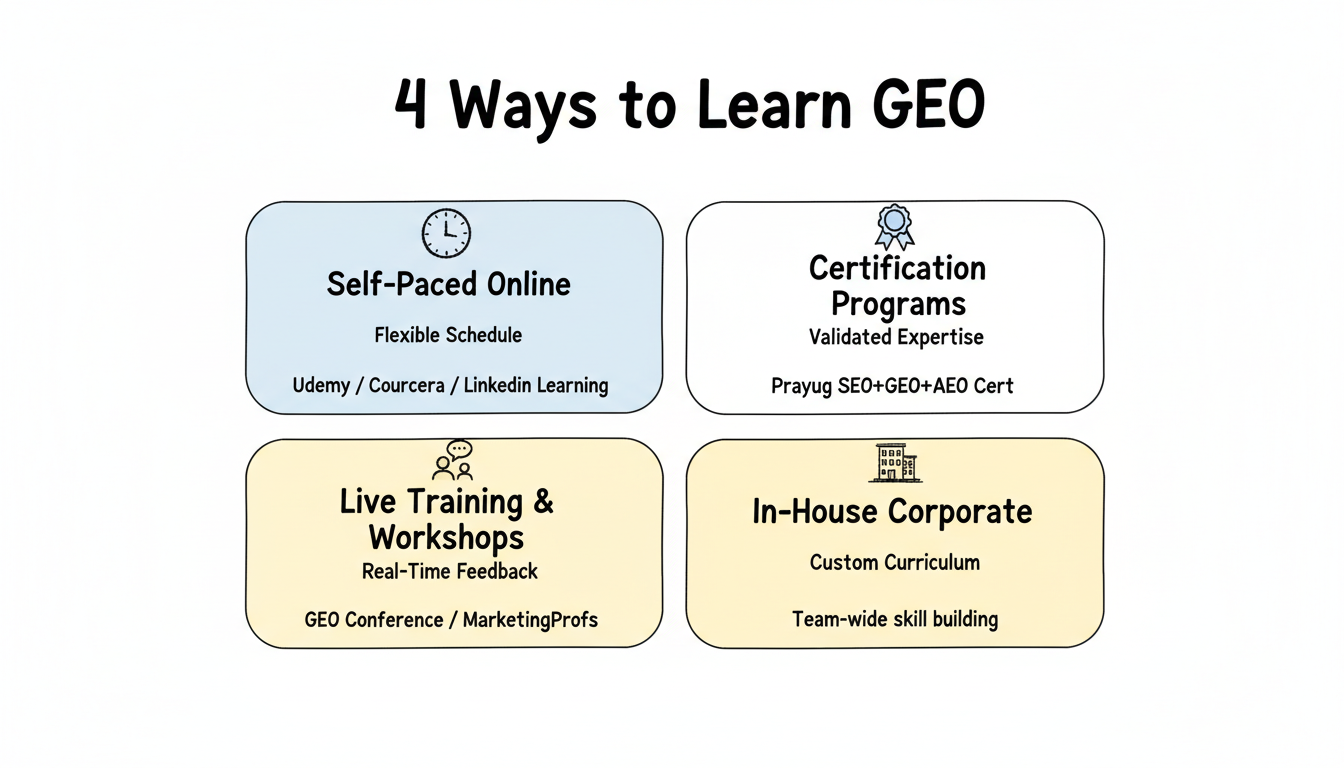
GEO education spans multiple formats, each serving different learning styles and career goals.
Self-paced courses offer flexibility for working professionals. Platforms like Udemy, Coursera, and LinkedIn Learning host comprehensive GEO programs that students complete on their own schedules.
The Udemy AI SEO Mastery course covers GEO and AEO fundamentals across 16 hours of content with 247 lectures. It addresses AI search visibility, content optimization for LLMs, and practical implementation strategies. Students gain lifetime access and can revisit material as the field evolves.
Coursera's SEO Mastery Specialization now includes dedicated GEO modules. The program combines video instruction with hands-on projects and peer assessments. Completion earns a certificate that professionals can display on LinkedIn profiles.
Formal certifications validate GEO expertise to employers and clients. Several organizations now offer GEO-specific credentials.
The Prayug SEO, GEO & AEO Certification Course provides 10 modules covering the complete spectrum of modern search optimization. The curriculum addresses traditional SEO foundations, answer engine optimization techniques, and generative engine strategies. Certification requires passing assessments that test practical application.
Industry associations have begun developing GEO certifications as the discipline matures. These credentials carry weight because they require demonstrated competency rather than just course completion.
Live training provides interactive learning with real-time feedback. The GEO Conference brings together researchers and practitioners to share the latest developments. Princeton researchers who coined the term "Generative Engine Optimization" have presented at these events, offering insights directly from academic research. These events combine keynote presentations with breakout sessions and networking opportunities that build professional connections.
Live workshops offer advantages self-paced courses cannot match. Instructors can observe students working through problems and provide immediate corrections. Participants can ask clarifying questions in the moment. Group discussions surface diverse perspectives and real-world applications that enrich understanding.
MarketingProfs and similar organizations offer webinars on XEO (extended engine optimization) and the future of search. These sessions address emerging trends and provide opportunities to ask questions to experienced practitioners.
Workshops at marketing conferences increasingly include GEO tracks. SMX, Pubcon, and Brighton SEO have added sessions specifically addressing AI search optimization techniques.
Enterprise organizations often develop custom GEO training programs for their teams. These programs align with specific business goals and use company-specific examples.
Benefits of in-house training include:
Organizations can engage consultants to develop and deliver these programs or build internal training capabilities.
Quality GEO courses cover several essential topic areas.
Foundational modules explain how generative AI systems work. Students learn how LLMs process text, how retrieval-augmented generation selects sources, and how citation decisions get made.
This theoretical foundation enables practitioners to develop optimization strategies based on how systems actually work rather than guessing or following outdated tactics.
Key concepts include:
Practical modules teach specific optimization tactics. Students learn content structuring for AI extraction, schema markup implementation, and E-E-A-T signal development.
Hands-on exercises have students optimize real content and measure results. This practical application reinforces concepts and builds portfolio examples.
Topics typically include:
Different AI platforms have different characteristics. Quality courses address optimization for each major platform:
Google AI Overviews: Understanding the relationship between traditional rankings and AI citations. The 87% correlation between top-10 rankings and AI Overview citations means traditional SEO remains foundational.
ChatGPT: Optimizing for conversational search with 400+ million weekly users. Understanding how ChatGPT's browsing capabilities access real-time content.
Perplexity: Leveraging the platform's transparent citation model and preference for fresh, research-quality content.
Voice Assistants: Adapting content for spoken responses and conversational queries.
Understanding whether GEO efforts work requires measurement capabilities. Courses teach students to:
Emerging tools like Ahrefs Brand Radar and Semrush's AI visibility features get covered alongside manual audit methodologies.
Selecting the appropriate course depends on individual circumstances and goals.
Experienced SEO practitioners should look for courses that build on existing knowledge rather than repeating SEO basics. Advanced courses addressing the specific differences between traditional optimization and GEO provide the most value.
Look for courses that:
Marketers without deep SEO backgrounds benefit from comprehensive courses covering both foundations and GEO specifics. The Prayug certification's combined SEO, AEO, and GEO curriculum serves this audience well.
These learners should prioritize:
Agency professionals often need credentials they can present to clients. Certification programs with recognized credentials provide business development value beyond skill development.
Consider courses that:
Enterprise marketers may need to justify training investments to leadership. Look for programs with clear ROI frameworks and case studies from similar organizations.
Valuable features include:
Effective GEO education follows a structured progression.
Begin with understanding how AI search works. Complete foundational modules on LLM processing, retrieval systems, and citation mechanisms. This knowledge provides context for all tactical learning that follows.
Recommended activities:
Develop practical implementation capabilities. Learn schema markup, content structuring, and technical optimization techniques.
Recommended activities:
Apply skills to comprehensive GEO strategies. Learn to audit AI visibility, develop optimization plans, and measure results.
Recommended activities:
Deepen expertise in specific areas based on career goals. Some practitioners specialize in e-commerce GEO, others in B2B, others in local search optimization for AI.
Recommended activities:
Formal courses provide structure, but continuous learning requires additional resources.
Stay current through publications covering AI search developments. Search Engine Journal, Search Engine Land, and Moz Blog publish regular GEO content. Following researchers and practitioners on social platforms surfaces emerging insights.
Join communities where GEO practitioners share knowledge. LinkedIn groups, Slack communities, and Reddit discussions provide peer learning opportunities. Asking questions and sharing experiences accelerates skill development.
Practical experimentation teaches lessons courses cannot. Run tests on your own properties. Try different optimization approaches. Measure what works. Real-world experience complements formal education.
As Google's John Mueller observed, "Good SEO is Good GEO." Many optimization principles apply across traditional and AI search. Google's own documentation on search quality, E-E-A-T, and content guidelines provides valuable guidance that applies to GEO.
Certifications signal competency to employers and clients, but their value varies.
Certifications provide significant value when:
Practical results often outweigh credentials when:
Quality certification programs share characteristics:
Avoid programs that:
Foundational GEO competency typically develops within 2-3 months of focused study. Mastery requiring strategic thinking and nuanced application takes 6-12 months of combined learning and practice. GEO evolves continuously, so ongoing learning remains necessary throughout careers.
SEO experience helps but isn't strictly required. GEO builds on some SEO foundations, so those with SEO backgrounds learn faster. Complete beginners should choose comprehensive courses covering both disciplines rather than GEO-only programs.
No single certification dominates the market yet. The Prayug SEO, GEO & AEO Certification offers comprehensive coverage. Coursera's programs carry academic credibility. The field continues maturing, and new certification options emerge regularly.
Free resources exist but have limitations. YouTube tutorials, blog articles, and documentation provide foundational knowledge. Structured courses with assessments and feedback accelerate learning and provide credentials. Many professionals combine free resources with paid courses for comprehensive education.
Related Articles:
By submitting this form, you agree to our Privacy Policy and Terms & Conditions.



