GEO vs SEO: Understanding the Key Differences and When to Use Each

The way people discover information online has split into two distinct paths. Some users still type queries into Google and click through search results. Others ask AI assistants questions and expect synthesized answers immediately. This reality has created a fundamental question for marketers: Should you focus on SEO, GEO, or both?

The answer depends on your audience, goals, and resources. This comparison breaks down what makes each approach distinct, when each works best, and how to make smart budget decisions between them.

Quick Comparison Table

Aspect SEO GEO
What It Optimizes Web pages Entities and information
Primary Goal Rank in search results Get cited in AI answers
Success Metric Rankings, clicks, traffic Citations, mentions, recommendations
User Action Clicks to your website May receive answer without clicking
Authority Model Backlinks and domain authority Entity trust and source credibility
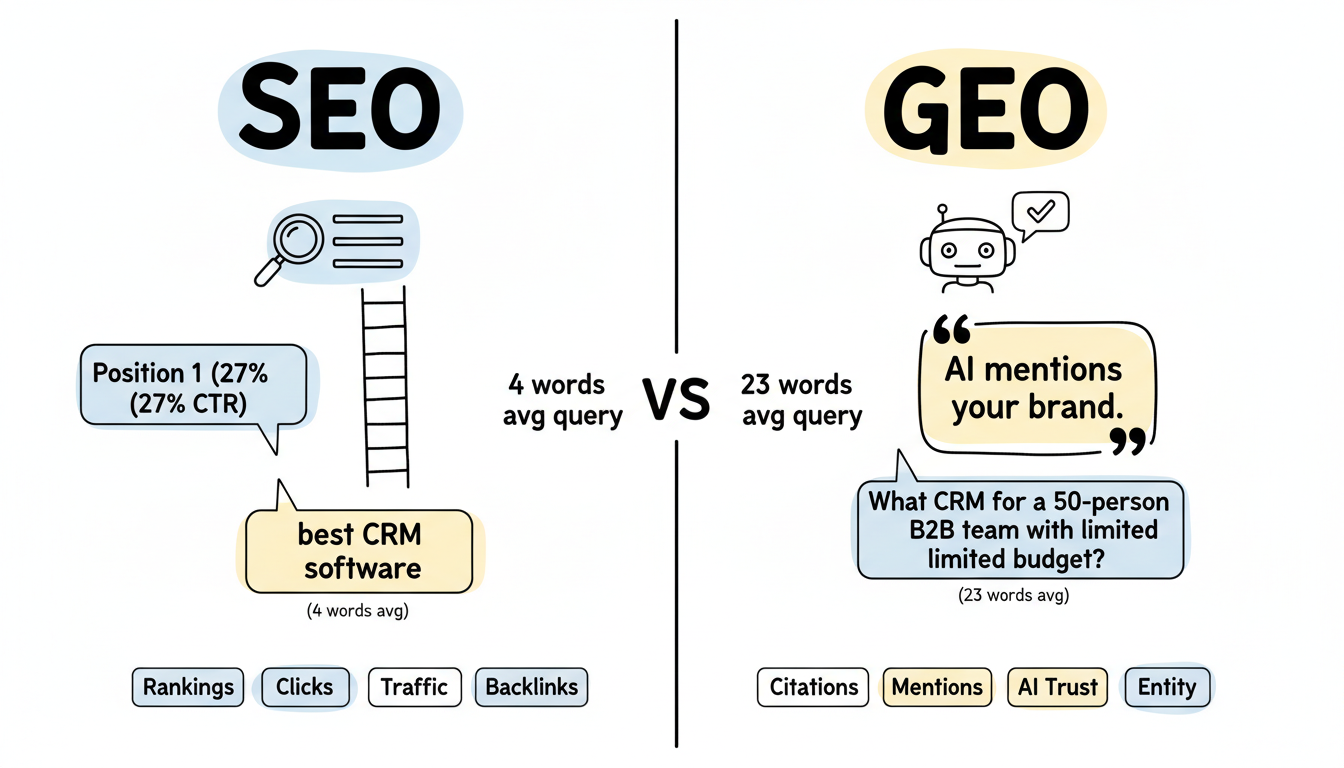
Query Type ~4 words average ~23 words average (conversational)
Update Speed Days to weeks Weeks to months
Measurement Mature tools (GA, GSC, Ahrefs) Emerging tools (Omnius, Profound)
Content Focus Keyword optimization Answer optimization
Competition View Page 1 rankings AI system selection

Both strategies matter—they simply optimize for different discovery channels.
What Is Traditional SEO?

Search Engine Optimization (SEO) is the practice of improving your website's visibility in search engine results pages (SERPs). When someone searches "best project management software" on Google, SEO determines which pages appear in those ten blue links.

How SEO Works

Search engines like Google crawl the web, index content, and rank pages based on hundreds of factors:

  • Content relevance: Does the page answer the query?
  • Backlinks: Do other credible sites link to this page?
  • Technical health: Is the site fast, mobile-friendly, and crawlable?
  • User experience: Do visitors engage with the content?

SEO success means appearing higher in search results, which drives more organic traffic to your website.

SEO Strengths

  • Proven track record: Two decades of established best practices
  • Measurable results: Clear metrics in Google Search Console and analytics
  • Direct traffic: Users click through to your site
  • Compounding returns: Rankings can persist for years

SEO Limitations

  • Zero-click searches growing: More users get answers without clicking
  • AI Overviews displacing clicks: Google's AI summaries appear before links
  • Competitive saturation: Top positions increasingly difficult to claim
  • Slower adaptation: Algorithm updates can take months to recover from

What Is GEO (Generative Engine Optimization)?

Generative Engine Optimization (GEO) is the practice of making your content and brand the source AI systems cite and recommend in their responses. When someone asks ChatGPT "what's the best project management software for remote teams," GEO determines whether your brand gets mentioned.

How GEO Works

AI systems like ChatGPT, Perplexity, and Google's AI Overviews evaluate sources differently than traditional search engines:

  • Entity recognition: Is your brand clearly identifiable as an authority?
  • Source consistency: Is your information reliable across the web?
  • Content clarity: Can AI easily extract and cite your information?
  • Trust signals: Do credible sources mention and validate your brand?

GEO success means being the brand AI systems trust, cite, and recommend.

GEO Strengths

  • Higher-intent audience: AI search converts at 4.4x traditional search rates
  • Growing channel: 58% of consumers now use AI for product recommendations
  • Implicit endorsement: AI citation carries authority weight
  • Competitive opportunity: Most competitors aren't optimizing yet

GEO Limitations

  • Emerging discipline: Best practices still evolving
  • Measurement challenges: Tracking tools less mature
  • Training lag: AI systems update periodically, not continuously
  • No click guarantee: Users may not visit your site after AI mentions you

Key Differences: Ranking vs Citations

The fundamental difference between SEO and GEO lies in what you're optimizing for.

SEO: Position-Based Competition

SEO is a ranking game. You compete for specific positions in search results:

  • Position 1: ~27% click-through rate
  • Position 2: ~15% click-through rate
  • Position 10: ~2% click-through rate
  • Page 2: Essentially invisible

Success means claiming and defending specific ranking positions against competitors.

GEO: Selection-Based Competition

GEO is a selection game. AI systems don't rank sources—they select which information to include in responses:

  • Your brand either gets mentioned or it doesn't
  • Citations may include your information alongside competitors
  • Selection criteria favor comprehensive, trustworthy sources

Success means being chosen as a source AI systems trust enough to cite.

Different Query Behaviors

User query patterns differ significantly between channels:

Traditional search queries: Short, keyword-focused

  • "best CRM software"
  • "CRM pricing comparison"
  • "Salesforce vs HubSpot"

AI assistant queries: Longer, conversational

  • "What CRM would you recommend for a 50-person B2B company with a limited budget that needs strong email integration?"
  • "Can you compare the top three CRM options for small businesses and tell me which has the best customer support?"

These longer, more specific queries give AI systems more context for selecting and synthesizing sources.

When to Use SEO vs GEO

Both strategies serve different purposes. Here's when each works best.

Prioritize SEO When

Your audience still searches traditionally: B2B buyers, researchers, and technical users often prefer clicking through to evaluate sources themselves.

You need direct website traffic: E-commerce, lead generation, and content monetization models require users on your site.

You're targeting specific keywords: If users search exact terms with clear purchase intent, ranking for those terms drives direct results.

Measurement precision matters: If you need clear attribution and ROI tracking, SEO's mature analytics provide better visibility.

Prioritize GEO When

Your audience uses AI assistants: Younger demographics and tech-forward professionals increasingly research through AI.

Brand awareness is the goal: Getting mentioned by AI systems builds credibility even without immediate clicks.

You're in competitive markets: When traditional rankings are difficult to crack, AI citations offer alternative visibility.

High-value, complex decisions: AI assistants help users evaluate complex purchases—being the recommended source matters.

The Best Approach: Integration

For most organizations, the answer isn't SEO vs GEO—it's both integrated into a unified strategy:

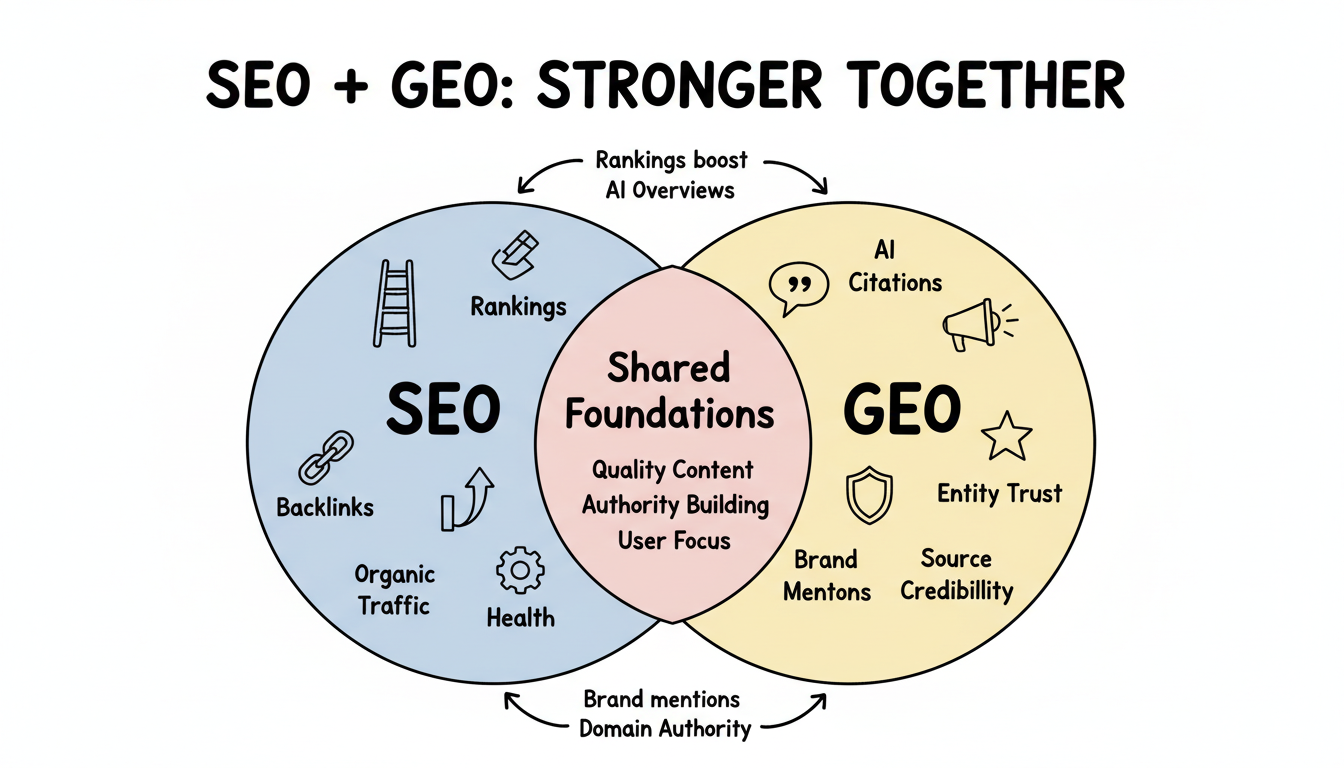
  • Strong SEO foundations help GEO performance (Google AI Overviews draw from search rankings)
  • GEO authority signals strengthen SEO (brand mentions and entity recognition)
  • Quality content serves both channels simultaneously

Microsoft's research puts it clearly: "Visibility is no longer defined by ranking position alone." Comprehensive search visibility requires both disciplines.

How SEO and GEO Work Together

Rather than competing, SEO and GEO complement each other in several ways.

Shared Foundations

Both strategies benefit from:

  • Technical health: Fast, crawlable, well-structured sites
  • Quality content: Comprehensive, accurate, useful information
  • Authority building: Credibility signals from third-party sources
  • User focus: Content that genuinely serves audience needs

Investment in these fundamentals improves both SEO and GEO performance.
Reinforcing Effects

Strong SEO can boost GEO:

  • Pages ranking well in Google appear more often in AI Overviews
  • Domain authority influences AI trust calculations
  • Featured snippet content frequently gets cited by AI systems

Strong GEO can boost SEO:

  • Brand mentions (even unlinked) signal authority
  • AI citations drive brand searches
  • Improved brand recognition increases click-through rates

Unified Content Strategy

Create content that serves both channels:

  1. Structure for AI extraction: Clear headings, direct answers, logical organization
  2. Optimize for keywords: Target relevant search terms users type
  3. Build citation-worthy depth: Include data, research, and authoritative perspectives
  4. Implement schema markup: Help both search engines and AI understand your content

Budget Allocation: SEO vs GEO

How should you divide investment between SEO and GEO? Consider these factors.

Assessment Framework

Answer these questions to guide allocation:

  1. Where does your audience search? Check analytics for AI-referred traffic trends.
  2. What's your competitive position? Established rankings favor maintaining SEO; poor rankings might justify GEO investment.
  3. What's your goal timeline? SEO often shows faster initial results; GEO builds over time.
  4. How complex is your product? Complex offerings benefit more from AI assistant recommendations.

Suggested Allocation Ranges

SEO-heavy (70-80% SEO / 20-30% GEO):

  • Established SEO presence with strong rankings
  • E-commerce or direct-response business model
  • Audience primarily uses traditional search

Balanced (50-60% SEO / 40-50% GEO):

  • Competitive market with moderate rankings
  • Brand awareness and lead generation goals
  • Tech-forward audience in AI-adopted industries

GEO-heavy (30-40% SEO / 60-70% GEO):

  • Struggling to rank traditionally
  • Targeting younger, AI-native audience
  • Complex products requiring research/recommendations

Budget Considerations

GEO investment includes:

  • Entity optimization and consistency work
  • Content restructuring for AI comprehension
  • Citation building and PR
  • AI visibility monitoring tools

Many GEO activities overlap with good SEO practice, making integrated approaches cost-efficient.

Success Metrics for Each

Measure the right things for each strategy.

SEO Metrics

  • Rankings: Position for target keywords
  • Organic traffic: Visitors from search engines
  • Click-through rate: Impressions to clicks ratio
  • Conversions: Leads or sales from organic traffic
  • Domain authority: Overall site authority scores

GEO Metrics

  • Citation rate: Frequency of AI mentions for relevant queries
  • Platform coverage: Which AI systems cite you
  • Mention sentiment: Positive, neutral, or negative context
  • AI-referred traffic: Visits from AI recommendations
  • Brand search lift: Increased brand searches following AI visibility

Integrated Metrics

  • Total search visibility: Combined presence across all search formats
  • Share of voice: Your visibility vs. competitors across channels
  • Revenue from search: Combined revenue from SEO and GEO efforts

Frequently Asked Questions

Will GEO replace SEO?

No. GEO and SEO serve different user behaviors that will coexist. Traditional search remains important for users who want to evaluate sources directly. GEO addresses users who prefer synthesized answers. Both channels will persist.

Can I do GEO without SEO?

You can, but results will be limited. Strong SEO foundations support GEO success—domain authority, quality content, and technical health matter for both. Starting GEO without SEO basics is building on a weak foundation.

How do I know if GEO is working?

Track AI mentions through manual testing (querying AI systems) and emerging tools like Omnius or Profound. Monitor AI-referred traffic in analytics. Watch for increases in brand searches that correlate with AI visibility.

Is GEO just for big brands?

No. AI systems recommend based on content quality and relevance, not just brand recognition. Smaller brands with excellent, authoritative content can compete effectively in AI citations.

Should I hire separate SEO and GEO specialists?

Not necessarily. The disciplines overlap significantly, and integrated strategies work best. Look for SEO professionals who understand GEO principles, or agencies offering combined services.


Need help determining the right balance of SEO and GEO for your business? Learn more about AI SEO Agency Services or explore our Complete GEO SEO Guide for implementation strategies.

Get started with Stackmatix!

Get Started

Share On:

blog-facebookblog-linkedinblog-twitterblog-instagram

Join thousands of venture-backed founders and marketers getting actionable growth insights from Stackmatix.

Thank you! Your submission has been received!
Oops! Something went wrong while submitting the form.

By submitting this form, you agree to our Privacy Policy and Terms & Conditions.

Related Blogs