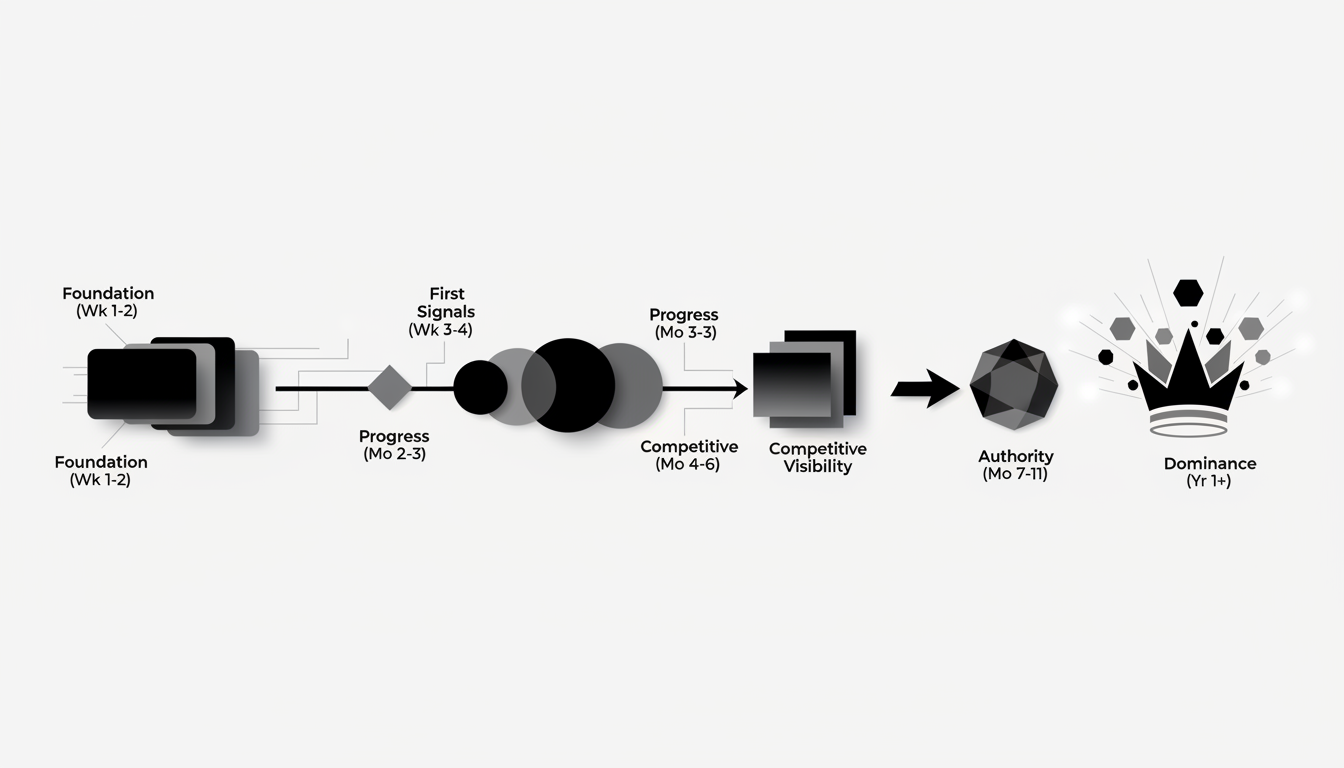
Answer engine optimization delivers results on different timelines than traditional SEO. Understanding realistic expectations prevents premature strategy changes and helps teams recognize genuine progress. This guide breaks down what to expect at each stage of AEO implementation.
Why AEO Timelines Differ from SEO
Traditional SEO timelines follow predictable crawl and index cycles. AEO timelines depend on factors including AI model training data cutoffs, real-time retrieval capabilities, and authority signal accumulation across multiple platforms.
Key timeline differences:
Factor | SEO Timeline | AEO Timeline |
Initial visibility | 2-6 months | 1-3 months (retrieval-based) |
Ranking stability | 3-6 months | Variable by platform |
Authority building | 6-12 months | Ongoing, cumulative |
Competitive displacement | 6-18 months | 3-12 months |
Some AI platforms retrieve information in real-time (Perplexity, ChatGPT with web browsing), enabling faster visibility for optimized content. Others rely on training data with periodic updates, creating longer feedback cycles.
Week 1-2: Foundation and Baseline
The first two weeks establish your starting point and implement foundational changes.
What happens:
- Complete AI visibility audit across ChatGPT, Perplexity, Google AI Overviews
- Document baseline citations (or lack thereof) for priority queries
- Implement technical foundations: schema markup, proper HTML structure
- Configure AI crawler access in robots.txt
What to expect: No visibility changes yet. This phase is purely diagnostic and foundational. Resist the urge to measure results—you're building infrastructure.
Success indicators:
- Audit completed for top 20 priority queries
- Schema markup validated with no errors
- Baseline metrics documented for comparison
Days 30-45: First Signals
After a month, initial indicators emerge—though not necessarily citations yet.
What happens:
- AI platforms with real-time retrieval begin accessing optimized content
- Third-party mention campaigns start generating external signals
- Content restructuring takes effect for crawlable platforms
What to expect:
- Perplexity may begin citing newly optimized content (real-time retrieval)
- ChatGPT with web browsing may reference updated pages
- Google AI Overviews may include content if existing SEO authority is strong
Success indicators:
- First citations appear in real-time retrieval platforms
- Improved accuracy in how AI describes your brand
- No reduction in existing citations (optimization didn't break anything)
Days 60-90: Measurable Progress
The two-to-three month mark shows meaningful progress for most implementations. Understanding AEO meaning helps teams interpret these early signals correctly and adjust strategies based on platform-specific behaviors.
What happens:
- Multiple optimization cycles completed
- Authority signals from third-party mentions accumulate
- Review platform improvements take effect
- Content portfolio expands with AEO-optimized pieces
What to expect:
- Consistent citations in Perplexity for optimized queries
- Improved brand representation in ChatGPT responses
- Beginning inclusion in Google AI Overviews
- Citation accuracy improvements across platforms
Success indicators:
- 15-30% citation rate for priority queries
- Reduced misinformation in AI responses about your brand
- First competitive displacement for lower-competition queries
Common pitfall: Comparing to competitors who've optimized for 12+ months. Focus on your baseline improvement, not absolute position.
Months 4-6: Competitive Visibility
The four-to-six month window separates serious AEO programs from abandoned experiments. At this stage, implementing a comprehensive AEO marketing plan becomes critical for sustained growth and competitive positioning.
What happens:
- Accumulated authority signals reach critical mass
- Content library covers most priority query variations
- Expert positioning and author entities strengthen
- Platform-specific optimization refinements based on data
What to expect:
- 30-50% citation rate for target queries
- Regular inclusion in Google AI Overviews
- ChatGPT recognizes your brand as relevant authority
- Some displacement of less-optimized competitors
Success indicators:
- Measurable referral traffic from AI platforms
- Conversion tracking shows AI-sourced revenue
- Citation share gains against specific competitors
Months 6-12: Authority Establishment
Sustained effort over six months to a year builds durable competitive advantages. Organizations pursuing AEO marketing certification often find this phase critical for demonstrating measurable business impact to stakeholders.
What happens:
- Deep content coverage across all query variations
- Strong third-party mention presence in AI training sources
- Expert entities well-established across platforms
- Technical optimization fully mature
What to expect:
- 50-70% citation rate for core queries
- Consistent presence in AI Overviews
- Brand recognition in ChatGPT without web browsing
- Significant competitive displacement achieved
Success indicators:
- AI visibility matches or exceeds SEO visibility
- Predictable AI referral traffic patterns
- Competitors beginning to respond to your visibility gains
Year 1+: Sustained Dominance
Beyond twelve months, focus shifts from building to maintaining and expanding. Teams leveraging free AEO tools for monitoring can track competitive positioning and identify new opportunities as AI platforms evolve.
What happens:
- Defensive optimization to protect position
- Expansion to adjacent query territories
- Continuous content refresh keeping information current
- Monitoring competitor responses and adapting
What to expect:
- Stable, high citation rates for established queries
- Growing share of emerging queries
- AI platforms treating you as default authority for topics
Success indicators:
- AI visibility as reliable traffic channel
- Measurable business impact from AI citations
- Competitive moat protecting your position
Factors That Accelerate or Delay Results
Not all implementations follow standard timelines.
Accelerating factors:
- Strong existing SEO authority
- Established third-party mentions
- Active review platform presence
- Published expert contributors
Delaying factors:
- New domains without history
- Thin content portfolios
- Competitors with mature AEO programs
- Technical issues blocking crawlers
Setting Realistic Expectations
Use these benchmarks when planning AEO programs:
Conservative timeline (new to AEO):
- 90 days: First measurable citations
- 6 months: Competitive visibility
- 12 months: Authority establishment
Accelerated timeline (strong existing authority):
- 30 days: First citations
- 3 months: Competitive visibility
- 6 months: Authority establishment
Key Takeaways
AEO results follow predictable phases when implementations are consistent:
- Weeks 1-2 establish foundations with no visible results yet
- Days 30-45 show first signals in real-time retrieval platforms
- Days 60-90 deliver measurable progress across platforms
- Months 4-6 achieve competitive visibility
- Months 6-12 establish lasting authority
- Year 1+ focuses on maintenance and expansion
The most common mistake is abandoning AEO programs during the 30-60 day period before real-time platforms show results. Patience and consistency separate successful programs from abandoned experiments.