February 19, 2026



AEO stands for Answer Engine Optimization—the practice of optimizing content to appear in AI-generated answers across platforms like ChatGPT, Google AI Overviews, Perplexity, and voice assistants. As AI systems increasingly provide direct answers instead of links, AEO has become essential for maintaining brand visibility in the evolving search landscape.
This guide explains what AEO means, why it matters, and how it fits into modern digital marketing strategy.
Answer Engine Optimization focuses on making your content the source that AI systems choose when generating responses to user queries. Unlike traditional SEO, which aims to rank pages in search results, AEO aims to get your content featured in the answer itself.
The core distinction: SEO gets you on page one. AEO gets you in the answer box before users scroll.
When someone asks ChatGPT "What's the best project management software for small teams?" or speaks a question to their voice assistant, AEO determines which brands and content get mentioned in the response.
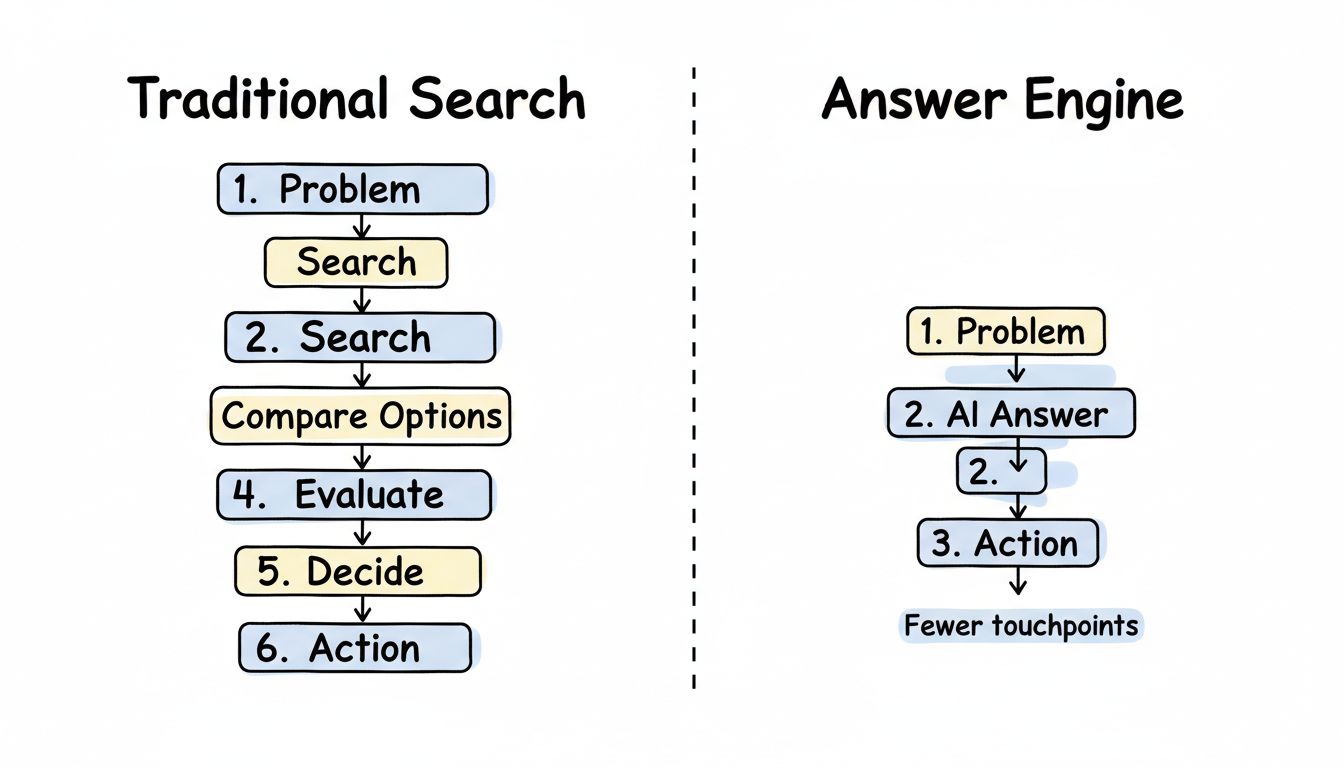
Traditional search engines return lists of links. Users browse options, click through, and evaluate information themselves.
Answer engines collapse this process. They synthesize information from multiple sources and deliver a direct response. The user experience shifts from "searching" to "delegating"—asking an AI-powered search assistant to find and summarize information on their behalf.
Traditional search funnel: Problem → Search → Compare options → Evaluate → Decide → Action
Answer engine funnel: Problem → AI Answer → Action
This compression means fewer touchpoints where brands can influence decisions. If your content isn't included in the AI's synthesized answer, you may never reach the user at all.
Several factors make AEO increasingly critical for businesses.
Google AI Overviews now appear at the top of most search results, providing synthesized answers before traditional organic listings. Understanding Google AI Overview ranking factors helps optimize for this prominent placement. Users read these summaries without scrolling further or clicking through to websites.
ChatGPT, Perplexity, and other AI assistants have moved from experimental tools to mainstream information sources. Millions of users now ask AI systems questions they previously typed into Google.
Smart speakers and voice assistants rely on answer engines to respond to spoken queries. With voice search, there's typically only one answer delivered—making AEO visibility even more critical.
AI answer engines deliver personalized responses based on user context, past interactions, and query specifics. The same question can yield different answers for different users, meaning AEO success requires content that performs across multiple contexts.
While AEO and SEO overlap, they differ in important ways.
Aspect | SEO | AEO |
Goal | Rank pages in search results | Get cited in AI-generated answers |
Target | Search engine algorithms | AI content retrieval systems |
Success metric | Rankings, organic traffic | AI citations, mention frequency |
Content format | Keyword-optimized pages | Extractable, direct answers |
Key tactics | Backlinks, keywords, technical SEO | Schema markup, E-E-A-T, structured content |
AEO doesn't replace SEO. Strong organic rankings still correlate with AI visibility—research shows most AI citations come from top-ranking content. However, AEO adds additional optimization requirements beyond traditional SEO.
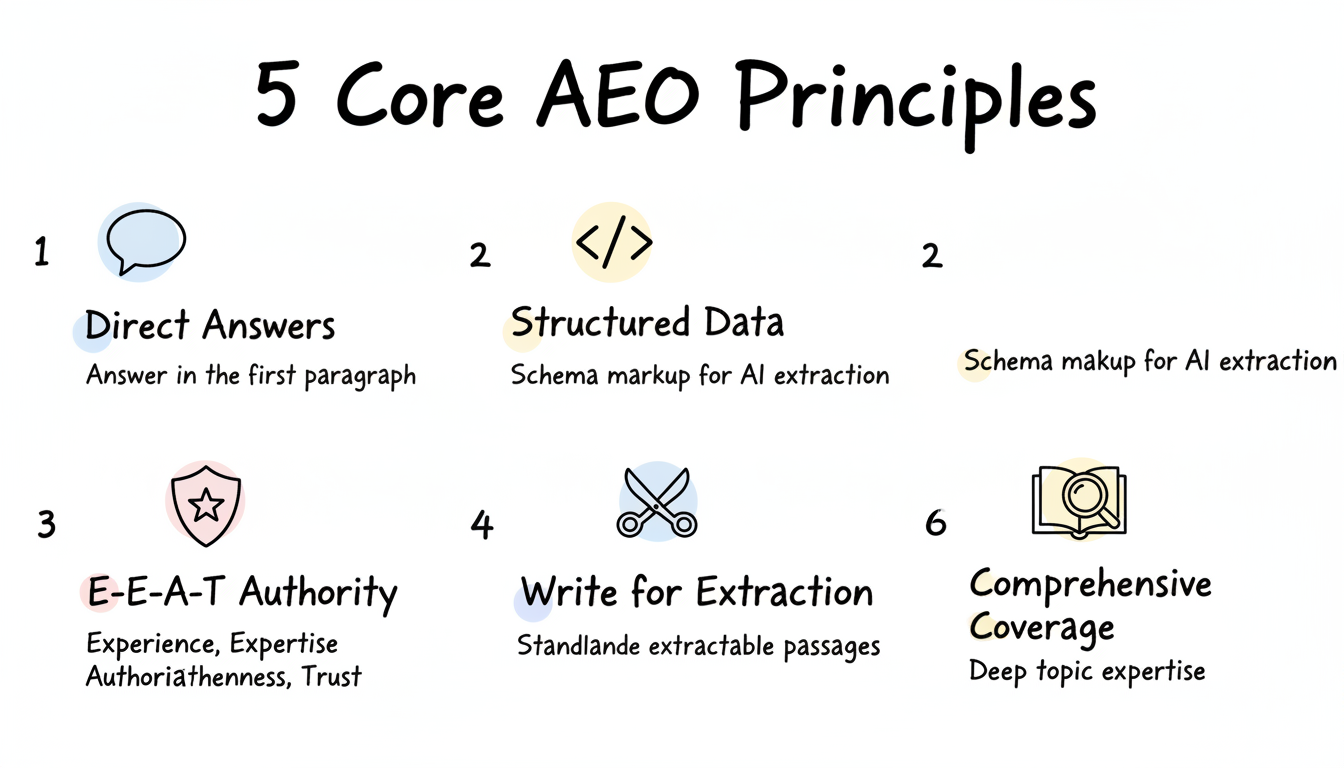
Effective Answer Engine Optimization follows several key principles.
AI systems look for clear, concise responses to questions. Content structured with direct answers in the first paragraph performs better than content that builds to conclusions gradually.
Schema markup helps AI systems understand your content's context, entities, and relationships. FAQ schema, HowTo schema, and organization markup improve extraction accuracy when optimizing content for generative AI.
AI systems prioritize content from authoritative sources. E-E-A-T signals (Experience, Expertise, Authoritativeness, Trustworthiness) influence which content gets selected for AI responses.
AI systems pull specific passages from longer content. Ensure key information exists in standalone, extractable segments rather than spread across multiple paragraphs.
While individual answers should be concise, overall topic coverage should be comprehensive. AI systems favor sources that demonstrate deep expertise across related questions. Tracking AEO optimization metrics helps measure how comprehensively your content addresses user queries.
Organizations new to AEO should begin with these steps:
As AI systems handle more information discovery, AEO will become increasingly central to digital marketing strategy. The discipline continues evolving as AI capabilities expand and user behaviors shift toward AI-assisted decision making.
Organizations that build AEO capabilities now position themselves for visibility in an AI-first search landscape.
AEO (Answer Engine Optimization) and GEO (Generative Engine Optimization) are related but distinct. AEO focuses on answer engines that provide direct responses. GEO focuses on generative AI that synthesizes content from multiple sources. In practice, the terms are often used interchangeably, and optimization tactics overlap significantly.
No. AEO complements SEO rather than replacing it. Strong SEO remains foundational—most AI citations come from top-ranking content. AEO adds additional optimization for how AI systems extract and present information.
By submitting this form, you agree to our Privacy Policy and Terms & Conditions.