February 19, 2026


AI-powered search assistants have evolved from simple chatbots to sophisticated, context-aware systems that understand intent, synthesize information, and deliver actionable answers. In 2026, these assistants are transforming how businesses and individuals discover and use information—making traditional keyword-based search feel increasingly dated.
This guide explores the capabilities that define modern AI search assistants and practical approaches to implementation.
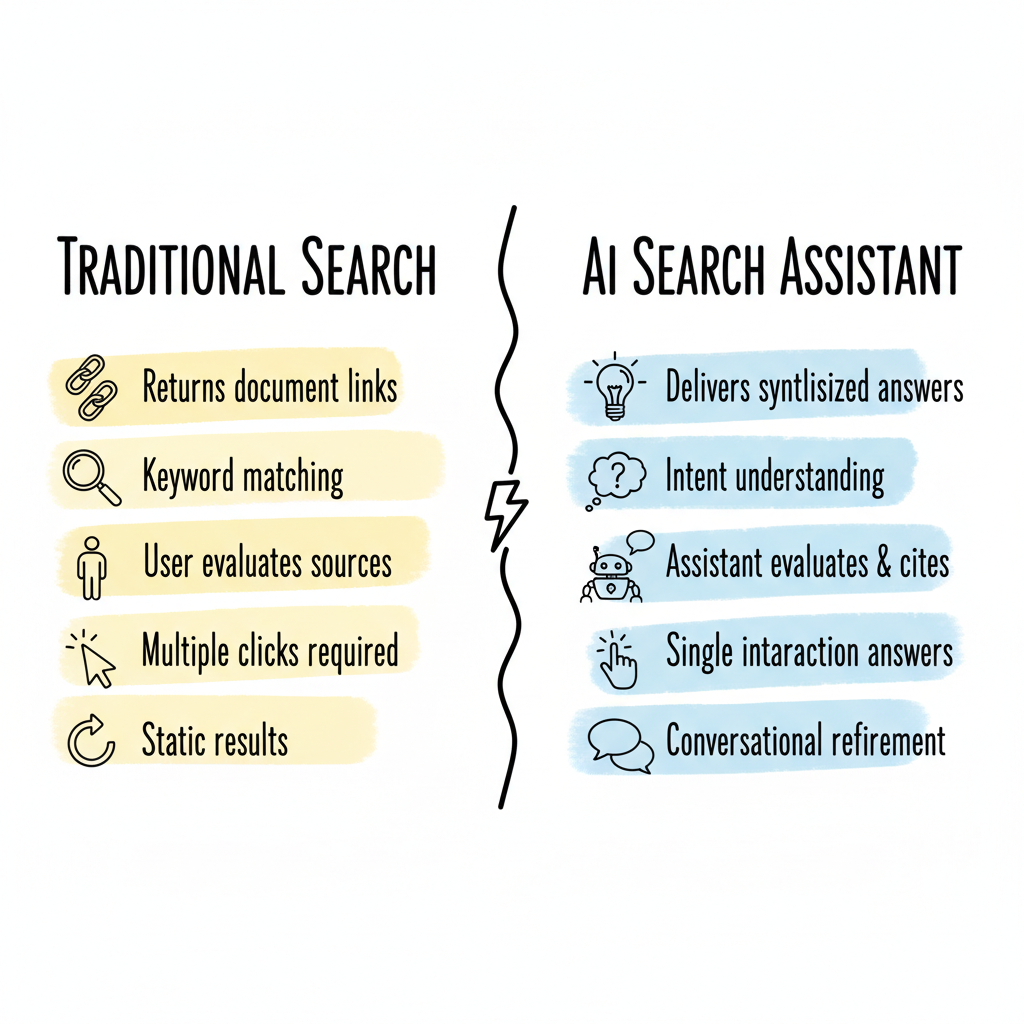
Traditional search returns a list of links. AI-powered search assistants return answers—synthesized, contextualized, and ready to use.
Traditional Search | AI Search Assistant |
Returns document links | Delivers synthesized answers |
Keyword matching | Intent understanding |
User evaluates sources | Assistant evaluates and cites |
Multiple clicks required | Single interaction answers |
Static results | Conversational refinement |
According to enterprise research, AI search assistants now offer capabilities that redefine information discovery:
Conversational interaction: Natural language queries replace keyword strings. Ask questions the way you'd ask a colleague.
Context awareness: Assistants remember previous queries, understand your role, and tailor responses to your specific needs.
Multi-source synthesis: Instead of showing ten links, assistants pull from dozens of sources to create comprehensive answers.
Citation and transparency: Quality assistants show their sources, allowing verification and deeper exploration.
Task completion: Beyond answering questions, assistants can execute actions—scheduling, drafting, analyzing data.
The market has segmented into distinct assistant categories, each serving different needs.
General-purpose assistants accessible to anyone:
Examples: ChatGPT, Claude, Perplexity, Gemini
Strengths:
Best for: General research, content creation, learning, personal productivity
Purpose-built for organizational knowledge:
Examples: Kore.ai, Microsoft Copilot, Google Workspace Gemini
Strengths:
Best for: Organizations needing AI search across proprietary data
Focused on specific domains or tasks:
Examples: Legal research assistants, medical information systems, code assistants
Strengths:
Best for: Professional applications requiring specialized accuracy
For organizations implementing AI search assistants, several factors determine success. Understanding how these systems differ from traditional approaches—much like how aeo-vs-geo-vs-seo frameworks differ in their optimization targets—is essential for strategic deployment.
Enterprise AI search requires connecting to your existing knowledge:
Integration Type | Examples | Complexity |
Document stores | SharePoint, Google Drive, Dropbox | Moderate |
Business systems | CRM, ERP, HRIS | High |
Databases | SQL, data warehouses | High |
Communication tools | Slack, Teams, email | Moderate |
Custom applications | Internal tools, APIs | Variable |
According to enterprise search analysis, platforms must integrate deeply across structured and unstructured systems—from file stores and intranets to CRMs, ERPs, and custom applications.
Enterprise deployment demands robust security:
Access controls: Ensure users only see information they're authorized to access Data privacy: Maintain compliance with regulations (GDPR, HIPAA, etc.) Audit trails: Track queries and responses for compliance AI governance: Manage autonomous actions and decision boundaries
Implementation success depends on response quality:
Behavioral relevance tuning: Systems that learn from user interactions improve over time Source prioritization: Weighting authoritative internal sources appropriately Freshness management: Ensuring answers reflect current information Accuracy validation: Methods for identifying and correcting errors
2026 marks a significant evolution: AI assistants becoming AI agents.
Assistant Capability | Agent Capability |
Answers questions | Takes actions |
Responds to requests | Anticipates needs |
Single-step tasks | Multi-step workflows |
Human-directed | Autonomous operation |
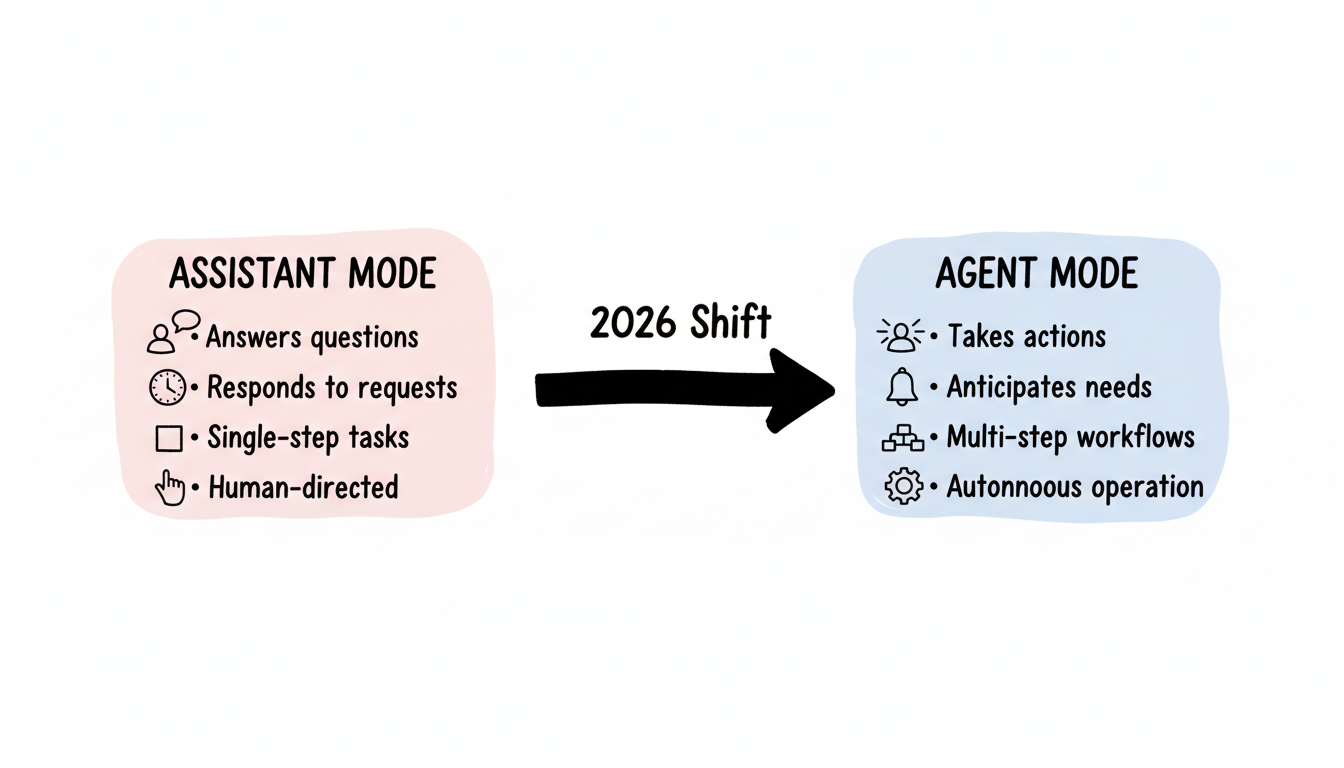
As industry analysis notes, AI is shifting from individual usage to team and workflow orchestration—coordinating entire workflows, connecting data across departments, and moving projects from idea to completion.
Automated research: Agents that monitor topics and compile reports without prompting Process automation: End-to-end workflows requiring minimal human intervention Real-time optimization: Systems monitoring and adjusting processes continuously Predictive assistance: Anticipating needs before explicit requests
Organizations can implement AI search assistants through several paths.
Advantages:
Considerations:
Advantages:
Considerations:
Advantages:
Considerations:
Track these metrics to evaluate AI search assistant effectiveness, similar to how you would track aeo-metrics-kpis for answer engine optimization:
Metric | What It Measures | Target |
Query resolution rate | Percentage of queries answered satisfactorily | 80%+ |
Time to answer | Speed of response delivery | Seconds |
User adoption | Active users relative to potential users | Growing |
Task completion | Actions successfully completed via assistant | High |
User satisfaction | Feedback scores and repeat usage | Positive trend |
Establishing a robust ai-search-measurement-framework ensures you can demonstrate ROI and identify areas for improvement as your implementation matures.
AI search assistants continue evolving rapidly:
Multi-modal expansion: Voice, video, and image understanding becoming standard, with voice-search-aeo-optimization becoming increasingly critical for natural interaction patterns
Deeper reasoning: Complex problem-solving and analysis capabilities Proactive intelligence: Assistants that surface relevant information automatically Ecosystem integration: Seamless operation across tools and platforms
AI search assistants understand natural language queries, synthesize information from multiple sources, and deliver direct answers rather than lists of links. They can engage in conversational refinement and remember context from previous interactions.
For consumer assistants, they access publicly available web data. Enterprise assistants require integration with internal systems—documents, databases, communication tools, and business applications—to search organizational knowledge.
Enterprise-grade assistants include security features like access controls, data encryption, and audit logging. Consumer assistants vary in their handling of data privacy. Evaluate security capabilities carefully before implementation.
Basic deployment can take weeks for platforms with pre-built integrations. Complex implementations involving multiple systems, custom development, and governance requirements may take months. Start with pilot programs to learn before broad rollout.
By submitting this form, you agree to our Privacy Policy and Terms & Conditions.