February 19, 2026


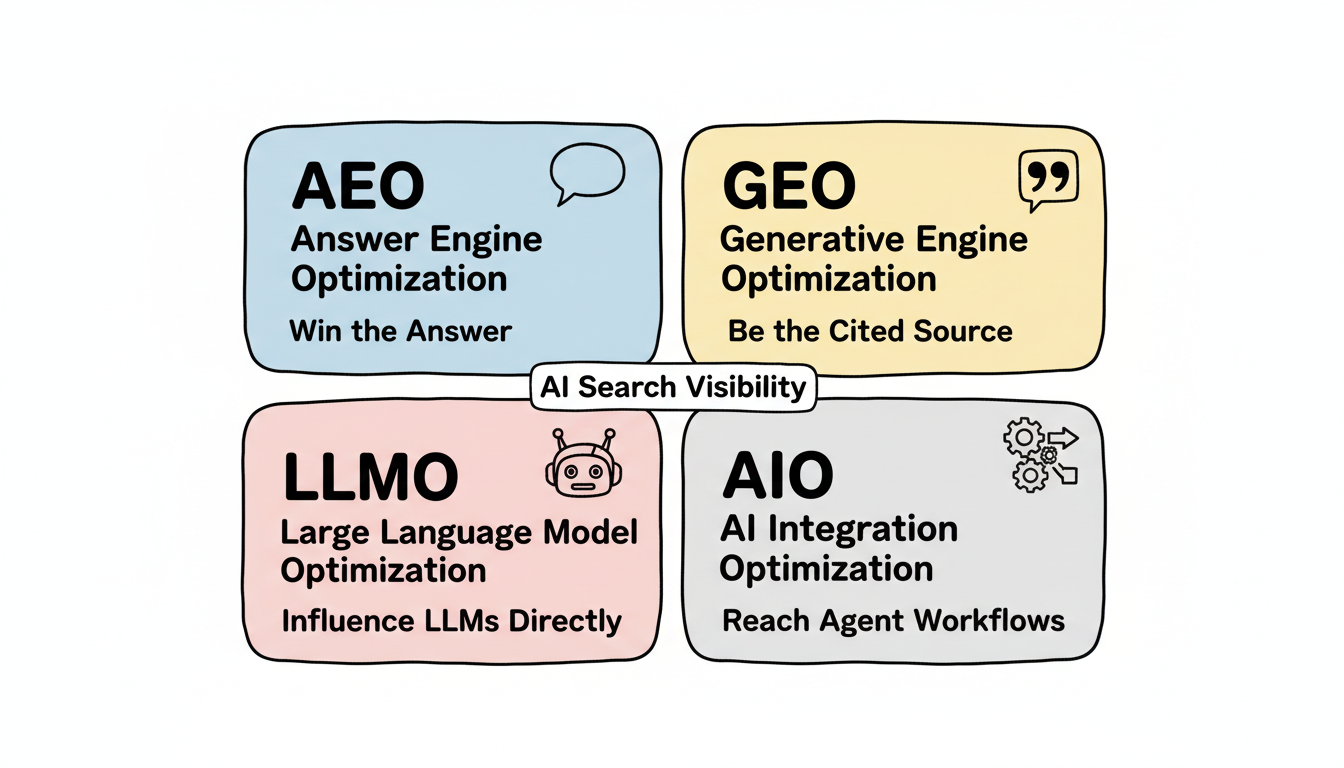
The language of search has changed. AI platforms introduced an entirely new vocabulary, and the businesses fluent in these terms dominate visibility. Two years ago, marketers optimized for keywords and rankings. Today, they optimize for citations, answer boxes, and AI responses.
This glossary covers the essential terms defining how brands perform in AI search—organized by category for quick reference.
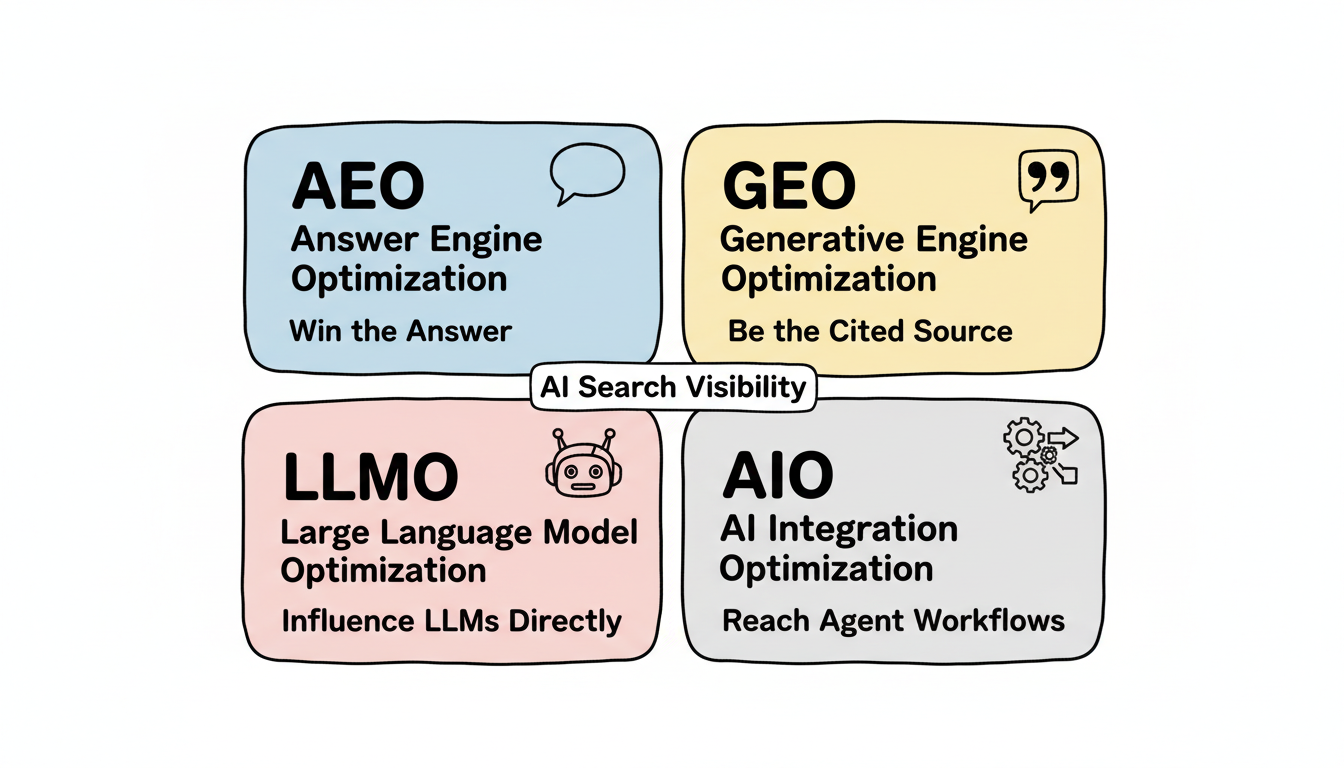
The practice of optimizing content to appear in AI-generated answers and direct response formats. AEO focuses on winning the answer—appearing in AI Overviews, featured snippets, and conversational AI responses rather than just ranking in traditional search results.
Why it matters: In 2026, most informational searches resolve instantly through AI summaries. Answer engine optimization ensures your content appears where decisions begin.
Structuring content so AI platforms can reference, cite, and synthesize it in generated responses. While AEO focuses on appearing as "the answer," GEO emphasizes being cited as a trusted source within AI-generated content.
Why it matters: Research from Princeton and Georgia Tech found that GEO methods can boost visibility in AI responses by 30-40%. Content must be quotable for machines, not just readable for humans.
Optimizing specifically for visibility within large language models like ChatGPT, Claude, and Gemini. LLMO encompasses tactics that influence how LLMs understand, reference, and recommend brands.
Why it matters: LLMs process queries differently than traditional search engines. LLMO addresses their specific requirements for authority, clarity, and factual consistency.
Structuring content for integration into AI tools, applications, and agent workflows. AIO looks beyond individual AI platforms to how content functions within broader AI ecosystems.
Why it matters: As AI agents handle more tasks, visibility within agent workflows—not just chat interfaces—becomes critical for reach.
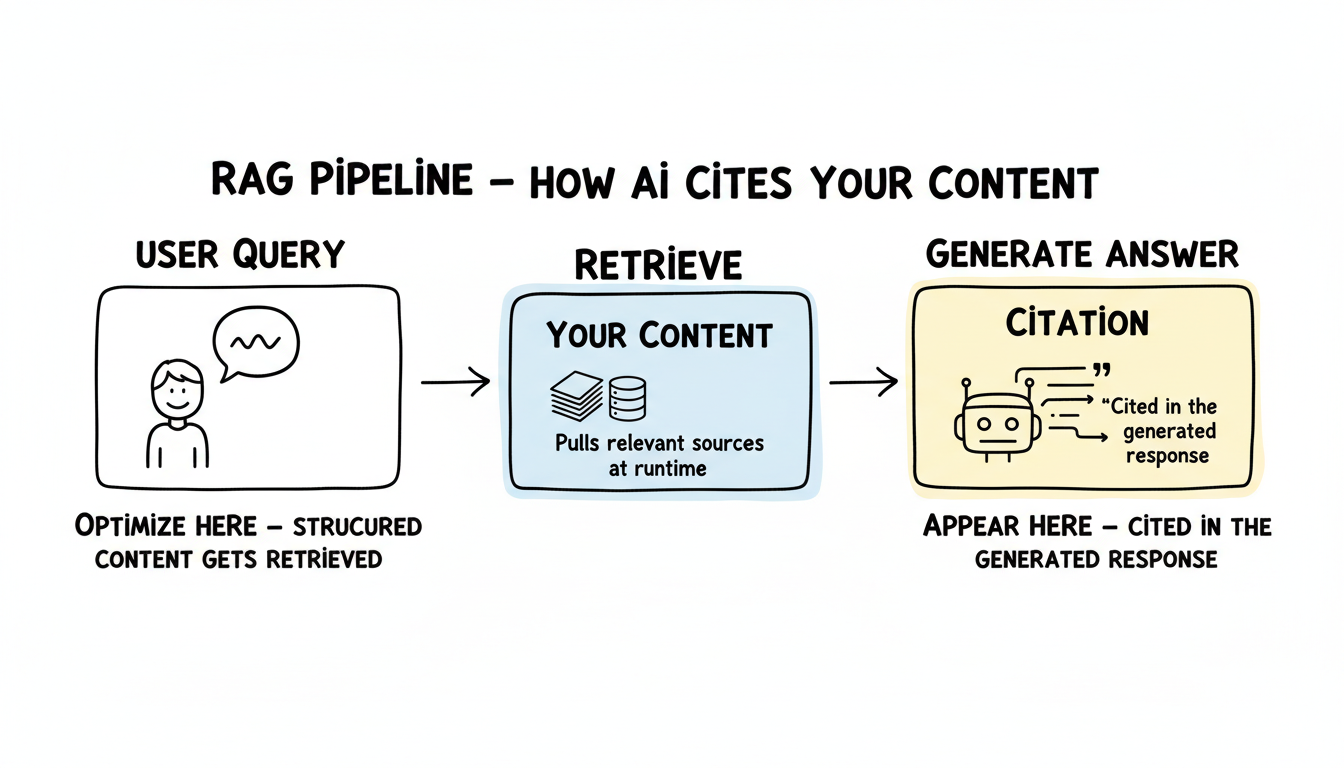
The technical framework powering most answer engines. RAG combines information retrieval with AI text generation—when users ask questions, the system retrieves relevant documents, then generates responses grounded in that retrieved content.
Why it matters: Understanding RAG explains why certain content gets cited. AI systems don't just "know" things—they actively pull from external sources at runtime.
The knowledge embedded in an AI model's training data. This is what the model "remembers" from training, as opposed to information it retrieves at query time.
Why it matters: ChatGPT relies heavily on parametric memory, while Perplexity prioritizes real-time retrieval. Different platforms require different optimization approaches.
The amount of text an AI model can process in a single interaction. Larger context windows allow AI systems to consider more information when generating responses.
Why it matters: Content structure affects whether your key information fits within AI context windows. Answer-first formatting ensures critical information gets processed.
How often and prominently your brand appears in AI-generated responses across platforms like ChatGPT, Perplexity, and Google AI Overviews. This extends beyond traditional search rankings to citation frequency in AI outputs.
Why it matters: Ranking #1 on Google doesn't guarantee AI visibility. Brands need to measure and optimize for both traditional rankings and AI citations.
Your brand's ability to be the primary source of truth for AI agents within your category. Citation dominance measures not just appearing in AI responses, but being the most-referenced source.
Why it matters: Multiple brands can appear in a single AI response. Citation dominance determines which brand users trust and remember.
The percentage of AI-generated responses in your category that mention or cite your brand compared to competitors. This adapts traditional share of voice metrics for AI search contexts.
Why it matters: Share of voice tracking reveals competitive position in AI responses—visibility your traditional SEO tools miss.
Queries answered directly on results pages without users clicking through to websites. AI Overviews and featured snippets satisfy user intent immediately, reducing website traffic even for high-ranking content.
Why it matters: Over 45% of searches in 2026 end without clicks. Zero-click optimization focuses on visibility and brand building within those answers.
Structuring content with direct answers positioned early, followed by supporting detail. AI systems extract content from the beginning of sections, making answer placement critical.
Why it matters: Research shows 40-60 word direct answers outperform 500-word narratives for citation probability. Position your key insight where AI systems scan first.
Content sections that present verifiable claims with supporting evidence—statistics, citations, case studies—in machine-readable formats. Proof blocks help AI systems verify and trust your content.
Why it matters: AI systems increasingly evaluate "factual integrity" when selecting sources. Structured proof blocks demonstrate credibility.
Content systems that anticipate and answer follow-up questions a user might ask an AI agent. Beyond single FAQs, conversational paths address the 2nd, 3rd, and 4th questions in a topic sequence.
Why it matters: AI conversations are iterative. Content that addresses the entire conversation thread captures more citations than single-answer content.
How AI systems identify and understand brands, people, products, and concepts as distinct entities with relationships to other entities. Strong entity signals help AI systems accurately represent your brand.
Why it matters: If AI can't identify your entity clearly, it can't cite you accurately. Consistent entity information across the web improves recognition.
Google's AI-generated summary that appears at the top of search results for many queries. AI Overviews synthesize information from multiple sources, often reducing clicks to individual websites.
Why it matters: AI Overviews now appear on millions of Google searches. Appearing in—or being cited by—AI Overviews is the new "position zero."
Shareable, article-like content created within Perplexity that synthesizes multiple sources. Pages represent how AI platforms are becoming content publishers, not just search tools.
Why it matters: Getting cited in Perplexity Pages provides lasting visibility as these pages get shared and discovered independently.
Google's quality evaluation framework, increasingly applied by AI systems to determine source credibility. Content demonstrating genuine expertise receives higher citation probability.
Why it matters: AI systems evaluate the same trust signals as search engines. Building E-E-A-T benefits both traditional SEO and generative AI optimization.
An emerging metric describing how AI systems evaluate content accuracy and source reliability. Content with high factual integrity—original research, verified data, expert attribution—receives citation preference.
Why it matters: As AI platforms combat misinformation, factual integrity becomes a technical requirement, not just a quality preference.
By submitting this form, you agree to our Privacy Policy and Terms & Conditions.