February 19, 2026


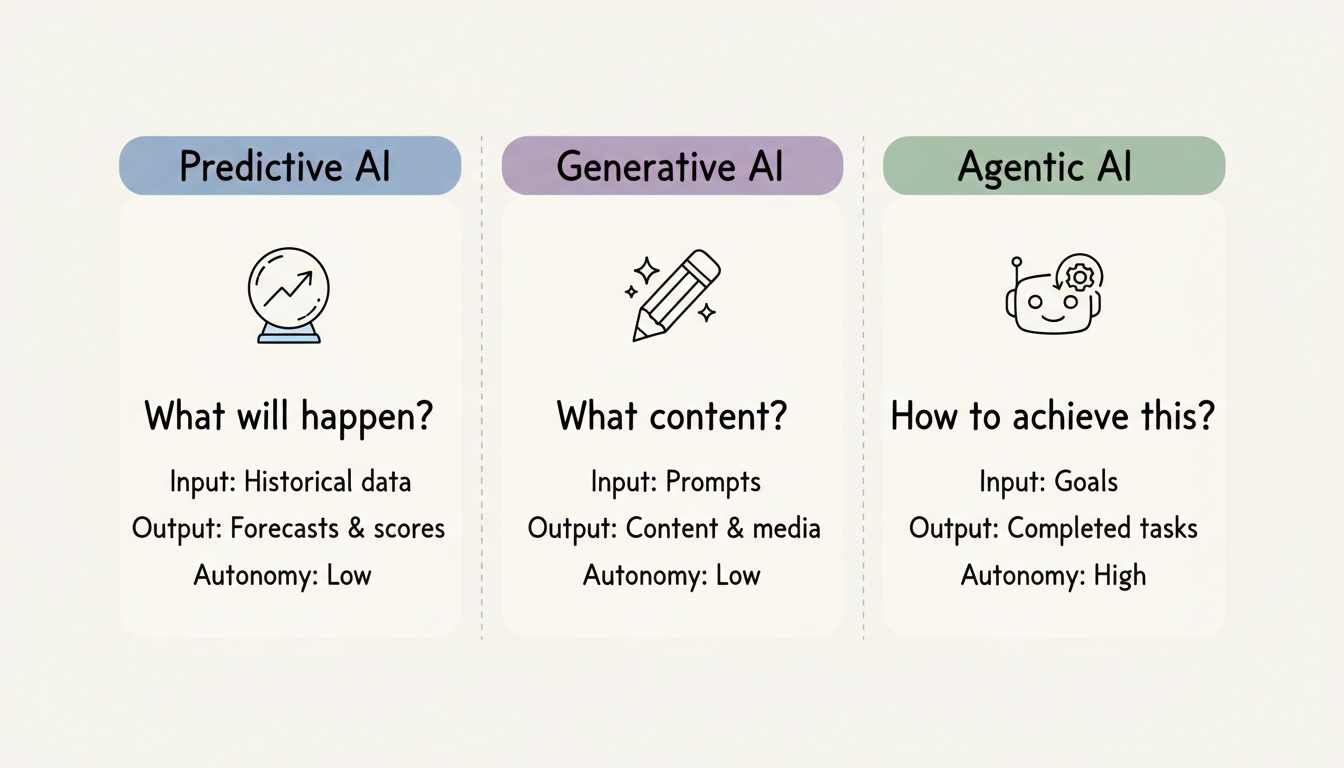
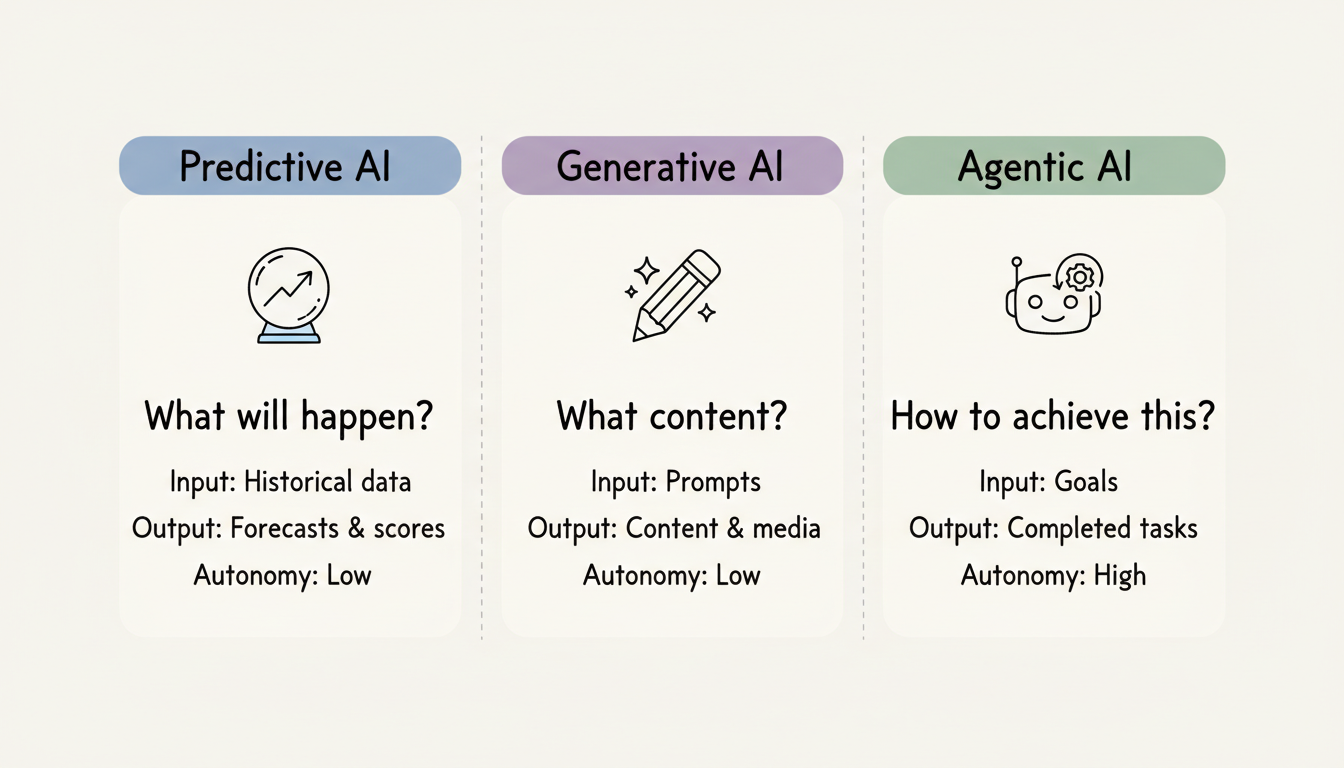
Three distinct AI paradigms now shape business technology: Predictive AI forecasts what will happen, Generative AI creates new content, and Agentic AI executes autonomous actions. Each solves different problems. Confusing them leads to misapplied tools and missed opportunities.
Understanding these distinctions helps you choose the right AI approach for specific challenges.
Predictive AI analyzes historical data to forecast future events. It answers "what will likely happen?" based on patterns in past information.
How it works: Predictive models learn relationships between variables in training data. When given new data, they estimate probable outcomes based on learned patterns.
Core capabilities:
Limitations: Predictive AI tells you what might happen but doesn't create content or take action. It requires quality historical data and struggles with unprecedented situations.
Generative AI produces new content—text, images, code, audio—based on prompts and training data. It answers "what content should exist?" for a given request.
How it works: Generative models learn patterns from vast content libraries. When prompted, they produce new content that follows learned patterns while meeting prompt requirements.
Core capabilities:
Limitations: Generative AI creates but doesn't act autonomously. Output quality depends on prompt quality. It can produce plausible-sounding incorrect information.
Agentic AI operates autonomously to achieve goals. It answers "how do I accomplish this objective?" by planning and executing multi-step workflows.
How it works: Agentic systems perceive their environment, reason about goals, take actions using available tools, and learn from outcomes to improve future performance.
Core capabilities:
Limitations: Agentic AI requires clear goal definition and appropriate tool access. Autonomous operation demands trust in system decisions.
Aspect | Predictive AI | Generative AI | Agentic AI |
Primary function | Forecast outcomes | Create content | Execute actions |
Core question | "What will happen?" | "What content?" | "How to achieve this?" |
User input | Historical data | Prompts | Goals |
Output | Predictions, scores | Content, media | Completed tasks |
Autonomy level | Low | Low | High |
Human involvement | Interprets results | Reviews output | Sets goals |
Lead scoring: Assign conversion probability to leads, enabling sales teams to prioritize high-value prospects.
Demand forecasting: Predict product demand to optimize inventory, staffing, and marketing spend.
Customer segmentation: Identify behavioral patterns that predict customer value, churn risk, or purchase timing.
Budget allocation: Forecast channel performance to distribute marketing budget optimally. Effective aeo-marketing-budget strategies often rely on predictive models to allocate resources across traditional search and answer engines.
Content production: Draft blog posts, social content, email campaigns, and ad copy at scale. Modern approaches to generative-ai-search-optimization leverage these capabilities to create content tailored for AI-powered search experiences.
Personalization: Generate customized content variations for different audience segments.
Creative ideation: Produce concepts, headlines, and variations for testing.
Documentation: Create product descriptions, help content, and technical documentation.
Campaign management: Autonomously adjust bids, budgets, and targeting based on performance.
Workflow automation: Execute complex processes spanning multiple tools and platforms.
Anomaly response: Detect issues and take corrective action without human intervention.
Research and analysis: Gather information, synthesize findings, and produce insights independently. Understanding copilot-market-adoption-trends reveals how businesses are deploying agentic systems to automate knowledge work.
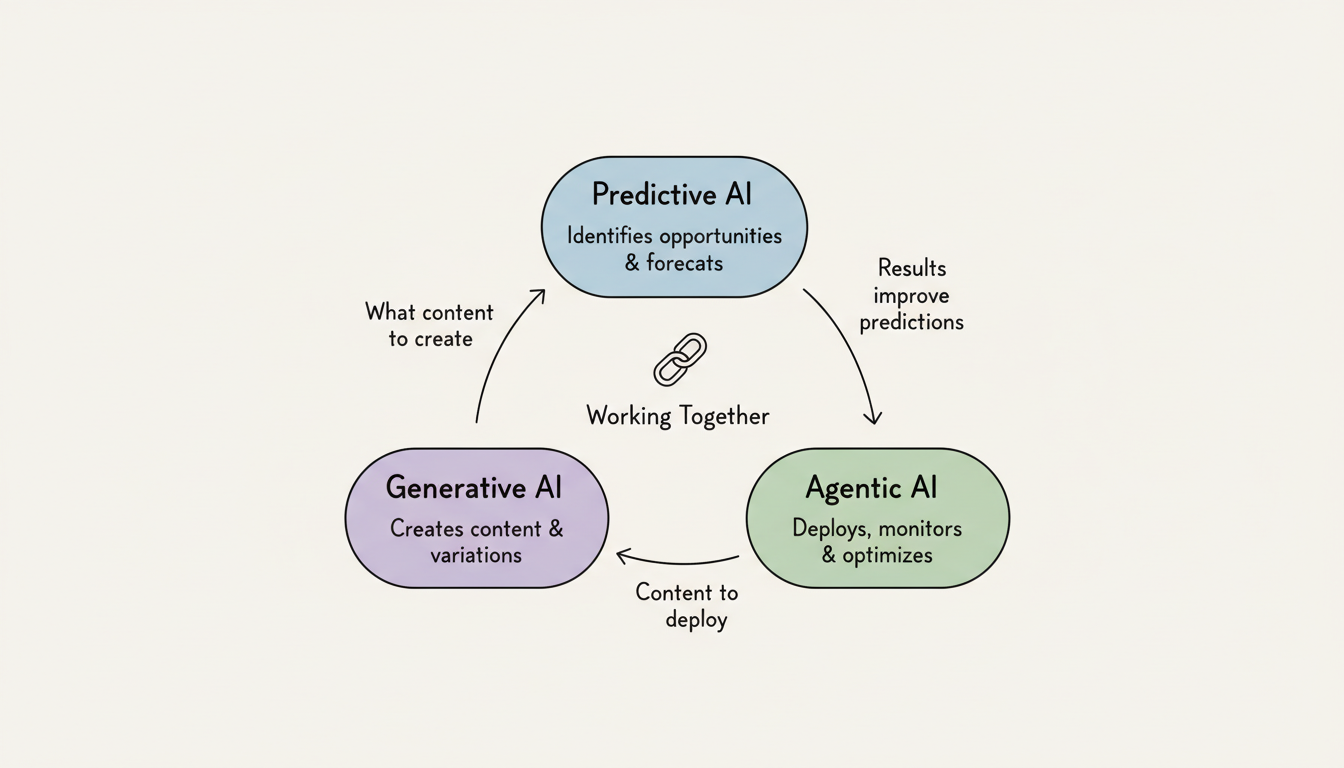
The three paradigms complement rather than compete.
Predictive AI identifies what content to create. Generative AI produces it.
Example workflow:
Generative AI produces content that agentic systems deploy.
Example workflow:
Predictive AI informs agentic decision-making.
Example workflow:
Generative AI produces plausible outputs but doesn't model probability. Asking ChatGPT to predict conversion rates gives confident-sounding but statistically meaningless answers. Use predictive models for forecasting.
Predictive models forecast but don't generate. They might predict which content topics perform well but can't write the content. Use generative AI for creation.
Not all applications need autonomy. Many tasks work better with human-in-the-loop workflows. Agentic AI fits specific use cases, not everything.
Modern applications often combine paradigms. A sophisticated marketing system might use predictive AI to identify opportunities, generative AI to create content, and agentic AI to deploy and optimize. This integration mirrors how ai-and-search-engine-optimization combines multiple AI capabilities to improve search visibility.
When evaluating AI solutions, ask:
What problem am I solving?
What inputs do I have?
What outputs do I need?
How much autonomy is appropriate?
The boundaries between paradigms continue blurring. Advanced systems increasingly combine prediction, generation, and agency into unified platforms. Understanding each paradigm's strengths helps you evaluate these integrated solutions effectively.
Start by identifying your specific needs. Match paradigms to problems. Combine approaches where synergies exist. The goal isn't using the most advanced AI—it's solving your actual business challenges.
By submitting this form, you agree to our Privacy Policy and Terms & Conditions.