February 19, 2026


AI-powered search has evolved far beyond simple keyword matching. In 2026, search engines and AI assistants offer sophisticated capabilities that fundamentally change how we discover, verify, and use information. Understanding these features helps both users leverage them effectively and businesses optimize for visibility.
This guide covers the key AI search features available today and their practical applications.
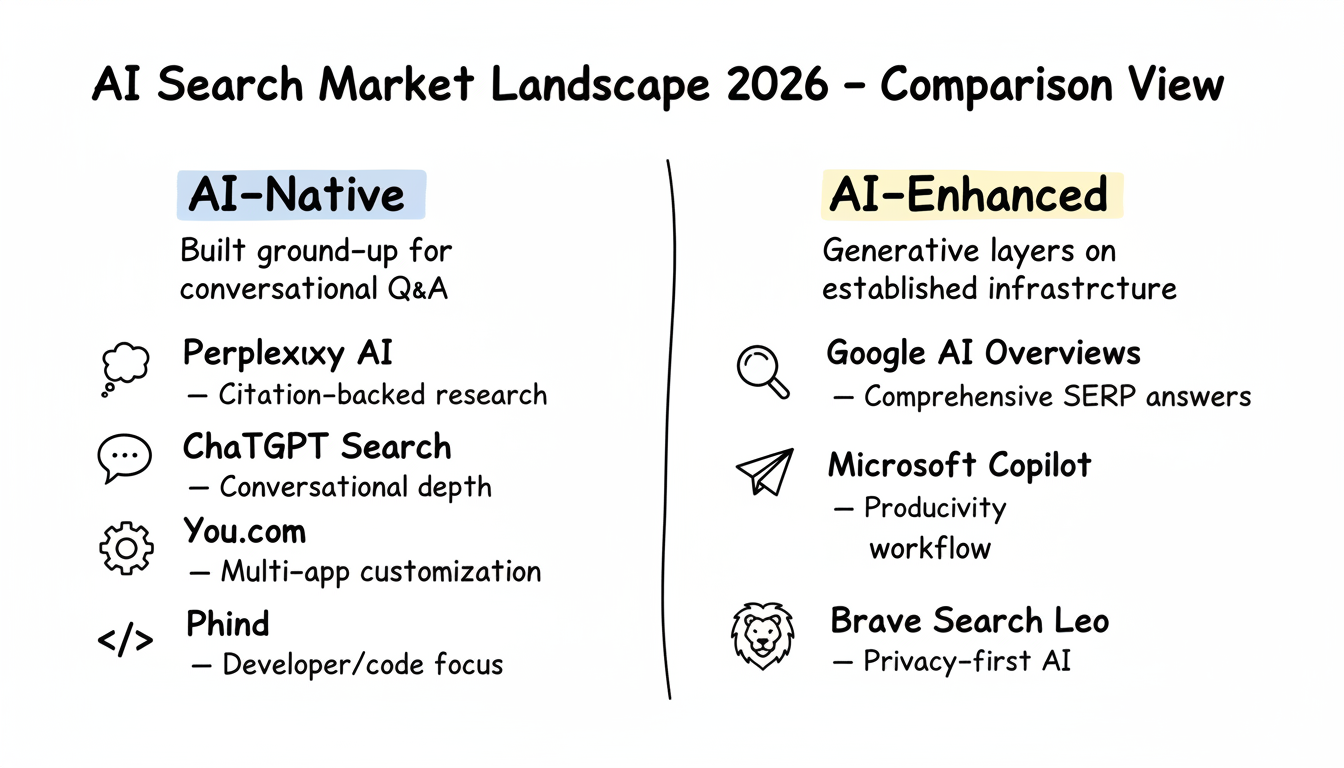
The AI search market has crystallized into distinct categories, each offering different feature sets.
Built from the ground up for conversational Q&A:
Platform | Primary Strength | Key Differentiator |
Perplexity AI | Citation-backed research | Source transparency |
ChatGPT Search | Conversational depth | GPT model reasoning |
You.com | Customization | Multi-app interface |
Phind | Developer focus | Code-specific search |
Generative layers integrated with established search infrastructure:
Platform | Integration Approach | Feature Focus |
Google AI Overviews | Embedded in SERP | Comprehensive answers |
Microsoft Copilot | Bing integration | Productivity workflow |
Brave Search Leo | Privacy-first AI | Anonymous search |
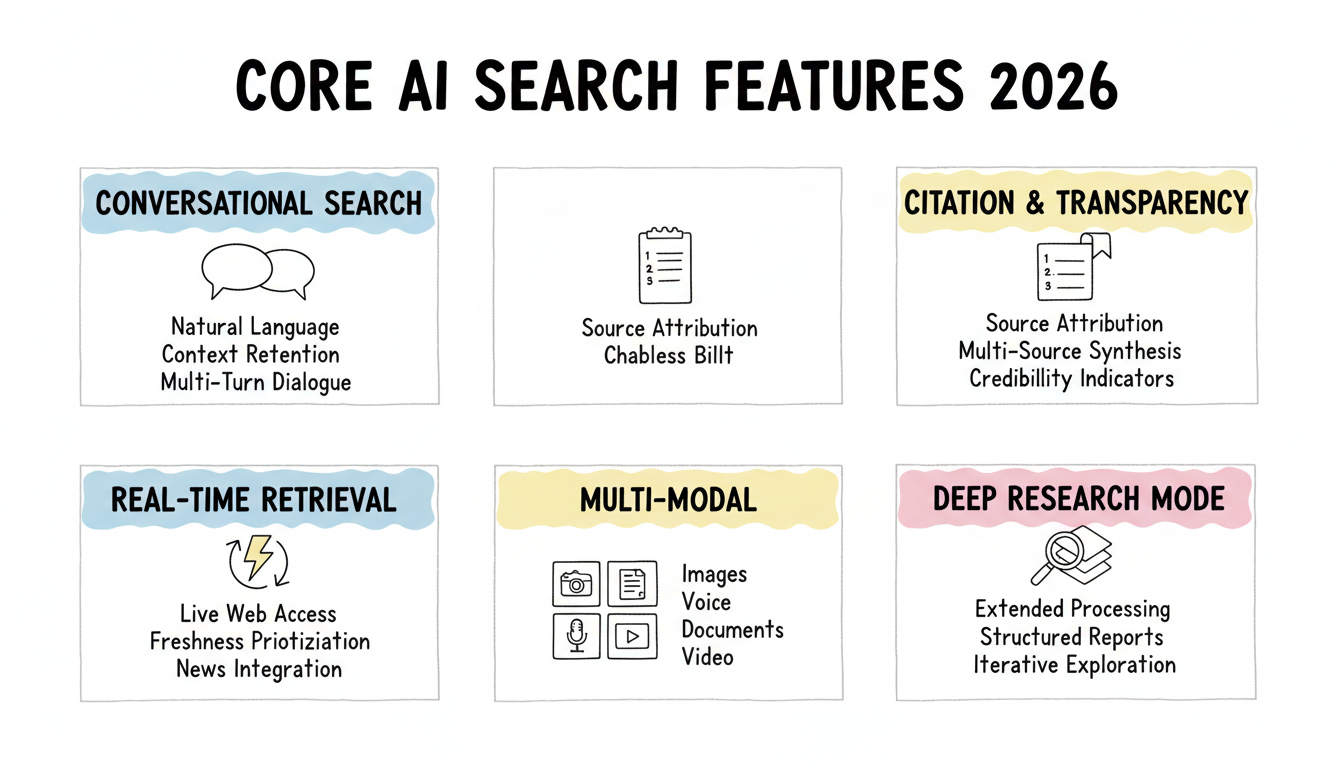
Natural language queries have replaced keyword strings. Key capabilities include:
Context retention: AI remembers previous queries within a session, allowing follow-up questions without restating context.
Clarifying questions: Advanced systems ask for clarification to better understand intent before delivering answers.
Multi-turn dialogue: Users can refine and redirect searches through conversation rather than starting over.
Example use case: Instead of multiple searches like "best project management tools" → "project management tools for remote teams" → "Asana vs Monday comparison," users can have a single conversation exploring the topic.
Modern AI search prioritizes verifiable information:
Source attribution: Answers include numbered citations linked to original sources. Users can click to verify claims.
Multi-source synthesis: AI pulls from dozens of sources to create comprehensive answers while showing which sources contributed.
Credibility indicators: Some platforms show source reputation or recency alongside citations.
This feature addresses the "black box" criticism of early AI systems, making responses trustworthy for research and professional use. Understanding Copilot citation patterns can help businesses optimize content for better visibility in AI-powered results.
AI search now accesses current information:
Live web access: Responses reflect recent events, not just training data.
Freshness prioritization: Systems can weight recent sources for time-sensitive queries.
News integration: Current events and breaking news appear in relevant responses.
AI search has expanded beyond text:
Modality | Capability | Use Case |
Image understanding | Analyze uploaded images | Visual search, product identification |
Image generation | Create visuals from descriptions | Content creation, visualization |
Voice interaction | Spoken queries and responses | Hands-free search |
Document processing | Analyze uploaded PDFs and files | Research, document comparison |
Advanced research capabilities for complex queries:
Extended processing: Systems spend more time gathering and synthesizing information for thorough answers.
Structured reports: Outputs include organized sections, summaries, and comprehensive coverage.
Iterative exploration: AI explores multiple angles and sub-topics automatically.
Google's AI integration focuses on comprehensive answers within traditional search. Many factors influence how content appears in these AI-generated summaries, and understanding Google AI Overview ranking factors is crucial for maintaining visibility in this evolving search landscape.
The leading citation-first research platform offers:
OpenAI's web-enabled search combines conversation with web grounding. Businesses looking to appear in ChatGPT results should explore ChatGPT SEO optimization strategies to ensure their content is discoverable and well-positioned.
Deeply integrated with Microsoft productivity tools:
Best features: Citation systems, deep research mode, document analysis
Workflow: Use Perplexity or similar tools with citation transparency. Verify important claims by checking sources. Use deep research for comprehensive topic exploration.
Best features: Real-time data, multi-source synthesis, structured outputs
Workflow: Query competitive landscape, industry trends, or market data. AI synthesizes information from multiple sources into actionable summaries.
Best features: Conversational dialogue, context retention, multi-modal generation
Workflow: Use ChatGPT or similar for brainstorming, drafting, and refining. Leverage image generation for visual content.
Best features: Code-specific search, documentation queries, debugging assistance
Workflow: Use Phind or similar developer-focused tools. Query technical documentation, get code examples, debug errors.
When choosing AI search tools, consider these criteria:
Factor | What to Evaluate |
Citation quality | Are sources credible and verifiable? |
Accuracy | Does the platform minimize hallucinations? |
Freshness | How current is the information? |
Privacy | What data is collected and retained? |
Integration | Does it connect with your workflows? |
Cost | Free tier limitations vs. paid features |
No single platform excels at everything:
AI search features continue evolving:
Agentic capabilities: AI that executes tasks, not just answers questions. Booking travel, comparing options, completing workflows.
Proactive intelligence: Systems that surface relevant information without explicit queries.
Cross-platform integration: Seamless AI assistance across tools and devices.
Personalization: Responses tailored to user history, preferences, and context. As these technologies mature, organizations will need to track performance through comprehensive AEO measurement and tracking to understand their visibility across AI platforms.
It depends on your use case. For research with verifiable sources, Perplexity leads. For deep reasoning and conversation, ChatGPT excels. For privacy, Brave Search is best. Most power users employ multiple tools.
Accuracy has improved significantly but varies by platform and query type. Citation-backed platforms allow verification. For important decisions, always check sources rather than trusting AI summaries alone.
Most platforms offer free tiers with limited usage. Premium plans typically run $15-20 per month, offering higher limits, better models, and advanced features like deep research and file upload.
For informational queries, AI search often provides better answers faster. However, traditional search remains valuable for navigating to specific websites, finding local businesses, and accessing diverse perspectives beyond AI summaries.
By submitting this form, you agree to our Privacy Policy and Terms & Conditions.