February 19, 2026


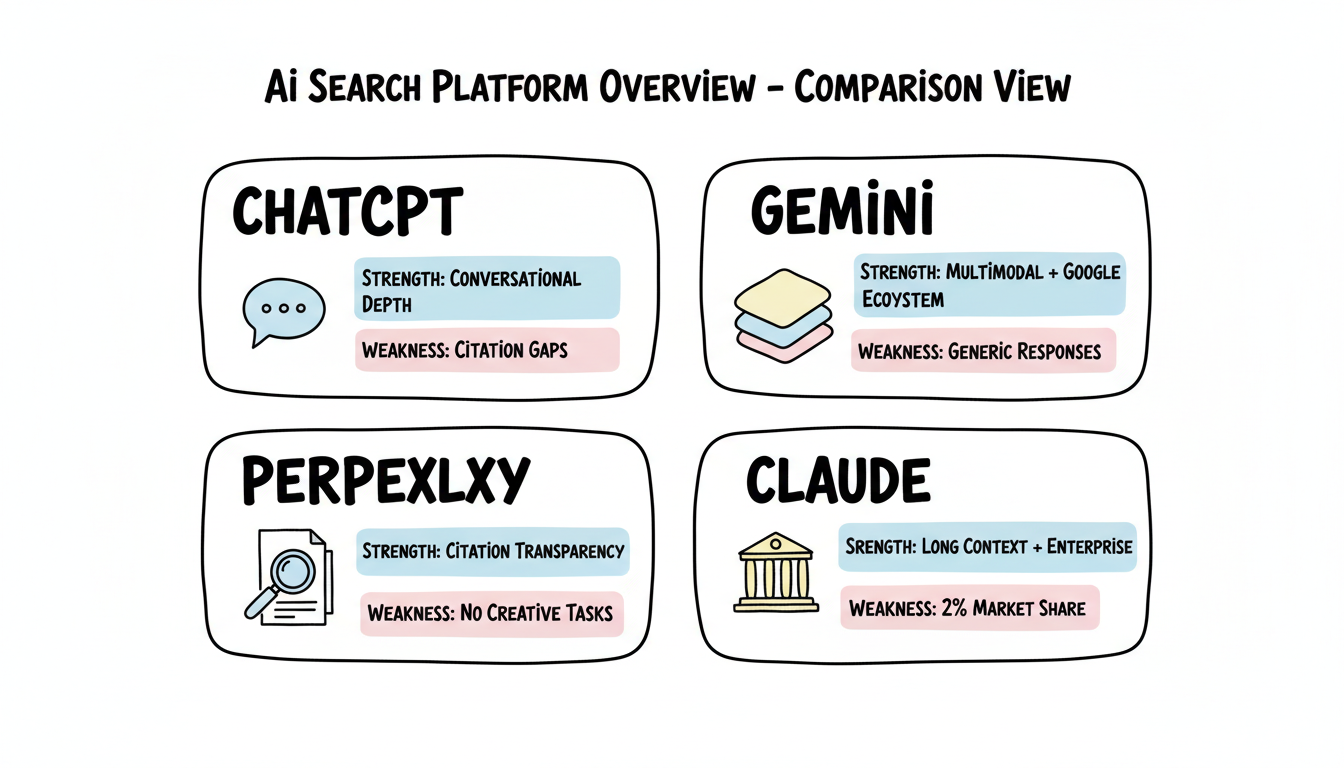
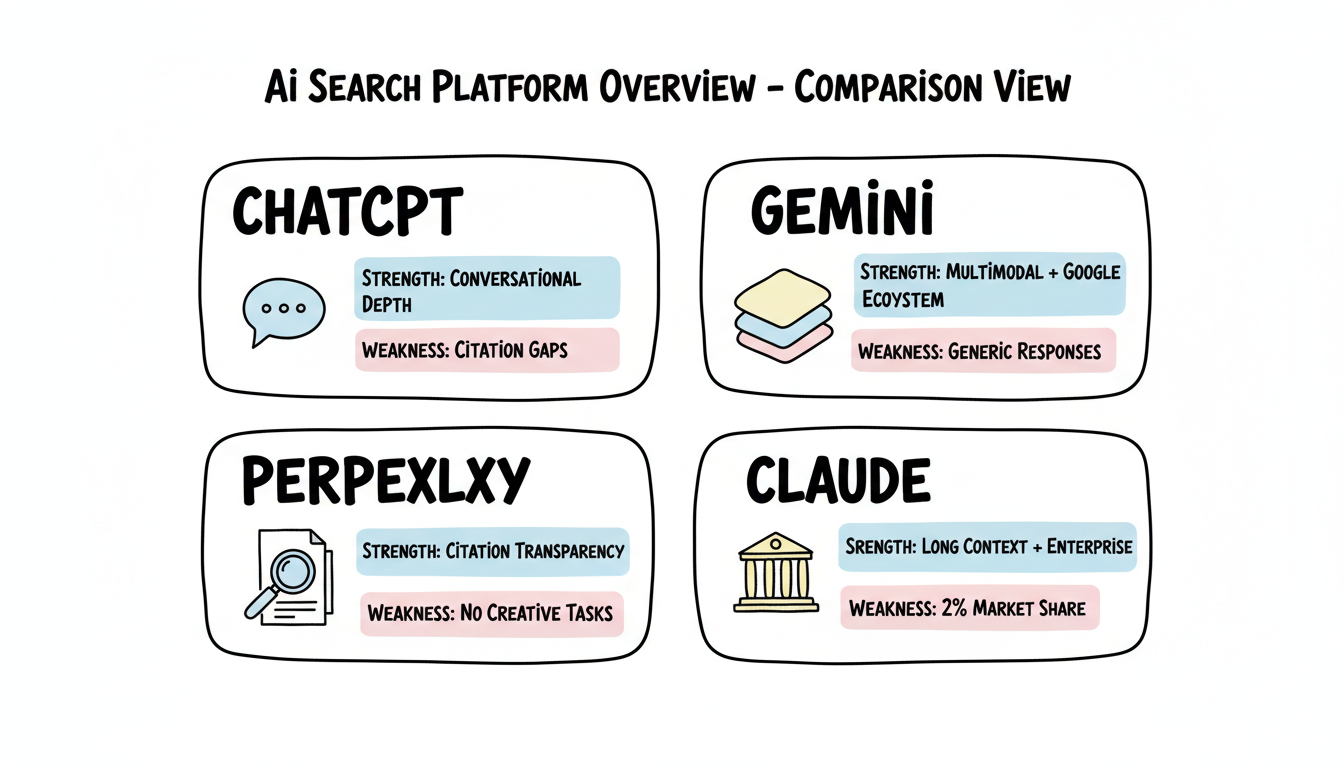
Understanding each AI search platform's distinct capabilities and limitations enables smarter optimization resource allocation. ChatGPT, Google Gemini, Perplexity, and Claude each excel in different areas—and each has blind spots that affect how they cite and present content. This analysis breaks down platform-by-platform strengths and weaknesses to inform your multi-platform AI visibility strategy.
According to Nodesure's AI platform comparison, each platform excels in different dimensions: ChatGPT leads in conversational depth and creative flexibility, Gemini offers superior multimodal capabilities and Google ecosystem integration, while Perplexity specializes in research-focused tasks with transparent source citations.
ChatGPT maintains market dominance but has distinct optimization implications.
According to AIML API's search engine comparison, ChatGPT functions as a conversational AI rather than a dedicated search engine, requiring users to manually toggle web search. While it offers creative flexibility and extensive plugin integration, it carries higher risk of hallucinations without explicit source verification.
ChatGPT strengths:
Strength | Description | Optimization Implication |
Conversational depth | Maintains context across long exchanges | Structure content for follow-up queries |
Creative flexibility | Excels at generating diverse content formats | Creative, engaging content performs well |
Plugin ecosystem | Extensive third-party integrations | Technical content benefits |
Largest user base | 900M weekly active users | Primary optimization target |
Agentic capabilities | Can perform multi-step tasks | Action-oriented content structure |
ChatGPT weaknesses:
ChatGPT Limitations
├── Citation Transparency
│   ├── Sources less prominently displayed
│   ├── Users must actively verify information
│   └── Hallucination risk without web search
│
├── Search Behavior
│   ├── Web search requires manual toggle
│   ├── Not default real-time information
│   └── Training data cutoff applies
│
├── Verification Gaps
│   ├── May generate plausible-sounding errors
│   ├── Confident presentation regardless of accuracy
│   └── Users often don't check sources
│
└── Content Attribution
    ├── Less consistent source linking
    ├── Citation format varies
    └── Source quality not always clear
Perplexity's research focus creates unique optimization opportunities, especially for brands implementing answer engine optimization strategies.
According to TopDevelopers' Perplexity analysis, Perplexity operates as a dedicated AI search engine with built-in web search and real-time data access. Its citation-first approach significantly reduces hallucination risk by grounding every response in verifiable sources.
Perplexity strengths:
Strength | Description | Optimization Implication |
Citation transparency | Sources displayed prominently in responses | Well-cited content earns visibility |
Real-time search | Built-in web search by default | Current, updated content favored |
Research efficiency | 2x faster for research tasks | Comprehensive, authoritative content |
Low hallucination risk | Grounded in sources | Factual accuracy rewarded |
Pro Search features | Multi-step research capabilities | In-depth content performs well |
Perplexity weaknesses:
According to Elementor's platform comparison, Perplexity functions more like a search engine than a conversational AI. It lacks ChatGPT's conversational depth and struggles with creative writing, brainstorming, and tasks requiring imaginative flexibility.
Perplexity Limitations
├── Conversational Depth
│   ├── Weaker at extended dialogue
│   ├── Less context retention
│   └── Search-like interaction style
│
├── Creative Tasks
│   ├── Limited creative writing ability
│   ├── Brainstorming less effective
│   └── Imaginative tasks suffer
│
├── User Experience
│   ├── More utilitarian interface
│   ├── Less engaging interaction
│   └── Smaller user base (2% share)
│
└── Content Types
    ├── Factual content preferred
    ├── Entertainment content underperforms
    └── Conversational content less suited
Gemini's ecosystem integration drives rapid growth but carries limitations. Organizations implementing AI SEO best practices in 2026 must account for Gemini's unique strengths in multimodal content processing.
According to Neontri's Gemini analysis, Gemini excels at multimodal tasks—processing text, images, audio, and video natively. Its deep integration with Google services (Search, YouTube, Workspace) creates unique visibility pathways, while handling long context windows effectively.
Gemini strengths:
Strength | Description | Optimization Implication |
Native multimodal | Processes text, images, audio, video | Multi-format content strategy |
Google ecosystem | Search, YouTube, Workspace integration | Traditional SEO compounds |
Large context | Handles extensive documents | Long-form content works well |
Fastest growth | +388% YoY referral traffic | Growing importance |
Mobile integration | Default on Android devices | Mobile-first optimization |
Gemini weaknesses:
Gemini Limitations
├── Response Quality
│   ├── "Dry" responses with lower emotional intelligence
│   ├── Writing can feel robotic or generic
│   └── Less engaging conversational style
│
├── Search Accuracy
│   ├── Inconsistencies in factual retrieval
│   ├── Information accuracy varies
│   └── May miss nuanced queries
│
├── Creative Output
│   ├── Less creative flexibility than ChatGPT
│   ├── Formulaic content generation
│   └── Personality less distinctive
│
└── Independence
    ├── Tied to Google ecosystem
    ├── Privacy concerns for some users
    └── Less standalone appeal
Anthropic's Claude targets high-value segments with distinct capabilities.
According to Appy Pie Automate's Claude analysis, Claude's clean architecture and large context window (100,000+ tokens) make it excellent for complex document processing and coding tasks. Its safety-focused design produces more careful, measured responses.
Claude strengths:
Strength | Description | Optimization Implication |
Long context window | 100K+ tokens standard | Comprehensive content works |
Clean architecture | Well-structured responses | Clear content organization |
Coding excellence | Strong technical capabilities | Technical documentation |
Safety-focused | Careful, measured outputs | Authoritative tone matters |
Enterprise adoption | High revenue per user ($2.2B projected) | B2B content opportunity |
Claude weaknesses:
According to Vertu's Claude analysis, Claude tends toward verbosity—generating 2-3x more code than necessary for programming tasks, over-explaining concepts, and adding excessive commentary. This can affect response conciseness.
Claude Limitations
├── Verbosity
│   ├── 2-3x more code than necessary
│   ├── Over-explains concepts
│   └── Excessive commentary
│
├── Market Position
│   ├── Only 2% market share
│   ├── Smaller reach than competitors
│   └── Enterprise focus limits consumer visibility
│
├── Multimodal
│   ├── Lacks native multimodal processing
│   ├── Text-primary platform
│   └── Visual content disadvantaged
│
└── Cost
    ├── Higher pricing tier
    ├── Enterprise-oriented pricing
    └── Less accessible to casual users
Strategic analysis for optimization resource allocation. Understanding how SearchGPT content formats differ across platforms helps inform content structure decisions.
Head-to-head comparison:
Capability | ChatGPT | Gemini | Perplexity | Claude |
Market share | 64-68% | 18-21% | 2% | 2% |
Citation clarity | Medium | Medium | High | Medium |
Creative tasks | Excellent | Good | Limited | Good |
Research tasks | Good | Good | Excellent | Good |
Multimodal | Growing | Excellent | Limited | Limited |
Long context | Good | Excellent | Good | Excellent |
Hallucination risk | Higher | Medium | Low | Low |
Ecosystem integration | Moderate | Excellent | Limited | Limited |
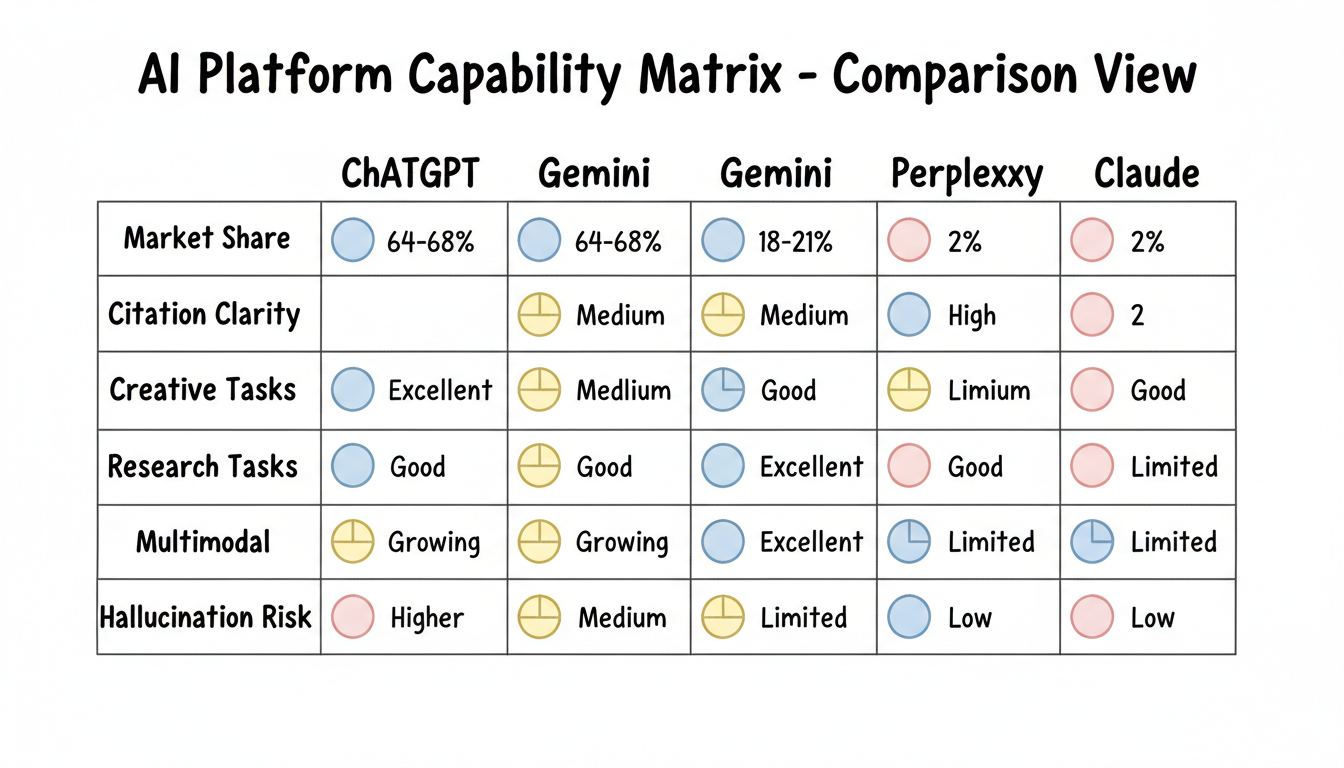
Match content strategy to platform strengths. For teams choosing between in-house vs agency AI search approaches, platform-specific expertise becomes a critical selection criterion.
Platform-specific approaches:
Platform | Content Focus | Format Priority | Key Tactic |
ChatGPT | Conversational, creative | Text, interactive | Plugin-friendly structure |
Gemini | Multimodal, comprehensive | Video, long-form | YouTube + traditional SEO |
Perplexity | Research, factual | Well-cited, authoritative | Citation-rich content |
Claude | Technical, enterprise | Documentation, code | B2B depth content |
Platform strengths and weaknesses guide strategic optimization:
According to Nodesure, the optimal approach matches content format to platform strength: creative and conversational content for ChatGPT, multimodal and ecosystem-integrated content for Gemini, research-backed authoritative content for Perplexity, and technical documentation for Claude. Understanding these platform-specific strengths and weaknesses enables precise resource allocation rather than generic "optimize for AI" approaches.
By submitting this form, you agree to our Privacy Policy and Terms & Conditions.