February 19, 2026


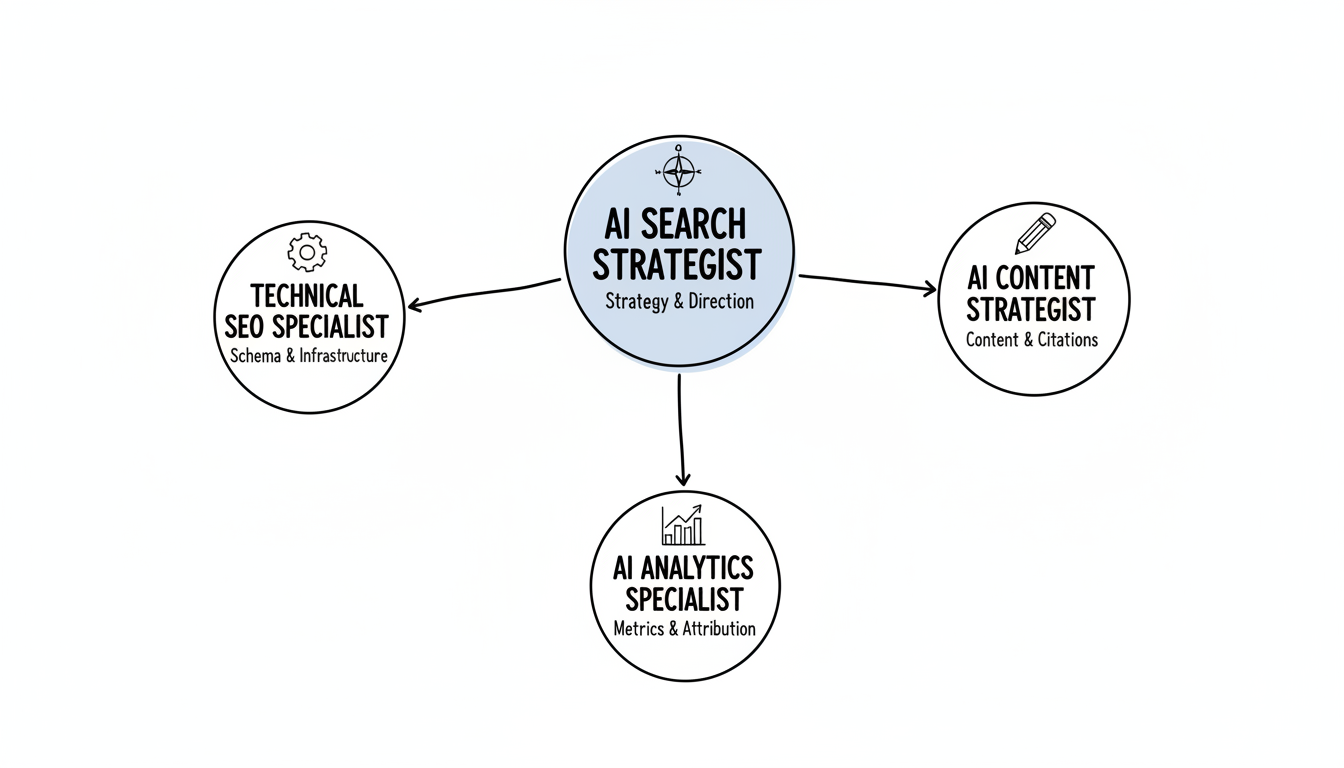
AI search optimization demands capabilities that traditional SEO teams weren't built to provide. As SEO evolves into what industry leaders now call "influence optimization"—building authority through thought leadership, PR coverage, and cross-channel presence—team structures must evolve accordingly. Organizations succeeding in AI search have moved from siloed SEO departments to integrated "site-to-brand teams" that coordinate technical optimization, content strategy, and authority building across every marketing discipline.
Traditional SEO teams focused on technical factors and keyword targeting. AI search changes the equation fundamentally.
The new reality: AI systems evaluate brand authority, citation patterns, and cross-platform presence when determining which sources to cite. BrightEdge research reveals that 34% of AI citations come from PR-driven coverage and 10% from social channels—signals traditional SEO teams rarely influence directly. Teams structured solely around technical optimization miss the majority of AI search optimization factors.
Site-to-brand integration: Enterprise SEO now requires managing across all marketing disciplines. The most effective AI search teams coordinate between technical SEO, content marketing, public relations, brand marketing, and analytics. Isolated optimization efforts underperform compared to integrated approaches that build authority across every touchpoint AI systems evaluate.
Strategic elevation: AI search optimization increasingly requires CEO and CMO stakeholder management. Executive leadership must understand how search and AI changes affect business outcomes. Teams need structures that facilitate upward communication and strategic alignment, not just tactical execution.
AI search optimization requires specific capabilities, whether through dedicated hires, role expansion, or external partnerships.
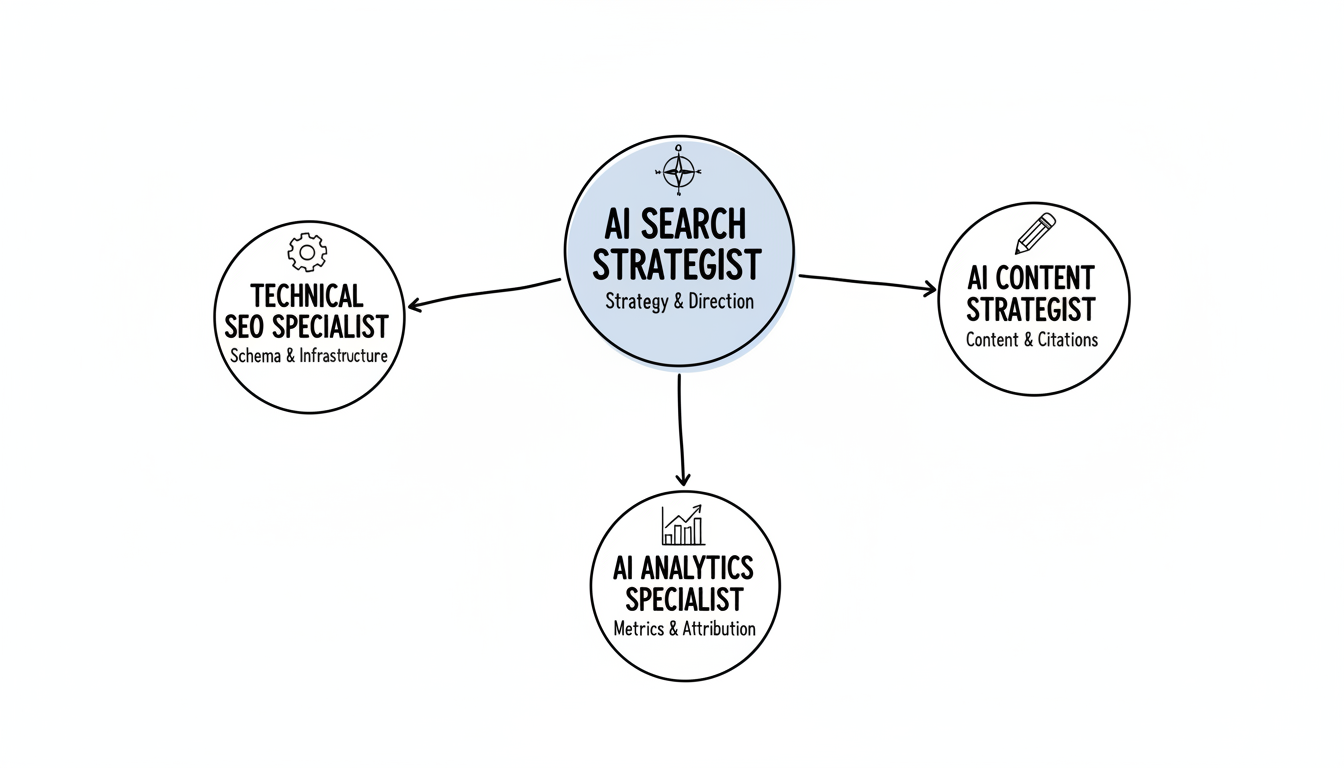
The strategist owns overall AI visibility direction and performance.
Responsibilities:
Skills required: Deep understanding of how AI systems evaluate and cite content. Strategic thinking that connects AI visibility to business outcomes. Communication skills for stakeholder alignment and cross-team coordination.
Technical specialists ensure content infrastructure supports AI discovery and comprehension.
Responsibilities:
Skills required: Schema.org vocabulary expertise. Understanding of AI crawler behavior across platforms. Development coordination experience. Structured data debugging capabilities.
Content strategists develop material optimized for AI citation potential.
Responsibilities:
Skills required: Understanding of content characteristics that earn AI citations. Editorial planning across topic clusters. Data analysis for content optimization decisions.
Analytics specialists measure what traditional tools don't capture.
Responsibilities:
Skills required: Experience with AI search optimization tools. Custom analytics implementation. Data visualization and reporting. Attribution modeling for complex journeys.
Organizations approach AI search team structure through three primary models.
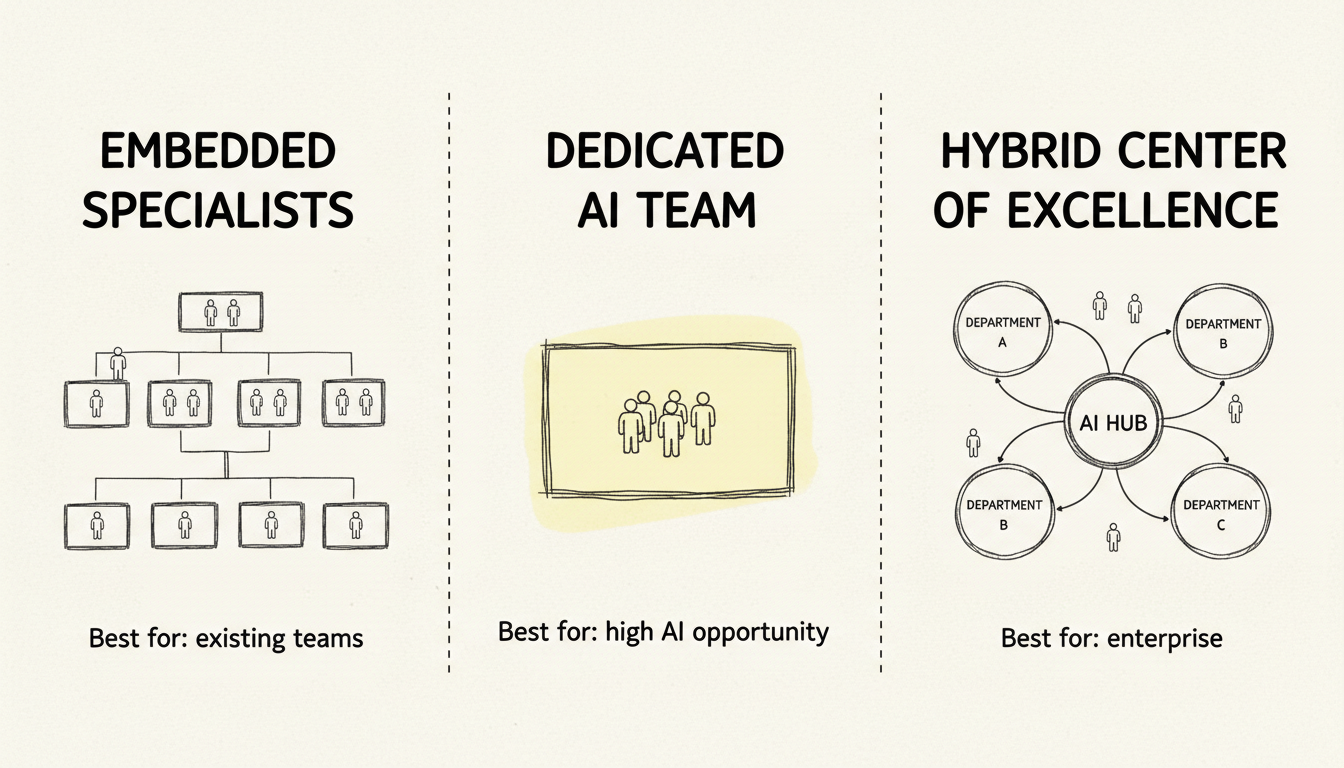
Integrate AI search specialists within existing marketing teams.
Structure: AI search responsibilities distribute across current roles. The SEO team adds AI-specific skills. Content teams learn AI optimization requirements. Analytics expands to track AI metrics.
Best for: Organizations with strong existing SEO foundations. Teams comfortable with skill expansion. Budgets that don't support dedicated AI hires.
Advantages: Lower cost than dedicated teams. Leverages existing expertise. Integrates AI thinking throughout marketing.
Challenges: Competing priorities dilute focus. Skill gaps may persist. Coordination overhead increases.
Build a standalone team focused exclusively on AI search optimization.
Structure: Separate team with dedicated AI strategist, technical specialist, content specialist, and analytics support. Reports to marketing leadership alongside but separate from traditional SEO.
Best for: Organizations with significant AI search opportunity. Budgets supporting dedicated resources. Complex competitive environments requiring focused attention.
Advantages: Undiluted focus on AI optimization. Deep expertise development. Clear accountability for results.
Challenges: Higher cost structure. Potential silos with other teams. Coordination requirements with traditional SEO.
Create a small core team that coordinates AI optimization across departments.
Structure: Central AI search strategist and analytics specialist supported by embedded capabilities in content, technical, and PR teams. The center of excellence sets standards and coordinates execution.
Best for: Mid-size to enterprise organizations. Complex marketing structures requiring coordination. Organizations valuing both focus and integration.
Advantages: Balances focus with integration. Scales efficiently across departments. Maintains strategic coherence.
Challenges: Requires strong coordination skills. Depends on department buy-in. May lack deep execution capacity.
AI search success depends on coordination beyond the core team.
PR generates the earned media coverage AI systems cite. Coordinate on:
Brand signals influence AI trust assessments. Coordinate on:
Technical implementation requires development resources. Coordinate on:
Customer insights inform content strategy. Coordinate on:
Teams adopt different philosophies toward AI tool usage in their work, and understanding the best free AI SEO tools can help teams make informed decisions about their technology stack.
Maximize AI tool usage for efficiency and scale.
Approach: Use AI tools extensively for research, content drafting, optimization analysis, and reporting automation. Human oversight focuses on strategy and quality control.
Risk: Over-reliance on AI tools may produce homogenized content that AI systems eventually devalue.
Prioritize human expertise and original insights.
Approach: Emphasize original research, expert perspectives, and proprietary data that AI cannot replicate. Use AI tools sparingly for efficiency without compromising originality.
Risk: Lower output volume may limit competitive coverage breadth.
Human expertise leads strategy while AI supports execution.
Approach: Use AI tools for research acceleration, draft assistance, and analysis automation while maintaining human control over strategy, voice, and quality. Original insights differentiate content.
Benefit: Most defensible long-term approach combining efficiency with differentiation.
Internal governance ensures consistent AI search execution.
Essential governance elements:
Alignment mechanisms:
Tracking progress requires implementing proper AI search KPI goal setting frameworks that align with business objectives.
Team structure should evolve with organizational maturity.
Early stage: Start with embedded capabilities and external partnerships. Focus on learning and foundation building before dedicated investment.
Growth stage: Add dedicated AI search coordinator role. Expand analytics capabilities. Increase content capacity for AI optimization.
Mature stage: Build full hybrid center of excellence. Develop proprietary tools and processes. Invest in advanced measurement and attribution.
Neither approach is universally correct. Integration maintains coordination with traditional search optimization but risks diluted focus. Separation enables dedicated attention but requires coordination mechanisms. The hybrid center of excellence model often balances these tradeoffs effectively for mid-size and larger organizations.
At minimum, one person should own AI search strategy and coordination, even if execution distributes across existing roles. This coordinator ensures AI optimization doesn't get lost among competing priorities and maintains strategic coherence across initiatives.
Track citation frequency, AI referral traffic, and share of voice improvements attributable to team initiatives. Connect these leading indicators to business outcomes like influenced revenue and market share. Measure cross-functional coordination effectiveness through project completion and stakeholder satisfaction.
By submitting this form, you agree to our Privacy Policy and Terms & Conditions.