
February 19, 2026


Tracking AI search metrics without clear goals produces data without direction. Effective goal setting connects AI visibility targets to business outcomes, establishes achievable milestones, and creates accountability for improvement. This framework provides the mechanics for setting AI search KPIs that drive actual results.
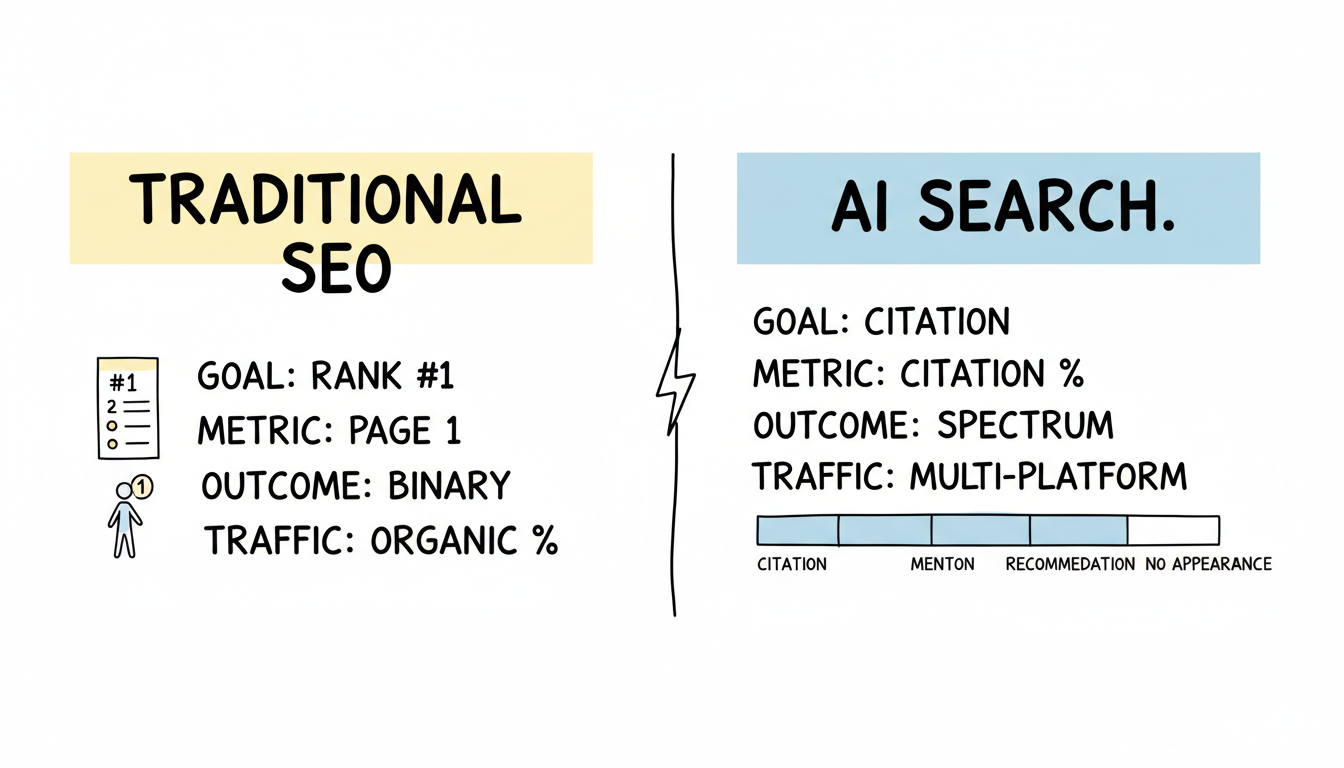
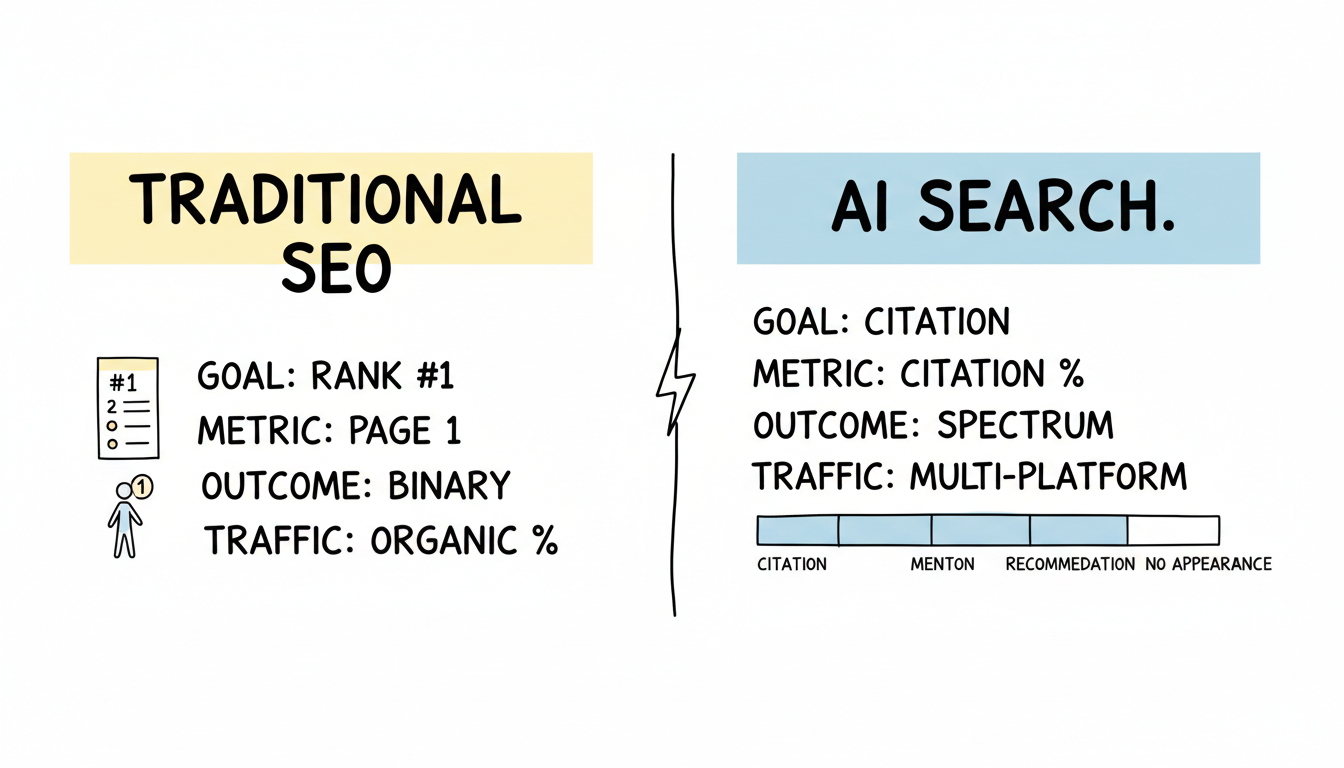
AI search goals require different approaches than traditional SEO targets.
Why AI search goal setting differs:
Traditional SEO | AI Search |
Rank #1 for keyword | Achieve citation presence |
X% organic traffic growth | X% citation rate improvement |
Page 1 ranking | Multi-platform visibility |
Clear success/failure | Probabilistic outcomes |
AI search success exists on a spectrum. A query might result in citation, mention, recommendation, or no appearance—each with different value.
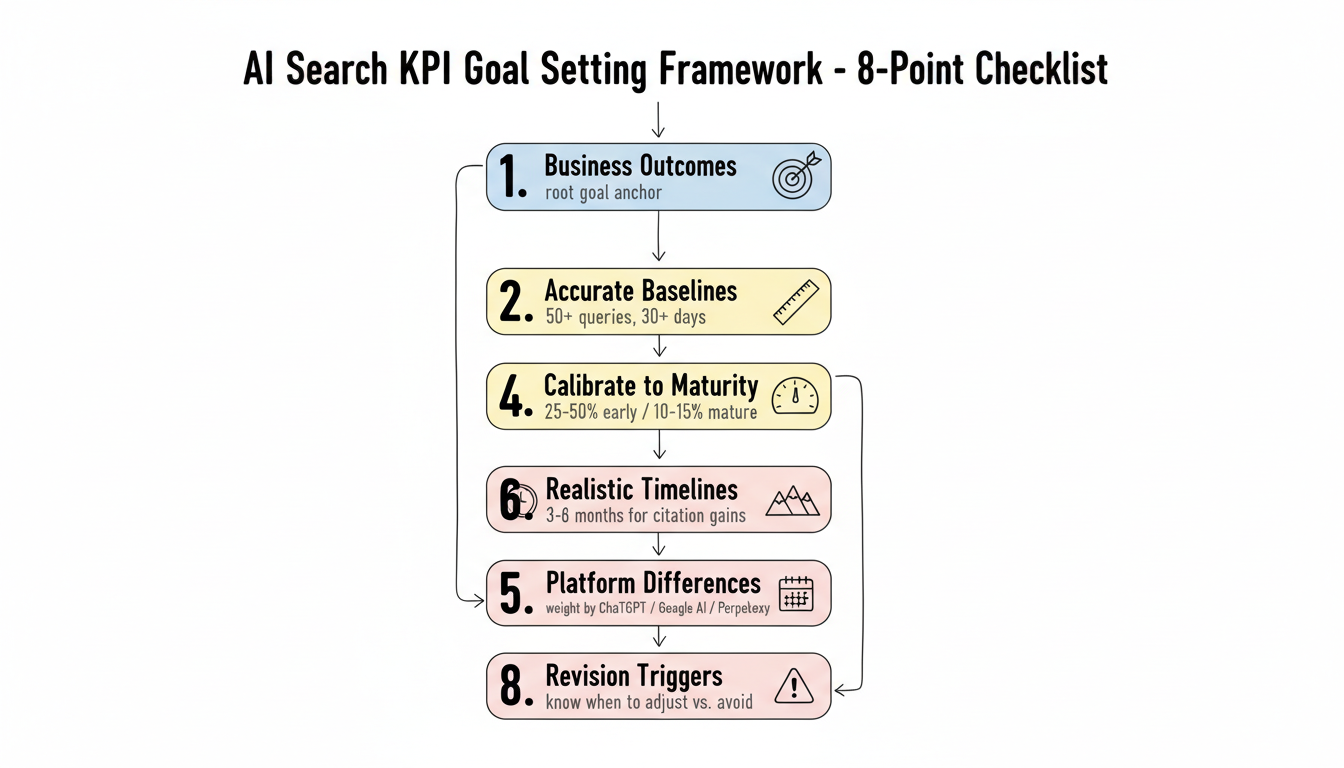
Every AI search KPI should trace back to business impact.
Objective-to-KPI mapping:
Business Objective | AI Search KPI | Connection |
Increase qualified leads | Citation rate for bottom-funnel queries | Citations drive consideration |
Build brand awareness | Share of voice in category queries | AI exposure creates recognition |
Reduce CAC | AI referral conversion rate | High-intent AI traffic converts better |
Enter new market | Citation presence for new vertical | AI visibility establishes credibility |
Mapping exercise:
Business objective: Generate 50 more qualified leads monthly

AI visibility requirement:
├── Calculate: 50 leads ÷ typical conversion = traffic needed
│   └── 50 ÷ 3% = 1,667 additional quality visits
│
├── AI traffic potential:
│   └── Citation in 20 queries × avg clicks = estimated traffic
│
└── Citation goal derived:
    └── Achieve citations in X additional high-intent queries
Work backward from business needs to visibility requirements. This approach aligns with broader ai-seo-strategy principles that connect technical optimization to business outcomes.
Goals without baselines are guesses. Document current state before setting targets.
Baseline requirements:
Metric | Baseline Method | Minimum Sample |
Citation rate | Query AI platforms with target queries | 50+ queries |
Share of voice | Track your citations vs. competitors | 50+ queries, 3+ competitors |
AI referral traffic | GA4 AI channel segmentation | 30+ days data |
Conversion rate | AI traffic conversion tracking | 100+ conversions |
Baseline documentation template:
Baseline Report (Date: YYYY-MM-DD)

Query Set: [N queries across X categories]

Current Citation Rate:
├── ChatGPT: X% (Y/Z queries)
├── Perplexity: X% (Y/Z queries)
├── Google AI: X% (Y/Z queries)
└── Overall: X% (Y/Z queries)

Share of Voice:
├── Your brand: X%
├── Competitor A: X%
├── Competitor B: X%
└── Competitor C: X%

AI Referral Traffic (30-day):
├── Total visits: X
├── Conversion rate: X%
└── Vs. organic conversion: +/-X%

Data quality notes:
└── [Any sampling limitations or caveats]
Revisit baselines quarterly as AI platforms and competitive landscape evolve. Understanding how-to-check-site-appears-google-ai-overviews is essential for accurate baseline measurement across platforms.
Targets should stretch capabilities without being unrealistic.
Target-setting framework:
Goal Type | Formula | Use Case |
Improvement-based | Baseline × (1 + improvement %) | Mature programs with stable data |
Benchmark-based | Industry average or competitor level | New programs seeking parity |
Outcome-based | Business need ÷ conversion rate | Revenue-driven goal setting |
Target calibration by maturity:
Program Maturity | Realistic Improvement Target |
First 6 months | 25-50% citation rate increase |
6-12 months | 15-30% improvement |
12+ months | 10-20% improvement |
Mature program | 5-15% improvement |
Early gains come easier. Adjust expectations as you capture initial opportunities.
Setting stretch targets:
Target Structure:
├── Base target (80% confidence of achievement)
│   └── Example: 20% citation rate improvement
│
├── Stretch target (50% confidence)
│   └── Example: 35% citation rate improvement
│
└── Moonshot (20% confidence)
    └── Example: 50% citation rate improvement

Compensation/Planning:
├── Plan resources for base target
├── Budget contingency for stretch
└── Celebrate moonshot if achieved
Goals need deadlines. AI search timelines differ from SEO timelines.
Typical AI search goal timeframes:
Goal Type | Realistic Timeline | Why |
Initial citation presence | 1-3 months | Content needs crawling and indexing |
Citation rate improvement | 3-6 months | Requires content optimization cycle |
Share of voice gains | 6-12 months | Competitive displacement takes time |
Conversion rate improvement | 3-4 months | Testing and optimization cycles |
Timeline by action type:
New content creation → 4-8 weeks to citation potential
Existing content optimization → 2-4 weeks
Technical improvements → 1-2 weeks
Authority building → 6-12 months ongoing
Don't expect faster results. AI platforms crawl and update on their own schedules.
Long-term goals need intermediate checkpoints for course correction.
Quarterly milestone structure:
Period | Milestone Type | Action |
Month 1 | Foundation | Complete baseline, launch tracking |
Month 3 | Progress check | 30% of annual target achieved |
Month 6 | Midpoint review | 50% of annual target, adjust if needed |
Month 9 | Acceleration | 75% of target, identify gaps |
Month 12 | Final review | Evaluate results, set next year's goals |
Checkpoint decision matrix:
If progress is ahead of target:
├── Consider raising stretch goal
├── Reallocate resources to lagging areas
└── Document what's working for replication

If progress is behind target:
├── Diagnose: strategy, execution, or external factors?
├── Adjust: revise target or increase resources
└── Escalate: if structural issues prevent success
Effective milestone tracking often requires specialized generative-engine-optimization-software to monitor performance across multiple AI platforms simultaneously.
Set platform-specific sub-goals within overall targets.
Platform goal allocation:
Platform | Traffic Share | Goal Weighting | Rationale |
ChatGPT | 60-65% | 50% of effort | Largest audience |
Google AI | 20-25% | 25% of effort | Search integration |
Perplexity | 5-10% | 15% of effort | High-quality traffic |
Others | 5-10% | 10% of effort | Coverage breadth |
Platform-specific targets example:
Overall citation rate goal: 25%

Platform breakdown:
├── ChatGPT: 30% citation rate (larger opportunity)
├── Perplexity: 35% citation rate (easier to optimize)
├── Google AI: 15% citation rate (higher competition)
└── Microsoft Copilot: 20% citation rate (moderate difficulty)
When evaluating which platforms to prioritize, review comparisons of the best-ai-search-engine-2026 to understand where your audience is most active.
Know when to revise goals mid-cycle.
Revision triggers:
Trigger | Response |
Platform algorithm change | Re-baseline within 30 days |
New competitor entry | Reassess share of voice targets |
Traffic quality shift | Adjust conversion expectations |
Resource change | Scale targets proportionally |
Early overachievement | Raise targets or reallocate |
Revision process:
Avoid constant revision—it undermines accountability. Revise only for material changes.
Effective AI search goal setting:
Goals transform AI search measurement from passive reporting to active performance management. Set them deliberately, track them rigorously, and adjust them thoughtfully.
By submitting this form, you agree to our Privacy Policy and Terms & Conditions.



