
February 19, 2026


Generative Engine Optimization (GEO) software has become essential for brands seeking visibility in AI-powered search environments. As users increasingly turn to ChatGPT, Perplexity, Google AI Overviews, and other AI platforms for information, specialized software helps marketers track, measure, and improve their presence in AI-generated responses. This guide examines the leading GEO software options available in 2026 and helps you select the right platform for your needs.
The GEO software market has matured rapidly. According to Y Combinator data, traditional search traffic is expected to drop 25% by 2026 and 50% by 2028, replaced by AI-generated answers. Brands that invest in the right GEO software position themselves to capture visibility in this transformed landscape.
Traditional SEO tools track rankings in search result pages. GEO software solves a different problem—monitoring how AI systems mention, cite, and recommend your brand when generating responses to user queries.
The need for GEO software has grown alongside AI search adoption. ChatGPT now serves over 400 million weekly active users. Perplexity processes millions of research queries daily. Google AI Overviews appear for increasing percentages of searches. Without specialized tracking, brands have no visibility into whether these platforms recommend them or their competitors.
GEO software addresses several critical needs:
Visibility monitoring: Track when and how AI platforms mention your brand across different query types and contexts.
Competitive intelligence: Understand which competitors appear in AI responses for queries relevant to your business.
Content optimization: Identify what makes content citation-worthy and receive guidance for improvement.
Performance measurement: Quantify GEO efforts with metrics that demonstrate ROI to stakeholders.
The GEO software market includes several distinct categories, each addressing different aspects of AI visibility optimization.
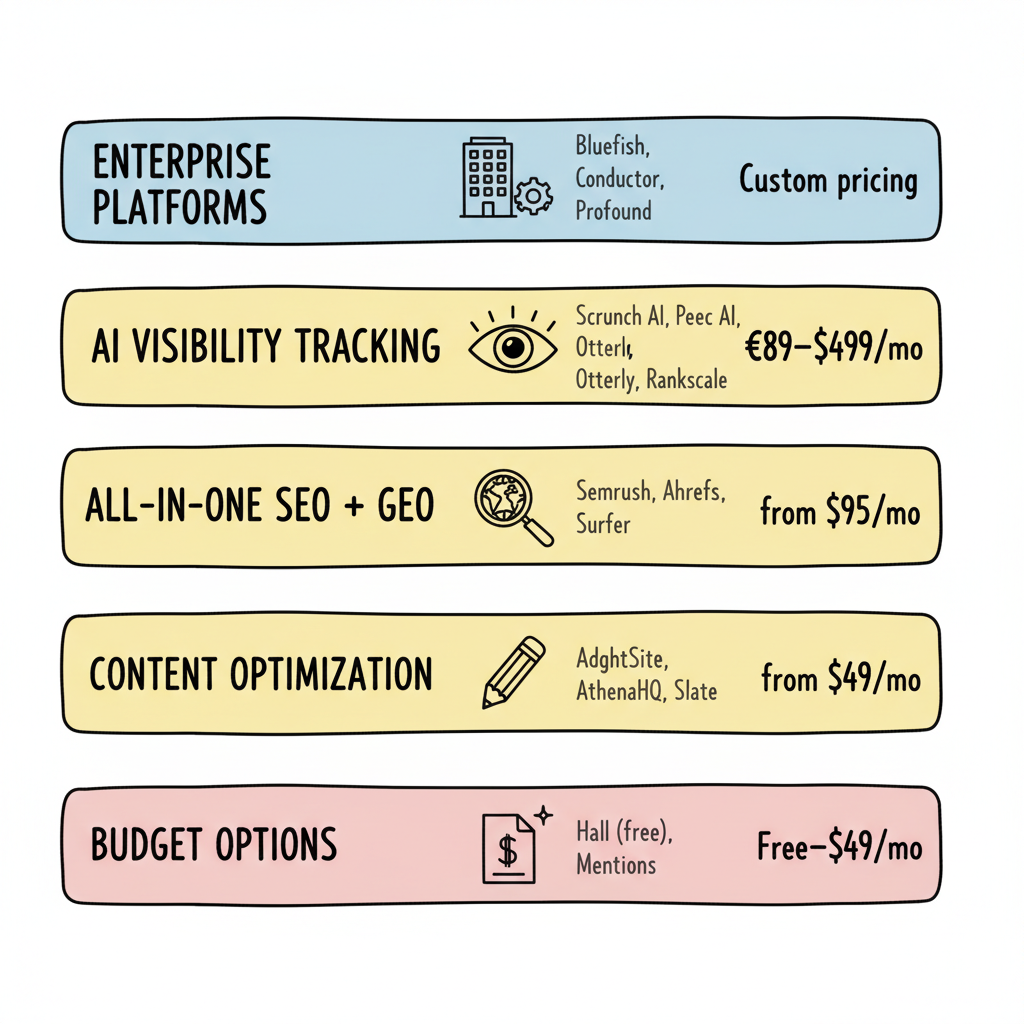
Large organizations require comprehensive platforms with advanced features, integrations, and enterprise-grade security.
Bluefish positions itself as the leading enterprise GEO platform, providing real-time visibility across ChatGPT, Gemini, Perplexity, Google AI Mode, and Google Summary. The platform offers advanced metrics including favorability, sentiment, safety, and accuracy scoring. Expert evaluations found Bluefish outperformed median platforms by significant margins across diagnostic depth, source-influence clarity, and metadata-governance reliability. The AI Brand Vault feature ensures metadata governance to control how AI models interpret brand data. Enterprise workflows automate GEO recommendations, backed by SOC 2 compliance, SSO, and role-based access controls.
Conductor has expanded its established SEO platform to include comprehensive AEO and GEO capabilities. The platform connects AI visibility insights to content execution, allowing teams to create optimized content, track performance, and prove ROI within a unified workflow. Enterprise capabilities include advanced integrations with existing marketing technology stacks, comprehensive reporting, and dedicated customer success support. Organizations already using Conductor for traditional SEO can add GEO capabilities without adopting entirely new tools.
Profound uses classification and embedding models to analyze AI-generated responses. The platform identifies mentions, citations, and sentiment, providing a visibility index that measures share of presence in AI search results. Enterprise-focused analytics help large organizations understand business impact from AI visibility changes.
These platforms focus specifically on monitoring brand presence across AI search environments.
Scrunch AI provides comprehensive visibility mapping across large language models. The platform tracks brand presence, performance metrics, and competitive positioning with detailed analytics including sentiment analysis and recommendation context. Enterprise organizations use Scrunch for understanding how AI systems perceive and recommend their brands across diverse query types.
Peec AI launched with substantial seed funding and offers multilingual tracking capabilities. Pricing starts at €89 per month for 25 prompts, scaling to €499 for higher volumes. The modern interface and European market focus distinguish Peec from US-centric competitors. The platform tracks visibility across ChatGPT, Perplexity, Gemini, and Google AI Overviews.
Otterly.AI offers accessible entry-level AI visibility tracking starting at $29 per month. The platform monitors brand presence across Perplexity, ChatGPT, Gemini, Copilot, and Google AI Overviews. For smaller businesses and agencies testing GEO strategies, Otterly provides essential monitoring without enterprise pricing complexity.
Rankscale.ai provides granular multi-LLM tracking with a credit-based pricing model starting at $20 per month for 120 credits. Budget-conscious teams get essential tracking capabilities while controlling costs based on actual usage.
Major SEO platforms have integrated GEO capabilities into their existing toolsets, providing unified workflows.
Semrush AI Visibility Toolkit tracks visibility across ChatGPT, Google AI Overviews, AI Mode, Gemini, Perplexity, Grok, DeepSeek, and Claude. Starting at $99 per month per domain, the toolkit integrates with existing Semrush workflows. Semrush reported $25 million in annual recurring revenue from AI products, indicating significant market adoption. Features include AI visibility scoring, prompt tracking, competitive benchmarks, and AI-search site audits that flag issues blocking AI crawlers.
Ahrefs Brand Radar helps brands track visibility in both AI search and traditional search from a unified platform. The integration means teams can correlate traditional SEO performance with AI visibility, supporting the research finding that 87% of AI citations come from content ranking in organic positions 1-10.
Surfer SEO AI Tracker adds AI visibility monitoring to Surfer's content optimization platform. Starting at $95 per month for 25 prompts, the tool tracks mentions across Google AI Overviews, ChatGPT, Perplexity, and Claude. Teams already using Surfer for content optimization can extend into GEO tracking within familiar workflows.
Some GEO software focuses less on tracking and more on creating content that AI systems want to cite.
Addlly AI combines content creation with GEO optimization. The platform uses custom AI agents trained on your brand data to manage AI search visibility. Features include zero-prompt workflow automation, custom brand training, and GEO audit tools that automatically scan and optimize content for maximum AI mentions.
LightSite AI provides AI-powered optimization recommendations starting at $49 per month. The platform analyzes content structure, identifies optimization opportunities, and suggests improvements to increase citation likelihood.
AthenaHQ focuses on understanding what makes content authoritative to AI systems. The platform tracks how brands appear in search results and how visibility leads to conversions. Starting at $295 per month, AthenaHQ serves SEO agencies needing comprehensive analytics with web analytics integration.
Slate solves content decay problems for GEO by automating large-scale content refreshes. The platform scans entire domains for freshness issues, prioritizes updates by business impact, and processes hundreds of pages simultaneously while maintaining brand voice.
Smaller teams and agencies have accessible entry points into GEO software.
Hall offers a free plan for basic AI visibility tracking. Based in Sydney, Australia, the platform provides prompt ideas and clear mention displays. The free tier allows teams to explore AI visibility before committing to paid solutions.
Mentions provides answer engine optimization tracking starting at $49 per month. Created by Contact Studios, an SEO agency, the platform offers lightweight functionality with excellent UI/UX at budget-friendly pricing.
When selecting GEO software, evaluate capabilities against your specific needs.
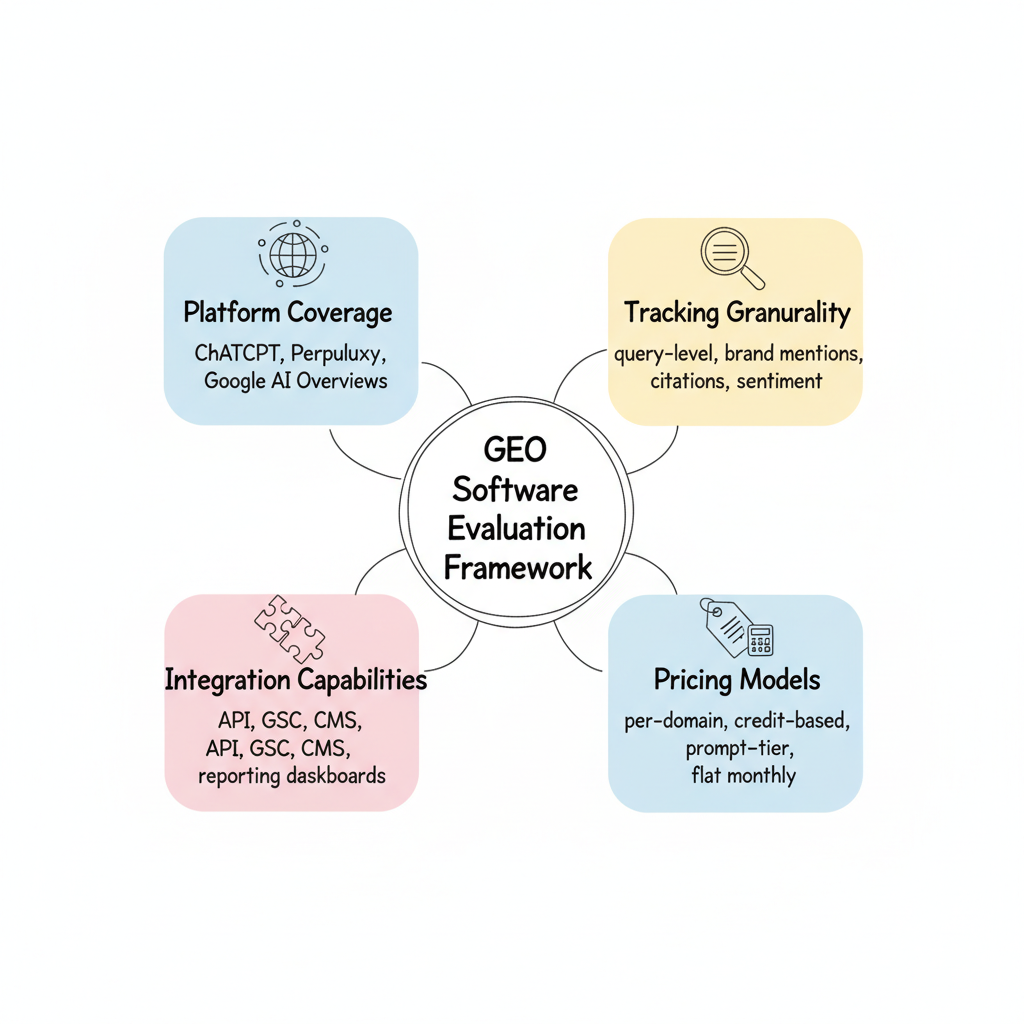
Different tools track different AI platforms. Ensure your chosen solution monitors the platforms that matter for your audience:
Consider what level of detail you need:
Evaluate how software fits your existing workflow:
GEO software pricing varies significantly:
Calculate costs based on your actual tracking requirements rather than feature comparisons alone.
Successful GEO software deployment follows a structured approach.
Before implementing software, understand your current state. Manually search 20-30 priority queries across ChatGPT, Perplexity, and Google AI Overviews. Document where you appear and where competitors dominate. This baseline informs software selection and establishes metrics for measuring improvement.
Focus tracking on queries that matter:
Start with 25-50 priority queries and expand based on insights gained.
Create regular review rhythms:
Software provides data—action produces results. Use insights to:
Justify software investments by tracking meaningful outcomes:
Citation growth rate: Track increases in AI citation frequency over time across monitored platforms.
Query coverage expansion: Measure how many priority queries generate your citations versus baseline.
Competitive position changes: Document queries where you've gained visibility or displaced competitors.
Time efficiency gains: Quantify hours saved versus manual monitoring approaches.
For comprehensive performance tracking, consider implementing Google Analytics 4 AI search tracking to measure traffic attribution from AI-generated results alongside traditional search metrics.
The GEO software market continues maturing rapidly. New entrants launch regularly with differentiated capabilities. Existing platforms add features as understanding of GEO requirements deepens. Expect consolidation as larger platforms acquire specialized tools.
Organizations seeking strategic guidance on software selection and implementation can benefit from AEO services consultation to evaluate options against specific business objectives. For teams building internal expertise, AEO training workshops provide hands-on experience with leading platforms and best practices for maximizing software ROI.
Stay informed about market developments. Optimal software choices in early 2026 may shift as capabilities evolve throughout the year and beyond.
Yes. Traditional SEO performance directly influences AI citation likelihood—research shows 87% of AI citations come from content ranking in positions 1-10. Use traditional tools for rankings, backlinks, and technical SEO. Add GEO software for AI visibility tracking and optimization guidance.
Otterly.AI at $29 per month, Rankscale.ai starting at $20 per month, or Mentions at $49 per month provide essential tracking at accessible price points. Hall offers a free plan for basic exploration. These options cover core visibility monitoring without enterprise complexity.
Software provides immediate visibility data upon configuration. Translating insights into improved AI citations typically takes 2-4 months as optimized content gets indexed and AI systems incorporate it into responses.
By submitting this form, you agree to our Privacy Policy and Terms & Conditions.



