February 19, 2026


Google AI Overviews now appear in over 50% of search results—up from just 18% in early 2025. This AI-generated answer box sits above traditional organic results, synthesizing information from multiple sources to answer user queries directly. Getting your website cited in these overviews has become one of the most valuable positions in search.
But here's what most guides won't tell you: being cited in AI Overviews isn't just about ranking well. Research shows that 40% of sources appearing in AI Overviews would rank in positions 11-20, not the top 10. The selection criteria are fundamentally different from traditional ranking factors.
This guide breaks down exactly how Google selects sources for AI Overviews and the specific optimizations that increase your citation likelihood.
The business case for AI Overview optimization is straightforward: visibility without clicks still builds brand authority, but citations with clicks deliver highly qualified traffic.
Traffic Quality Transformation Users who click through from AI Overviews arrive with higher intent. They've already seen your brand positioned as an authoritative source on their exact question. Google's own documentation notes that AI Overview visitors often show "more engaged audience" behavior than traditional organic traffic.
Visibility in the Zero-Click Era Nearly 100% of keywords triggering AI Overviews have informational intent. These are the queries where zero-click answers are most common. If you're not cited in the overview, you're invisible for a growing segment of searches—even if you rank #1 organically.
Competitive Differentiation AI Overviews typically cite 5-10 sources per response, with longer answers citing up to 28 sources. Each citation slot represents an opportunity to appear alongside (or instead of) competitors. The businesses that understand these selection criteria gain an unfair advantage.
Compounding Authority Signals Being cited in AI Overviews reinforces your entity authority in Google's systems. This creates a flywheel effect: AI citations strengthen your Knowledge Graph presence, which improves your likelihood of future citations. Early optimization compounds over time.
Understanding the selection mechanism is essential for optimization. AI Overviews don't simply pull from top-ranked pages—they use a sophisticated multi-stage process.
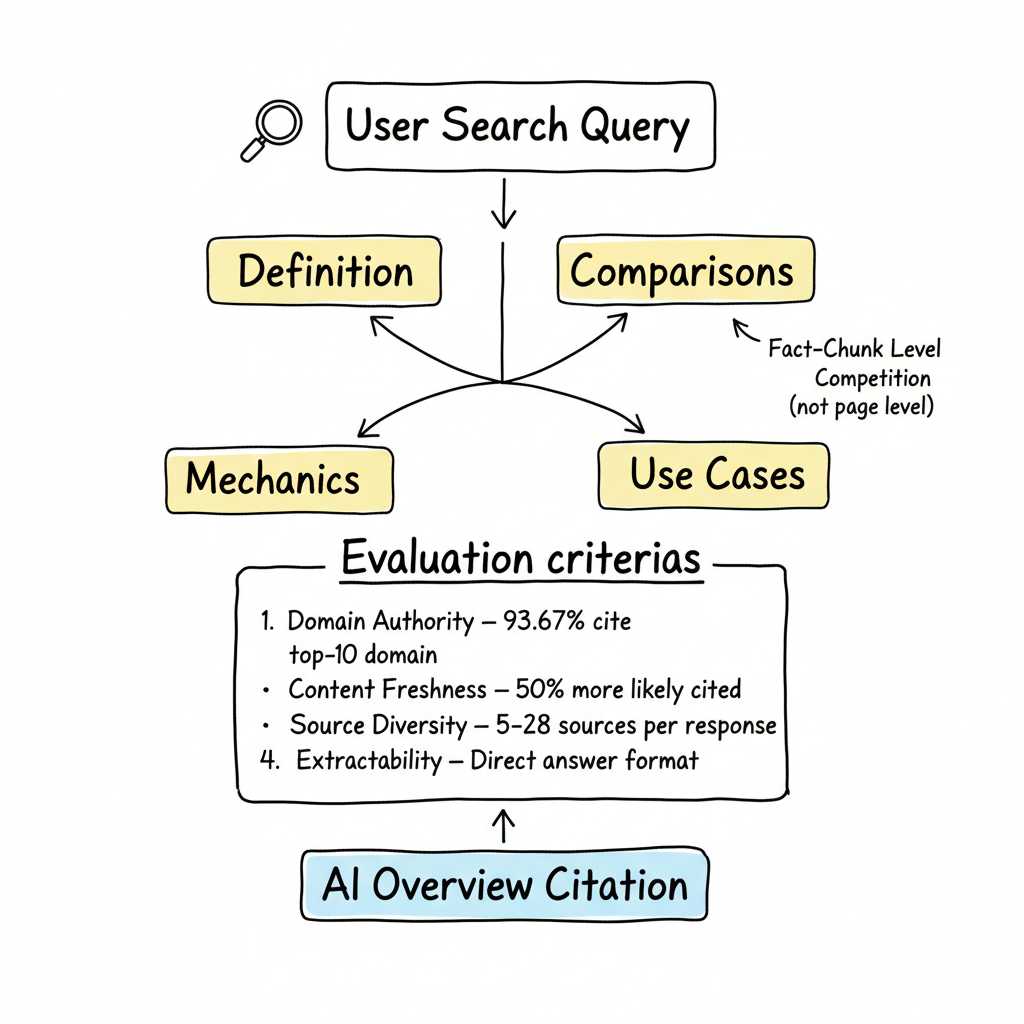
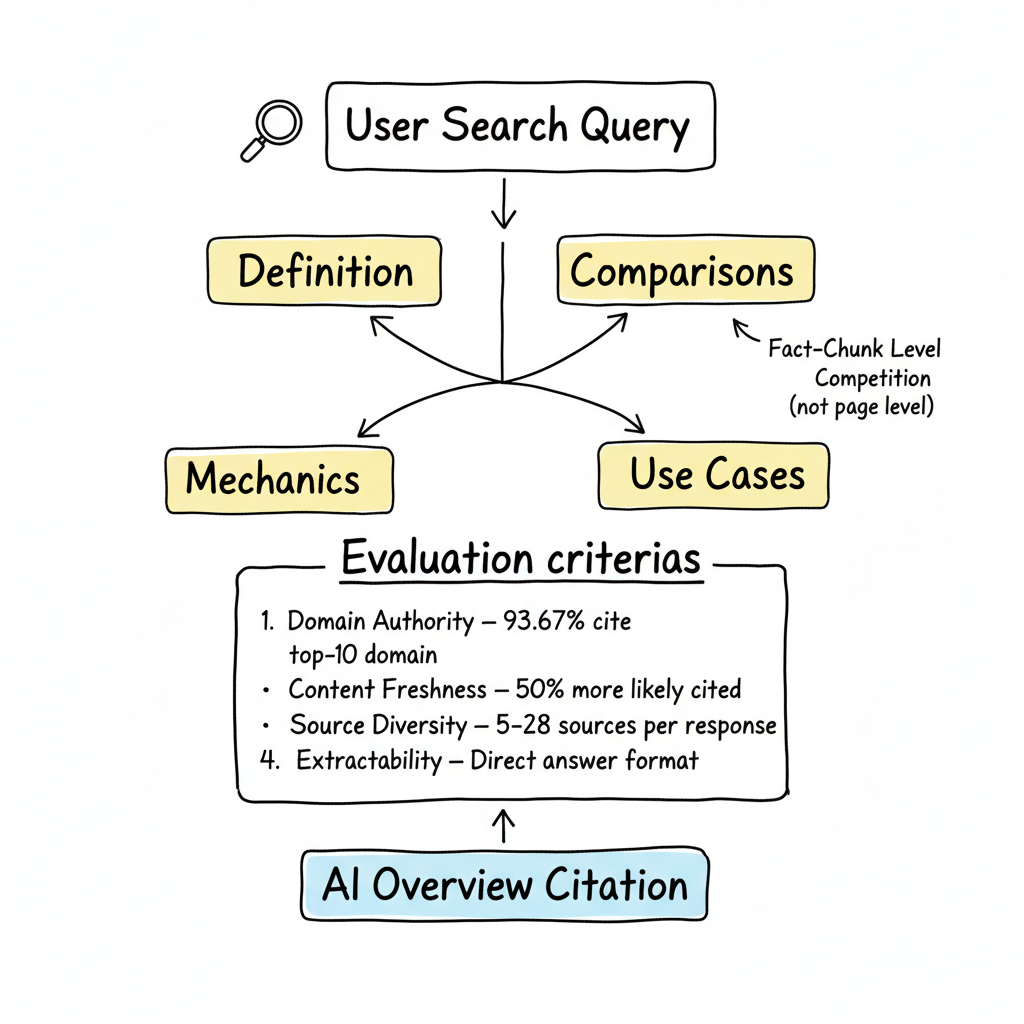
When a user submits a query, Google's AI decomposes it into multiple parallel sub-queries. Each sub-query explores a different facet: definitions, mechanics, constraints, comparisons, use cases. Your content competes not at the page level but at the "fact-chunk" level.
This means a single paragraph that perfectly answers a specific sub-query can be selected—even if the overall page isn't the best result for the main query. The unit of competition is the extractable answer, not the comprehensive page.
Research analyzing hundreds of thousands of AI Overview responses reveals consistent patterns in source selection:
Correlation with Traditional Rankings 93.67% of AI Overview citations link to at least one page that ranks in the top 10 organic results. However, only 4.5% of cited URLs directly match a Page 1 organic URL. This suggests Google draws from deeper pages on authoritative domains rather than simply citing whatever ranks #1.
Domain Authority Signals Traditional authority metrics still matter. Sites with strong backlink profiles, established brand recognition, and topical expertise receive preference. But authority alone isn't sufficient—content structure and extractability determine which specific pages get cited. Understanding ai-overview-google-seo-technical aspects helps you align with Google's selection criteria.
Content Freshness Recent studies indicate content freshness is 50% more likely to earn AI citations. Google's systems prioritize recently published or updated content, particularly for queries where recency matters.
Source Diversity Mandate AI Overviews are explicitly designed to surface diverse sources. The system evaluates URLs as distinct sources—meaning your site might be cited multiple times if different pages answer different sub-queries effectively. This creates opportunity for comprehensive topical coverage.
Not all content earns citations equally. Specific quality signals dramatically increase selection likelihood.
Research tracking AI Overview performance found that using an authoritative tone (confident but not commanding) improved visibility by 89%. Adding citations from trusted sources generated a 132% visibility increase. AI systems favor content that demonstrates expertise through referenced claims.
Practical implementation:
The most significant finding from recent research: comprehensiveness is the single most important factor. AI systems strongly favor sources that thoroughly address topics from multiple angles over shallow content, even if that shallow content is technically well-optimized.
This inverts traditional SEO thinking. A 3,000-word definitive guide that covers every angle of a topic will outperform a 500-word piece optimized for a specific keyword—even if the shorter piece has better on-page SEO signals. When optimizing content for generative AI, depth and comprehensiveness trump keyword density.
AI systems extract content more easily when answers are direct and clearly structured. The ideal format:
Content that buries answers after lengthy introductions rarely gets cited. Lead with the answer, then elaborate.
AI Overviews face ongoing scrutiny for accuracy issues. Google's systems increasingly prioritize verifiable information from authoritative sources. Content that makes claims without support, uses outdated statistics, or contradicts established consensus faces citation disadvantages.
Beyond content quality, technical factors determine whether your pages can be crawled, understood, and cited.
Multiple AI systems crawl the web beyond Googlebot. Ensure your robots.txt permits:
Blocking these bots won't prevent AI systems from knowing about your content (they have other data sources), but it reduces your citation eligibility for real-time retrieval. When evaluating ai-search-engine-comparison options, consider how different platforms handle crawler permissions.
AI systems testing source quality evaluate mobile rendering and load performance. Pages that fail Core Web Vitals thresholds may be deprioritized. The technical bar isn't higher than traditional SEO—but it's equally important.
Key thresholds:
Semantic HTML helps AI systems understand content structure:
Many AI systems test mobile rendering when evaluating sources. Non-responsive designs or mobile usability issues can disqualify otherwise excellent content. Google's mobile-first indexing makes this doubly important.
Beyond individual page quality, domain-level authority influences citation likelihood.
Google's E-E-A-T framework (Experience, Expertise, Authoritativeness, Trustworthiness) applies to AI Overview source selection:
Experience: Content demonstrating first-hand experience with topics receives preference. Case studies, original research, and practical implementation guides signal experience.
Expertise: Author credentials matter. Pages with identified authors who have demonstrable expertise in the topic earn more citations than anonymous content.
Authoritativeness: Domain authority built through quality backlinks, brand mentions, and industry recognition influences selection. Sites recognized as authorities in their niche receive preference.
Trustworthiness: Accurate information, transparent sourcing, and correction policies build trust signals. Sites with history of misinformation face disadvantages. Understanding the relationship between ai-seo-vs-traditional-seo helps you balance these evolving trust signals.
Established brands with Knowledge Graph presence receive citation advantages. AI systems can confidently attribute information to recognized entities. Building brand entity signals—consistent NAP information, Wikipedia/Wikidata presence, structured data—increases citation likelihood. Learn more about seo-knowledge-graph-implementation to strengthen your entity signals.
Traditional link signals remain relevant. Sites with backlinks from authoritative sources, particularly in their topic area, signal trustworthiness to AI systems. The quality-over-quantity principle applies: a few links from recognized authorities matter more than many links from unknown sources.
How you organize content directly impacts extractability.
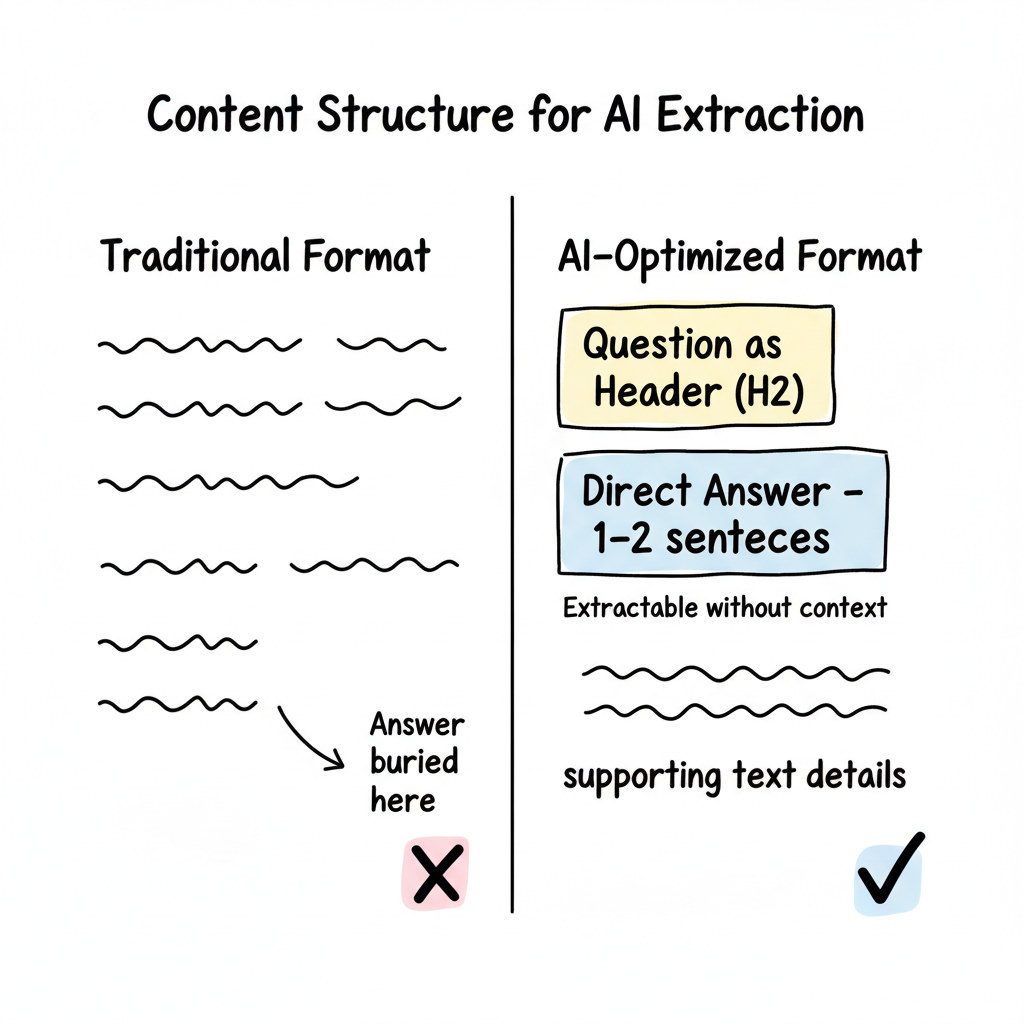
AI Overviews frequently answer questions. Structure content around the actual questions users ask:
Each major section should contain a standalone answer that AI systems can extract without surrounding context:
Structure pattern:
## [Question as Header]
[1-2 sentence direct answer]

[Supporting paragraphs with detail]
This format lets AI systems pull the direct answer while giving human readers the full context. When implementing generative-ai-search-engine-optimization strategies, this extractable format becomes critical.
Structured formats extract cleanly. When presenting:
AI systems parse these formats more reliably than running text.
Site structure influences crawling and topic understanding. Create clear hierarchies:
Schema markup explicitly tells AI systems what your content means.
FAQPage Schema Essential for Q&A content. Marks questions and answers explicitly for AI extraction.
HowTo Schema For instructional content. Structures steps, tools, and materials in machine-readable format.
Article Schema Identifies author, publication date, and content type. Helps AI systems understand content freshness and attribution.
Organization Schema Establishes entity identity. Links your content to your brand entity for proper attribution.
Research indicates sites with comprehensive schema implementation see higher AI Overview citation rates. Schema doesn't guarantee citations, but it removes friction from the selection process by making content meaning explicit.
You can't optimize what you can't measure. Track your AI Overview performance systematically.
Search Console doesn't yet provide AI Overview-specific metrics, but you can infer performance:
Understanding ai-overview-ctr-data helps you interpret these patterns accurately.
Several tools now track AI Overview appearances:
For businesses evaluating professional help, understanding aeo-services-vs-seo-services differences helps you choose the right partner.
For high-priority queries, manually verify AI Overview presence:
Traditional CTR metrics don't capture AI Overview value. Track:
Implement comprehensive aeo-optimization-metrics to measure your true AI Overview performance.
B2B Technology Publisher A B2B technology site restructured content around question-based headers and added FAQPage schema across their knowledge base. Within 4 months, AI Overview citations increased 340% for their target queries. The key change: leading each section with direct, extractable answers rather than context-setting introductions.
E-commerce Product Guides An e-commerce site created comprehensive buying guides with comparison tables and structured product specifications. Despite lower domain authority than competitors, their structured content earned citations for product comparison queries—demonstrating that content structure can overcome authority gaps.
Healthcare Information Site A healthcare publisher focused on E-E-A-T signals: adding physician author credentials, linking to primary research, and updating content quarterly. Their citation rate for medical queries increased 180% compared to competitors with higher domain authority but less demonstrated expertise.
Local Service Business A regional service business optimized their Google Business Profile and created location-specific FAQ content. They now appear in AI Overviews for "how to" queries in their service area, despite competing against national brands with vastly larger SEO footprints.
Getting featured in AI Overviews requires a different mindset than traditional SEO. The focus shifts from ranking pages to making content extractable, authoritative, and directly useful.
Start with content quality: comprehensive coverage, authoritative tone, supported claims. Layer on technical requirements: proper schema, clean HTML structure, fast loading. Build domain authority through E-E-A-T signals and quality backlinks.
Most importantly, format for extraction. Every section should contain a standalone answer that AI systems can cite without context. Headers should match how users phrase questions. Supporting detail should elaborate without burying the core answer.
The sites winning AI Overview citations in 2026 aren't necessarily the highest-ranking domains. They're the sites that understand how AI systems select sources—and optimize specifically for that selection process.
Your AI Overview strategy starts with a single question: can an AI system extract a useful answer from your content without human interpretation? If the answer isn't clearly yes, that's where optimization begins.
The opportunity window remains open. While competitors focus on traditional ranking factors, the businesses investing in AI Overview optimization today will capture disproportionate visibility as AI-generated answers become the default search experience. The tactics outlined here provide the roadmap—execution determines results.
By submitting this form, you agree to our Privacy Policy and Terms & Conditions.