February 19, 2026


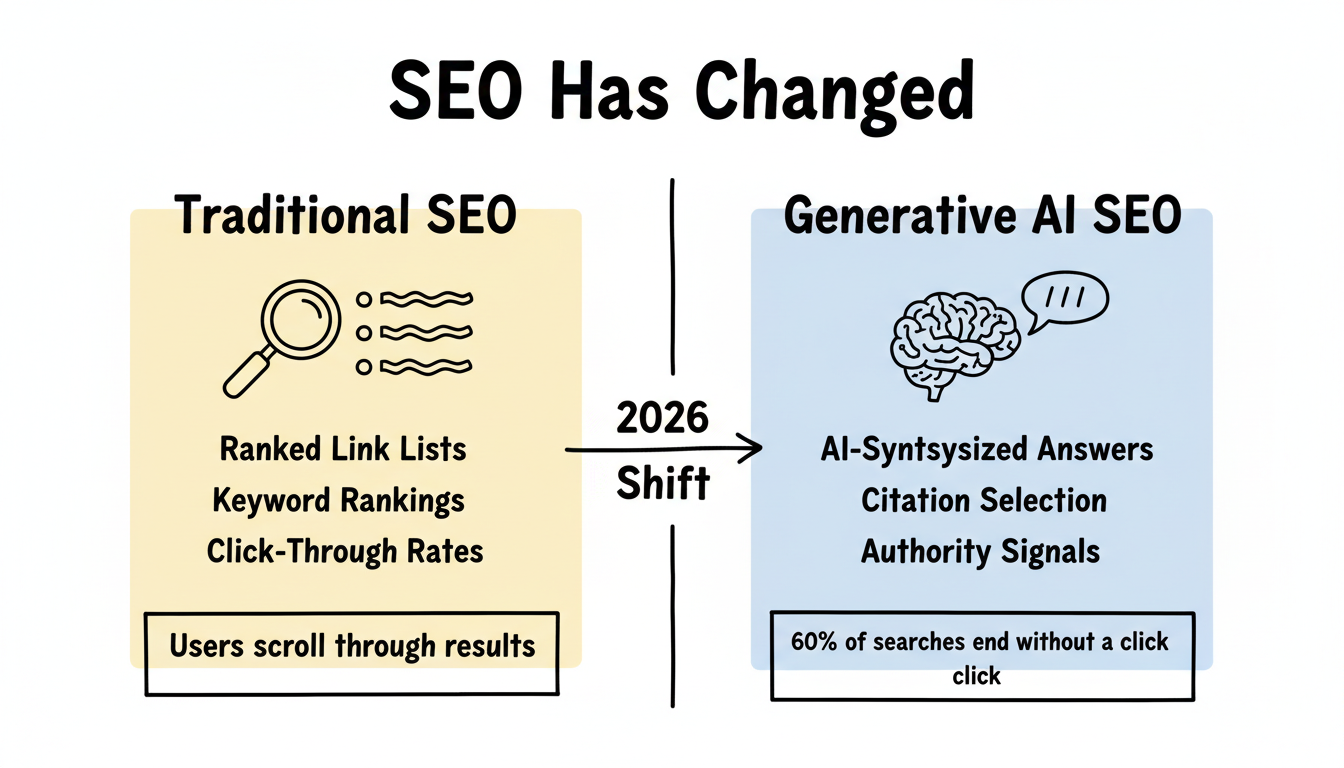
Generative AI search engine optimization represents the evolution of SEO for an era where AI systems actively generate answers rather than simply returning lists of links. In 2026, search has fundamentally changed. Users interact with AI Overviews, chatbots like ChatGPT and Perplexity, voice assistants, and multimodal search interfaces. These systems don't just find relevant pages—they synthesize information and cite sources within generated responses.
This transformation requires new optimization approaches. Traditional SEO focused on ranking pages in search results. Generative AI SEO focuses on making content citation-worthy for AI systems that generate responses. The skills overlap but the execution differs.
Understanding where generative AI appears in search helps prioritize optimization efforts.
Google's AI Overviews appear at the top of search results for many queries, providing synthesized answers before traditional organic listings. Interest in AI Overviews has increased dramatically, and these features now influence click behavior significantly—nearly 60% of Google searches end without a click to external websites.
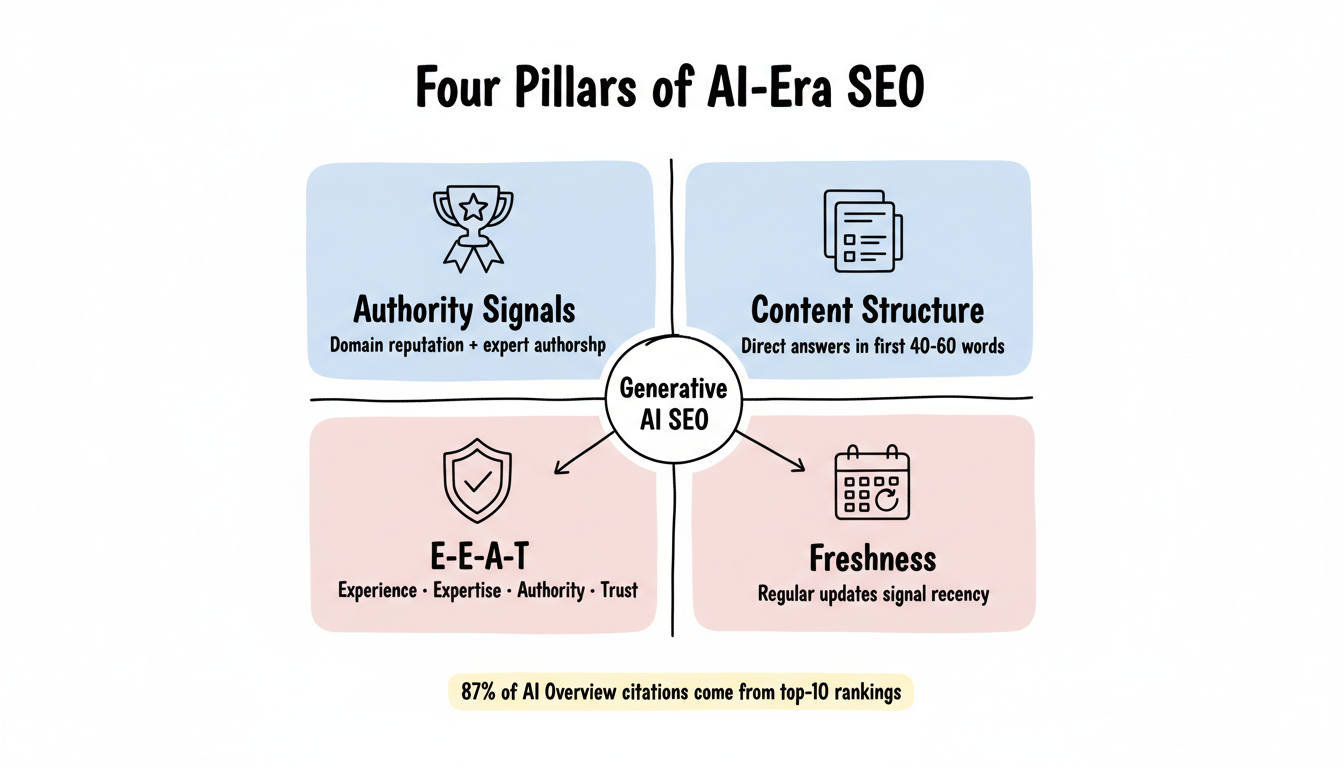
Research shows that 87% of AI Overview citations come from content ranking in positions 1-10. This correlation means traditional SEO remains foundational, but optimization for AI extraction has become an additional requirement for maximum visibility. Understanding Google AI Overview mobile vs desktop differences helps ensure your content performs well across all devices.
ChatGPT has over 400 million weekly active users who use it as a primary research tool. Perplexity positions itself as an answer engine with transparent source attribution. Claude, Gemini, and other platforms serve growing user bases seeking AI-generated answers to their questions. The distinctions between SearchGPT vs ChatGPT Search reveal how different platforms prioritize and cite sources.
These platforms cite sources differently than traditional search. They don't rank pages—they select which content to quote and attribute when generating responses. Citation decisions depend on perceived authority, content structure, and information quality rather than traditional ranking factors.
Voice search continues growing through smart speakers and mobile assistants. These interfaces provide single answers rather than result lists, making selection as the chosen answer critical for visibility.
Multimodal search combining text, images, and video has expanded dramatically. AI systems can now process video content directly—YouTube citations in AI Overviews increased 121% in recent periods. This signals the importance of diversified content formats in generative AI SEO strategies.
Several principles guide effective optimization for AI-powered search.
AI systems prioritize authoritative sources when selecting content to cite. They evaluate authority through multiple signals: domain reputation, backlink profiles, expert authorship, consistent expertise across content, and cross-platform mentions.
Building authority requires sustained effort:
AI systems extract information from content in chunks. How you structure content determines how cleanly it extracts and how likely it is to be cited.
Effective structural elements include:
Content that extracts cleanly into quotable segments earns more citations than dense, unstructured prose regardless of quality. Examining AI Overview case studies demonstrates how proper structure directly impacts citation frequency.
Experience, Expertise, Authoritativeness, and Trustworthiness have become the most important factors in AI citation selection. AI systems prioritize sources demonstrating genuine expertise over content farms optimizing for volume.
This means:
AI platforms increasingly favor recent information. Perplexity has no fixed knowledge cutoff and actively prefers updated sources. ChatGPT browses the web in real-time. Google AI Overviews prefer current sources when generating responses.
Content maintenance has become an operational requirement. Regularly update statistics, add recent examples, and incorporate new developments into existing content. Display update timestamps prominently to signal freshness.
Put these principles into practice through systematic optimization efforts.
Before optimizing, understand your current state. Search priority queries across ChatGPT, Perplexity, and Google AI Overviews. Document where your content appears, where competitors appear, and where you're absent.
This audit reveals:
Schema markup translates content into structured code that AI systems process directly. Priority implementations include:
Article schema for blog posts and informational content—helps AI systems understand content type and context.
FAQ schema for question-answer pairs—formats content for direct extraction into AI responses.
Organization schema to clarify brand identity and attributes—helps AI systems understand your entity. Implementing organization schema knowledge graph markup ensures AI platforms correctly understand your brand relationships and authority signals.
Person schema to build author recognition—connects content to expert authors.
HowTo schema for process and instructional content—structures step-by-step information for extraction.
Validate all schema implementation using testing tools and keep schema current when content changes.
Restructure existing content for AI extraction:
Add clear headings that function as topic signals. Convert vague headers like "More Information" to specific headers like "How Pricing Works" or "Common Implementation Challenges."
Lead with answers. Rewrite sections to state conclusions first, then provide supporting detail. AI systems often extract opening statements as citations.
Break up long paragraphs. Divide paragraphs containing multiple ideas into focused segments of 40-80 words each.
Add FAQ sections. Compile common questions and direct answers at the end of relevant pages.
Update statistics and examples. Replace dated references with current information.
Develop new content designed for AI citation:
Conduct original research. Surveys, experiments, data analysis, and proprietary metrics provide information AI systems cannot find elsewhere.
Share specific results. Include quantified outcomes—"campaigns improved conversion rates by 34%" cites better than vague claims of improvement.
Provide expert perspectives. Include attributable quotes from named experts with relevant credentials.
Cover topics comprehensively. AI systems prefer sources demonstrating depth over surface-level coverage that barely addresses subjects.
Technical factors affect AI accessibility:
Verify crawler access. Check robots.txt to ensure you're not blocking GPTBot (OpenAI), ClaudeBot (Anthropic), PerplexityBot, or other AI crawlers. Blocking these eliminates visibility opportunities.
Enable server-side rendering. AI crawlers typically don't execute JavaScript like browsers. Ensure content is available in plain HTML.
Optimize page speed. Address Core Web Vitals issues that slow crawling and affect user experience signals.
Structure URLs semantically. Clear URL structures help AI systems understand content hierarchy and relationships.
Traditional SEO metrics don't fully capture generative AI visibility. Implement AI-specific measurement:
Citation frequency. Track how often your content appears in AI-generated responses across platforms.
Citation context. Evaluate whether you're cited as a primary authority or mentioned briefly among many sources.
Platform coverage. Identify which AI platforms cite your content and where gaps exist.
Query coverage. Document which queries trigger your citations and where you're absent despite relevance.
Emerging tools from providers like Semrush, Ahrefs, and specialized platforms offer automated citation tracking. Manual audits remain valuable for understanding citation context and quality.
Generative AI SEO doesn't replace traditional SEO—it extends it. The most effective strategies integrate both approaches:
Traditional SEO provides the authority foundation that AI systems recognize. Sites with strong organic rankings have dramatically higher chances of being cited.
Generative AI SEO adds optimization for extraction, citation-worthiness, and AI platform-specific requirements.
Organizations implementing both approaches see significantly better results than those pursuing either in isolation. The 87% correlation between top-10 rankings and AI citations demonstrates that traditional SEO success enables generative AI visibility.
As one industry report noted, 63% of marketers now prioritize generative search optimization in their content strategies. This isn't replacing traditional SEO—it's extending it for the AI era.
The terms are often used interchangeably. Both refer to optimizing content for visibility in AI-generated responses. GEO (Generative Engine Optimization) is the more common industry term, while "generative AI SEO" describes the same discipline using more descriptive language.
Prioritize both together. Traditional SEO builds the authority foundation that enables AI citations. The 87% correlation between top-10 rankings and AI Overview citations demonstrates that traditional success supports generative visibility. Implement both simultaneously rather than choosing between them.
Structural improvements and schema implementation can affect citations within weeks. Building substantial authority and consistent citation patterns typically requires 3-6 months of sustained effort. Continuous optimization and content maintenance provide ongoing improvements.
By submitting this form, you agree to our Privacy Policy and Terms & Conditions.