February 19, 2026


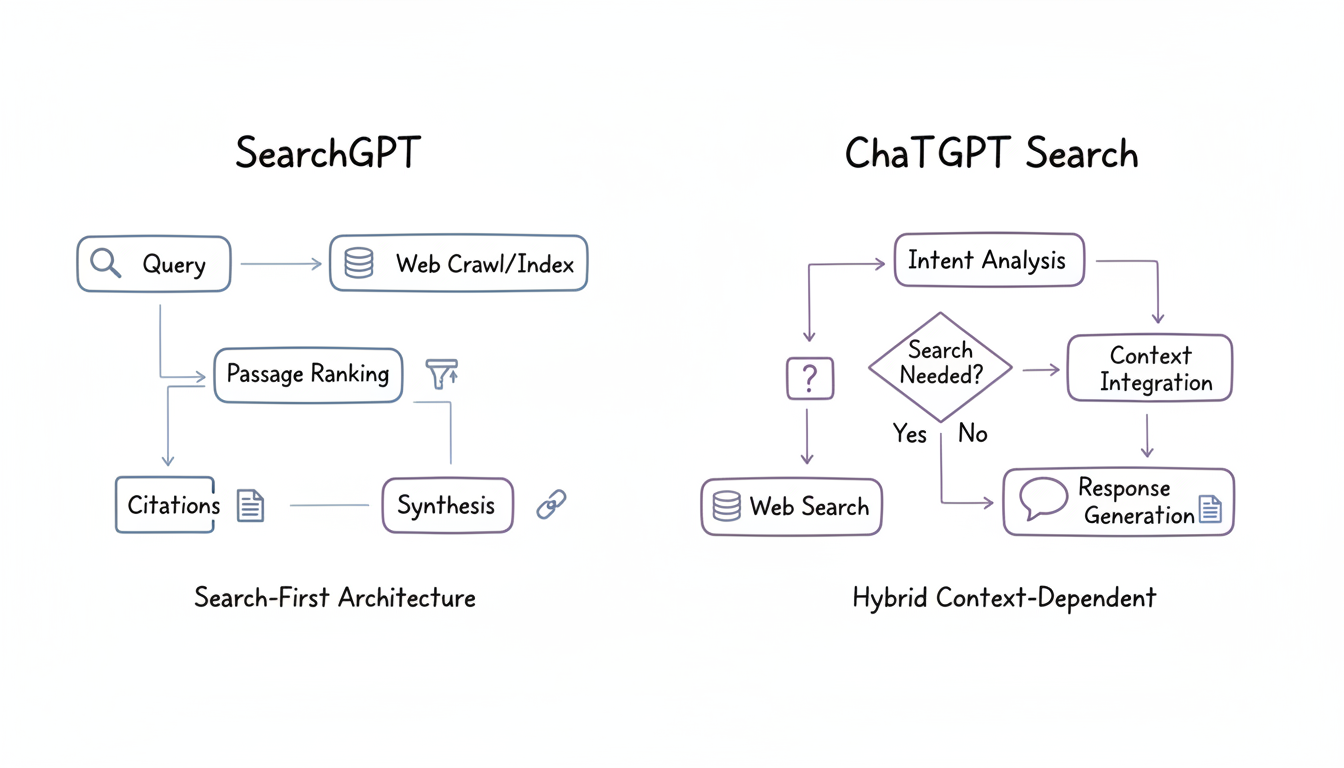
The terms "SearchGPT" and "ChatGPT Search" often get used interchangeably, but they represent related yet distinct capabilities within OpenAI's ecosystem. Understanding these technical differences matters for content optimization—each system retrieves, processes, and cites information differently.
This guide breaks down how SearchGPT and ChatGPT Search actually work, their real-time data access differences, citation mechanisms, and what these distinctions mean for your AI search optimization strategy in 2026.
SearchGPT is OpenAI's AI-powered search engine that delivers conversational responses based on real-time information from across the web. Think of it as a direct competitor to Google—an alternative search interface that uses AI to synthesize answers rather than return a list of links.
Real-time web retrieval: SearchGPT actively searches the web for every query, pulling current information from live sources. This means results reflect the latest available data, not just training data.
Source citations: SearchGPT explicitly cites sources in its responses. When it references information, users see numbered citations linking to the original web pages.
Conversational interface: Rather than ten blue links, SearchGPT delivers synthesized answers in natural language, with sources provided for verification.
Search-first architecture: SearchGPT is designed as a search tool. Its primary function is finding and synthesizing current web information.
ChatGPT Search is the web browsing capability built into ChatGPT—the conversational AI assistant. When ChatGPT needs current information to answer a question, it can search the web and incorporate findings into its response.
Hybrid approach: ChatGPT primarily operates from its training data, using web search when queries require current information. According to research, SearchGPT (real-time web search) is used in approximately 46% of ChatGPT interactions.
Conversational context: ChatGPT Search operates within ongoing conversations. It can reference earlier context, remember preferences (when memory is enabled), and maintain dialogue continuity.
Tool among tools: Web search is one of many ChatGPT capabilities alongside code execution, image generation, file analysis, and more. It's a feature, not the core function.
Model-driven decisions: ChatGPT decides when to search based on the query. Questions about current events trigger searches; questions about concepts may not.
The fundamental difference between these systems lies in when and how they access live web data.
SearchGPT searches the web for virtually every query. Its architecture assumes users want current information:
ChatGPT decides whether to search based on query analysis:
Query Type | Search Behavior |
Current events ("latest news on...") | Triggers web search |
Time-sensitive data ("stock price today") | Triggers web search |
Conceptual questions ("explain photosynthesis") | Uses training data |
Historical facts ("who wrote Hamlet") | Uses training data |
Ambiguous queries | May or may not search |
This hybrid approach means ChatGPT responses sometimes reflect training data (with knowledge cutoffs) rather than current information. Users can explicitly request web searches, but the default behavior varies.
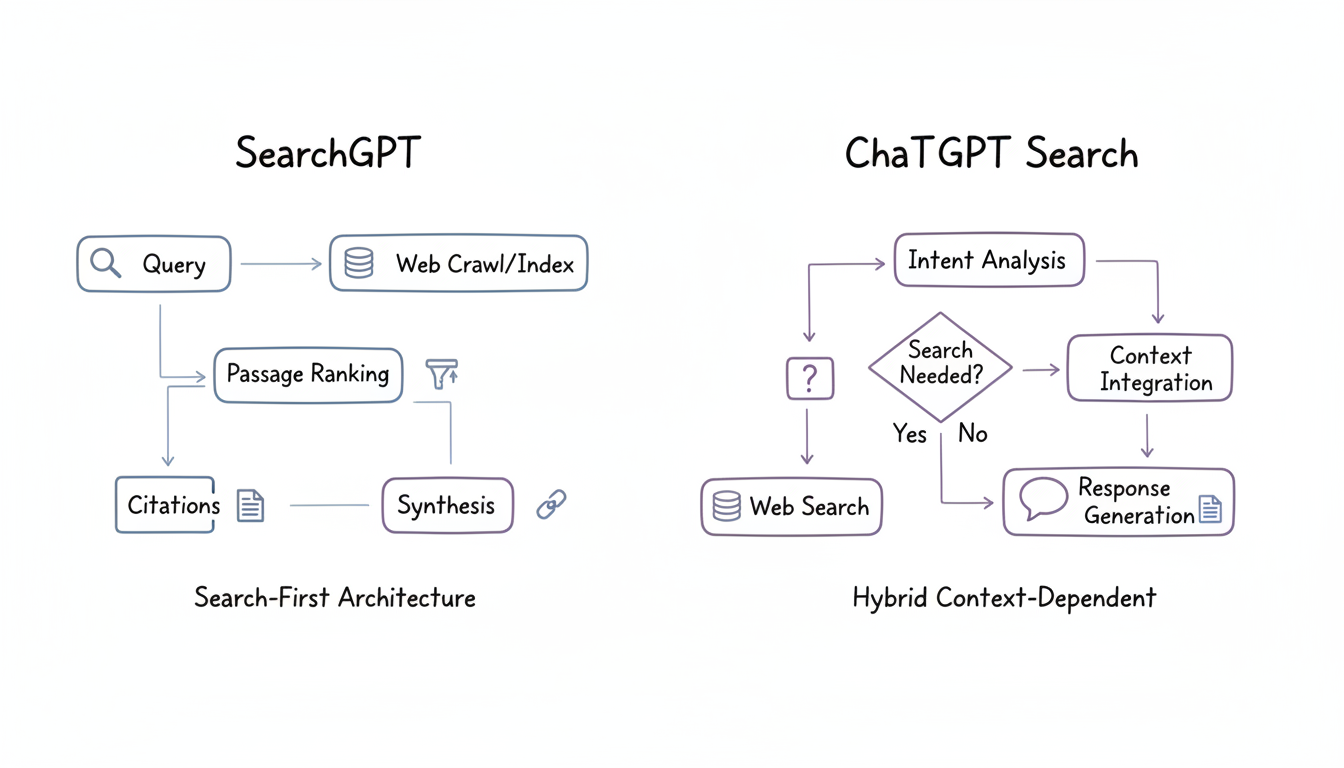
Both systems use retrieval-augmented generation (RAG), but with different implementations.
SearchGPT operates more like a traditional search engine with AI synthesis:
The focus is on finding the best current information and presenting it conversationally.
ChatGPT Search integrates browsing into the broader assistant:
The model "thinks with" web search as a tool rather than building exclusively on it.
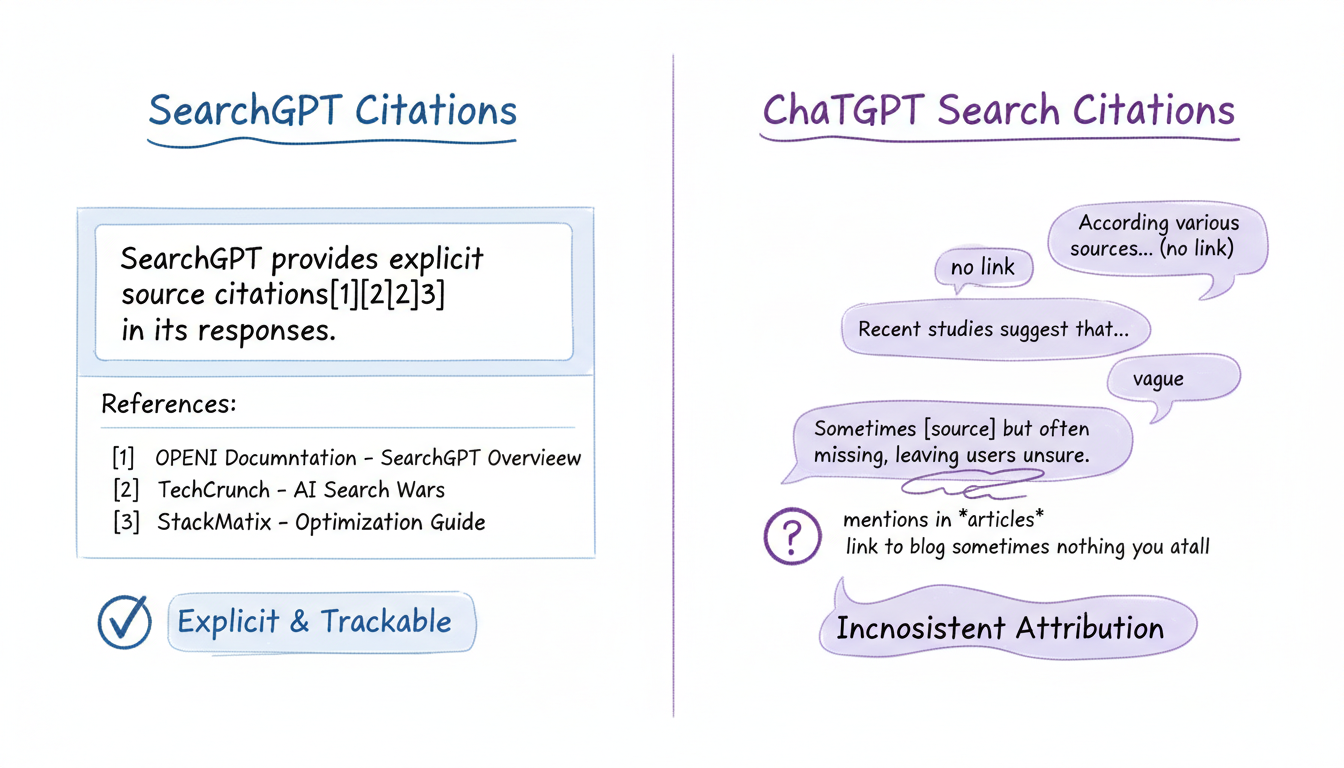
How each system attributes information differs in important ways for content creators.
SearchGPT provides explicit source citations:
This transparency makes SearchGPT visibility trackable—you can see when your content gets cited.
ChatGPT's citation behavior is less consistent:
This inconsistency makes ChatGPT visibility harder to track. Your content may inform responses without explicit citation.
These technical differences create distinct optimization strategies that align with broader AI overview Google SEO technical best practices.
Because SearchGPT actively retrieves web content for every query:
Focus on crawlability: Ensure content is accessible to web crawlers Prioritize freshness: Keep content updated—SearchGPT pulls real-time data Structure for extraction: Use clear headings and extractable passages Build domain authority: SearchGPT respects traditional authority signals Target citation-worthy content: Create fact-dense, verifiable information
SearchGPT optimization resembles traditional SEO with added emphasis on passage-level optimization.
Because ChatGPT uses training data plus selective web search:
Build training data presence: Content published before training cutoffs influences responses even without live search Create citable patterns: Repeated, consistent messaging across web properties builds brand associations Answer conceptual questions: Content that explains concepts may be referenced from training data Target explicit search triggers: Create content for queries that definitely trigger web searches (current events, recent data)
ChatGPT optimization combines traditional authority building with content designed for both training and retrieval. Organizations should also establish clear AI search KPI goal setting frameworks to measure visibility across these platforms.
Understanding when users turn to SearchGPT vs ChatGPT helps prioritize optimization efforts.
Marketers developing platform-specific content strategies should account for these distinct use cases when planning content across different AI search platforms.
No. SearchGPT is a search engine feature while ChatGPT is a conversational AI assistant. ChatGPT can use SearchGPT/web search as one of its capabilities, but they serve different primary functions.
No. ChatGPT searches the web when queries require current information. For conceptual or historical questions, it often responds from training data without searching.
Both matter. SearchGPT offers more trackable citations, while ChatGPT has significantly more users (800M+ weekly active users). Organizations should consider how to choose AI SEO agency partners who can optimize for both platforms to maximize AI search visibility.
It's difficult. Unlike SearchGPT's explicit citations, ChatGPT doesn't always attribute sources. Monitoring requires manual testing or specialized tools.
Focus on foundational best practices: clear structure, factual accuracy, regular updates, and domain authority. These principles improve visibility across both systems.
By submitting this form, you agree to our Privacy Policy and Terms & Conditions.