February 19, 2026


Technical SEO has evolved from a ranking factor to an absolute prerequisite for AI visibility. In 2026, Google's AI Overviews rely on structured data, site performance, and technical signals to understand, trust, and cite content. Without solid technical foundations, even excellent content remains invisible to AI systems.
This guide covers the essential technical requirements for AI Overview optimization.
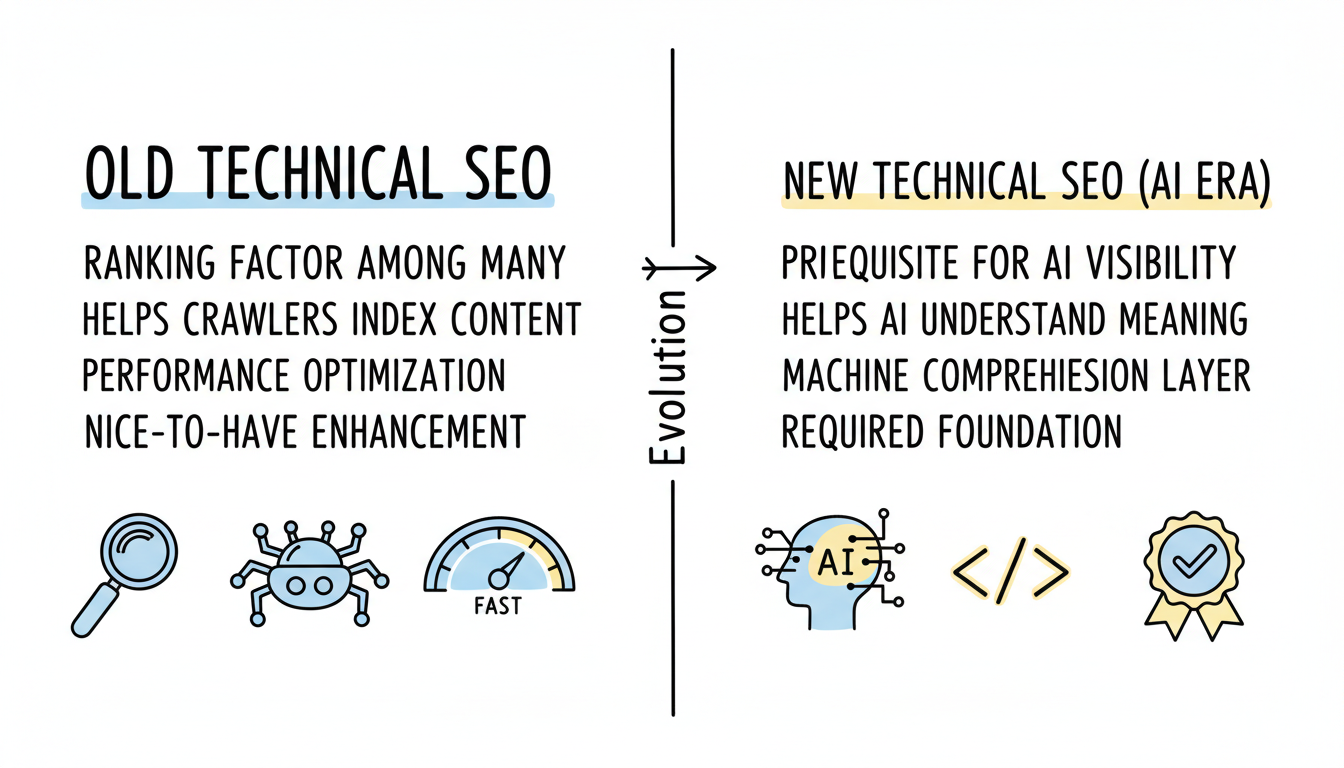
The relationship between technical SEO and AI visibility has fundamentally changed:
Old Technical SEO | New Technical SEO |
Ranking factor among many | Prerequisite for AI visibility |
Helps crawlers index content | Helps AI understand meaning |
Performance optimization | Machine comprehension layer |
Nice-to-have enhancement | Required foundation |
Google now pulls approximately 80% of AI Overview sources from the top 10 organic results, with citation preference for sites demonstrating technical excellence. Technical SEO isn't just about ranking—it's about being understood, as detailed in our guide on how Google selects AI Overview sources.
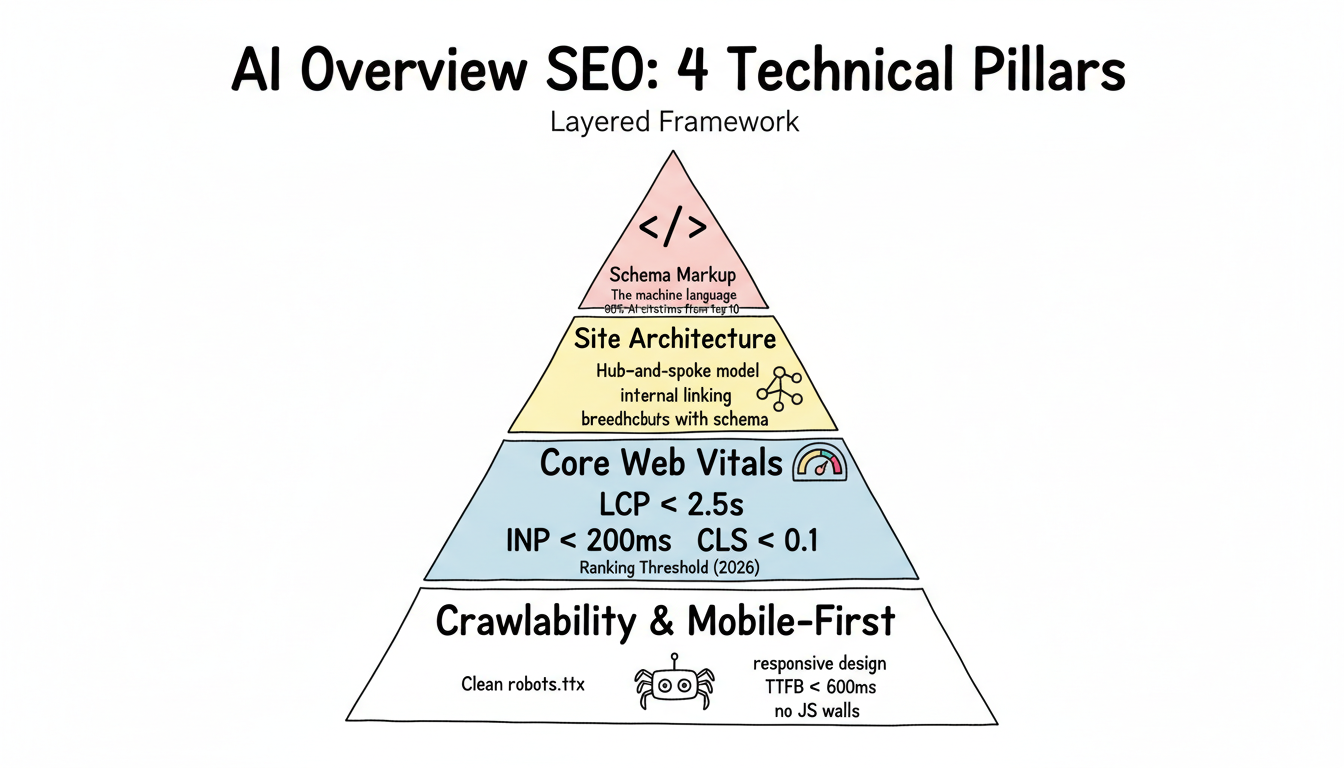
Schema markup has become the universal language between human content and AI understanding. In 2026, it's not optional—it's foundational.
Priority schema types for AI Overviews:
Schema Type | Purpose | AI Impact |
Organization | Establishes entity identity | Brand recognition in AI responses |
Person | Author credentials and expertise | E-E-A-T signal for citations |
Article | Content type and metadata | Proper content categorization |
FAQ | Question-answer pairs | Direct extraction for AI answers |
HowTo | Step-by-step processes | Process-based query matching |
Product | Product details and attributes | Commercial query inclusion |
LocalBusiness | Location and service area | Local AI visibility |
Implementation example (Organization schema):
{
  "@context": "https://schema.org",
  "@type": "Organization",
  "name": "Your Company",
  "url": "https://yoursite.com",
  "sameAs": [
    "https://linkedin.com/company/yourcompany",
    "https://twitter.com/yourcompany"
  ],
  "description": "Brief company description with key expertise",
  "contactPoint": {
    "@type": "ContactPoint",
    "telephone": "+1-xxx-xxx-xxxx",
    "contactType": "customer service"
  }
}
Key implementation principles:
Google's December 2025 Core Update elevated Core Web Vitals from ranking factor to ranking threshold. Sites failing these metrics are filtered before AI citation consideration.
Current Core Web Vitals requirements (2026):
Metric | Target | Measurement |
LCP (Largest Contentful Paint) | Under 2.5 seconds | Loading speed |
INP (Interaction to Next Paint) | Under 200 milliseconds | Interactivity |
CLS (Cumulative Layout Shift) | Under 0.1 | Visual stability |
INP has become critical. Sites that load quickly but feel "laggy" when users interact lose ranking potential. Google now prioritizes interactivity over pure loading speed.
Optimization priorities:
AI systems crawl and understand sites through their architecture. Clear structure improves both indexation and comprehension.
Architecture requirements:
Element | Requirement | AI Benefit |
URL structure | Descriptive, hierarchical | Context understanding |
Internal linking | Logical content connections | Entity relationship mapping |
Navigation | Clear hierarchy | Topic authority signals |
Sitemaps | Complete and current | Crawl efficiency |
Breadcrumbs | Implemented with schema | Category understanding |
Hub-and-spoke model: Create hub pages that link to all related content. This helps AI systems understand topic relationships and establish your authority in content clusters.
With mobile-first indexing standard, mobile experience directly impacts AI visibility.
Mobile technical checklist:
AI systems can only cite content they can access and understand.
Crawlability essentials:
New for 2026: Consider implementing llms.txt files and MCP server protocols to guide AI crawlers to important content efficiently. These emerging standards help AI systems understand site structure and content priorities.
Task | Tool | Action |
Core Web Vitals assessment | PageSpeed Insights | Identify failing pages |
Schema audit | Rich Results Test | Find markup gaps |
Crawl analysis | Search Console | Review coverage issues |
Mobile testing | Mobile-Friendly Test | Verify responsive design |
Site speed testing | GTmetrix, WebPageTest | Baseline performance |
Priority order:
Validation process:
Quick wins:
Advanced optimization:
Content structure:
Technical SEO requires ongoing attention. Establish these monitoring practices:
Weekly checks:
Monthly audits:
AI-specific monitoring:
For comprehensive tracking of your AEO optimization efforts, consider implementing dedicated AEO analytics setup to measure both technical performance and AI visibility metrics across platforms.
Mistake | Problem | Solution |
Schema without validation | Errors prevent parsing | Always validate before deployment |
Orphaned pages | No internal links | Create clear navigation paths |
JavaScript-dependent content | AI may not render | Use server-side rendering |
Slow server response | Crawl budget wasted | Optimize hosting and caching |
Mobile-only issues | Mobile-first indexing suffers | Test regularly on actual devices |
Duplicate content | Confuses AI attribution | Implement proper canonicalization |
Schema markup doesn't guarantee AI Overview inclusion, but it significantly improves how AI systems understand your content. Without schema, AI must guess meaning—with schema, you provide direct answers. Most AI-cited sources have comprehensive schema implementation. This structured data approach is fundamental to what is AEO vs SEO strategy differences.
Critical. Google's 2025 updates made Core Web Vitals a ranking threshold rather than just a factor. Sites failing these metrics are filtered before AI citation consideration, regardless of content quality.
Limited success is possible through content quality alone, but technical optimization dramatically increases chances. Schema markup, in particular, has become essential for AI systems to properly understand and cite content.
Monthly audits are recommended for key metrics. Google updates its systems regularly, and new technical requirements emerge. The December 2025 update, for example, significantly elevated INP importance—sites that weren't monitoring this metric were caught off guard.
By submitting this form, you agree to our Privacy Policy and Terms & Conditions.