
February 19, 2026


The AI search landscape has fragmented into a competitive market where each platform excels at different tasks. ChatGPT commands nearly 65% of AI chatbot traffic, Google Gemini has surged to 21.5%, and Perplexity has carved out a citation-focused niche. For marketers optimizing content, understanding where and why each platform cites sources is critical for visibility strategy.
Here's how the major AI search platforms compare in 2026—and what it means for your content optimization approach.
The AI search market underwent dramatic shifts throughout 2025, reshaping the competitive landscape:
Platform | Market Share (Q4 2025) | Monthly Active Users | Key Strength |
ChatGPT | 64.5% | ~800 million WAUs | Conversational depth |
Google Gemini | 21.5% | ~520 million monthly | Ecosystem integration |
Perplexity | 2.5% | ~15 million MAUs | Source citations |
Claude | 2% | ~185 million monthly | Reasoning tasks |
Key trend: ChatGPT's share dropped from 86.7% to 64.5% in twelve months, while Gemini grew nearly 4x. This signals a market maturing beyond first-mover advantage into genuine competition.
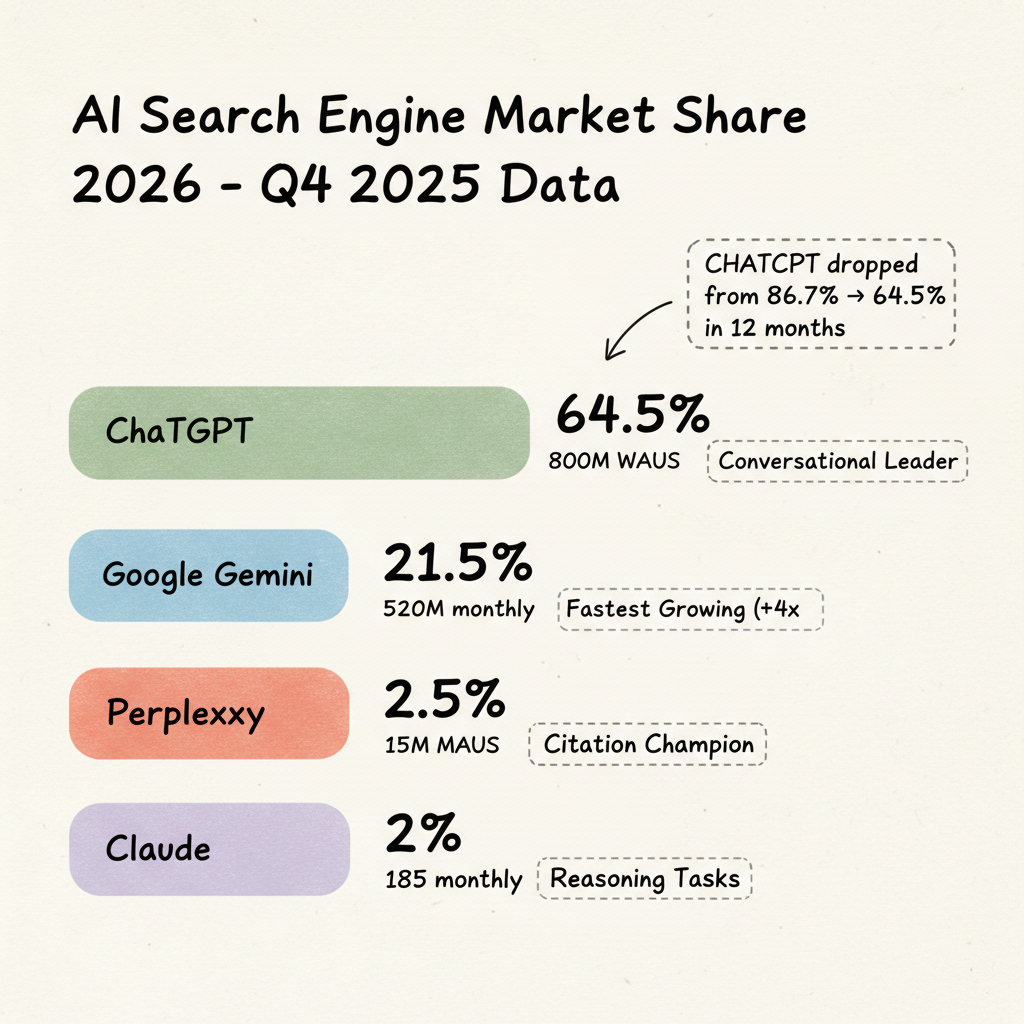
Session duration reveals how users interact differently with each platform:
Longer sessions on ChatGPT indicate deeper engagement but also suggest users may receive less direct answers, prompting follow-up questions.
ChatGPT remains the dominant AI platform, processing billions of queries weekly through conversational interaction.
Conversational depth: ChatGPT excels at multi-turn dialogues. Users can refine queries, ask follow-ups, and explore topics through natural conversation rather than reformulating searches.
Creative generation: For content creation, brainstorming, and ideation tasks, ChatGPT produces more human-like, creative outputs than research-focused competitors. This aligns with broader search engine optimization using AI trends that prioritize natural language processing.
Custom GPTs and agents: The GPT Store allows specialized applications, making ChatGPT extensible for specific workflows from marketing to coding.
Automatic web search: ChatGPT now searches the web automatically for many queries, blending conversational AI with real-time information retrieval.
Citation transparency: ChatGPT provides fewer source citations by default. Users must often request verification, making fact-checking more difficult.
Freshness lag: Despite web browsing capabilities, ChatGPT sometimes relies on training data rather than live search, potentially surfacing outdated information.
Black box responses: It's often unclear where specific information originated, challenging for users who need verifiable sources.
Google Gemini represents the fastest-growing AI platform, leveraging deep integration across Google's product suite.
Ecosystem integration: Gemini works within Gmail, Docs, Chrome, Android, and Google Search. Users access AI assistance without switching platforms.
Multimodal capabilities: Gemini processes text, images, audio, and video together, understanding rich content formats better than text-only competitors.
Real-time web access: Built on Google's search infrastructure, Gemini retrieves current information with the freshness of traditional Google search.
AI Overviews distribution: Gemini powers AI Overviews in Google Search, reaching users who never specifically choose an AI assistant.
Less conversational: Gemini feels more like enhanced search than conversation. Multi-turn dialogue is improving but trails ChatGPT.
Source opacity: AI Overviews often feel like a "black box"—users can't always identify which source contributed specific information.
Feature fragmentation: Gemini capabilities vary across products (Search vs. app vs. Workspace), creating inconsistent experiences.
Perplexity has positioned itself as the citation-first answer engine, prioritizing source transparency over conversational depth.
Source citations: Every claim links to its source directly in the response. Users can verify information and explore further without guessing origins.
Real-time accuracy: Perplexity searches the live web for every query, ensuring answers reflect current information rather than training data. This approach closely mirrors what is AEO principles that emphasize answer verification.
Research focus: Deep Research mode performs comprehensive investigations, producing detailed reports with extensive source documentation.
Multi-model access: Pro users can switch between GPT-4, Claude, and other models, selecting the best system for each task.
Market scale: With only 2.5% market share, Perplexity reaches far fewer users than ChatGPT or Google.
Less creative: Perplexity prioritizes factual accuracy over creative generation. Content creation tasks are better suited to ChatGPT.
Narrower scope: Best for research and fact-finding, less capable for coding, creative work, or complex reasoning.
Factor | ChatGPT | Google Gemini | Perplexity |
Primary output | Conversation | Search + AI summary | Cited answers |
Source transparency | Low | Medium | High |
Content freshness | Variable | High | High |
Creative capability | High | Medium | Low |
Ecosystem integration | Standalone | Deep (Google) | Standalone |
Best for research | No | Moderate | Yes |
Best for content creation | Yes | Moderate | No |
Citation format | General links | In-text references | Numbered citations |
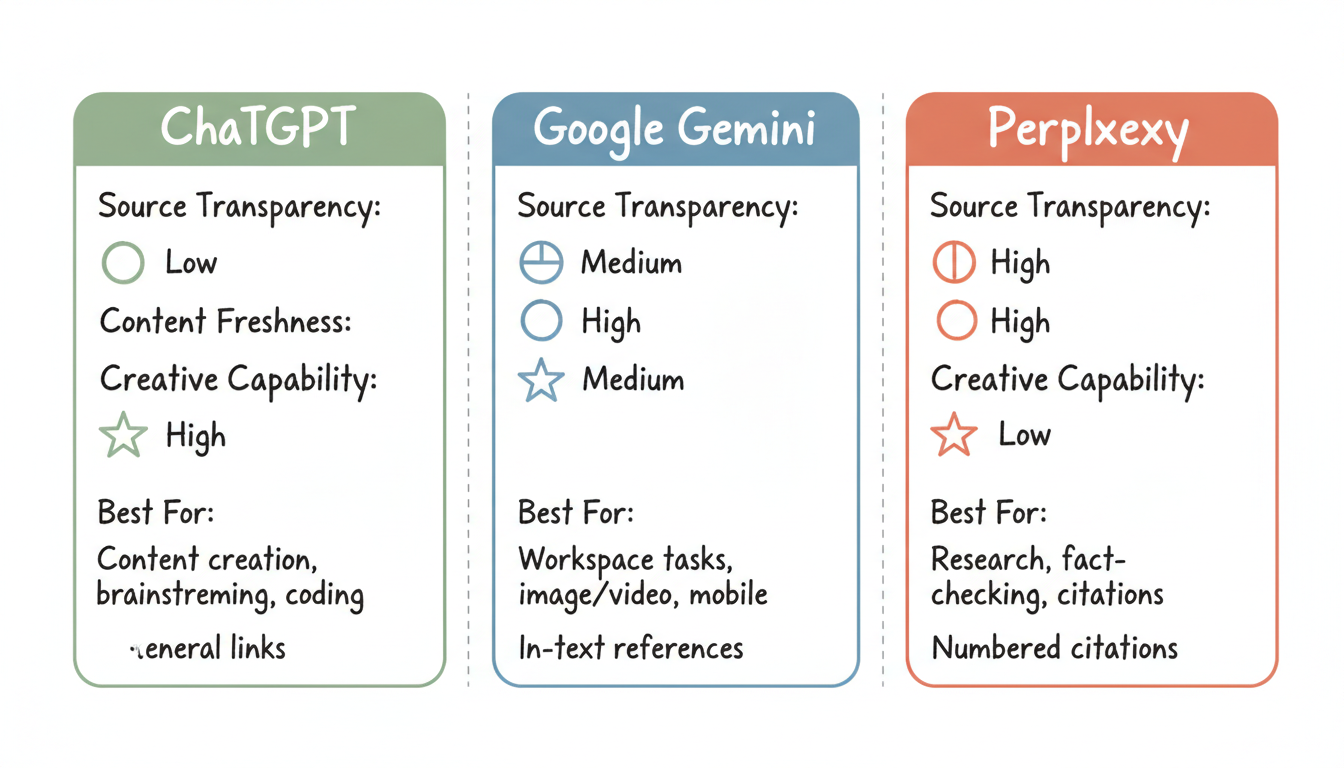
Each platform's characteristics shape optimization strategies, and understanding the differences between SEO vs GEO vs AEO is essential for comprehensive visibility.
Across all platforms, certain fundamentals apply:
For most businesses, a prioritized approach works best:
Content that performs well in traditional search typically earns AI citations across platforms. The platforms draw from similar authority signals, making good SEO the foundation for AI visibility. Companies specializing in AI SEO can help navigate these overlapping optimization requirements.
Focus on Google and ChatGPT first—they command 95%+ of combined query volume. Add platform-specific optimizations (like citation formatting for Perplexity) only after establishing fundamentals. Most content best practices work across platforms.
Early data suggests ChatGPT-referred traffic converts higher than Google traffic, potentially because users arrive with more specific intent. However, volume from Google far exceeds AI platforms, making total conversions higher from traditional search.
The market is fragmenting rather than consolidating. Experts predict ChatGPT stabilizing around 50-55%, Gemini reaching 25-30%, and specialists like Perplexity capturing 15-20% collectively. Different use cases favor different platforms.
Use specialized tools like Otterly.AI, SE Visible, or Semrush AI Toolkit that monitor citations across ChatGPT, Perplexity, and AI Overviews simultaneously. Manual monitoring through regular platform queries supplements automated tracking.
By submitting this form, you agree to our Privacy Policy and Terms & Conditions.



