February 19, 2026


Search behavior has fundamentally shifted. With over 400 million weekly ChatGPT users and AI-powered search becoming the default for many queries, a new optimization discipline has emerged: Answer Engine Optimization, or AEO.
Here's what AEO means, how it differs from traditional SEO, and why it matters for content visibility in 2026.
According to WebFX's comprehensive AEO guide, Answer Engine Optimization (AEO) is the practice of optimizing content so that AI-powered answer engines can understand, trust, and cite it in their responses.
The core principle: AEO focuses on making your content the answer that AI systems select and present to users—rather than just ranking high in traditional search results.
According to Addlly.ai's analysis of AEO, AEO prioritizes structuring your content for clarity and delivering information in formats that AI can easily parse and present to users. This approach differs significantly from traditional techniques covered in what-is-aeo-vs-seo guides, which focus primarily on search engine rankings.
According to SEO.com's comparison of AEO and SEO, the two disciplines share common goals but differ in their primary focus. SEO optimizes for search engine rankings through keywords and backlinks. AEO optimizes for AI citation through structured content and direct answers.
Key differences:
Factor | Traditional SEO | AEO |
Primary goal | Rank in search results | Get cited in AI responses |
Success metric | Position on SERP | Citation frequency |
Content focus | Keywords and backlinks | Structure and clarity |
User interaction | Click through to website | Answer delivered directly |
Optimization target | Search algorithms | Language models |
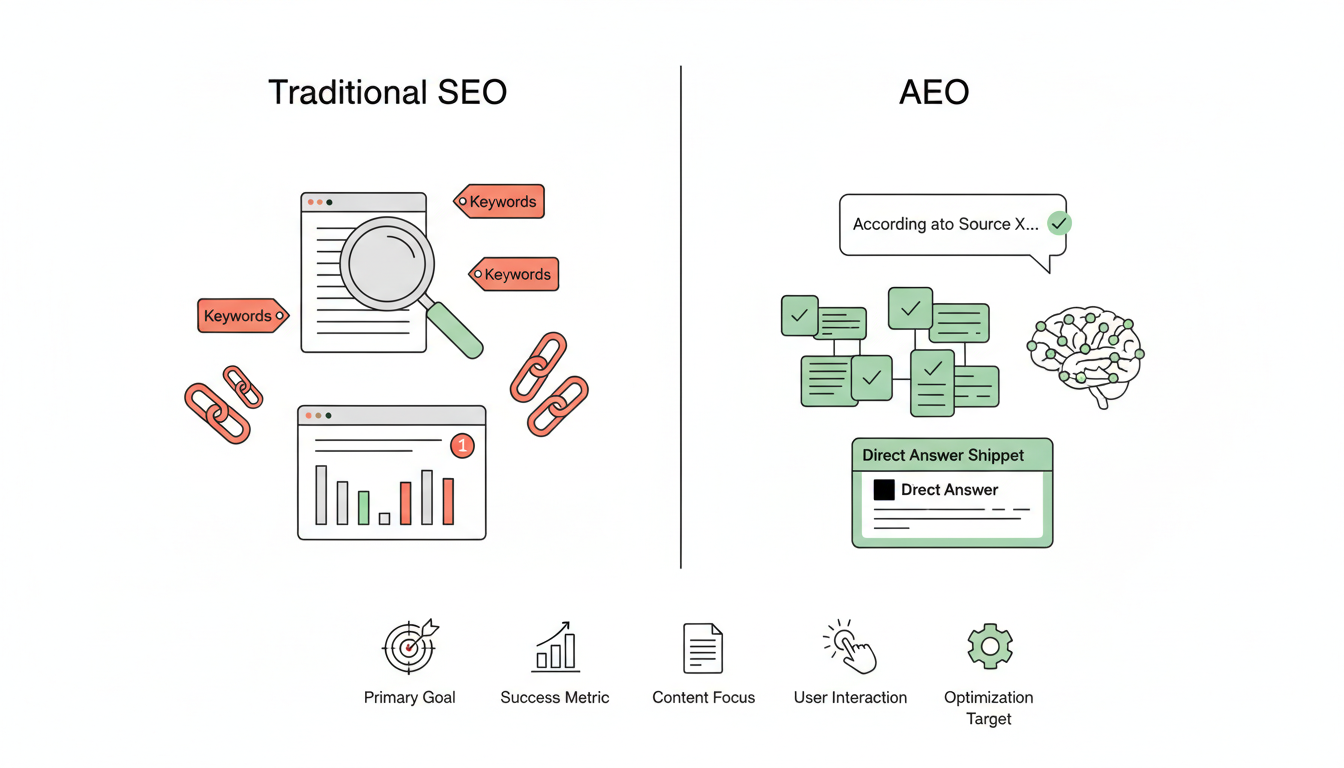
According to Brew Interactive's AEO guide, AEO isn't about replacing SEO—it's about extending your optimization strategy to include AI-powered platforms. Understanding the aeo-vs-geo-difference is also crucial for comprehensive optimization.
According to Connect Media Agency's research, the shift toward answer engines is accelerating. Over 400 million weekly ChatGPT users and 60% of searches ending without clicks demonstrate that users increasingly prefer direct answers over browsing multiple websites.
The visibility shift:
According to The Spearpoint's analysis, companies with dedicated AEO strategies capture 3.4x more traffic from AI-referred sources than those relying solely on traditional SEO.
According to SEO Optimizers' AEO methodology, effective AEO requires specific content strategies that help AI systems identify, understand, and cite your content.
Essential AEO tactics:
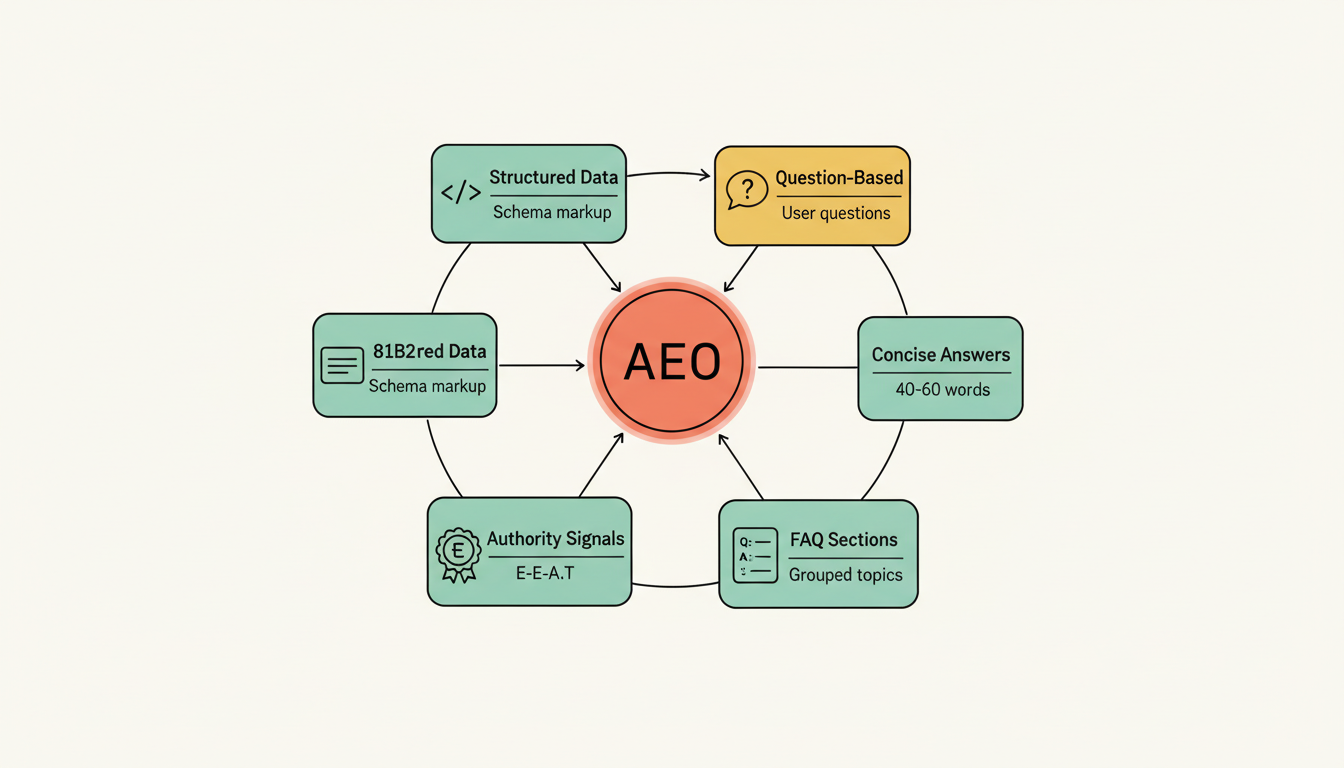
According to Connect Media Agency, implementing schema markup increases AI visibility by 2.5x compared to unstructured content. Modern ai-content-optimization-tools can help automate many of these implementation tasks.
According to Profound's AEO playbook, Experience, Expertise, Authoritativeness, and Trustworthiness (E-E-A-T) signals are critical for AI citation. Answer engines prioritize sources they can trust.
Building E-E-A-T for AEO:
AI systems evaluate trustworthiness before citing content—weak E-E-A-T signals mean fewer citations.
According to The Spearpoint's research, AEO requires different metrics than traditional SEO tracking.
AEO metrics to monitor:
According to their data, AEO-optimized pages show click-through rate improvements of 14% when content is structured for AI consumption. Implementing a comprehensive aeo-strategy framework helps track and improve these metrics systematically.
According to CLCME's AEO platform analysis, several tools have emerged specifically for AEO tracking and optimization.
Key AEO tools:
These tools help you understand where and how AI systems cite your content.
Answer Engine Optimization is essential for content visibility in 2026:
Understanding what AEO is—and implementing it alongside traditional SEO—positions your content for visibility in both AI-powered and traditional search environments.
By submitting this form, you agree to our Privacy Policy and Terms & Conditions.