
February 19, 2026


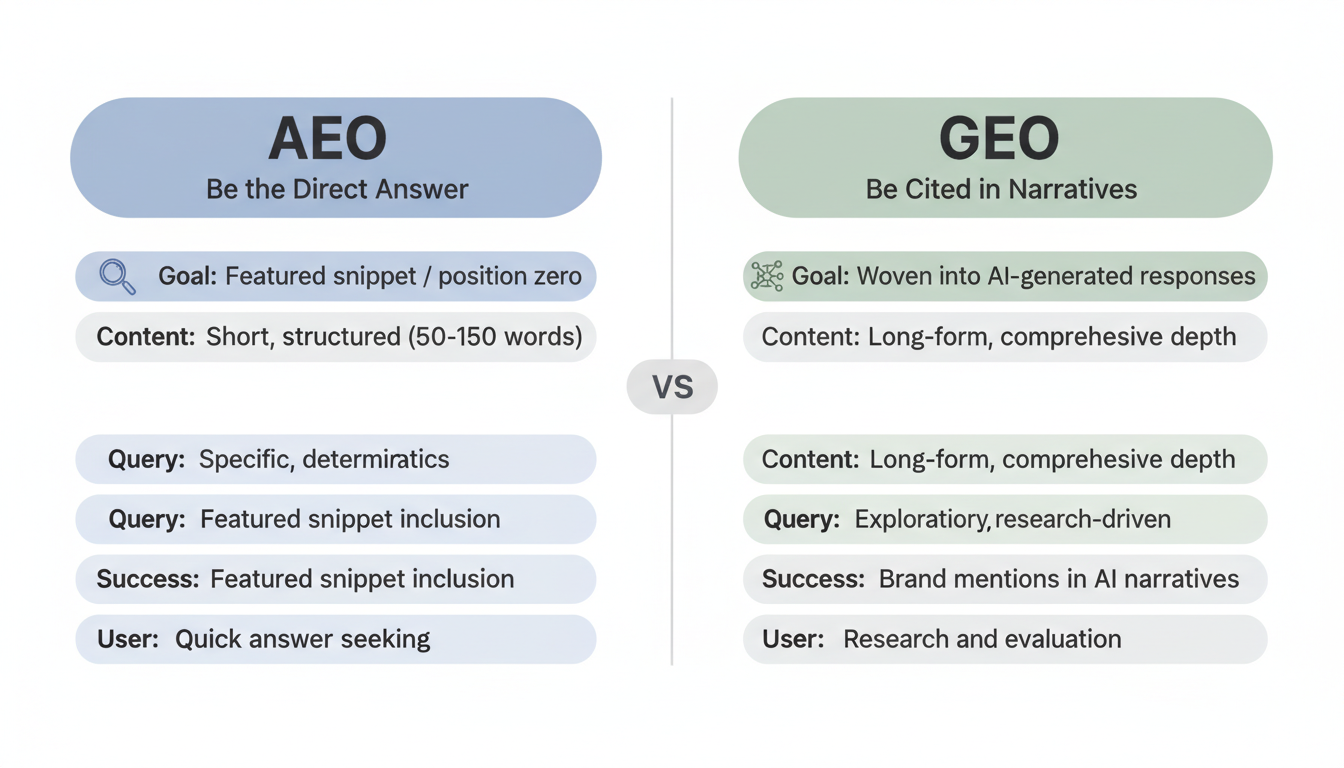
AEO gets you cited as the direct answer. GEO gets you woven into AI-generated narratives. Both matter in 2026—but they solve different problems and require different tactics.
Answer Engine Optimization (AEO) focuses on providing the single best answer AI systems extract and quote. Generative Engine Optimization (GEO) focuses on building the authority that makes AI systems include you when they synthesize comprehensive responses.
Understanding when to prioritize each—and how to make them work together—determines your AI search visibility strategy.
AEO is the practice of structuring content so AI platforms can extract and cite it as a direct answer. When someone asks a specific question, AEO-optimized content provides the quotable response.
AEO targets deterministic queries: Questions with definitive answers that AI systems resolve with a single response. "How much does X cost?" "What is the difference between Y and Z?" These queries have right answers, and AEO positions you as the source.
Key AEO characteristics:
Where AEO works best:
Companies with established AEO strategy frameworks see 27% higher conversion rates from answer engine referrals compared to traditional search traffic. The ROI comes from being the trusted answer at the exact moment users need information.
GEO is the practice of building the authority and content depth that makes generative AI systems reference your brand when constructing comprehensive responses. GEO focuses on influence during synthesis, not just citation.
GEO targets exploratory queries: Research questions, comparison requests, and strategic questions where AI systems pull from multiple sources to build answers. "What's the best approach for X?" "How do I improve Y?" These queries require synthesized insight.
Key GEO characteristics:
Where GEO works best:
GEO success means your brand appears in the narrative AI tells—even when users never click through to your site. The visibility comes from being recognized as a credible source AI systems trust.
Dimension | AEO | GEO |
Primary goal | Be the direct answer | Be cited in synthesized responses |
Content format | Short, structured answers | Long-form, comprehensive coverage |
Query type | Specific, deterministic | Exploratory, research-driven |
Success metric | Featured snippet inclusion | Brand mentions in AI narratives |
Content structure | FAQs, definitions, lists | Topic clusters, analysis, depth |
Optimization focus | Clarity and extractability | Authority and trustworthiness |
User behavior | Quick answer seeking | Research and evaluation |
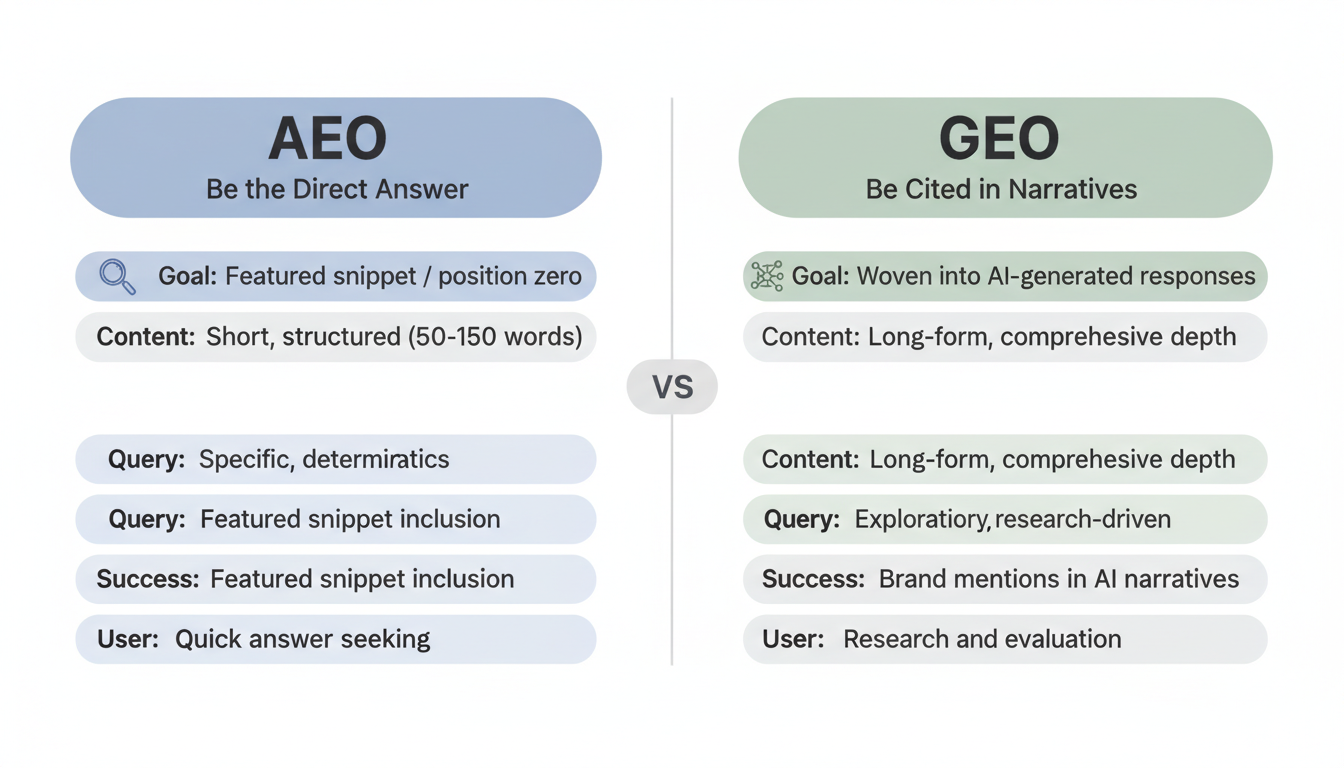
AEO aims at position zero: Being the single answer extracted and displayed.
GEO aims at answer integration: Being woven into the comprehensive response AI constructs.
This distinction matters because the same content can succeed at one and fail at the other. A concise FAQ answer that wins featured snippets may lack the depth GEO requires. A comprehensive guide that earns AI narrative inclusion may be too long for snippet extraction.
Choose AEO-first strategies when your audience asks specific questions with definitive answers.
AEO priority situations:
Industries that benefit most from AEO:
If a single question determines whether someone moves forward with your business, AEO agency services should lead your strategy.
Choose GEO-first strategies when your audience conducts research or evaluates options through AI.
GEO priority situations:
Industries that benefit most from GEO:
When decisions form through explanation and context, GEO optimization trends carry more weight.
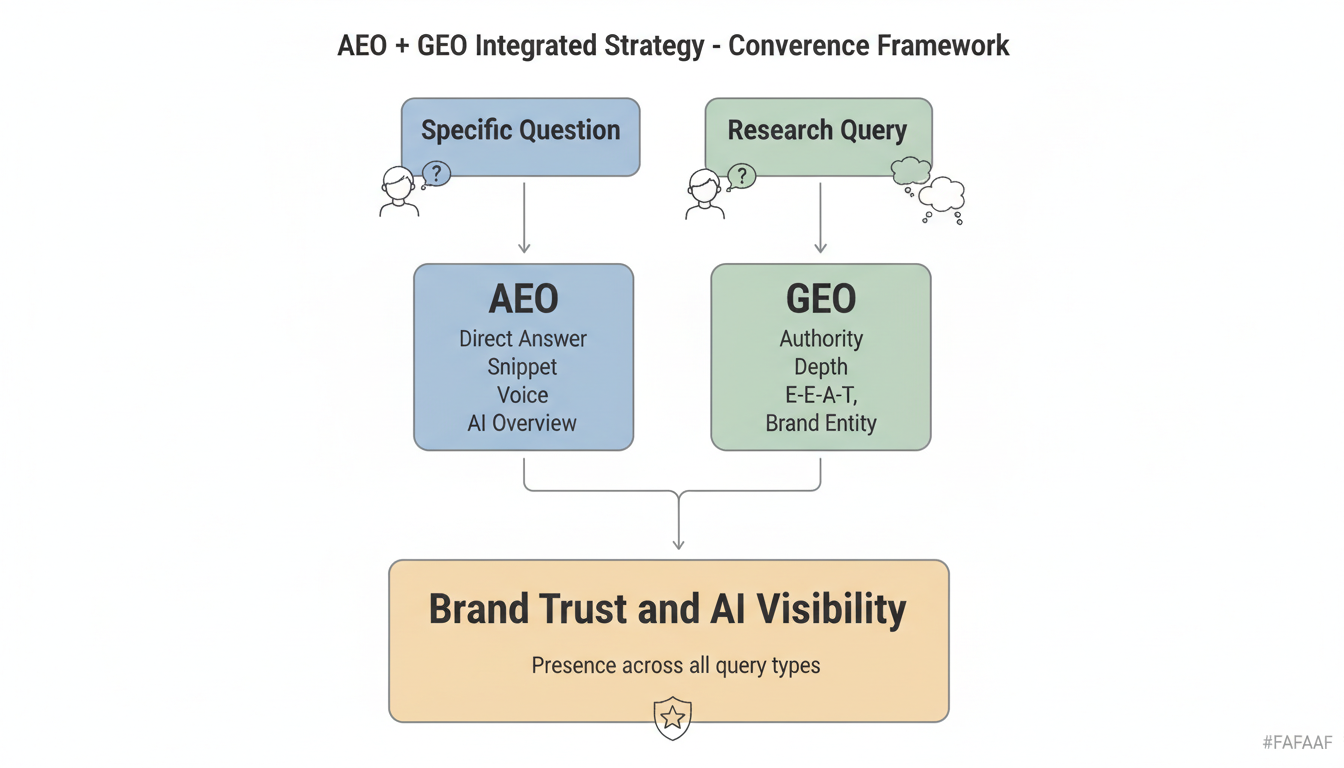
The most effective AI visibility strategies combine both approaches. AEO captures users seeking specific answers. GEO influences users during research and evaluation.
The integrated approach:
Practical implementation:
The user journey increasingly moves between quick questions and deeper exploration. Understanding SEO AEO GEO AIO relationships helps brands capture attention throughout the journey.
If you're new to AI optimization:
Weeks 1-4: AEO Foundation
Weeks 5-12: GEO Layer
If you have strong traditional SEO:
Phase 1: Assess AI Visibility
Phase 2: Expand Existing Content
Professionals exploring AEO marketing jobs should understand both optimization approaches to remain competitive in the evolving search landscape.
If you're optimizing across large content libraries:
Tiered approach:
Organizations seeking best AEO services should prioritize vendors that demonstrate expertise in both answer engine and generative engine optimization.
Different metrics matter for each approach:
AEO metrics:
GEO metrics:
Track both separately. AEO success doesn't guarantee GEO success, and vice versa. Comprehensive visibility requires monitoring across both dimensions using AI SEO implementation checklists.
They complement each other. AEO captures quick wins. GEO builds lasting influence. Ignoring either creates gaps in your AI visibility.
Long content isn't automatically GEO-optimized. Short content isn't automatically AEO-ready. Structure and authority matter more than word count. Understanding AI Overview content requirements helps avoid this trap.
Match optimization to how users actually ask questions. Specific queries need AEO treatment. Research queries need GEO depth. Analyze your target queries to prioritize correctly. Long-tail keywords for featured snippet success often reveal query intent patterns.
Most businesses benefit from both. AEO captures users with specific questions. GEO influences users during research. The optimal balance depends on your industry, audience behavior, and the types of queries you target.
Neither is universally more important. AEO matters for businesses that answer specific questions (professional services, e-commerce, SaaS support). GEO matters for businesses where expertise drives decisions (agencies, consultants, B2B services). Most need both.
Yes, with proper structure. Comprehensive content (GEO) can include structured summaries and FAQ sections (AEO). The key is creating extractable answers within authoritative depth.
AEO results can appear within weeks as AI systems extract your structured answers. GEO results build more gradually as AI systems recognize your topical authority. Both require ongoing optimization.
By submitting this form, you agree to our Privacy Policy and Terms & Conditions.



