February 19, 2026


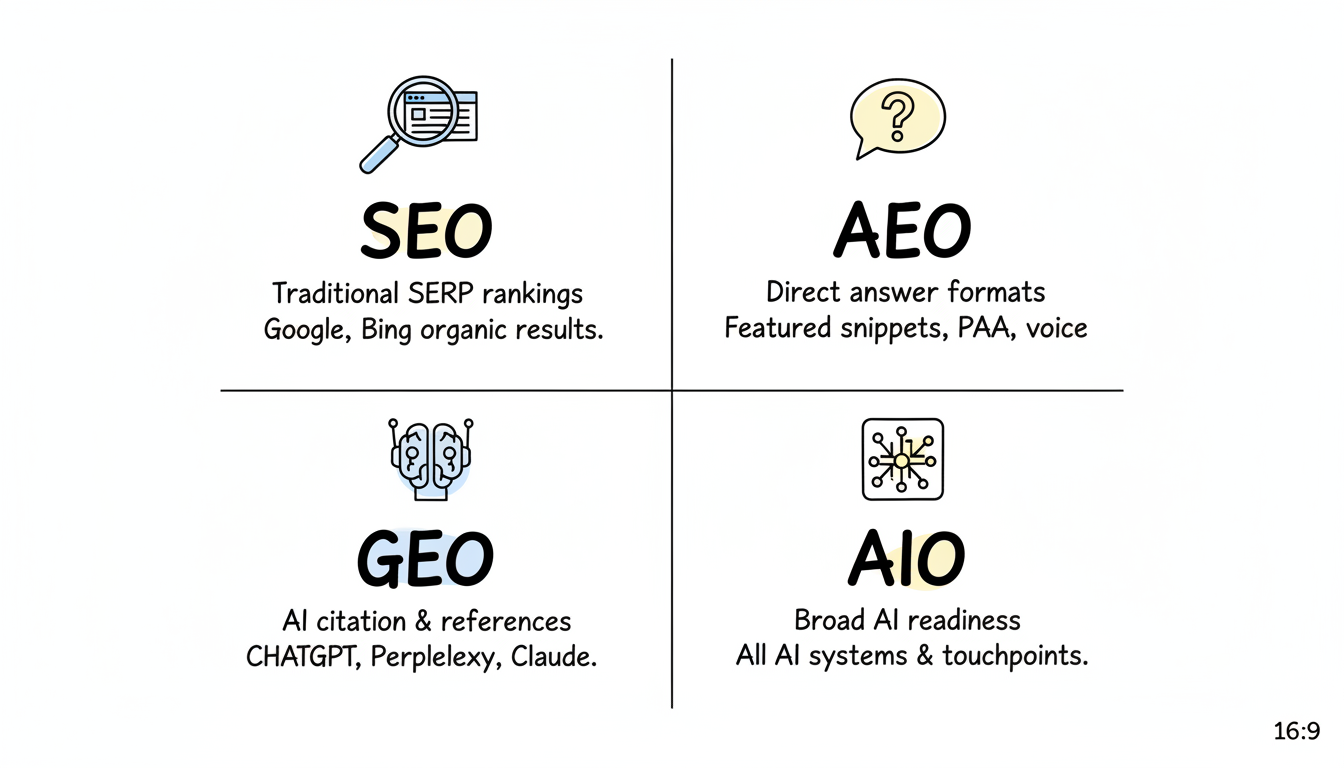
If you've followed digital marketing discussions recently, you've encountered an expanding alphabet of optimization acronyms: SEO, AEO, GEO, AIO, SXO, and more. The parade of three-letter terms can feel overwhelming—and it's reasonable to question whether these distinctions actually matter or represent marketing buzzwords repackaging familiar concepts.
The reality falls somewhere in between. While all these approaches share foundational principles of creating helpful, well-structured content, they target different systems and user behaviors that require specific optimization tactics. Understanding how SEO, AEO, GEO, and AIO differ—and how they interconnect—provides a framework for comprehensive visibility in 2026's fragmented search landscape.
Search Engine Optimization remains the bedrock of online visibility. Despite predictions of its demise with each new search innovation, SEO fundamentals continue driving measurable results.
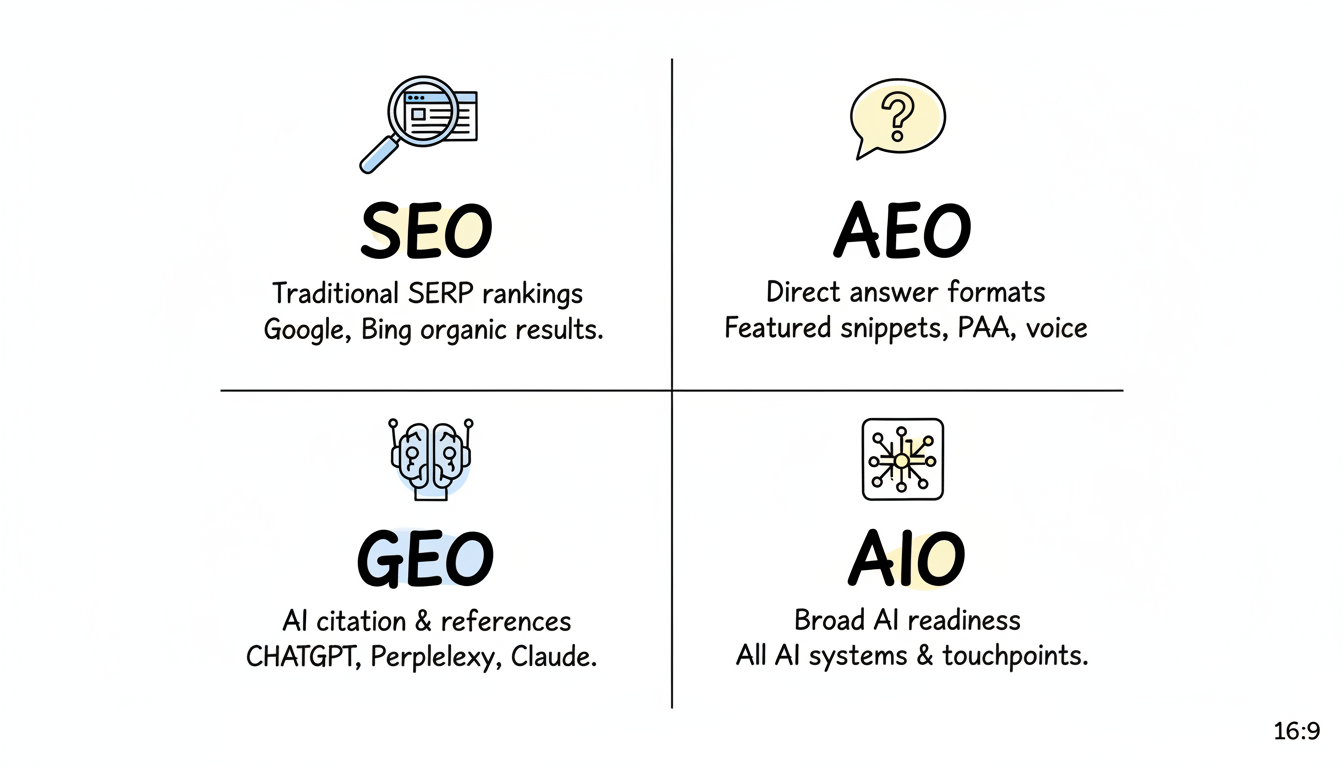
What SEO Is: The practice of optimizing web pages to rank higher in traditional search engine results pages (SERPs). This encompasses technical optimization (site speed, crawlability, mobile-friendliness), on-page optimization (content relevance, keyword targeting, internal linking), and off-page factors (backlinks, brand mentions, domain authority).
What SEO Targets: Organic rankings in Google, Bing, and other traditional search engines—the familiar "blue links" that have defined web search for decades.
Why SEO Still Matters: Despite AI search growth, traditional organic search continues driving the majority of website traffic across most industries. The 2026 AEO/GEO Benchmarks Report confirms that organic traffic remains essential, with SEO providing the foundation upon which other optimization strategies build.
Key SEO Focus Areas for 2026:
Answer Engine Optimization focuses on earning visibility in direct answer formats—featured snippets, People Also Ask boxes, voice search responses, and AI-generated answer boxes.
What AEO Is: The strategic structuring of content to appear when search systems provide direct answers rather than link listings. AEO prioritizes clarity and conciseness, formatting information so answer systems can extract and display it directly.
What AEO Targets: Featured snippets at position zero, PAA expansions, voice assistant responses (Alexa, Siri, Google Assistant), and AI Overviews that synthesize answers from multiple sources.
The AEO Mindset Shift: Traditional SEO asks "How do we rank for this keyword?" AEO asks "How do we become the answer to this question?" This shift from keyword targeting to question answering fundamentally changes content structure. Implementing schema markup validators for AEO helps ensure your structured data properly supports answer engine visibility.
Key AEO Tactics:
Generative Engine Optimization represents the newest frontier—optimizing content to be cited when AI systems generate responses. Unlike AEO, which targets answer boxes within traditional search, GEO targets standalone AI platforms like ChatGPT, Perplexity, Claude, and the generative components of Google's AI Overviews.
What GEO Is: Tailoring content to become a trusted source that AI models reference when synthesizing responses to user queries. GEO focuses on making your content the voice that AI systems quote, cite, and recommend.
What GEO Targets: ChatGPT citations, Perplexity sources, Claude references, Gemini mentions, Google AI Overview citations, and any AI system that acknowledges sources when generating responses. Understanding the GEO implementation guide can help you structure content specifically for generative AI citation.
The GEO Distinction: While SEO helps you rank and AEO helps you answer, GEO helps you get repeated. AI systems don't just find your content—they actively choose to cite it as authoritative, trustworthy, and valuable. That choice depends on factors beyond traditional ranking signals.
Key GEO Factors:
AI Optimization encompasses all aspects of making your digital presence work harmoniously with AI systems across touchpoints—not just search.
What AIO Is: The practice of ensuring AI systems across all applications accurately understand your brand, products, services, and content. AIO extends beyond search to include recommendation algorithms, AI chatbots, virtual assistants, and AI-powered platforms.
What AIO Targets: How AI chatbots understand your products, how recommendation algorithms rank your content, how AI tools categorize your brand, and how AI-powered platforms display your information.
AIO vs GEO: While GEO specifically targets AI search citations, AIO takes a broader view of AI interaction. Your content might appear in ChatGPT search results (GEO), but AIO also considers how customer service chatbots answer questions about your products or how AI shopping assistants recommend your offerings.
Key AIO Considerations:
These optimization approaches aren't separate silos—they form an integrated ecosystem where success in one area supports the others.
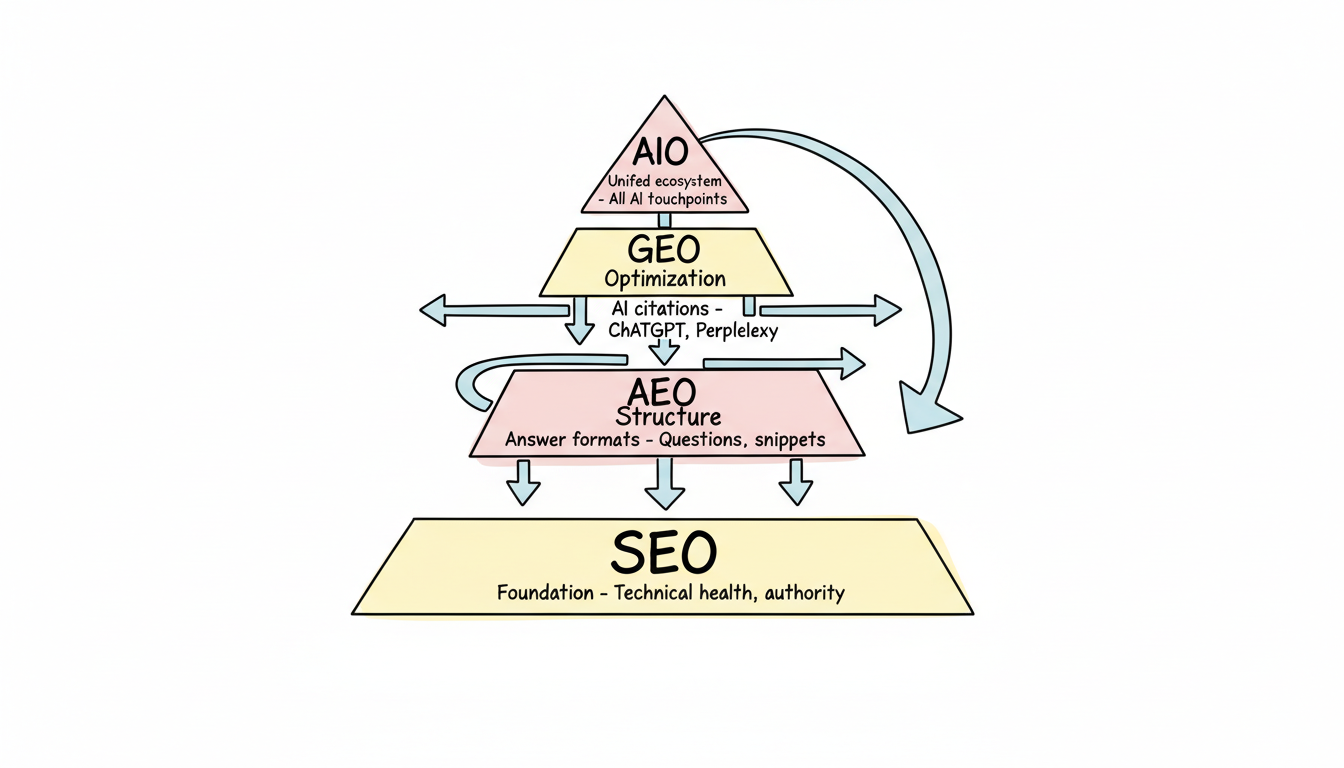
SEO Provides the Foundation: Technical accessibility, domain authority, and content quality signals that SEO builds remain prerequisites for AEO, GEO, and AIO success. AI systems rely on traditional search infrastructure to discover and evaluate content.
AEO Informs GEO: Content structured to answer questions directly (AEO) naturally aligns with what AI systems want to cite (GEO). Clear, helpful answers earn both featured snippets and AI citations.
GEO Reinforces SEO: As AI systems increasingly cite certain sources, those sources gain authority signals that traditional search algorithms recognize. Being cited by ChatGPT can indirectly boost Google rankings.
AIO Unifies the Ecosystem: A holistic AIO approach ensures consistency across all AI touchpoints, preventing conflicting information that could undermine trust in any single channel. Learning how to optimize for AI search engines provides a comprehensive framework that bridges all these disciplines.
Rather than treating these as separate initiatives, successful organizations implement them as layers of a unified strategy.
Layer 1: SEO Foundation
Layer 2: AEO Structure
Layer 3: GEO Optimization
Layer 4: AIO Consistency
Some industry voices argue these acronyms represent marketing hype repackaging identical concepts. There's truth to this critique—all these approaches share the fundamental goal of helping machines understand and surface your content.
However, the distinctions matter because:
The organizations winning in 2026 aren't choosing between these approaches—they're implementing all of them as complementary components of a unified visibility strategy.
The proliferation of optimization acronyms reflects genuine complexity in how users discover information today. Someone searching "best project management software" might:
Each touchpoint represents an opportunity—or a gap in your visibility strategy.
Rather than debating which acronym matters most, focus on the underlying principle all share: create genuinely helpful, clearly structured, expertly crafted content that any system—human or AI—would recognize as valuable. The acronyms will continue evolving. That fundamental goal remains constant.
By submitting this form, you agree to our Privacy Policy and Terms & Conditions.