February 19, 2026


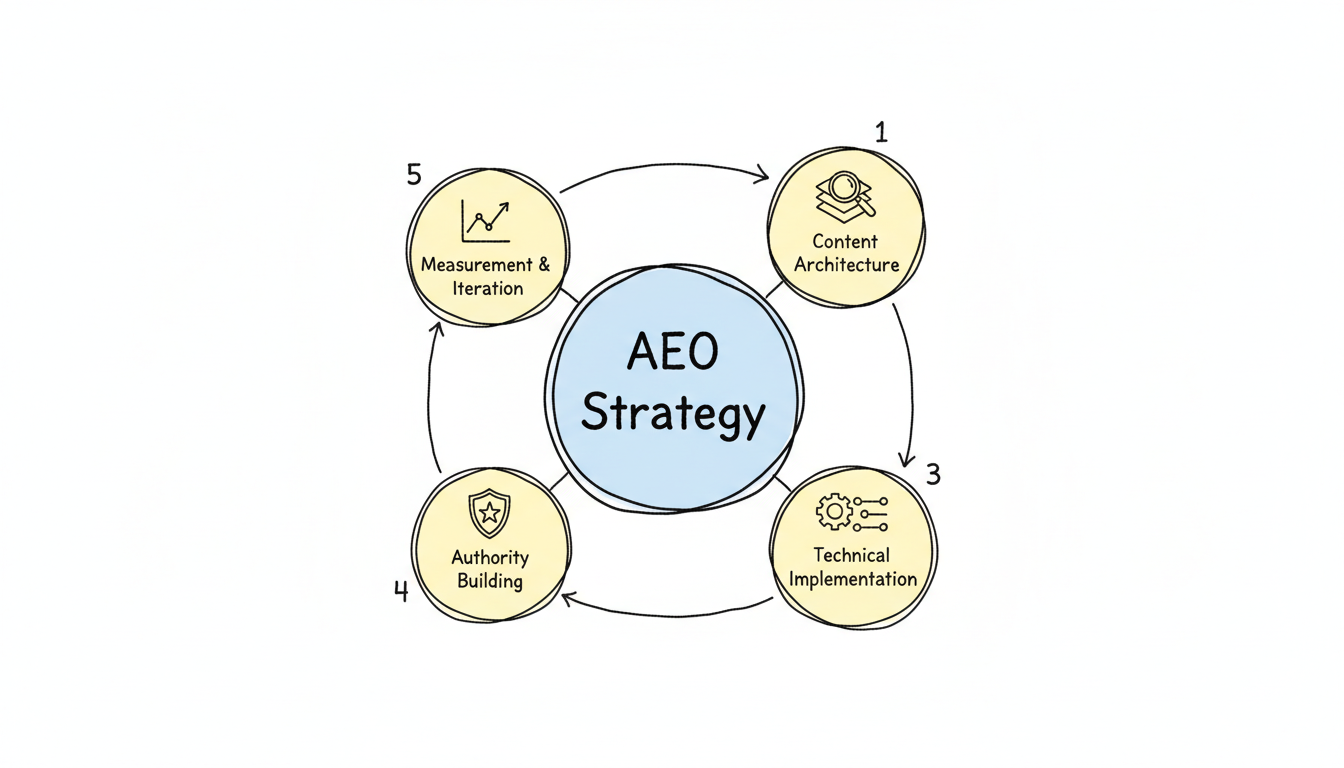
Answer Engine Optimization (AEO) in 2026 is no longer a siloed SEO task—it requires a unified framework that connects content, technical implementation, authority building, and measurement. Organizations that approach AEO strategically rather than tactically capture significantly more AI-generated citations and the high-converting traffic they deliver.
This guide provides a comprehensive AEO strategy framework to plan, implement, and optimize your visibility across ChatGPT, Perplexity, Google AI Overviews, and other AI-powered search platforms.
According to DW Media's analysis of AEO trends for 2026, success is no longer measured by blue links, but by "citation dominance"—your brand's ability to be the primary source of truth for AI agents. This fundamental shift requires marketers to move beyond keyword density to focus on structured proof blocks, persona-led answer nodes, and maintaining high factual integrity across the decentralized web.
Why a strategic framework matters:
Every AEO strategy begins with understanding your current visibility landscape.
According to ALM Corp's guide to ranking on AI search engines, your first week should focus on audit and baseline establishment:
Week 1 audit activities:
Map where competitors get cited and identify gaps in your coverage.
Analysis framework:
Query Category | Your Citations | Competitor A | Competitor B | Gap Priority |
Product/Service | Count | Count | Count | High/Med/Low |
How-to | Count | Count | Count | High/Med/Low |
Comparison | Count | Count | Count | High/Med/Low |
Industry definitions | Count | Count | Count | High/Med/Low |
According to ABM Agency's B2B website structure guide, AEO success requires targeting the right query types. Research shows that Google AI Overviews appear in 88% of informational search intent queries.
Priority query categories:
Content structure determines whether AI systems can extract, cite, and trust your information.
According to Shopify's AEO optimization guide, AI citations connect to snippable, machine-digestible portions of text. Structure content to balance human narrative with machine extractability.
Content structure requirements:
According to DW Media's analysis, 2026 AEO focuses on "conversational paths"—anticipating the 2nd, 3rd, and 4th follow-up questions a buyer will ask an AI agent and providing answers within a single, interconnected content system.
Conversational path planning:
According to insights on AI content optimization, AI doesn't reward effort—it rewards clarity. Content must be understood in seconds or AI will skip it. Understanding platform-specific content strategies and format structure is essential for maximizing citation potential.
Density optimization tactics:
Technical foundations enable AI systems to access, understand, and trust your content.
According to ALM Corp's implementation guide, Week 2 should focus on technical implementation:
Technical priorities:
AI systems understand content through entities—the people, places, things, and concepts mentioned. This is where knowledge graph SEO implementation becomes critical.
Entity optimization approach:
According to DW Media's trends analysis, AI scrapers now use "provenance verification" to rank content. Implement visible freshness signals:
Freshness implementation:
Authority determines whether AI systems trust your content enough to cite it.
According to ABM Agency's research, AI engines value E-E-A-T (Experience, Expertise, Authoritativeness, and Trustworthiness) signals that demonstrate deep knowledge.
Authority signal priorities:
According to DW Media's analysis, implement digital signatures or schema that proves your content was created by a human expert. In a sea of synthetic content, "human-verified" signals are becoming a ranking factor for answer engines. This connects to broader AI search citation strategies across platforms.
Distribute optimized content across platforms where AI systems look for validation:
Platform priorities:
Platform | Content Type | Authority Signal |
Industry publications | Guest posts, contributed articles | Third-party validation |
Community participation | User consensus signals | |
YouTube | Video content | Multi-format expertise |
Professional content | Professional authority |
Measurement enables continuous improvement and demonstrates ROI.
According to Spearpoint's AEO guide, manual query testing remains necessary as standardized measurement tools continue developing. Establishing comprehensive AEO optimization metrics is essential for tracking progress.
Core metrics:
According to Spearpoint's analytics guidance, Google Analytics 4 Custom Channel Groups can separate answer engine traffic from traditional sources.
Tracking setup:
Monthly review questions:
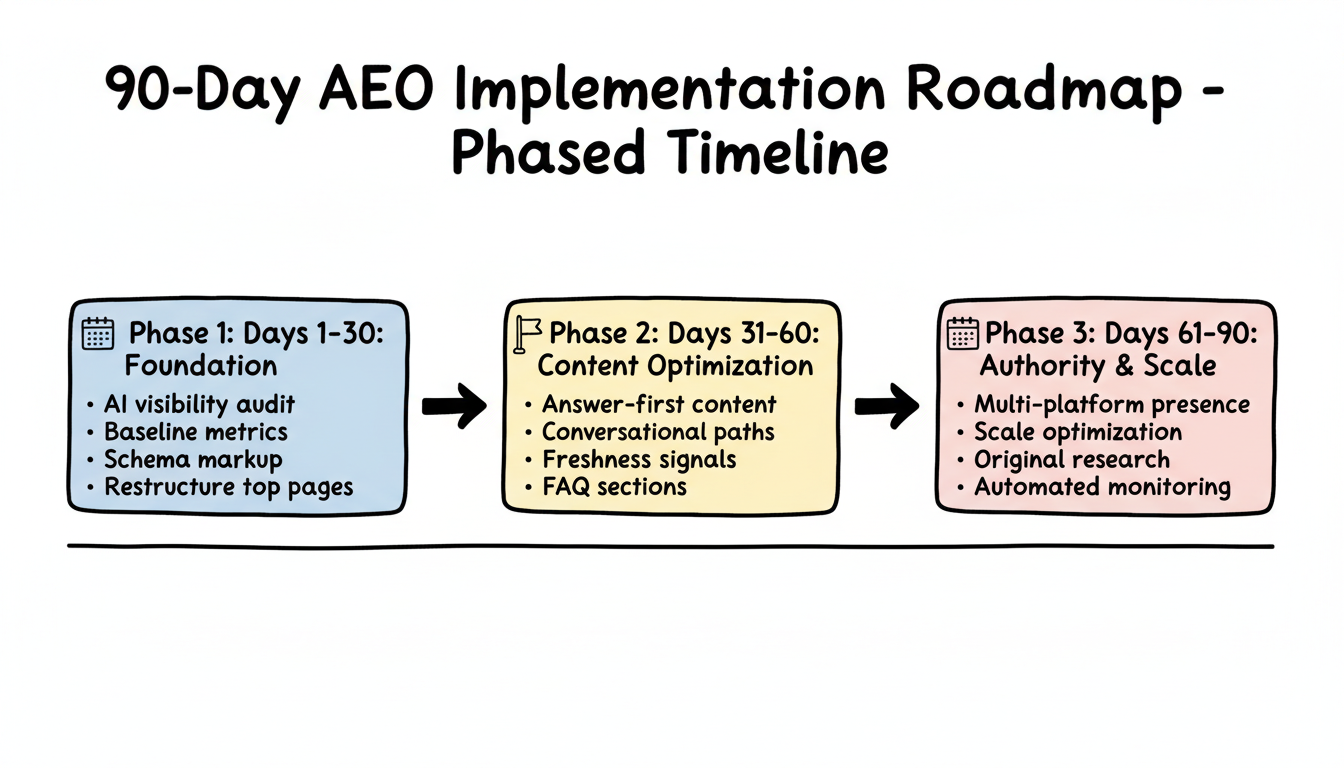
According to Search Engine Land's AI-driven search playbook, a phased approach ensures sustainable implementation.
Focus areas:
Focus areas:
Understanding how to optimize content for generative AI will accelerate this phase significantly.
Focus areas:
According to Connect Media Agency's AEO guide, AEO complements SEO rather than replacing it—strong SEO gets content discovered while AEO ensures AI can understand and use it. Understanding the relationship between SEO and generative AI prevents this mistake.
Without baseline metrics and ongoing tracking, you can't identify what's working or justify continued investment. Start measurement from day one.
Technical implementation and authority building are equally important. A comprehensive framework addresses all three pillars. Many organizations benefit from working with specialized answer engine optimization services to ensure proper implementation.
According to Spearpoint's implementation guidance, the biggest barrier to AEO success is often organizational—securing budget allocation and internal buy-in. Present AEO as complementary investment requiring strategic fund reallocation rather than separate budget.
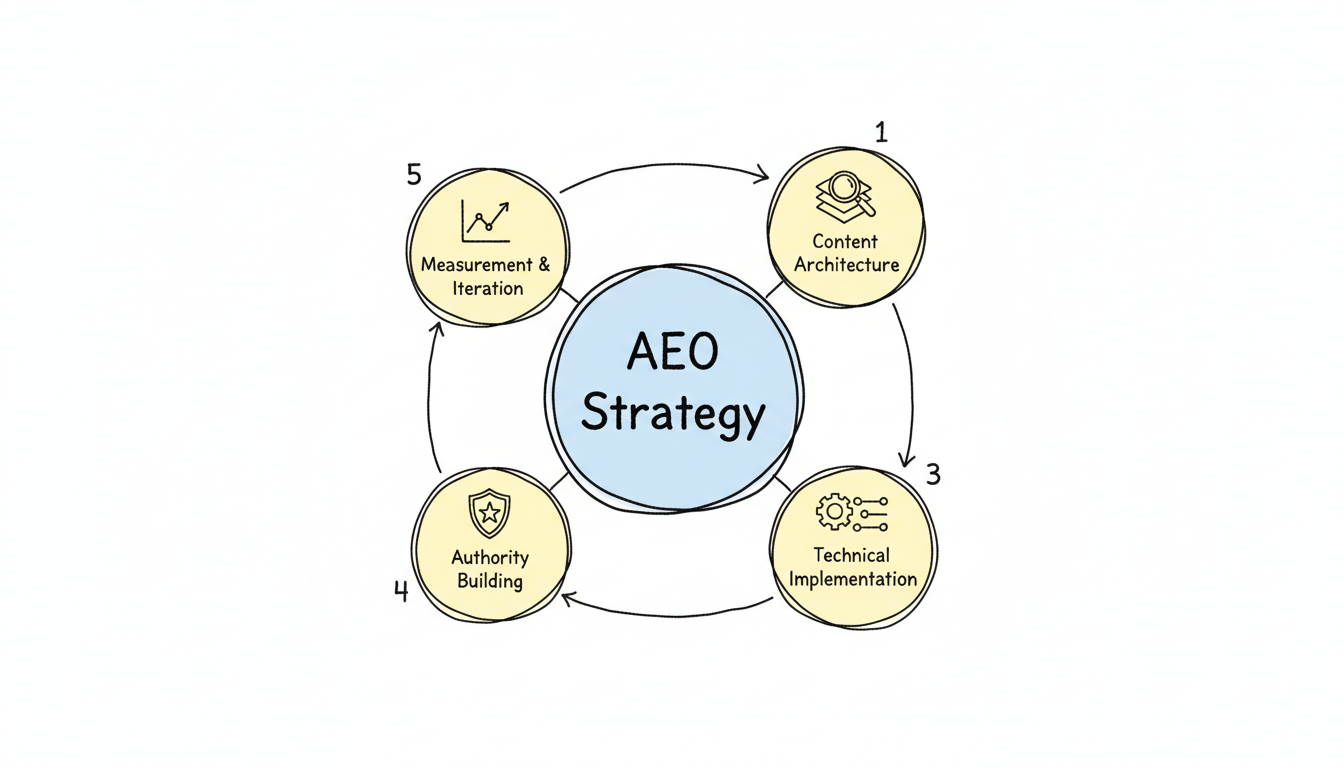
Building a comprehensive AEO strategy framework requires coordinated effort across five components:
The 90-day implementation roadmap provides a realistic timeline for organizations building AEO capabilities. Start with quick wins—schema markup, answer capsules on priority pages, and content refresh schedules—while building toward comprehensive optimization. Looking at AEO optimization examples from successful implementations can guide your approach.
According to ALM Corp's research, the opportunity window remains wide open. Most businesses haven't yet prioritized AI optimization, creating first-mover advantages for those who act now.
By submitting this form, you agree to our Privacy Policy and Terms & Conditions.