
February 19, 2026


Last Updated: January 2026
AI content optimization tools have transformed how marketers create search-optimized content. These platforms analyze top-ranking pages, identify semantic patterns, and guide writers to produce content that ranks—and increasingly, content that AI systems cite in their responses.
This guide covers the leading AI content optimization tools, comparing features, pricing, and use cases to help you choose the right solution.
AI content optimization tools use natural language processing (NLP) and machine learning to analyze search results and provide data-driven recommendations for content creation. Rather than relying on keyword density or intuition, these tools:
The core value proposition: write content that matches what search engines (and AI systems) expect to see for a given topic.
Modern content optimization tools have evolved beyond traditional SEO. Many now include AI search analytics tracking capabilities, answer engine optimization features, content scoring for AI discoverability, and visibility tracking across ChatGPT, Perplexity, and Google AI Overviews.
The market includes several established players and emerging platforms. Here are the leading tools for 2026:
Best For: Enterprise teams and agencies focused on content depth and topical relevance
Clearscope has evolved from a pure content optimizer into a "discoverability platform" that tracks visibility across Google Search and AI engines including ChatGPT, Gemini, and Perplexity.
Key Features:
Integrations: Google Docs, WordPress
Pricing:
Strengths:
Limitations:
Best For: Content teams needing real-time optimization scoring
Surfer SEO provides real-time content scoring as you write, analyzing top-ranking pages and recommending specific improvements. It's one of the most popular platforms when comparing seo-ai-vs-search-atlas and other enterprise solutions.
Key Features:
Integrations: Google Docs, WordPress, Jasper
Pricing:
Strengths:
Limitations:
Best For: Large websites and enterprise content strategists building topical authority
MarketMuse focuses on content strategy and planning, helping teams identify what to create, update, and consolidate across large content libraries.
Key Features:
Integrations: CMS platforms, Google Docs
Pricing:
Strengths:
Limitations:
Best For: Lean teams needing fast research-to-outline workflows
Frase combines SERP research with content brief generation at an accessible price point, making it popular with solo creators and small teams.
Key Features:
Integrations: Google Docs, WordPress
Pricing:
Strengths:
Limitations:
Best For: Budget-conscious teams wanting semantic SEO optimization
NeuronWriter provides semantic analysis and content optimization at one of the lowest price points in the market.
Key Features:
Pricing:
Strengths:
Limitations:
Best For: Marketing teams creating brand-consistent content at scale
Jasper focuses on AI content generation with brand voice controls, making it strong for marketing copy and brand content rather than pure SEO optimization.
Key Features:
Pricing:
Strengths:
Limitations:
Best For: Teams producing SEO content at high volume
Scalenut combines AI writing with SEO optimization, featuring "Cruise Mode" for largely automated content creation.
Key Features:
Pricing:
Strengths:
Limitations:
Understanding the mechanics helps you use these tools effectively, whether you're implementing llm-optimization-best-practices or traditional search optimization.
Tools analyze the top 10-30 results for your target keyword, extracting:
This analysis forms the basis for optimization recommendations.
Natural language processing identifies semantic relationships between terms. Rather than focusing on exact-match keywords, tools identify:
This helps create content that covers topics comprehensively rather than stuffing keywords. Understanding these relationships is crucial for effective geo-content-optimization and broader content strategy.
Most tools provide optimization scores based on:
Scores typically range from 0-100 or letter grades (A-F).
Many tools now include AI writing features that:
AI-generated content requires editing but accelerates production, especially when combined with principles from seo-and-generative-ai strategies.
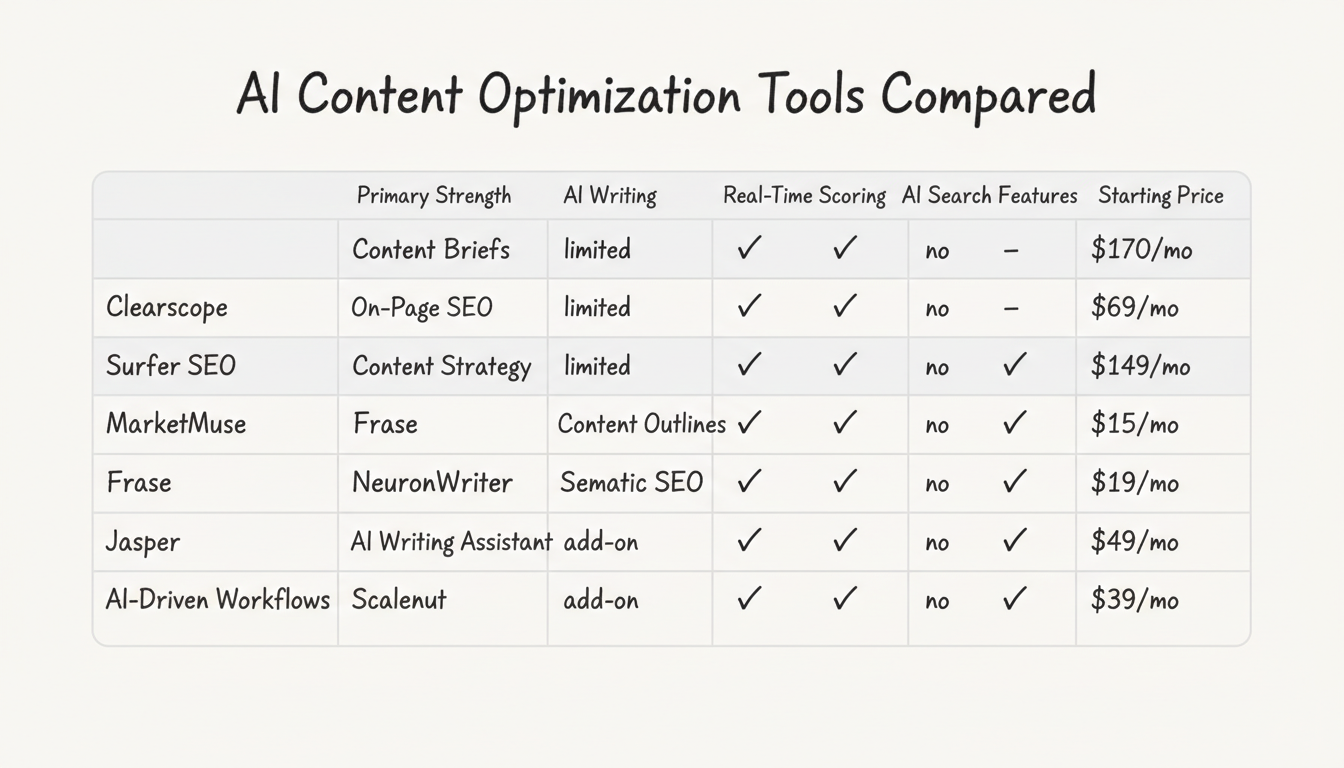
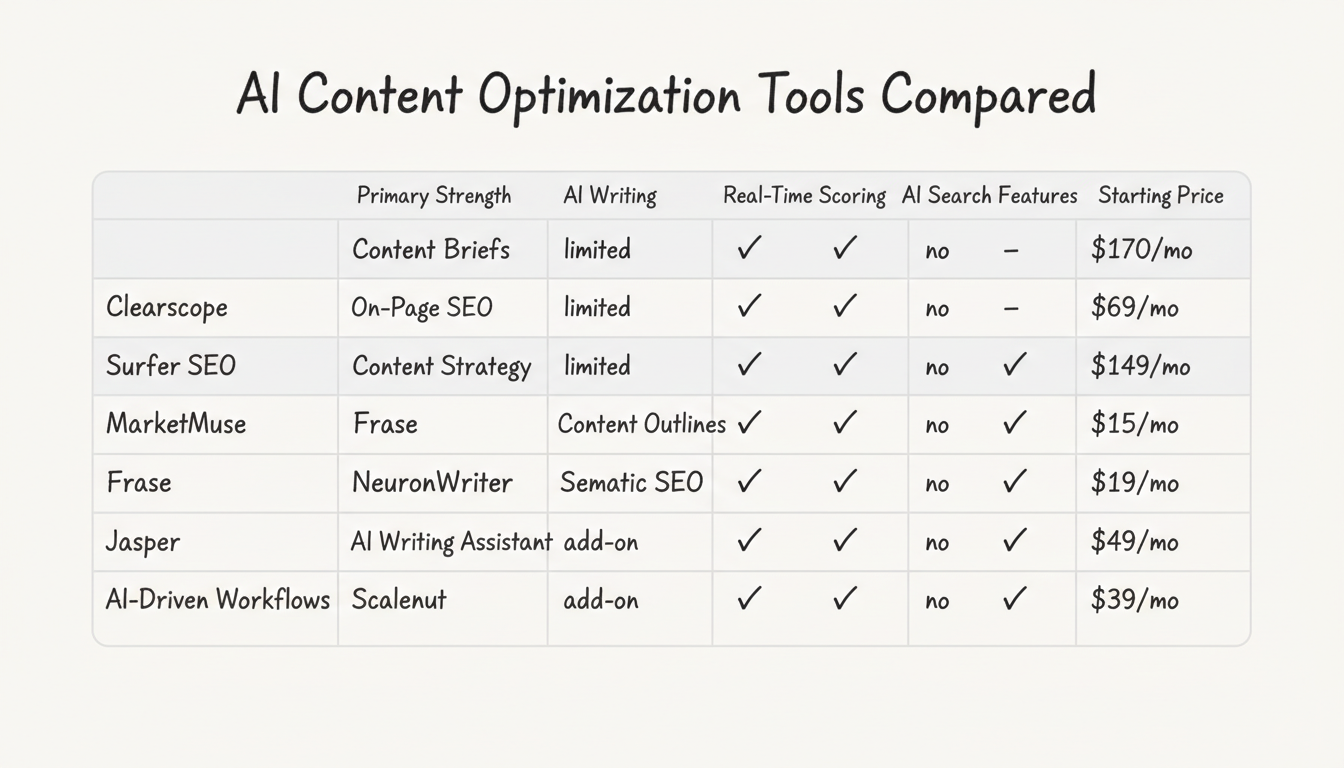
Tool | Primary Strength | AI Writing | Real-Time Scoring | AI Search Features | Starting Price |
Clearscope | Semantic depth | Limited | Yes | Yes | $129/mo |
Surfer SEO | Real-time optimization | Add-on | Yes | Limited | $89/mo |
MarketMuse | Content strategy | Yes | No | Limited | $149/mo |
Frase | Research & briefs | Yes | Yes | Limited | $15/mo |
NeuronWriter | Budget optimization | Yes | Yes | No | $19/mo |
Jasper | Brand content | Yes | No | No | $49/mo |
Scalenut | Volume production | Yes | Yes | Limited | $39/mo |
For SEO-focused content teams: Surfer SEO or Clearscope For content strategists: MarketMuse For solo creators on budget: Frase or NeuronWriter For high-volume production: Scalenut For brand/marketing content: Jasper
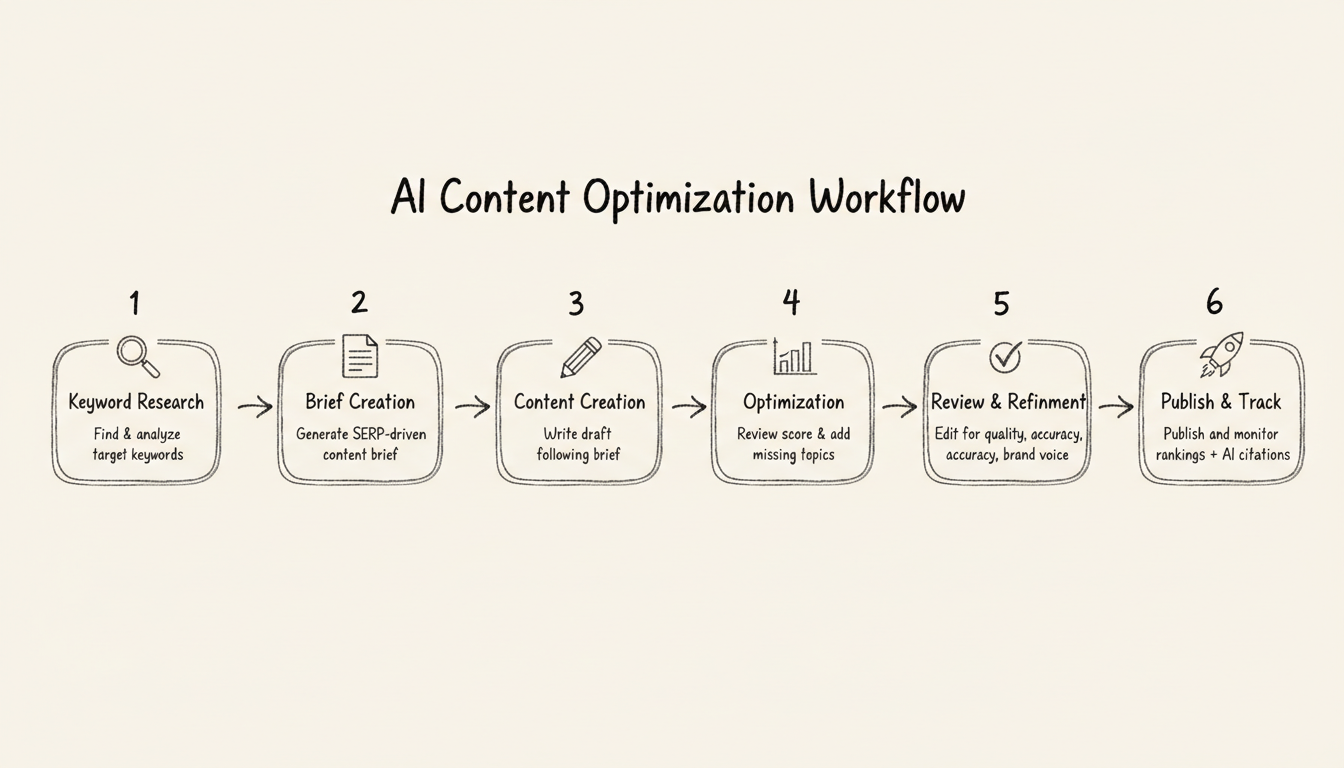
An effective workflow using AI content optimization tools:
Understanding the difference between aeo-vs-seo-comparison helps inform your keyword selection and optimization strategy.
Consider using google-analytics-4-ai-search-tracking to measure performance across both traditional and AI-powered search channels.
Tool | Entry Level | Mid-Tier | Enterprise |
Clearscope | $129/mo | $399/mo | Custom |
Surfer SEO | $89/mo | $129/mo | $219/mo |
MarketMuse | Free (limited) | $149/mo | $399/mo |
Frase | $15/mo | $45/mo | $115/mo |
NeuronWriter | $19/mo | $37/mo | $57/mo |
Jasper | $49/mo | $69/mo | Custom |
Scalenut | $39/mo | $79/mo | $149/mo |
Time Savings
Quality Improvements
Performance Gains
Example ROI: A team creating 20 articles monthly at $500/article average cost:
For comprehensive ROI analysis across multiple platforms, review strategies for cross-platform-ai-search-roi-analysis.
Understand search intent before optimizing. Tools provide data, but interpreting intent requires human judgment. Commercial and informational queries need different content approaches.
A perfect score doesn't guarantee rankings. Use recommendations to improve comprehensiveness while maintaining quality and readability. Balancing multiple optimization approaches, including aeo-seo-geo strategies, yields better long-term results.
AI drafts accelerate production but require editing for accuracy, tone, and brand alignment. Never publish AI content without review.
No single tool does everything. Pair optimization tools with keyword research (Ahrefs, Semrush) and technical SEO tools for comprehensive coverage. Many teams also leverage best-free-ai-seo-tools-2026 to supplement paid platforms.
Hitting every recommended term can create unnatural content. Prioritize readability and user value over perfect scores.
Tools analyze what exists in SERPs. Original insights, proprietary data, and expert perspectives create content that stands out beyond optimization scores.
Rankings change, competitors improve, and algorithms evolve. Schedule regular content refreshes using updated SERP analysis.
Which content optimization tool is best for beginners? Frase offers the best balance of capabilities and accessibility at $15/month. Its interface is intuitive, and the brief generation workflow is easy to learn. NeuronWriter at $19/month is another beginner-friendly option.
Do I need both Clearscope and Surfer SEO? Generally no—they serve similar purposes. Choose based on your workflow preference: Clearscope for strategic topic planning and AI visibility tracking, Surfer for real-time writing optimization. Most teams use one or the other.
Can AI content optimization tools replace writers? No. These tools enhance writer productivity and content quality but don't replace human creativity, expertise, and editorial judgment. AI-generated drafts consistently require editing.
How accurate are content scores? Scores correlate with ranking patterns but aren't guarantees. A high-scoring article that misses user intent will underperform. Use scores as one input among several, including quality judgment.
Should I optimize for AI search or traditional SEO? Both, but traditional SEO remains foundational. Google AI Overviews heavily weight existing rankings—pages in top positions have higher AI Overview inclusion rates. Optimize for search first, then enhance for AI discoverability using what-is-geo-generative-engine-optimization principles.
How often should I re-optimize content? Quarterly reviews for high-value content, annually for evergreen pieces. Re-run SERP analysis to identify changes in ranking patterns and competitor content.
Are free tiers worth using? For testing, yes. MarketMuse's free tier provides limited but useful analysis. Free trials from Frase, Surfer, and others help evaluate fit before committing.
By submitting this form, you agree to our Privacy Policy and Terms & Conditions.



