
February 19, 2026


Traditional SEO analytics don't capture AI search visibility. Google Analytics shows traffic sources, but it can't tell you when ChatGPT mentions your brand or how often Perplexity cites your content. As AI-generated answers become primary search interfaces, measuring performance requires fundamentally different approaches.
AI search analytics has emerged as a distinct discipline—tracking brand mentions, citation frequency, sentiment analysis, and visibility across platforms that generate answers rather than link lists. This guide covers the metrics that matter and the tools that measure them.
Google Analytics and similar platforms track visitors who click through to your site. But AI search often delivers answers without clicks. A user asking ChatGPT about your product category might receive a response mentioning your brand—without ever visiting your website.
This creates a measurement blind spot. Your brand could be recommended hundreds of times daily in AI responses while your analytics shows declining traffic. Traditional metrics miss the visibility that happens before (or instead of) the click.
The challenge compounds across platforms. Perplexity citations, Google AI Overviews, ChatGPT mentions, and Claude responses each represent distinct visibility channels. Measuring performance requires tracking each platform separately while building a unified view of AI search presence.
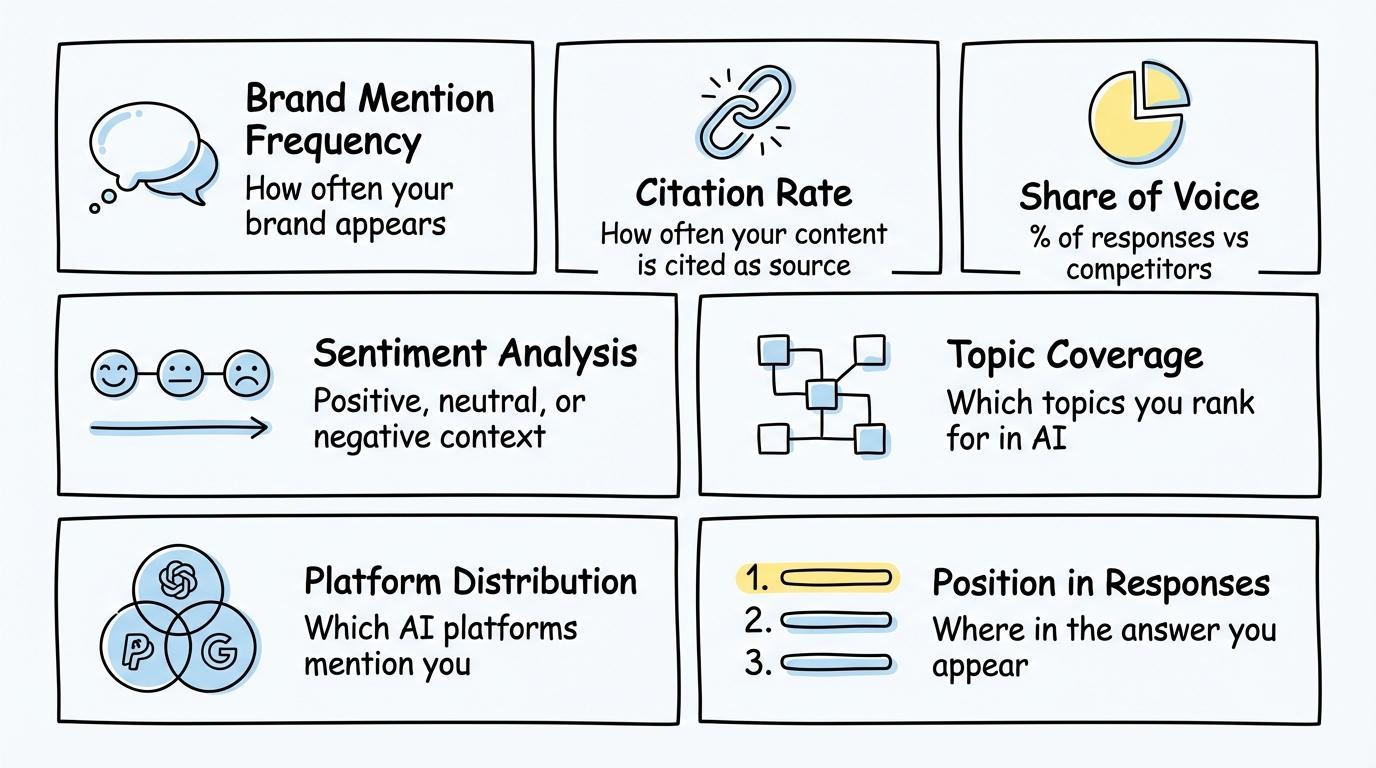
Effective AI search analytics centers on metrics traditional SEO platforms don't measure.
Brand Mention Frequency How often does your brand appear in AI-generated responses? This baseline metric tracks raw visibility—the number of times AI platforms mention your company, products, or content when answering relevant queries. Frequency matters because repeated mentions build recognition and trust.
Citation Rate Beyond mentions, how often do AI platforms cite your content as a source? Citations include linked references that enable users to verify information or explore further. Citation rate indicates whether AI systems consider your content authoritative enough to reference explicitly. Using AI citation tracking tools can help you monitor this metric across multiple platforms systematically.
Share of Voice What percentage of relevant AI responses include your brand versus competitors? Share of voice contextualizes your visibility within the competitive landscape. A brand mentioned in 30% of responses for industry queries holds stronger position than one appearing in 5%.
Sentiment Analysis When AI mentions your brand, is the context positive, negative, or neutral? AI systems synthesize information from multiple sources—including reviews, news, and discussions. Sentiment tracking reveals how AI platforms characterize your brand to users.
Topic Coverage For which topics does your brand appear in AI responses? Topic coverage mapping shows where you have AI visibility and where competitors dominate. Gaps in coverage identify optimization opportunities.
Platform Distribution Which AI platforms mention your brand most frequently? Distribution analysis shows whether your visibility concentrates on Google AI Overviews, spreads across ChatGPT and Perplexity, or skews toward specific platforms requiring targeted optimization. Understanding the AI search platform strengths weaknesses analysis helps you prioritize where to focus measurement efforts.
Position in Responses Where in AI-generated answers does your brand appear? Early mentions in responses carry more weight than passing references buried in lengthy answers. Position tracking assesses visibility quality, not just quantity.
Several platforms now specialize in AI visibility tracking. Each offers different capabilities and price points.
SE Visible Purpose-built for AI search analytics, SE Visible tracks brand visibility across ChatGPT, Perplexity, Google AI Overviews, and Claude. The platform monitors keyword-level visibility, competitor comparisons, and citation tracking. Particularly strong for enterprise brands needing comprehensive cross-platform monitoring.
Ahrefs Brand Radar Ahrefs expanded into AI visibility with Brand Radar, tracking how often brands appear in AI-generated content. Integrates with existing Ahrefs backlink and keyword data, making it convenient for teams already using the platform for traditional SEO.
Semrush AI Toolkit Semrush's AI visibility features include AI Overview tracking and citation analysis. The platform shows which queries trigger AI Overviews featuring your brand, competitor citation patterns, and visibility trends over time.
Profound Focused specifically on AI answer engine visibility, Profound tracks brand mentions and sentiment across major AI platforms. Offers competitive benchmarking and automated alerts when visibility changes significantly.
Scrunch Emphasizes real-time AI visibility monitoring with sentiment analysis. Useful for brands concerned about reputation management in AI responses, with alerts for negative mentions requiring attention.
BrightEdge Enterprise SEO platform with expanding AI search capabilities. Tracks AI Overview appearances and provides recommendations for improving AI visibility alongside traditional search optimization.
OmniSEO Newer entrant focusing on Generative Engine Optimization (GEO) metrics. Tracks citations, sentiment, and visibility across AI platforms with emphasis on actionable optimization recommendations.
Effective AI analytics require consolidating data into actionable dashboards.
Visibility Scorecard Create a composite visibility score combining mention frequency, citation rate, and share of voice. Track this score weekly to identify trends. A simple weighted formula—(mentions × 0.3) + (citations × 0.5) + (share of voice × 0.2)—provides a single metric for executive reporting.
Competitive Benchmarking Track the same metrics for 3-5 key competitors. Relative performance matters more than absolute numbers in AI search. If your visibility increases 20% but competitors increase 40%, you're losing ground despite improvement.
Platform Breakdown Segment metrics by AI platform. Performance varies significantly across Google AI Overviews, ChatGPT, Perplexity, and others. Platform-level tracking identifies where optimization efforts should focus. Analyzing AI search platform market share comparison 2026 data helps you allocate measurement resources to platforms with the largest user bases.
Topic Heat Map Map topics where your brand has strong AI visibility versus weak or absent visibility. Heat maps reveal content gaps and competitive opportunities. Green indicates leadership, yellow indicates competition, red indicates absence.
Sentiment Trend Track sentiment over time, not just current state. Sentiment shifts can indicate emerging reputation issues before they become crises—or successful brand positioning changes taking effect.
AI search metrics gain meaning when connected to business results.
AI Traffic Attribution Some AI platforms (particularly Perplexity) send referral traffic that analytics can track. Segment this traffic to understand visitor quality—conversion rates, engagement metrics, and revenue attribution from AI-referred visitors. Implementing Google Analytics 4 for AI search tracking provides the technical foundation for accurate attribution modeling.
Brand Search Correlation AI visibility often correlates with branded search volume. Users who encounter your brand in AI responses may later search directly for your company. Track branded search trends alongside AI visibility metrics to identify correlation.
Assisted Conversions AI mentions may not drive direct clicks but could influence conversions that arrive through other channels. Attribution modeling should consider AI visibility as a potential awareness touchpoint in longer customer journeys.
Share of Voice Impact Higher AI share of voice should correlate with market share over time. Track quarterly business metrics against AI visibility trends to establish correlation—or identify disconnects requiring investigation.
Avoid these pitfalls when implementing AI search analytics.
Measuring Only Citations Citations represent direct attribution, but mentions without citations still build awareness. Don't ignore brand mentions simply because they lack clickable links.
Platform Myopia Focusing exclusively on Google AI Overviews misses visibility on ChatGPT, Perplexity, and emerging platforms. Multi-platform tracking is essential as user behavior fragments across AI interfaces.
Ignoring Sentiment Volume metrics without sentiment context mislead. 1,000 negative mentions harm more than 100 positive mentions help. Always pair frequency metrics with sentiment analysis.
Static Benchmarking AI search evolves rapidly. Benchmarks set in early 2026 may not reflect reality by year-end. Update competitive baselines quarterly to maintain relevant context.
Vanity Metrics Raw mention counts feel impressive but may not indicate business value. Focus on metrics tied to outcomes—qualified traffic, brand search growth, competitive share of voice—rather than absolute numbers.
Before optimizing, establish baseline measurements.
Query your core topics across ChatGPT, Perplexity, and Google with AI Overviews enabled. Document which queries return your brand, how prominently, and with what sentiment. Record competitor appearances for the same queries.
This manual baseline provides context for automated tracking tools. It also reveals immediate optimization opportunities—queries where competitors appear but you don't.
Revisit baseline queries monthly to measure progress. Automated tools track broader patterns, but periodic manual checks verify tool accuracy and surface nuances automated systems miss.
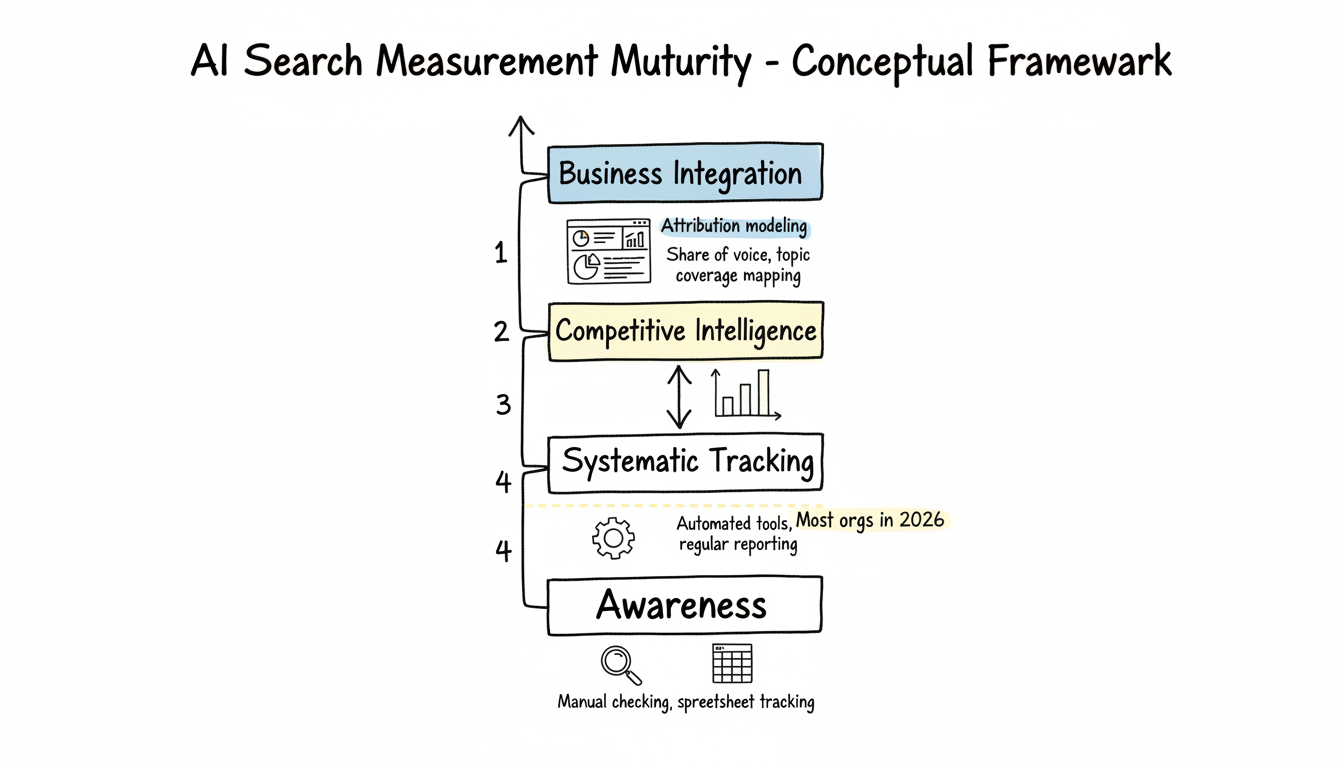
Organizations typically progress through measurement maturity stages.
Stage 1: Awareness Basic monitoring of whether your brand appears in AI responses for key queries. Manual checking, spreadsheet tracking.
Stage 2: Systematic Tracking Automated tools monitoring visibility across platforms. Regular reporting on core metrics—mentions, citations, sentiment.
Stage 3: Competitive Intelligence Comprehensive competitor tracking. Share of voice analysis. Topic coverage mapping.
Stage 4: Business Integration AI visibility metrics connected to business outcomes. Attribution modeling. Executive dashboards with actionable insights.
Most organizations in 2026 operate between stages 1 and 2. Advancing to stages 3 and 4 creates competitive advantage as AI search becomes primary discovery channel.
AI search analytics remains an emerging discipline. Tools improve monthly. Best practices evolve as platforms change. The organizations investing in measurement infrastructure now—even imperfect measurement—will be positioned to optimize as the landscape matures.
By submitting this form, you agree to our Privacy Policy and Terms & Conditions.



