February 19, 2026


Measuring return on investment across multiple AI search platforms presents challenges traditional SEO never faced. When your brand appears in ChatGPT, Perplexity, Google AI Overviews, and Microsoft Copilot simultaneously—each with different attribution capabilities—calculating true ROI requires new frameworks, tools, and metrics. Organizations investing in AI search platform market share comparison 2026 need clear methods to connect platform-specific performance to business outcomes.
According to ALM Corp's 2026 Digital Marketing Budget Guide, content marketing and search optimization including AEO deliver 5:1 to 10:1 long-term ROI while building permanent assets. In 2026, this category has expanded beyond traditional SEO to include Answer Engine Optimization (AEO), ensuring your content gets cited by ChatGPT, Perplexity, Google's AI Overviews, and other generative AI platforms.
AI search traffic behaves differently than traditional search traffic, complicating ROI measurement.
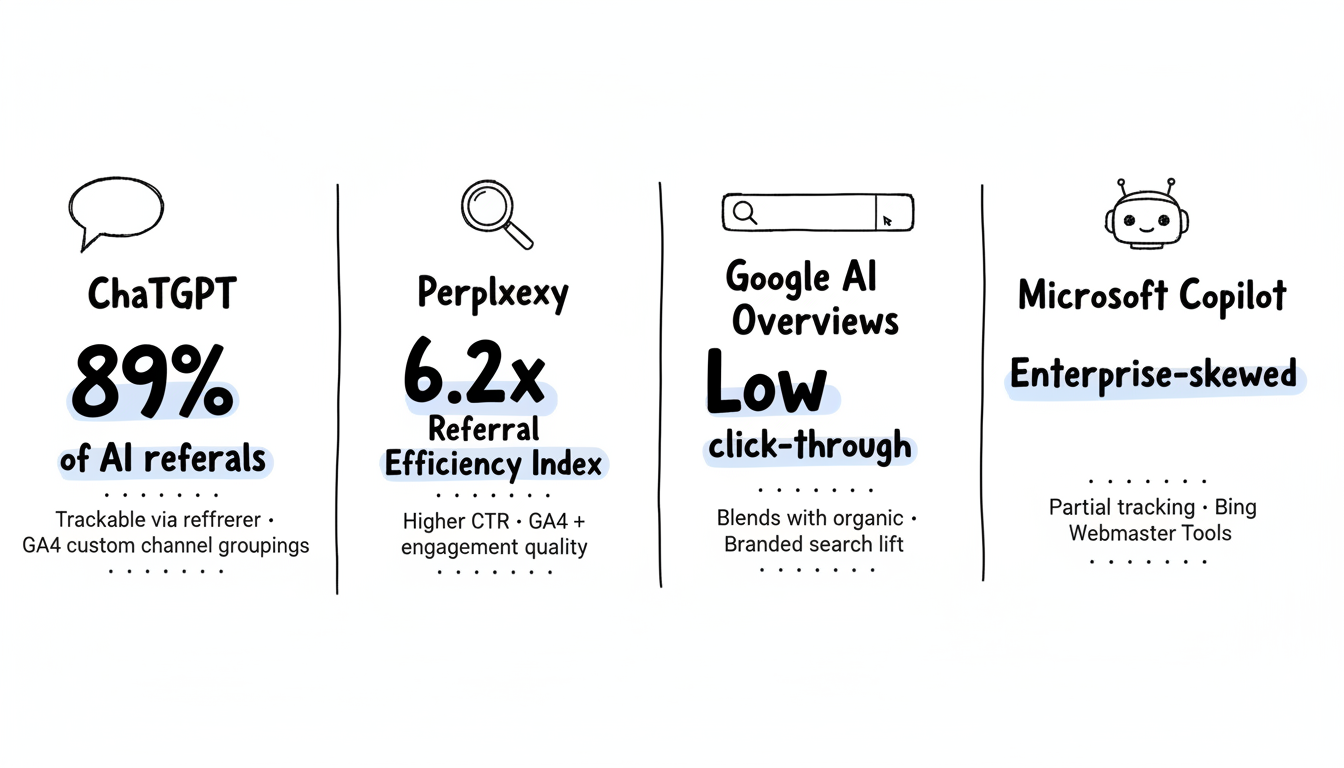
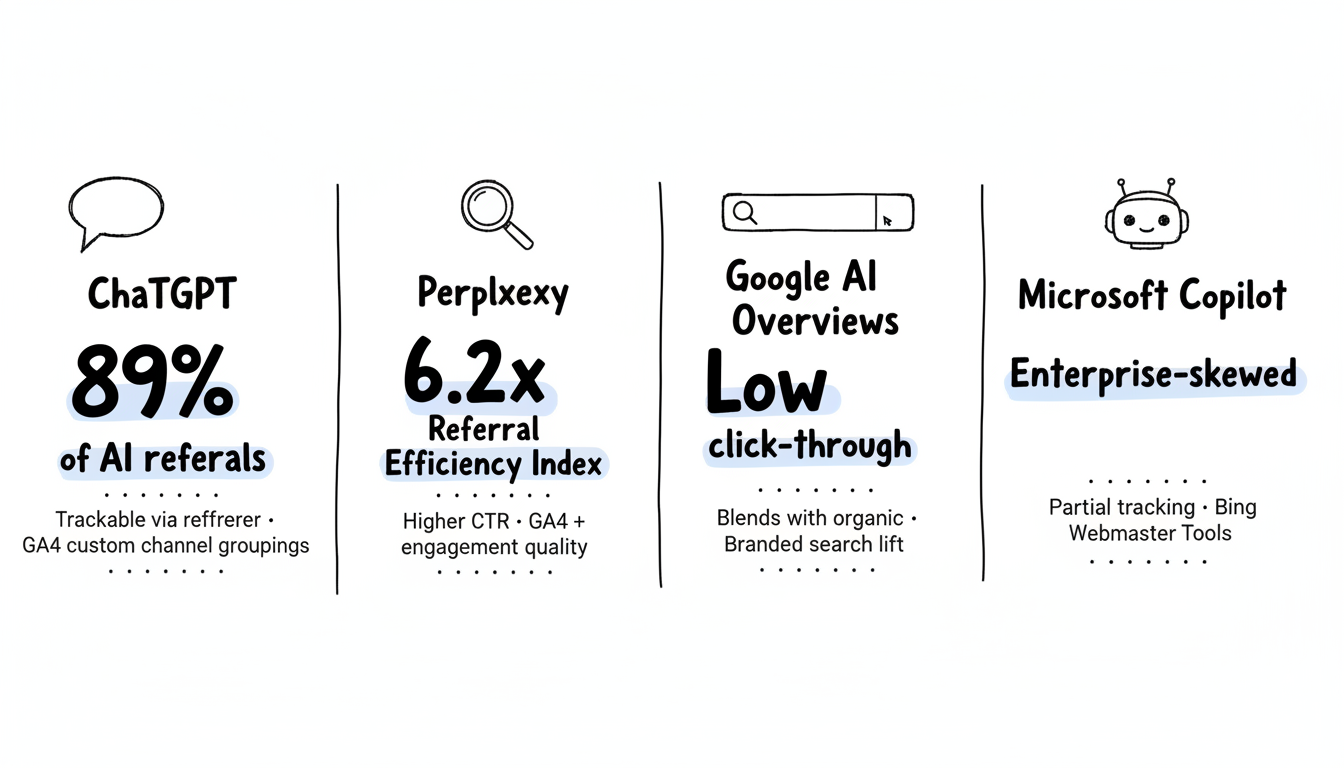
According to NoGood's future of search analysis, ChatGPT leads with 800 million weekly active users and drives 89% of measured AI referrals—meaning when AI search traffic does click through to websites, it overwhelmingly comes from ChatGPT. However, Perplexity demonstrates a Referral Efficiency Index of 6.2x, meaning Perplexity users are far more likely to click citations than users on other platforms.
Platform attribution characteristics:
Platform | Traffic Attribution | Click Behavior | Measurement Approach |
ChatGPT | Trackable via referrer | 89% of AI referrals | GA4 custom channel groupings |
Perplexity | Trackable via referrer | 6.2x higher CTR | GA4 + engagement quality |
Google AI Overviews | Blends with organic | Low click-through | Branded search lift |
Microsoft Copilot | Partial tracking | Enterprise-skewed | Bing Webmaster Tools |
Traditional SEO metrics don't capture AI visibility value. New metrics bridge this gap.
According to NoGood, the primary new metrics to track include: citation frequency (how often your brand appears in AI responses), LLM referral traffic (custom channel groupings in GA4 to attribute traffic from chat.openai.com, perplexity.ai), branded search lift (tracking whether uncited appearances drive direct brand searches), and engagement quality over click quantity (higher time on page and conversion rates offsetting lower click volumes).
ROI metrics framework:
Cross-Platform AI ROI Metrics
├── Visibility Metrics
│   ├── Citation frequency by platform
│   ├── Share of AI voice vs competitors
│   ├── Topic-specific visibility scores
│   └── Platform coverage percentage
│
├── Traffic Metrics
│   ├── AI referral sessions (by platform)
│   ├── Referral efficiency index
│   ├── Branded search volume changes
│   └── Dark traffic attribution
│
├── Engagement Quality
│   ├── Time on site from AI traffic
│   ├── Pages per session
│   ├── Bounce rate comparison
│   └── Goal completion rates
│
└── Business Outcomes
    ├── AI-attributed conversions
    ├── Revenue from AI channels
    ├── Customer acquisition cost
    └── Lifetime value by source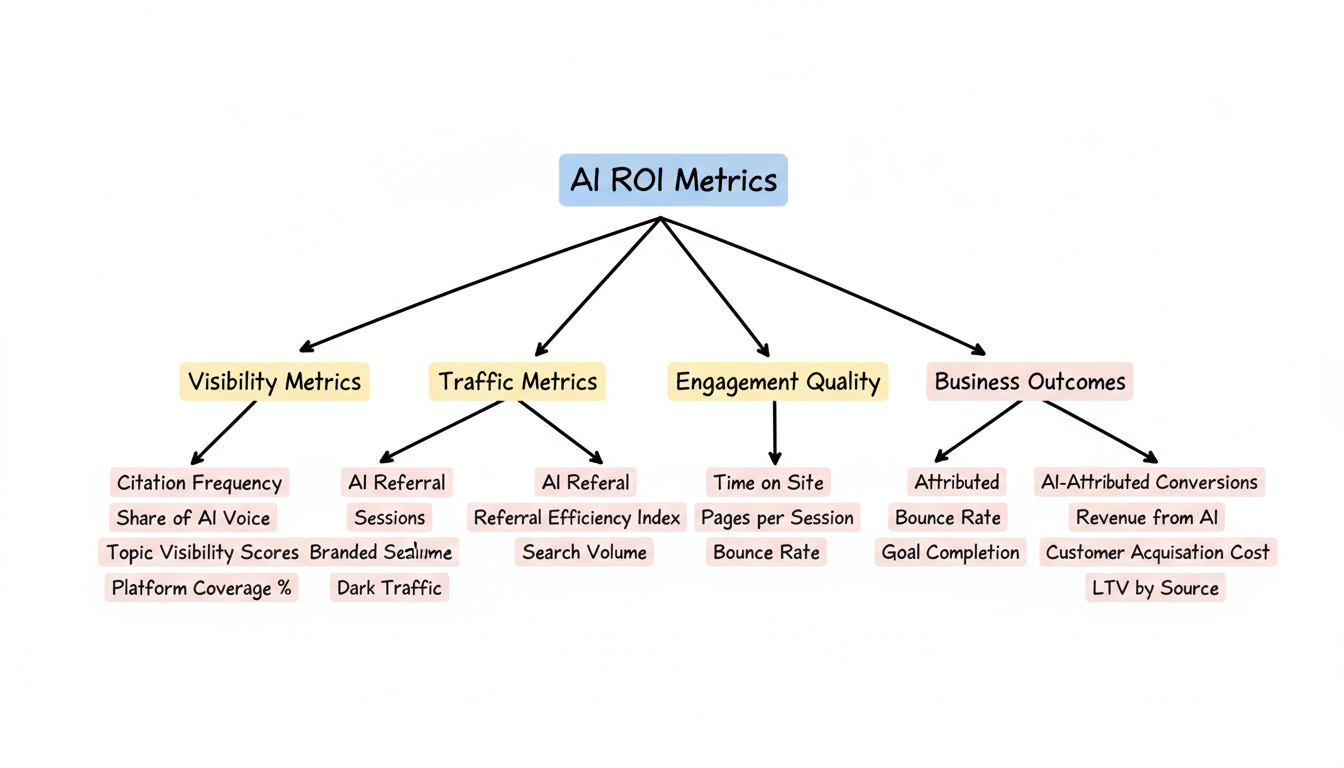
Investment allocation should reflect platform-specific opportunities and audience fit.
According to Digital Applied's AI Marketing Strategy, measurement and analytics should receive 10-15% of AI marketing budget for tracking AI visibility, lead quality, and ROI across channels. This includes AI visibility tracking tools, attribution platforms, dashboard creation, and reporting infrastructure.
Budget allocation by company size:
Company Size | Monthly AI Budget | Annual Investment | Focus Areas |
Small Business | $500-$2,000 | $6,000-$24,000 | Content + 1-2 platform tools |
Mid-Market | $2,000-$10,000 | $24,000-$120,000 | Multi-platform tracking + optimization |
Enterprise | $10,000-$50,000+ | $120,000-$600,000+ | Full visibility stack + dedicated team |
Documented results demonstrate achievable AI search ROI when properly measured.
According to OBA PR's AI Discoverability Report, a B2B SaaS company achieved these results over 6 months: AI citation rate increased from 0% to 71% average across ChatGPT, Perplexity, and Claude; inbound demo requests grew from 85 to 289 monthly (+240%); AI-attributed demos reached 124/month (43% of total); closed-won deals increased from $2.8M to $7.6M quarterly. On a $72,000 investment, they achieved $4.8M in attributed revenue—a 6,567% ROI.
Key success factors identified:
Specialized tools enable comprehensive cross-platform tracking.
According to Superlines' GEO tools comparison, leading AI visibility platforms offer: multi-engine coverage across ChatGPT, Gemini, Claude, Perplexity, Copilot, and Google AI Overviews; competitor benchmarking with side-by-side visibility comparisons; AI-generated action recommendations for content optimization; and traffic attribution via GA4 integration for full-funnel AI search analytics.
Tool pricing and capabilities:
Tool | Monthly Cost | Key ROI Features |
Superlines | $295-$595 | Multi-engine coverage, GA4 integration |
Goodie AI | Varies | Attribution tracking, ROI measurement |
Profound | Custom | Competitive intelligence, citation tracking |
BrightEdge | Custom | Business impact mapping, persona analysis |
OmniSEO (WebFX) | Custom | Professional analysis + recommendations |
Understanding the capabilities of different AEO optimization software platforms helps organizations choose tools that align with their measurement needs and budget constraints. Organizations looking to optimize for specific platforms may also benefit from implementing SearchGPT optimization strategies or focusing on Perplexity SEO to maximize visibility where their target audience searches.
The ultimate ROI question: does AI visibility drive revenue?
According to WordStream's 2026 AI Marketing Trends, clicks are down, but conversion quality is up. People increasingly turn to ChatGPT, Perplexity, and AI Overviews before ever visiting a website. Those who do click arrive more qualified and ready to act.
Revenue attribution model:
Successful AI search conversion optimization requires understanding how users interact with different AI platforms and tailoring conversion paths accordingly. Organizations developing comprehensive AI SEO strategies often find that platform-specific approaches yield better results than one-size-fits-all tactics.
Cross-platform AI search ROI measurement requires new approaches:
According to WSI World's 2026 Marketing Predictions, brand mentions now matter more than traditional backlinks. AI systems surface brands referenced across trusted sources—reviews, forums, podcasts, and social channels. This emerging "AI authority" is becoming a key driver of visibility—and measuring its ROI requires the frameworks, tools, and metrics designed specifically for cross-platform AI search performance. Organizations seeking expertise in this area may benefit from working with top generative engine optimization companies or reviewing winning AI Overview case studies to understand proven strategies.
By submitting this form, you agree to our Privacy Policy and Terms & Conditions.