February 19, 2026


Last Updated: January 2026
The launch of SearchGPT has fundamentally changed how businesses approach search visibility. Unlike traditional search engines or even standard ChatGPT, SearchGPT combines real-time web access with conversational AI to deliver cited, authoritative answers. For businesses seeking visibility in this new paradigm, understanding SearchGPT's unique ranking algorithm is essential.
This guide provides a comprehensive framework for optimizing your brand's presence in SearchGPT results, based on FirstPageSage's research into the platform's 5-factor ranking algorithm and proven optimization strategies for 2026.
SearchGPT represents OpenAI's direct entry into the search market, combining the conversational capabilities of large language models with real-time web browsing. Understanding the distinction between SearchGPT and standard ChatGPT is crucial for developing an effective optimization strategy.
Feature | ChatGPT | SearchGPT |
Data Access | Static knowledge base (training cutoff) | Real-time web browsing |
Citations | Limited or none | Inline citations with sources |
Information Currency | Months to years old | Current, up-to-date |
Use Case | Analysis, writing, coding | Search queries, research, fact-finding |
Result Format | Conversational responses | Search results with sources |
SearchGPT actively crawls the web during each query, pulling current information and providing citations that users can verify. This real-time capability means that your website's current content, reputation, and digital footprint directly impact your visibility in SearchGPT results.
According to Search Engine Journal, SearchGPT processes queries by first understanding user intent, then conducting targeted web searches, synthesizing information from multiple sources, and presenting answers with clear attribution. This process prioritizes authoritative, well-cited sources over keyword-optimized content, similar to how AEO content guidelines emphasize structured, citation-ready content for answer engines.
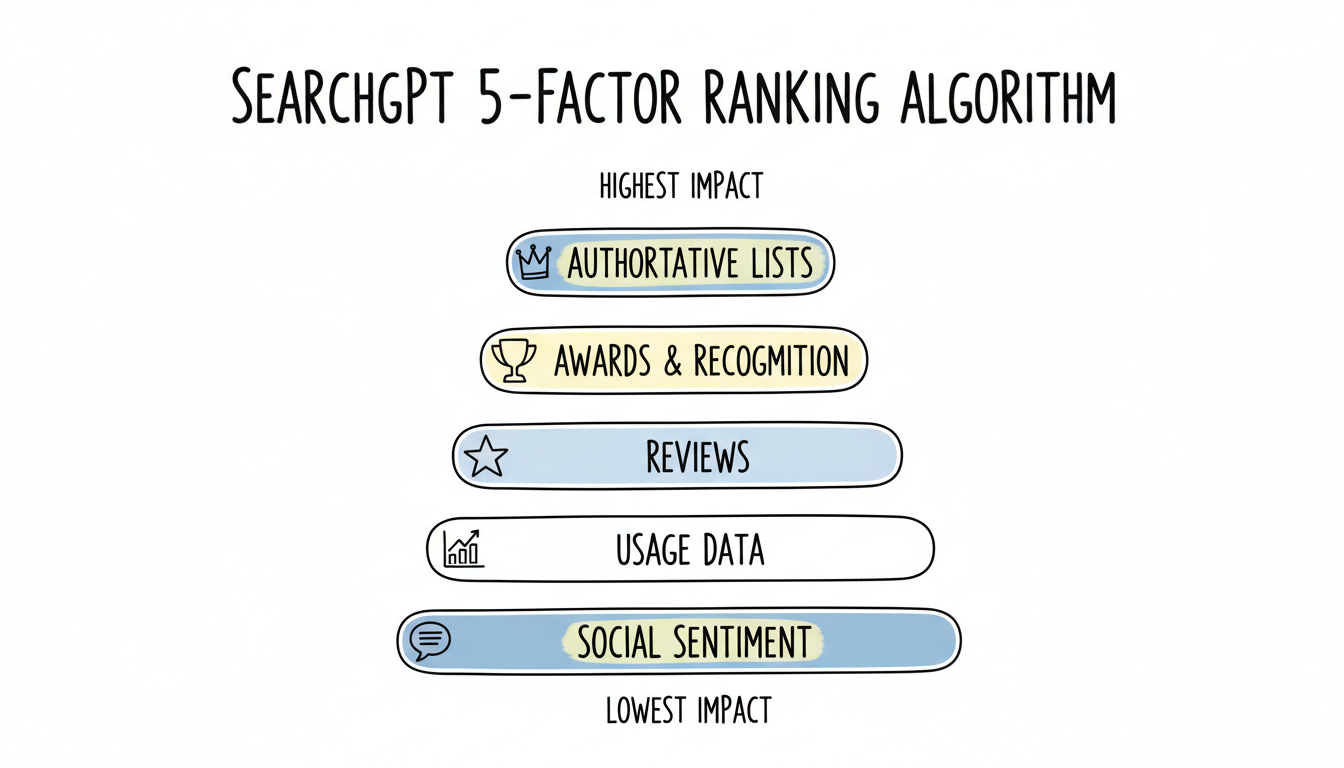
FirstPageSage's analysis has identified five key factors that determine SearchGPT visibility, ranked by importance:
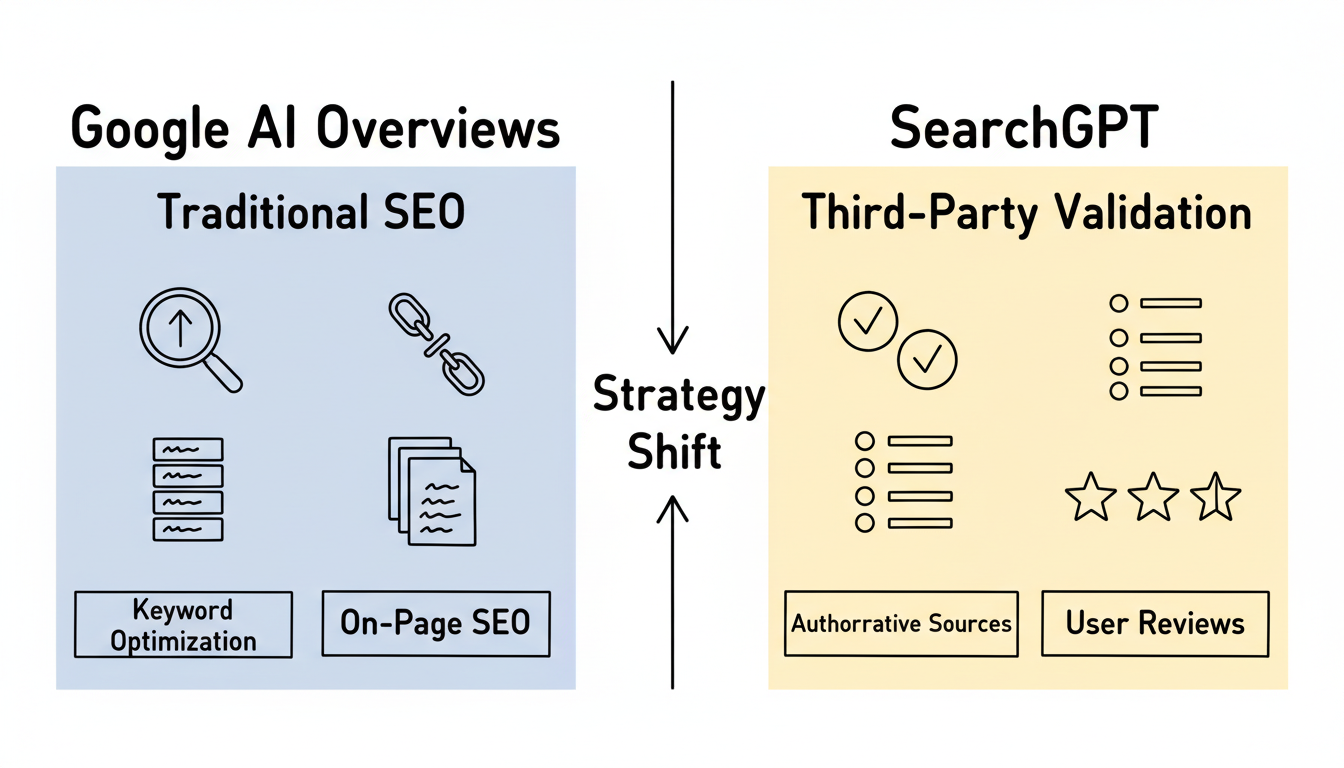
This hierarchy differs significantly from traditional SEO factors. While Google weighs backlinks, on-page optimization, and technical SEO heavily, SearchGPT prioritizes third-party validation and real-world reputation signals. Understanding these distinctions becomes crucial when implementing a comprehensive AEO strategy framework that spans multiple AI search platforms.
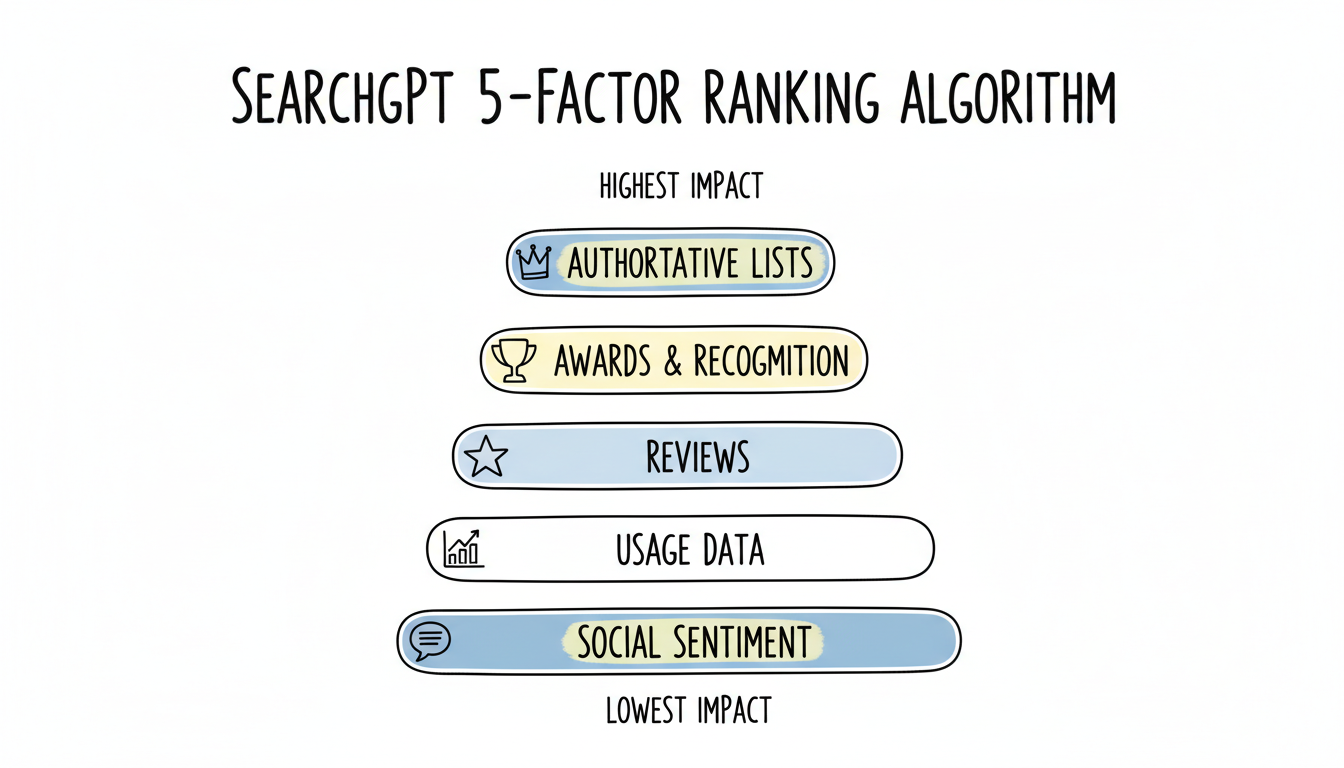
SearchGPT's algorithm reflects its core purpose: providing users with trustworthy recommendations. Rather than relying on self-reported claims or optimized landing pages, SearchGPT looks for external validation that a business is genuinely respected in its industry.
This shift requires a fundamental change in SEO strategy—from optimizing your own properties to building a reputation ecosystem across the web.
Authoritative list placement carries the most weight in SearchGPT's ranking algorithm. When SearchGPT encounters a query like "best AI SEO agencies," it prioritizes sources that appear on trusted, curated lists.
Industry-Specific Lists:
Geographic Lists:
Niche Authority Lists:
According to FirstPageSage, companies appearing on multiple authoritative lists see significantly higher SearchGPT citation rates compared to those relying solely on traditional SEO. This approach aligns with broader AEO marketing strategies that emphasize third-party validation.
Major reference directories serve as foundational data sources for SearchGPT. These platforms are trusted implicitly by AI systems due to their editorial standards and verification processes.
Tier 1 (Highest Authority):
Tier 2 (Strong Authority):
Tier 3 (Supporting Authority):
Wikipedia remains the most influential directory for SearchGPT visibility. However, Wikipedia has strict notability requirements and prohibits self-promotion. Effective approaches include:
For all directory profiles:
These directory optimizations form a critical component of technical AEO optimization, ensuring AI systems can discover and verify your business information across trusted sources.
Awards and media recognition provide third-party validation that SearchGPT weights heavily. Unlike self-reported claims, awards represent external verification of excellence.
Industry Awards:
Business Awards:
Regional Recognition:
Winning an award matters less than how searchable that win becomes:
Media mentions amplify your SearchGPT visibility:
Review platforms serve as social proof that SearchGPT actively incorporates into recommendations. A strong review profile signals market validation and customer satisfaction, much like how reviews influence visibility across enterprise AI search copilot platforms.
B2B Software/Services:
B2C Services:
Professional Services:
Volume: SearchGPT considers review quantity as a signal of market presence. Active review collection programs are essential.
Recency: Recent reviews carry more weight than historical ones. Maintain consistent review velocity throughout the year.
Diversity: Reviews across multiple platforms signal broader market validation than concentration on a single site.
Response Rate: Actively responding to reviews (positive and negative) demonstrates engagement and customer service commitment.
Community discussions on platforms like Reddit and Quora provide SearchGPT with real-world usage signals and sentiment data. These platforms capture authentic user opinions that SearchGPT incorporates into its recommendations.
Reddit:
Quora:
LinkedIn:
While SearchGPT's algorithm differs from traditional SEO, domain authority still matters. A strong domain provides the foundation that other visibility factors build upon.
Technical Excellence:
Content Quality:
Link Profile:
Google's E-E-A-T framework (Experience, Expertise, Authoritativeness, Trustworthiness) also influences SearchGPT visibility:
According to Search Engine Land, AI search engines increasingly rely on E-E-A-T signals to filter authoritative sources from less reliable content. This emphasis on expertise mirrors the requirements outlined in AEO implementation services for building AI-ready content architectures.
Understanding how SearchGPT's real-time data access differs from ChatGPT's static knowledge base is crucial for optimization.
Standard ChatGPT:
For businesses exploring both platforms, understanding ChatGPT optimization tactics remains important for conversational AI visibility.
SearchGPT's real-time access means:
Because SearchGPT accesses real-time data:
As AI-powered search features proliferate, understanding the differences between SearchGPT and Google AI Overviews helps optimize for both. The google-ai-overviews-official-platform-guide provides comprehensive details on Google's approach.
According to Google's official guidance, there are no special requirements for AI Overviews optimization—standard SEO best practices apply:
Google AI Overviews pull from existing search rankings, meaning pages that rank well organically are more likely to appear in AI Overviews. Businesses concerned about their presentation can also explore strategies for disabling google-ai-overviews-when-and-how when appropriate.
SearchGPT's algorithm, by contrast:
Understanding these algorithmic differences is essential when developing a unified AEO vs GEO strategy that addresses both answer engines and generative engine optimization.
For maximum AI search visibility in 2026:
Factor | Google AI Overviews | SearchGPT |
Primary Focus | Traditional SEO | Third-party validation |
Content Strategy | Comprehensive, keyword-optimized | Authority-building across web |
Link Building | Quality backlinks | Directory and list inclusion |
Reviews | Google Reviews impact | Multi-platform review profile |
Technical SEO | Critical | Important but secondary |
Tracking your SearchGPT performance requires different metrics than traditional SEO. For comprehensive visibility tracking across AI platforms, refer to our guide on searchgpt-citation-tracking-measuring-visibility.
Citation Tracking:
Supporting Metrics:
Manual Testing:
Automated Monitoring:
While dedicated SearchGPT analytics tools are still emerging in 2026, effective monitoring combines:
A B2B SaaS company implemented SearchGPT optimization strategies over six months with measurable results, following a structured AEO optimization timeline.
Month 1-2: Foundation Building
Month 3-4: Authority Building
Month 5-6: Amplification
Metric | Before | After | Change |
SearchGPT citations | 2/month | 14/month | +600% |
Directory listings | 5 | 20 | +300% |
Total reviews | 23 | 78 | +239% |
Authoritative list placements | 1 | 5 | +400% |
Media mentions | 3/year | 12/6mo | +700% |
These results demonstrate the effectiveness of professional AEO services case studies that prioritize systematic third-party validation over traditional SEO tactics.
SearchGPT optimization requires a fundamentally different approach than traditional SEO. Rather than focusing primarily on on-page optimization and link building, success in SearchGPT requires building a comprehensive reputation ecosystem.
Immediate (This Month):
Short-Term (Next Quarter): 4. Apply for relevant industry awards 5. Develop thought leadership for media coverage 6. Establish social monitoring and response
Ongoing: 7. Maintain fresh, authoritative content 8. Track SearchGPT citation patterns 9. Adjust strategy based on algorithm changes
As AI search engines continue evolving, the emphasis on third-party validation and real-world reputation signals will likely increase. Businesses that invest in genuine authority building—rather than gaming algorithms—will maintain sustainable visibility across SearchGPT, Google AI Overviews, Perplexity, and future AI search platforms. For businesses evaluating whether to invest in these emerging channels, examining the knowledge-graph-roi can help justify the resource allocation for comprehensive AEO programs.
The companies winning in AI search in 2026 are those that understand a fundamental truth: AI systems are designed to surface genuinely authoritative, trustworthy sources. Building that authority requires consistent effort across multiple channels, but the results—sustainable visibility across the AI search ecosystem—make the investment worthwhile.
By submitting this form, you agree to our Privacy Policy and Terms & Conditions.