February 19, 2026


The search landscape has splintered. Traditional SEO now shares the stage with two distinct but related disciplines: Answer Engine Optimization (AEO) and Generative Engine Optimization (GEO). While these terms sometimes get used interchangeably, they represent fundamentally different approaches to AI search visibility—and understanding the distinction matters for building an effective 2026 strategy.
This comprehensive guide breaks down AEO vs GEO, explaining what each discipline optimizes for, when to prioritize one over the other, and how they work together in a unified AI search strategy.
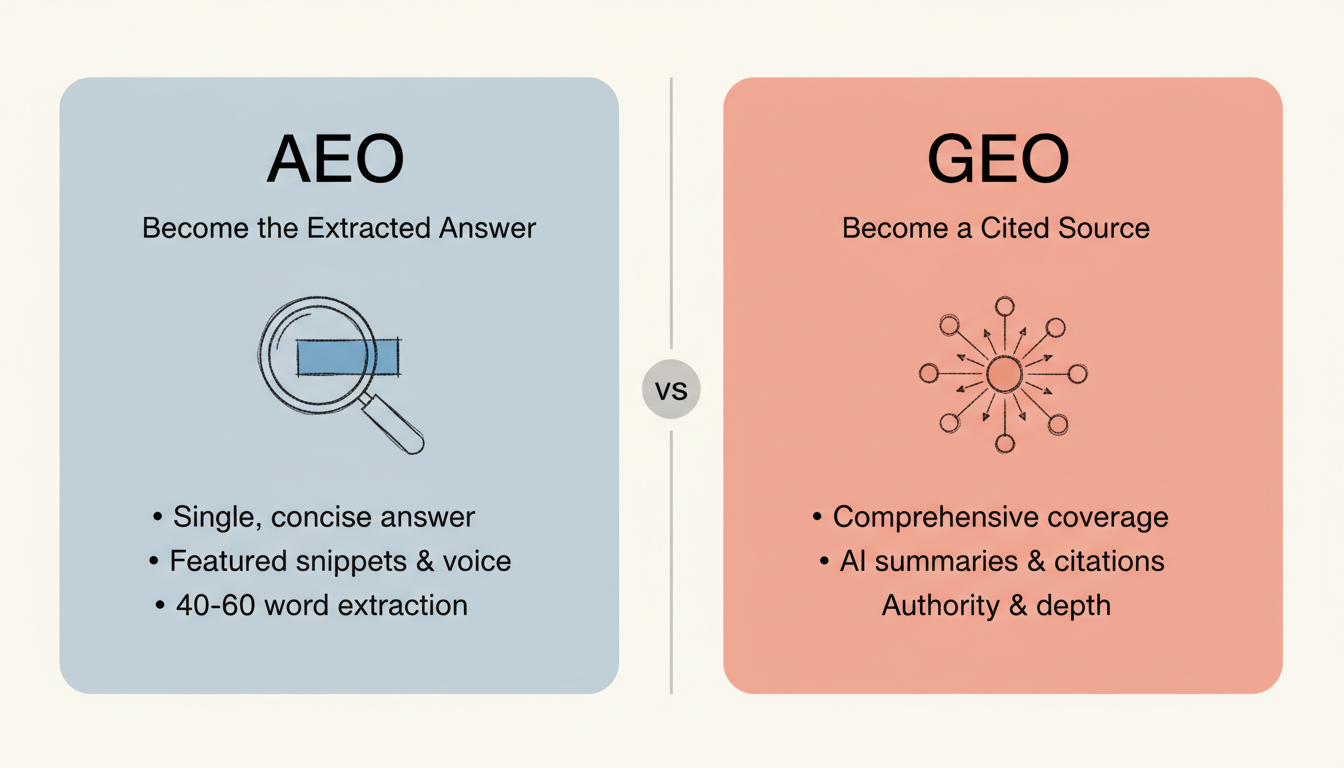
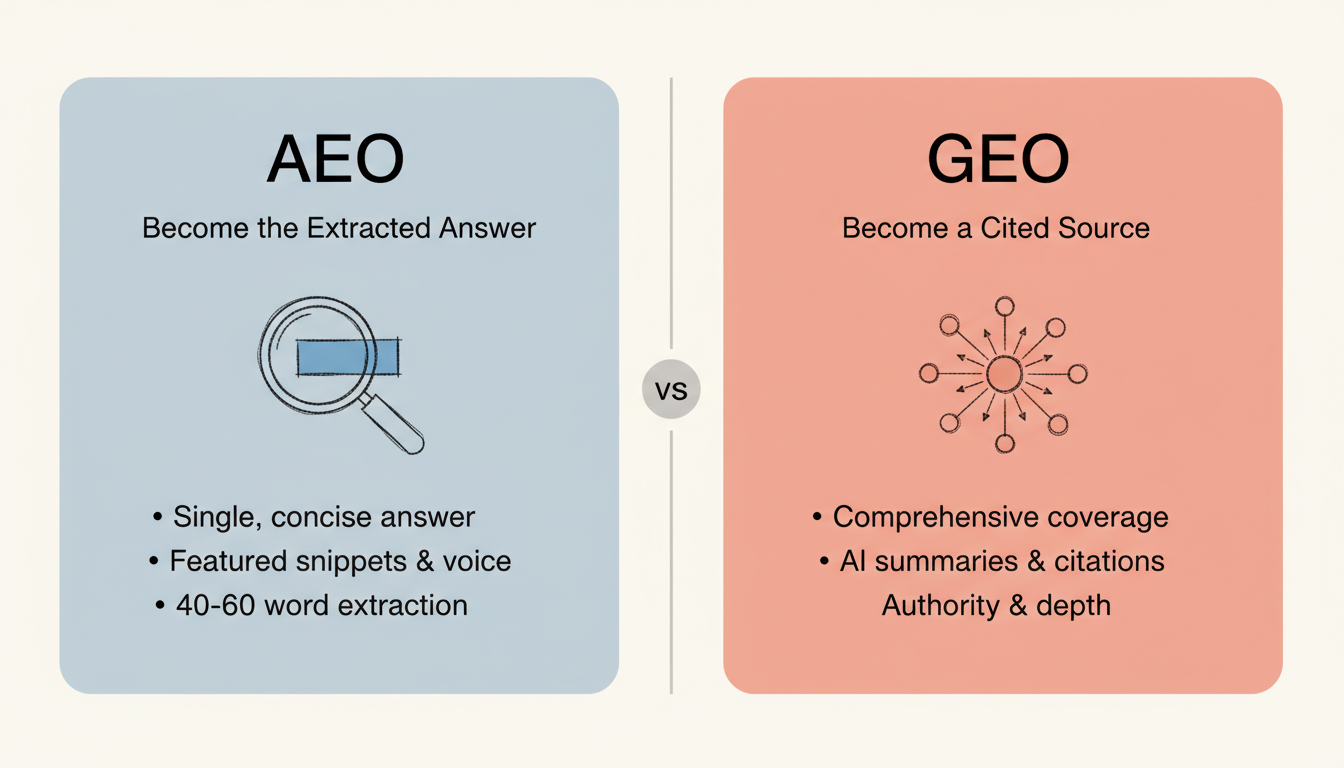
Answer Engine Optimization focuses on making your content the direct answer to user questions. AEO strategy targets the mechanisms that extract and display answers directly in search results—featured snippets, People Also Ask boxes, voice search responses, and knowledge panels.
AEO asks: "How do I become the extracted answer?"
When someone searches "what temperature kills salmonella," Google doesn't want them to click through multiple sites. It wants to display the answer immediately. AEO optimizes content to be that extracted answer.
Target | Description |
Featured snippets | The "Position Zero" boxes displaying direct answers |
People Also Ask | Expandable question/answer boxes in search results |
Voice search | Responses from Alexa, Siri, Google Assistant |
Knowledge panels | Structured information boxes for entities |
Quick answers | Direct responses in search result pages |
Question-answer formatting: Structure content with clear questions as headers and concise answers immediately following. The answer should be extractable in 40-60 words.
Structured data markup: Implement FAQ, HowTo, and QAPage schema to signal answer-ready content to search engines.
Concise, definitive statements: AEO rewards content that provides clear, authoritative answers without hedging or burying information.
List and table optimization: Numbered steps and comparison tables get extracted more frequently than prose paragraphs.
Generative Engine Optimization focuses on making your content citable, synthesizable, and reference-worthy for AI systems that generate responses. Rather than extracting a single answer, generative AI systems like ChatGPT, Perplexity, and Google's AI Overviews synthesize information from multiple sources into comprehensive responses.
GEO asks: "How do I become a trusted source that AI systems cite and draw from?"
When someone asks ChatGPT "what's the best project management methodology for startups," the AI doesn't extract one answer—it synthesizes information from many sources, potentially citing several. Generative engine optimization (GEO) optimizes for inclusion in that synthesis.
Target | Description |
AI Overview citations | Sources linked in Google AI Overview responses |
ChatGPT references | Mentions and citations in ChatGPT responses |
Perplexity citations | Direct source links in Perplexity answers |
AI summary inclusion | Being synthesized into AI-generated summaries |
LLM training influence | Contributing to AI model knowledge |
Comprehensive topic coverage: AI systems favor sources that provide thorough, complete information they can draw from for various aspects of a topic.
Authoritative external citations: Content that references studies, research, and expert sources gets cited more frequently by AI systems that value verifiability.
Brand and entity establishment: Building clear entity identity helps AI systems recognize and reference your brand accurately across queries.
Unique data and insights: Original research, proprietary statistics, and novel perspectives give AI systems reasons to cite your content specifically.
Content freshness: AI systems weight recency, particularly for topics where information changes frequently.
Understanding the fundamental differences between AEO and GEO clarifies when each approach applies.
Aspect | AEO | GEO |
Primary goal | Become the extracted answer | Become a cited source |
Target format | Single, concise answer | Comprehensive, citable content |
Success indicator | Answer extraction | Citation inclusion |
Optimization focus | Featured snippets, voice | AI summaries, chatbots |
Content style | Concise, definitive | Thorough, authoritative |
Measurement | Snippet captures | AI citations |
AEO technical requirements:
GEO technical requirements:
AEO content approach:
GEO content approach:
AEO delivers strongest results for specific use cases.
Definitional queries: "What is" and "definition of" searches where users want quick, clear answers.
How-to questions: Step-by-step queries where numbered processes get extracted as featured snippets.
Voice search optimization: Queries commonly asked via smart speakers and voice assistants require AEO-optimized answers.
Quick reference content: Specifications, conversions, formulas, and factual lookups benefit from AEO formatting.
Local business queries: "Near me" and local intent questions often trigger direct answer boxes.
Consider prioritizing AEO when:
GEO proves more valuable for different scenarios.
Complex research queries: Multi-faceted questions where AI systems synthesize information from multiple sources.
Comparison and evaluation: "Best," "vs," and comparison queries where AI systems aggregate perspectives.
Strategic and advisory topics: Business, health, and financial topics where AI systems cite authoritative sources.
Brand visibility goals: When AI mention frequency and brand accuracy matter for reputation.
Emerging topic authority: New subject areas where establishing citation presence builds long-term visibility.
Consider prioritizing GEO when:
The most effective 2026 AI search strategies don't choose between AEO and GEO—they integrate both approaches based on content type and user intent.
Industry analysis suggests AEO and GEO are converging. The techniques that win featured snippets increasingly overlap with those that earn AI citations. By 2027, the distinction may matter less as AI systems unify answer extraction and citation patterns.
However, understanding the difference between SEO vs AEO today helps optimize content for current platform behaviors.
Foundation layer (GEO): Build comprehensive, authoritative content that AI systems trust and cite. Establish entity identity, topical authority, and citation-worthy depth.
Extraction layer (AEO): Within comprehensive content, format specific sections for answer extraction. Include FAQ sections, clear definitions, and step-by-step processes.
Monitoring layer: Track both featured snippet captures and AI citation mentions to measure combined effectiveness.
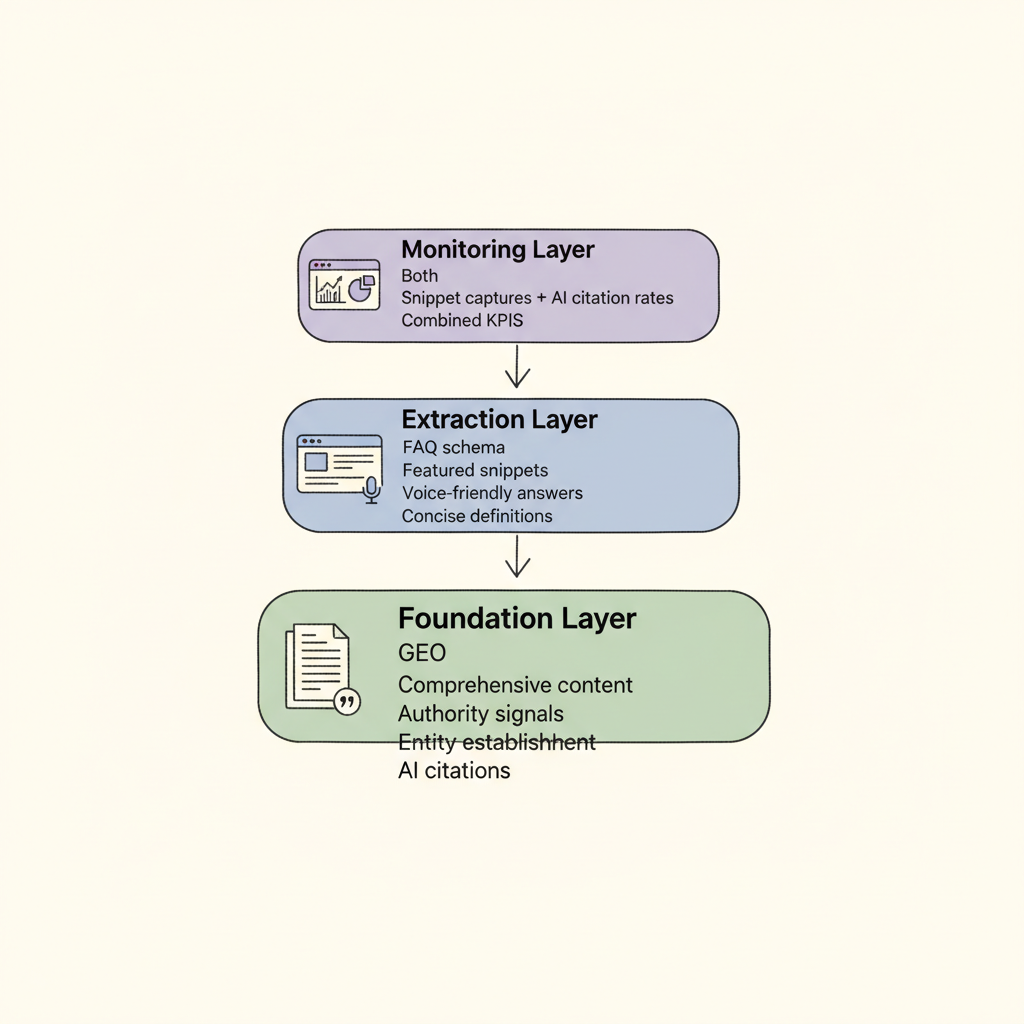
Effective content serves both AEO and GEO goals:
Different AI platforms weight AEO and GEO factors differently.
Google's AI Overviews maintain strongest correlation with traditional organic rankings (93.67%). Sites performing well in traditional SEO have advantages, but citation patterns increasingly diverge from ranking positions. Understanding Google AI Overview SEO impact requires balanced AEO + GEO with strong traditional SEO foundation.
ChatGPT relies heavily on parametric knowledge plus Bing integration. Citations match Bing's top 10 results 87% of the time. Focus: Bing optimization plus comprehensive, authoritative content for training data influence.
Perplexity indexes over 200 billion URLs with heavy Reddit citation patterns (46.5% of citations). Focus: GEO emphasis with real-time content freshness and community presence.
Google Assistant, Alexa, and Siri primarily extract single answers. Focus: AEO techniques—concise, structured, voice-friendly formatting.
Track distinct metrics for each discipline.
Metric | Tool |
Featured snippet captures | SEMrush, Ahrefs |
PAA appearances | SERP tracking tools |
Voice search rankings | Voice search audits |
Zero-click visibility | Search Console |
Metric | Tool |
AI Overview citations | Otterly AI, Scrunch AI |
ChatGPT mentions | Brand monitoring tools |
Perplexity citations | Manual tracking, APIs |
AI mention sentiment | Brand accuracy audits |
Start with these practical steps to implement both AEO and GEO.
Gartner predicts conventional search traffic will decline 50% by 2028 as AI systems capture more queries. Whether that traffic shifts toward answer extraction (AEO) or AI synthesis (GEO), businesses optimizing for both disciplines now build advantages that compound over time.
The distinction between AEO and GEO may blur, but the underlying principle remains: make your content the most authoritative, useful, and accessible source for whatever mechanism delivers answers to your audience. In 2026, that means mastering both the art of the extractable answer and the science of AI citation worthiness.
By submitting this form, you agree to our Privacy Policy and Terms & Conditions.