February 19, 2026


Last Updated: January 2026
For SEO professionals, the emergence of Answer Engine Optimization (AEO) raises practical questions. Does AEO replace SEO? Should resources shift away from traditional tactics? How do these disciplines intersect?
This guide examines the SEO vs AEO relationship from a practitioner's perspective—clarifying what changes, what stays the same, and how to integrate both approaches effectively.
Traditional SEO hasn't become obsolete. The core practices that drive organic visibility remain effective:
Research shows that Google AI Overviews draw heavily from pages already ranking in traditional results. Pages with strong organic rankings have significantly higher chances of appearing in AI-generated responses.
The foundation matters. Understanding key differences between SEO and AEO helps clarify that AEO builds on SEO—it doesn't bypass it.
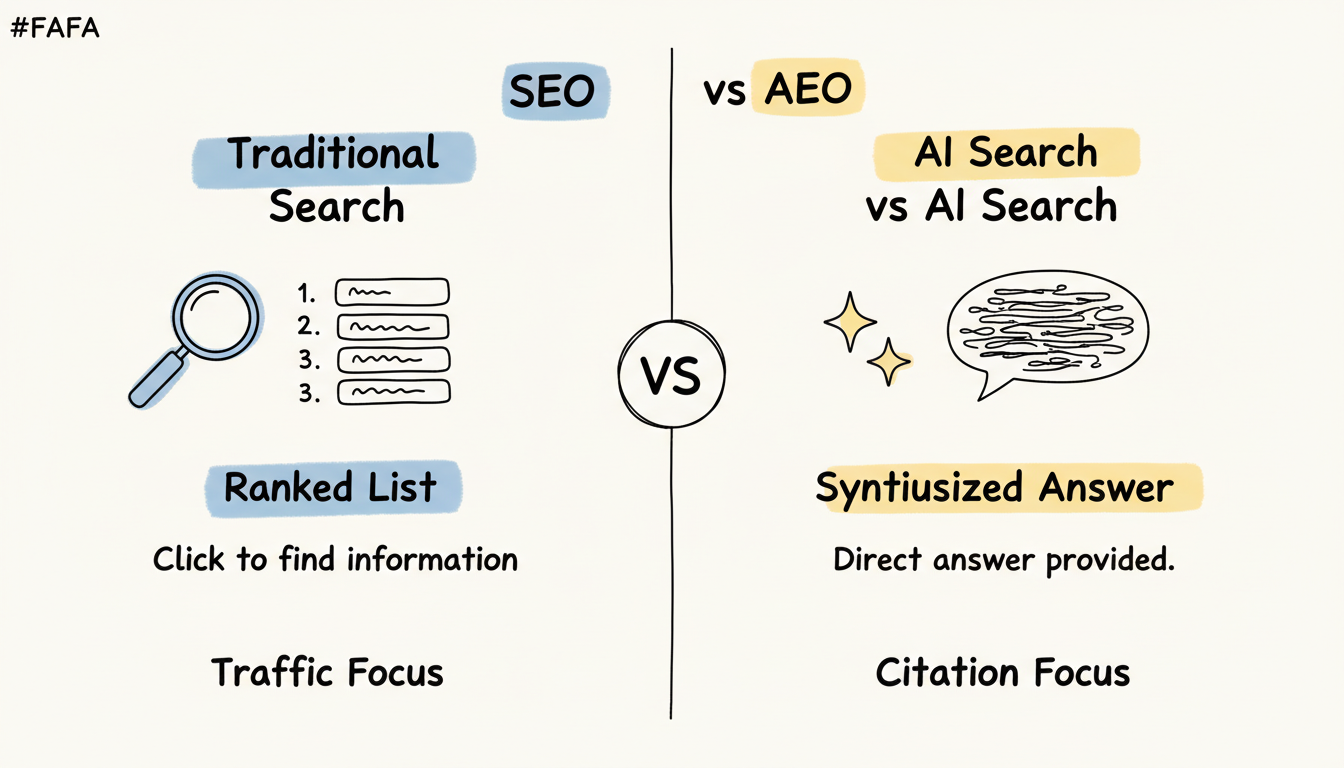
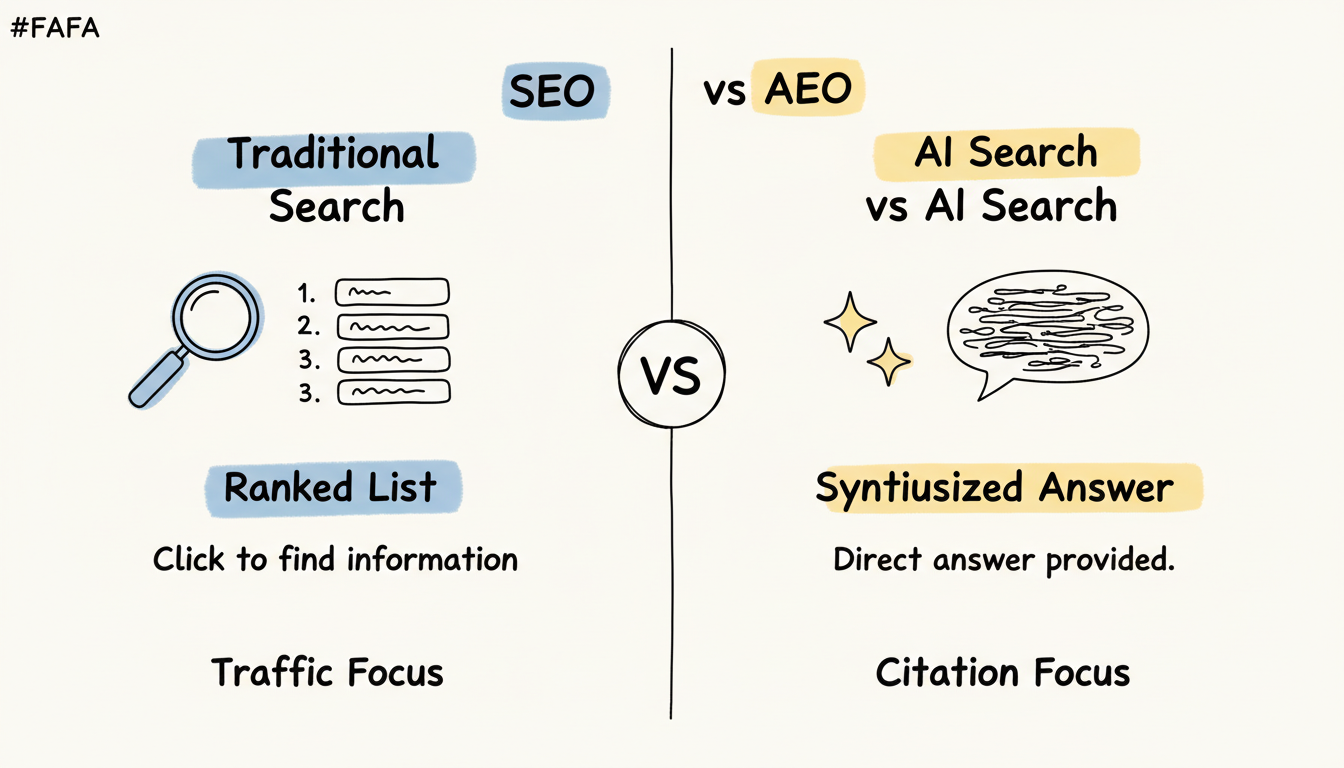
While SEO gets content indexed and ranked, AEO gets content cited. The distinction matters because AI search changes user behavior:
Traditional Search | AI Search |
User sees ranked list | User sees synthesized answer |
User clicks to find information | User may get answer directly |
Traffic is the primary metric | Citation is the primary metric |
Rankings determine visibility | Selection determines visibility |
AEO addresses this shift through optimization tactics that make content more extractable and quotable by AI systems.
Understanding the practical differences helps prioritize optimization efforts.
SEO approach: Comprehensive pages that thoroughly cover topics, often with 1,500+ words, targeting keyword density and topical completeness.
AEO approach: Modular content with clear, extractable statements. Short paragraphs (under 80 words) that stand alone when quoted. Key information front-loaded after every heading.
SEO metrics: Rankings, organic traffic, click-through rates, time on page, bounce rate.
AEO metrics: Citation frequency and other key AEO optimization metrics, AI referral traffic, share of voice in AI responses, citation accuracy.
SEO optimization: Title tags, meta descriptions, header hierarchy, internal linking, backlink acquisition, page speed.
AEO optimization: FAQ sections, schema markup, entity consistency, content freshness, cross-platform presence, quotable statements.
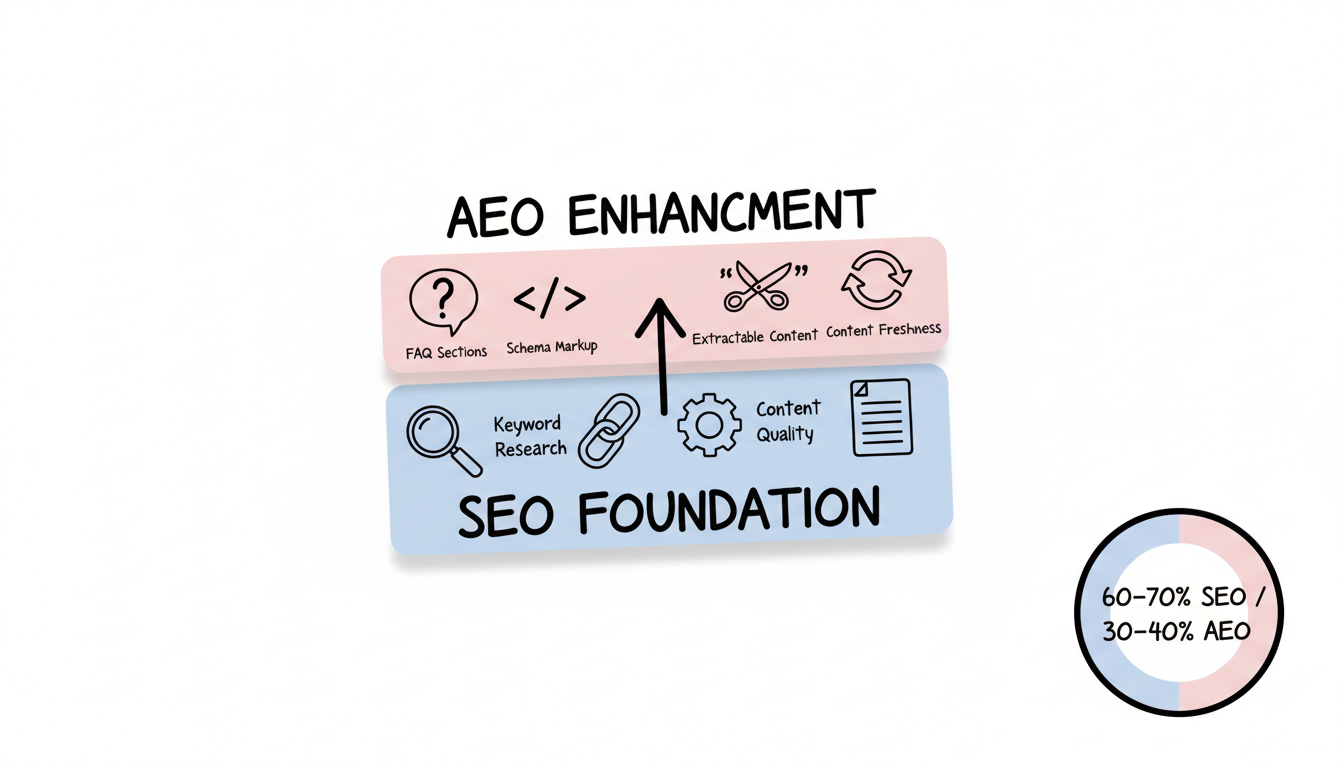
Effective digital visibility in 2026 requires both disciplines. Here's how to integrate them:
Don't rebuild from scratch. Take content that already ranks well and enhance it for AI extraction:
Following proven AEO best practices for 2026 ensures your enhancements align with current AI platform requirements.
Traffic-focused goals: Emphasize traditional SEO. Rankings still drive the majority of organic clicks.
Brand visibility goals: Emphasize AEO. AI citations build awareness even without clicks.
Comprehensive visibility: Balance both. Start with SEO foundations, layer AEO enhancements.
For most teams, a reasonable split:
This ratio shifts as AI search adoption grows, but SEO fundamentals remain the foundation.
Unlikely. AI search platforms rely on web content that SEO makes discoverable and credible. Without SEO producing authoritative, indexed content, AI systems would have little to cite.
No. Domain authority still correlates with AI citations. Backlinks signal trustworthiness to both traditional algorithms and AI systems.
False. Research shows substantial overlap between top organic results and AI Overview citations. Strong rankings increase AI visibility, not decrease it.
Not entirely. The same quality content serves both purposes—AEO optimization is often about restructuring existing content rather than creating entirely new material.
For teams with established SEO practices, adding AEO involves incremental changes:
Immediate actions:
Short-term improvements:
Ongoing integration:
Many organizations benefit from working with an experienced AEO agency to accelerate implementation while maintaining SEO fundamentals.
SEO isn't going anywhere. Traditional optimization remains essential for discoverability, authority, and the foundation that AI systems build upon.
AEO extends SEO's reach. Rather than replacing rankings, AEO captures visibility in the new AI search landscape.
Integration beats replacement. The most effective approach layers AEO onto strong SEO fundamentals rather than choosing one over the other.
Start with what you have. Existing high-ranking content is the best candidate for AEO enhancement. Restructure before you rebuild.
No. SEO remains fundamental to organic visibility. AEO optimization complements SEO but depends on the foundation that traditional optimization provides. Continue SEO practices while adding AEO enhancements.
SEO success measures rankings and traffic. AEO success measures citation frequency and AI referral traffic. Track AI visits in analytics by filtering traffic from perplexity.ai, chat.openai.com, and similar sources. Use specialized tools like Otterly.AI to monitor citations.
The core skills overlap—content strategy, technical implementation, data analysis. AEO adds emphasis on content structuring, schema implementation, and entity optimization. Most SEO practitioners can adapt existing skills with targeted upskilling.
SEO first. Build the foundation that enables both organic rankings and AI citations. Once SEO fundamentals are solid, allocate time to AEO enhancements starting with your highest-performing content.
By submitting this form, you agree to our Privacy Policy and Terms & Conditions.