
February 19, 2026


Answer engine optimization has evolved from experimental tactic to essential strategy. With over 400 million weekly ChatGPT users and 60% of searches ending without clicks, brands must master the practices that earn citations in AI-generated responses. This comprehensive checklist covers proven AEO optimization techniques for visibility across ChatGPT, Perplexity, Google AI Overviews, and voice assistants.
According to Connect Media Agency's AEO guide, answer engine optimization helps optimize content for AI-powered search platforms like ChatGPT, Perplexity, Google's AI Overviews, and voice assistants such as Siri and Alexa. SEO helps search engines find your content—AEO helps AI understand and use it.
Understanding the core difference between traditional SEO and AEO is essential before implementing best practices.
According to LinkedIn analysis on mastering AEO, the distinction is straightforward: SEO ranks pages while AEO delivers answers. AI tools prefer clear, short, and structured answers. Voice search queries are increasing rapidly, and users want instant answers rather than long articles.
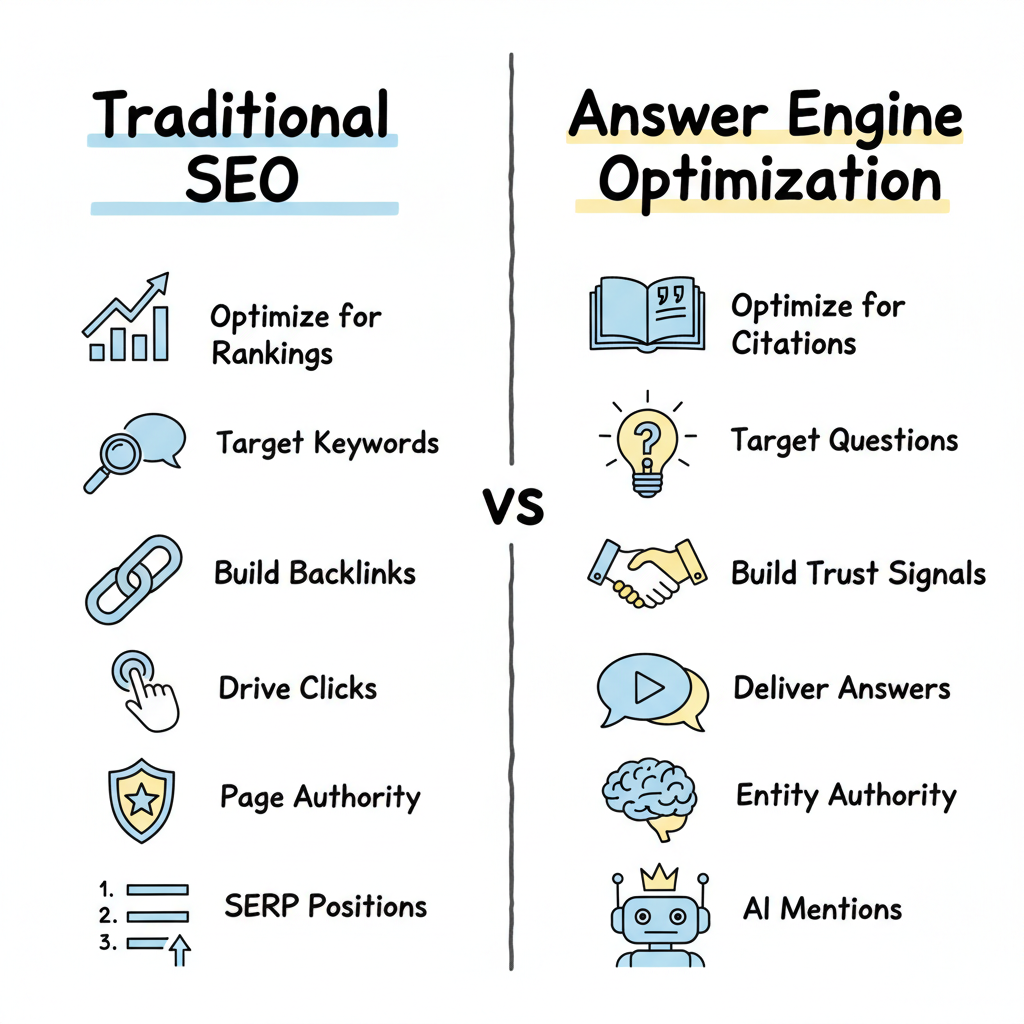
The strategic difference:
Traditional SEO | Answer Engine Optimization |
Optimize for rankings | Optimize for citations |
Target keywords | Target questions |
Build backlinks | Build trust signals |
Drive clicks | Deliver answers |
Page authority | Entity authority |
SERP positions | AI mentions |
According to Addlly AI's AEO guide, answer engine optimization is the process of getting your brand, product, or service visible and represented accurately in AI-generated answers, including ChatGPT, Perplexity, or Google AI Overview.
The most critical structural change for AEO success involves leading with direct answers rather than building to them.
According to HubSpot's AEO checklist video, the first AEO best practice is putting the answer first. AI systems look for immediate, clear responses they can extract and cite—burying answers deep in content reduces citation probability significantly.
Answer-first implementation:
Traditional Content Structure
├── Introduction with context
├── Background information
├── Building to the main point
└── Answer near the end

AEO-Optimized Structure
├── Direct answer in first 1-2 lines
├── Supporting context
├── Additional details
└── Related considerations
Practical guidelines:
According to SEOProfy's AEO vs SEO analysis, the AEO strategies that work best right now include short and direct answers, conversational subheadings and FAQs, and citations from authoritative sources.
Content structure determines whether AI systems can effectively identify, extract, and cite your information. Following proven AI search content structure principles ensures your content is machine-readable and citation-ready.
According to LinkedIn's AEO guide, effective AEO requires clear, well-structured headings (H1-H3), simple natural language that sounds human, bullet points and numbered lists, and FAQ-style content that improves AI and snippet visibility.
Structural elements that work:
Element | Purpose | Implementation |
Question-based H2s | Signal answerable content | "What is..." / "How to..." format |
Bullet lists | Provide extractable points | 3-7 concise items per list |
Numbered lists | Show step-by-step processes | Clear sequence with brief descriptions |
Tables | Present comparative data | 3-5 columns with clear headers |
Short paragraphs | Enable clean extraction | 2-4 sentences maximum |
The heading hierarchy:
Optimal Heading Structure
├── H1: Primary topic (one per page)
│   ├── H2: Major subtopics (question format)
│   │   ├── H3: Supporting details
│   │   └── H3: Additional context
│   └── H2: Next major subtopic
│       ├── H3: Supporting details
│       └── H3: Additional context
└── Consistent pattern throughout
FAQ sections have become essential for AEO, providing structured question-and-answer content AI systems can easily parse.
According to HubSpot's Field Notes, adding FAQs is a critical AEO best practice that significantly improves visibility in AI-generated answers. FAQ schema combined with well-structured Q&A content creates multiple citation opportunities.
FAQ optimization guidelines:
Guideline | Implementation | Why It Works |
Real questions | Use actual search queries | Matches user intent exactly |
Concise answers | 40-60 words per answer | Fits AI extraction preferences |
Natural language | Conversational tone | Mirrors voice search queries |
Comprehensive coverage | 5-15 FAQs per page | Addresses multiple query variations |
Schema markup | FAQPage JSON-LD | Machine-readable structure |
FAQ content sources:
AI systems prioritize unique, authoritative content over aggregated information from multiple sources.
According to HubSpot's AEO checklist, including original insights is a critical best practice that differentiates content from competitors. AI systems seek sources with unique perspectives, proprietary data, and expert analysis they can cite confidently.
Types of original content that earn citations:
Original Content Types
├── Proprietary Research
│   ├── Survey data
│   ├── Industry analysis
│   └── Trend reports
│
├── Expert Perspectives
│   ├── Named author insights
│   ├── Professional experience
│   └── Unique methodologies
│
├── Case Studies
│   ├── Specific results
│   ├── Process documentation
│   └── Lessons learned
│
└── Data Journalism
    ├── Original data analysis
    ├── New conclusions
    └── Visual data presentation
According to Nicklafferty's AEO platform analysis, based on Profound's analysis of 2.6 billion citations across AI platforms, content with original data and unique insights significantly outperforms aggregated content in citation frequency.
Schema markup provides explicit signals that help AI systems understand, categorize, and cite content accurately. Implementing the right schema types is crucial for any comprehensive AEO optimization tutorial.
According to Addlly AI, schema markup helps answer engines, AI platforms, and search engines understand your content and identify direct answers. Proper implementation is essential for AEO success.
Essential schema types for AEO:
Schema Type | Use Case | AEO Benefit |
FAQPage | Q&A content | Direct answer extraction |
HowTo | Tutorials, guides | Step extraction for summaries |
Article | Blog posts, news | Content categorization |
Organization | Brand pages | Entity recognition |
Person | Author profiles | E-E-A-T signals |
Product | Product pages | Feature and spec extraction |
Implementation checklist:
Voice search represents a significant portion of answer engine queries, requiring specific optimization approaches. Proper mobile AEO optimization ensures your content performs well across voice-activated devices and mobile search interfaces.
According to Addlly AI, optimizing content for voice search helps answer engines find and deliver your information quickly, improving visibility in voice search results and AI-generated answers across platforms like Google Assistant, ChatGPT, and Perplexity AI.
Voice search optimization tactics:
Tactic | Implementation | Example |
Natural language | Conversational phrasing | "How do I..." not "How to..." |
Question targeting | Full question as heading | "What is the best way to..." |
Concise answers | 29 words average | Featured snippet length |
Local intent | Location modifiers | "Near me" variations |
Long-tail focus | 7-10 word queries | Complete question phrases |
Voice query patterns to target:
Voice Search Query Types
├── What is...? (Definitional)
├── How do I...? (Procedural)
├── Why does...? (Explanatory)
├── Which is...? (Comparative)
├── Where can I...? (Locational)
├── When should I...? (Temporal)
└── Who provides...? (Entity-based)
AI systems evaluate source trustworthiness before citation, making entity authority development essential.
According to Laura Jawad Marketing's GEO strategies, when your business shows up consistently across the web, tied to a clear area of expertise, AI systems have more confidence referencing you when related questions come up.
Entity authority building:
Signal | Development Approach | Impact |
Cross-web consistency | Same NAP+E everywhere | Reduces AI confusion |
Expert authors | Named, credentialed individuals | E-E-A-T validation |
Third-party mentions | PR, media coverage | External validation |
Review signals | Ratings on multiple platforms | Trust indicators |
Brand mentions | Industry discussion participation | Awareness signals |
According to Kevin Indig's State of AI Search Optimization 2026, 85% of brand mentions in AI search for high purchase intent prompts come from third-party sources, making earned media critical for AEO success.
Traditional SEO metrics don't capture AEO performance—dedicated tracking is required.
According to SE Ranking's AI visibility tools comparison, the best AI search visibility tools run queries on LLM chatbots (ChatGPT, Anthropic Claude, Google Gemini, Perplexity) and keep a record of how often and in what contexts your brand or content is referenced.
Metrics to track:
Metric | What It Measures | Target |
Citation frequency | Brand mentions in AI answers | Increasing trend |
Mention sentiment | How AI describes your brand | Positive and accurate |
Platform coverage | Visibility across AI engines | All major platforms |
Citation context | Where in answers you appear | Primary source position |
Referral traffic | Visitors from AI sources | Growing percentage |
Recommended tracking tools:
According to LinkedIn's AEO tools ranking, AEO tools help companies track how often AI models mention their brand, understand competitor citations, and generate structured content that AI engines trust. Key platforms include Profound, SE Visible, Ahrefs Brand Radar, and Scrunch.
AI systems factor content recency into citation decisions, especially for time-sensitive topics. Understanding content freshness signals answer engines use when evaluating sources helps maintain competitive visibility.
According to Conductor's answer engine tracking guide, with ChatGPT representing nearly 90% of overall AI referral traffic, maintaining fresh, accurate content that AI systems can confidently cite has become essential for visibility.
Content freshness checklist:
AEO and SEO complement rather than replace each other—integrated strategies perform best.
According to Shopify's AEO guide, the similarities between AEO and SEO are only growing as AI answer engines rely more heavily on search results. Sources cited by ChatGPT and other AI-powered answer engines tend to rank in top positions in traditional Google search.
The integrated approach:
SEO + AEO Integration
├── Technical Foundation (Both)
│   ├── Fast page speed
│   ├── Mobile optimization
│   ├── Crawlable architecture
│   └── Schema markup
│
├── Content Strategy (Both)
│   ├── Quality, comprehensive content
│   ├── Answer-first structure (AEO focus)
│   ├── Keyword targeting (SEO focus)
│   └── E-E-A-T signals
│
├── Authority Building (Both)
│   ├── Backlinks (SEO focus)
│   ├── Entity signals (AEO focus)
│   ├── Brand mentions
│   └── Expert positioning
│
└── Measurement (Different)
    ├── Rankings and traffic (SEO)
    └── Citations and mentions (AEO)
According to SEO.com's AEO vs SEO comparison, combining AEO and SEO strategies maximizes online visibility across traditional search engines, AI-powered platforms, social media search engines, and voice assistants, ensuring content appears wherever users are searching.
Content Structure:
FAQ Implementation:
Technical Requirements:
Authority Signals:
Measurement Setup:
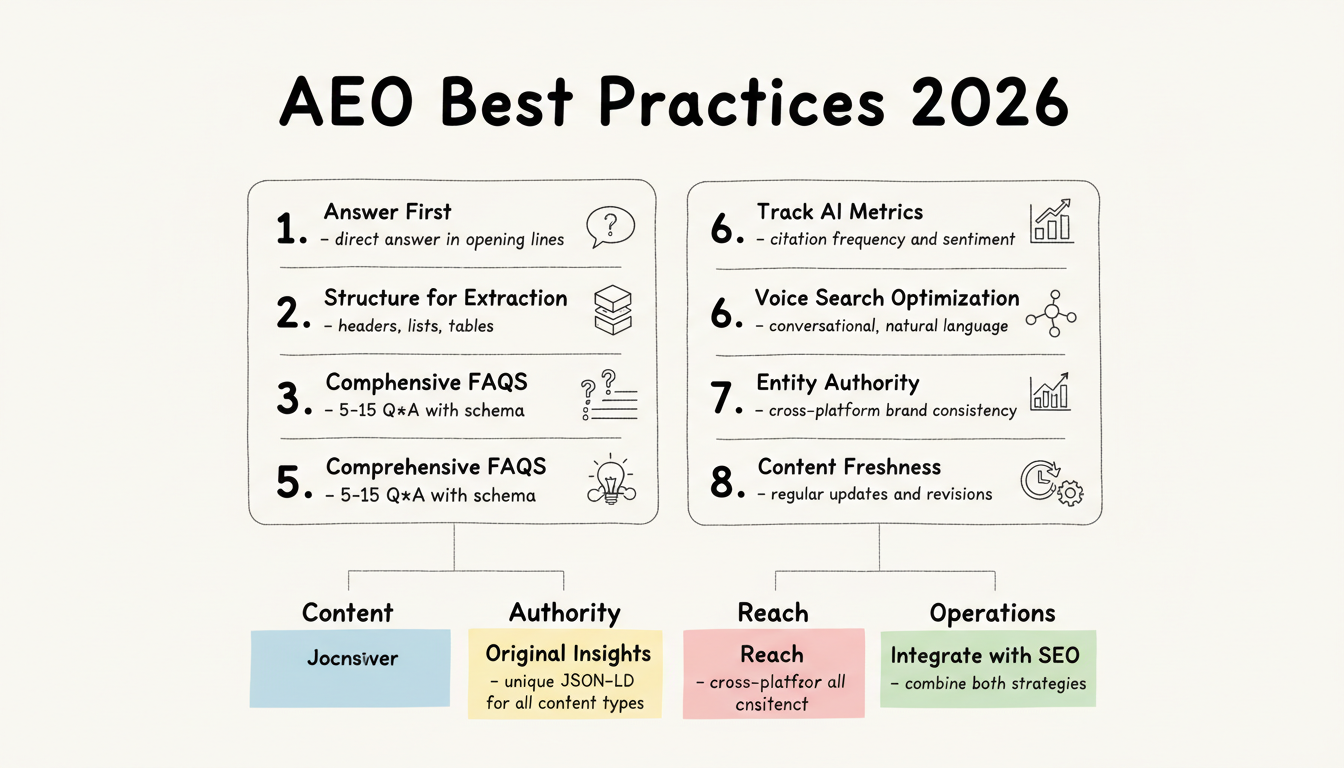
Implementing AEO best practices in 2026 requires systematic attention to content, technical, and authority factors:
Following these best practices positions brands for sustainable visibility as AI search continues to dominate discovery. The shift from traditional rankings to answer engine citations requires a methodical approach that balances content quality, technical implementation, and authority building.
By submitting this form, you agree to our Privacy Policy and Terms & Conditions.



