
February 19, 2026


AI search engines don't read content the way humans do. They process pages in chunks, extract specific passages, and cite sources that make their job easy. Your content's structure directly determines whether AI systems can find, understand, and cite your information.
According to Yoast's 2025 SEO analysis, structured content outperformed clever content across AI search systems. Clear headings, predictable formats, and direct answers made it easier for AI to extract and reuse information—no shortcuts required.
This guide provides the formatting framework that earns AI citations in 2026.
AI search systems—ChatGPT, Perplexity, Google AI Overviews—don't process content sequentially. They chunk pages into segments, evaluate each independently, and extract the most relevant passages.
According to PromptWire's LLM optimization research, content that forces a "scroll for value" interaction is often abandoned by retrieval agents. If the model has to parse 500 words of backstory to find the answer, the retrieval attempt typically fails.
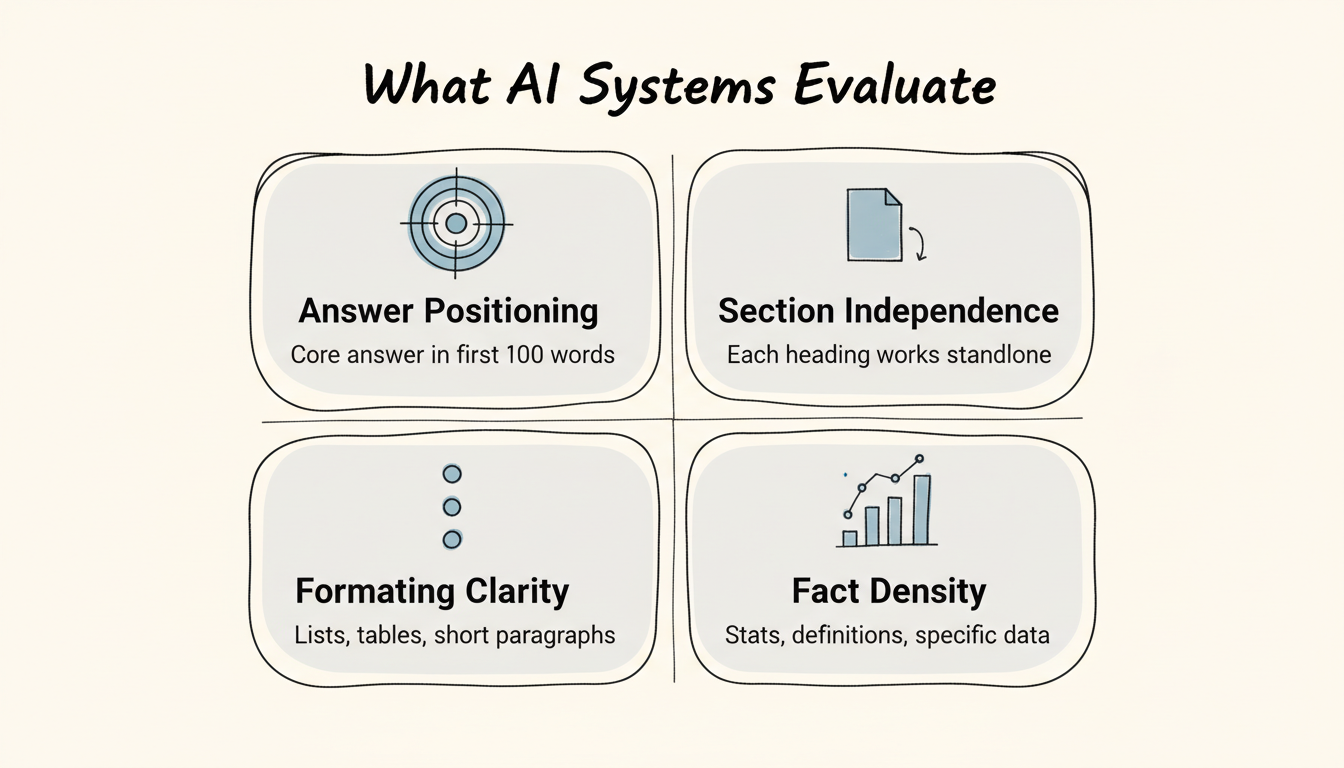
What AI systems evaluate:
Factor | What AI Looks For |
Answer positioning | Core answer in first 100 words |
Section independence | Each heading block works standalone |
Formatting clarity | Lists, tables, and short paragraphs |
Fact density | Statistics, definitions, specific data |
According to Kevin Indig's State of AI Search 2026, structure matters more than keyword density. LLMs extract and cite specific passages, so clear organization makes pages easier to parse and excerpt.
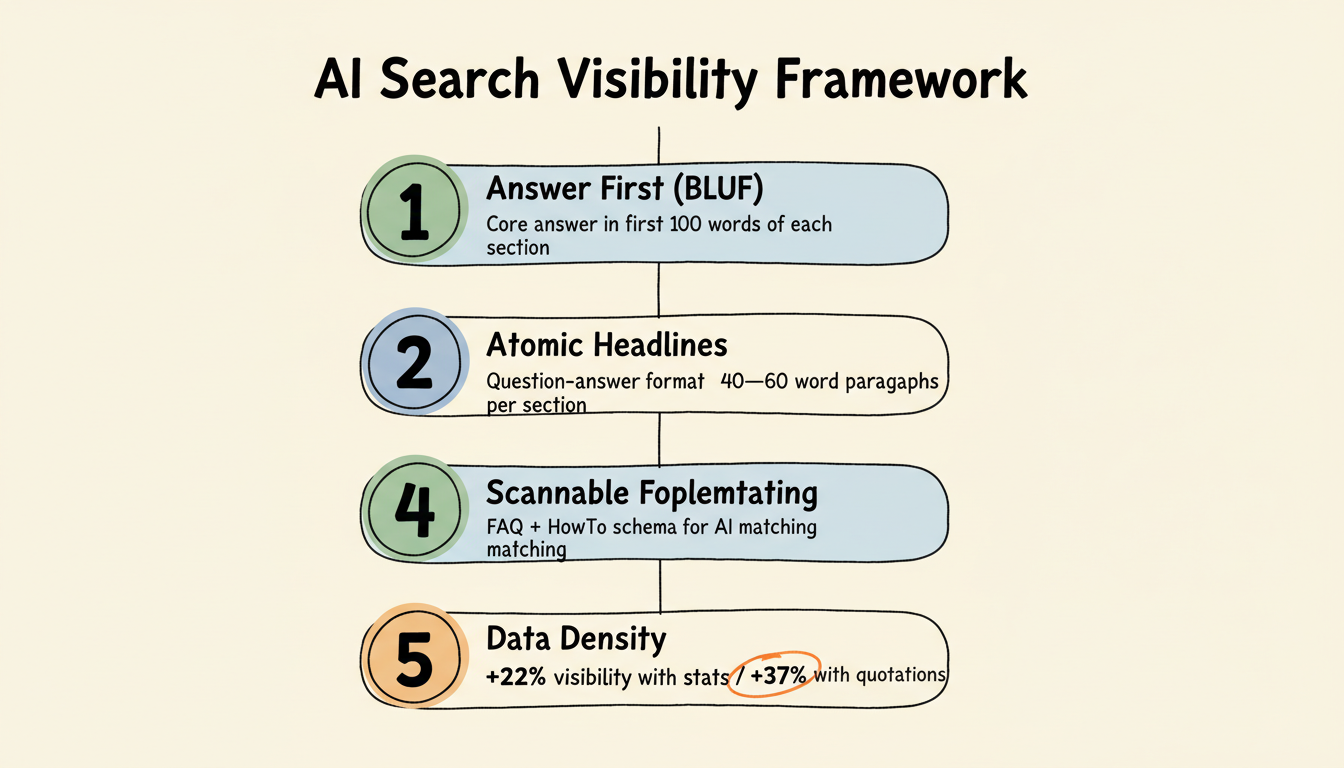
BLUF stands for "Bottom Line Up Front"—a military communication technique that puts the critical information first. This approach aligns perfectly with how AI systems retrieve content, particularly when optimizing for featured snippet optimization ai.
According to PromptWire, pages that fail to define the core topic immediately are consistently retrieved less frequently for definition-based queries.
Implementation:
Example structure:
## What Is Enterprise AI Search?

Enterprise AI search uses machine learning and natural language processing
to help employees find information across company systems. Unlike keyword-based
search, it understands intent and delivers relevant results from documents,
emails, and databases simultaneously.

[Then expand with implementation details, examples, use cases...]
According to SEO Sherpa's AI optimization guide, Perplexity processes content in chunks, not like a human reading top to bottom. Every heading, subheading, and paragraph must stand alone as a complete, answer-ready unit.
Atomic headline principles:
Heading structure that works:
Poor Heading | Better Heading |
Background | What Is AI Search and Why Does It Matter? |
Costs | How Much Does AI Search Implementation Cost? |
Benefits | What ROI Can You Expect from AI Search? |
Comparison | ChatGPT vs Perplexity: Which AI Search Is Better? |
According to Firebrand Marketing's GEO guide, modular sections help generative engines parse content. Each section should be independently valuable.
AI systems prefer scannable, structured content they can easily excerpt. Understanding these aeo optimization techniques conversion principles helps maximize visibility.
According to ALM Corp's AI ranking guide, content with bullet points and numbered lists receives more citations than dense paragraphs.
When to use lists:
Comparison tables are citation magnets. According to Search Engine Land's AI playbook, comparison tables make differences explicit and scannable—formats that consistently perform well in AI citations.
According to The Digital Bloom's AI visibility report, 40-60 word paragraphs provide optimal chunking for AI extraction. Keep paragraphs focused on single ideas.
Schema markup acts as a translation layer between your content and AI systems.
According to Wellows' schema best practices, using specific and accurate schema types helps AI systems match content to the right search intent. FAQ schema plays a key role in improving search visibility for question-led and informational content.
Priority schema types:
Schema Type | Best For |
FAQPage | Question-answer content |
HowTo | Step-by-step guides |
Article | Blog posts, news, analysis |
Organization | Company information |
Implementation tips:
Before publishing, verify your content meets AI formatting standards. Tracking these aeo optimization metrics ensures consistent performance.
Structure checks:
Technical checks:
According to SEOprofy's LLM SEO strategies, running pages through readability tools and Google Search Console before publishing flags heading gaps and overly dense text that hurt AI visibility.
Data-rich content earns more AI citations.
According to The Digital Bloom, adding statistics increases AI visibility by 22%, while quotations boost visibility by 37%.
How to add citation-worthy data:
According to Exploding Topics' AI visibility guide, your content needs to strip back marketing copy and provide genuine facts and figures. If AI cannot easily parse your data, it will not cite it.
Avoid these structure errors that kill AI visibility. Many of these issues also affect generative engine optimization performance.
Content that builds to conclusions fails AI retrieval. AI systems scan for immediate relevance—they don't read to the end hoping to find answers.
According to Semrush's LLM optimization guide, key passages must make sense in isolation. Avoid dependencies on earlier passages or external content. AI extracts chunks, not entire documents.
AI systems prefer factual, direct content. Excessive promotional language and vague claims reduce citation probability.
Mixing heading styles, paragraph lengths, and list formats confuses AI parsing. Maintain consistent structure throughout.
AI search visibility depends on how well your content structure serves machine retrieval:
The fundamental shift in 2026 is clear: content optimized for human skimming also performs best for AI extraction. Structure your content so any section can stand alone as a complete answer—and AI systems will reward you with citations.
By submitting this form, you agree to our Privacy Policy and Terms & Conditions.



