February 19, 2026


For years, search strategy could be summarized simply: rank higher. Higher rankings meant more impressions, more clicks, and more conversions. That formula still works—but it's no longer the complete picture.
In 2026, users increasingly ask questions and receive direct answers without clicking any results. AI systems summarize, compare, and present conclusions. Being visible no longer means being listed—it means being selected as the answer.
Here's how SEO and AEO differ, and why you need both.
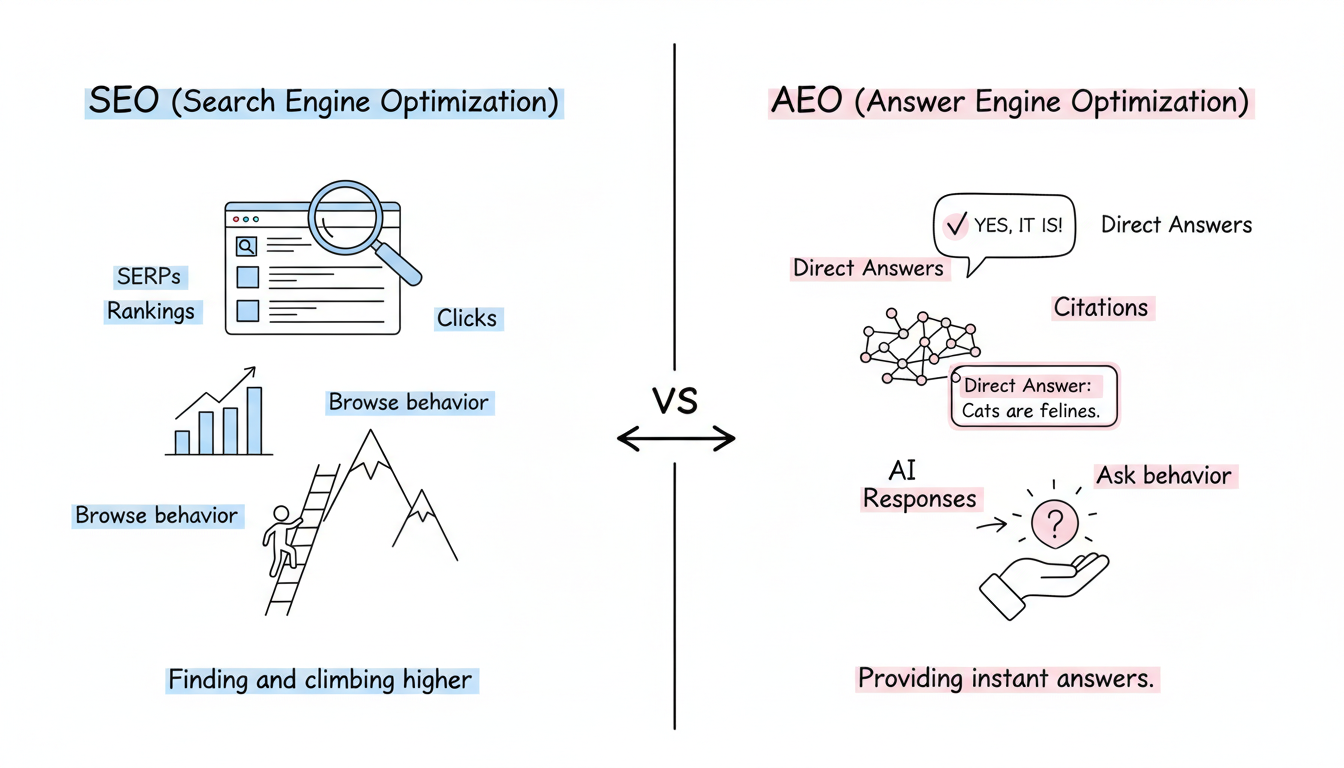
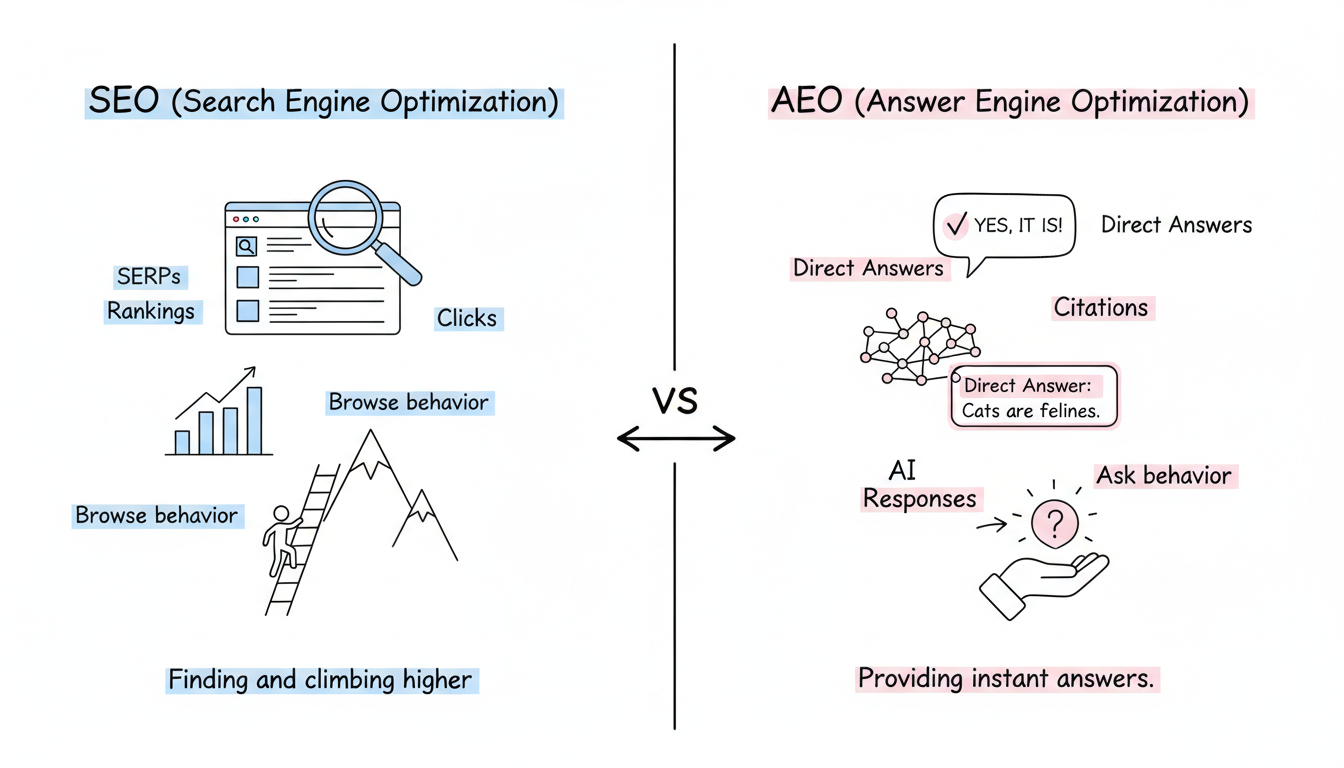
Traditional SEO optimizes for search engine results pages. Answer Engine Optimization (AEO) optimizes for direct answers—the AI-generated summaries, featured snippets, and conversational responses that users see before traditional links.
Aspect | SEO | AEO |
Goal | Rank pages higher | Get content into answers |
Success metric | Position in SERPs | Citation in AI responses |
Primary output | Clickable links | Direct answers |
User behavior | Browse and compare | Ask and receive |
Content focus | Comprehensive coverage | Extractable answers |
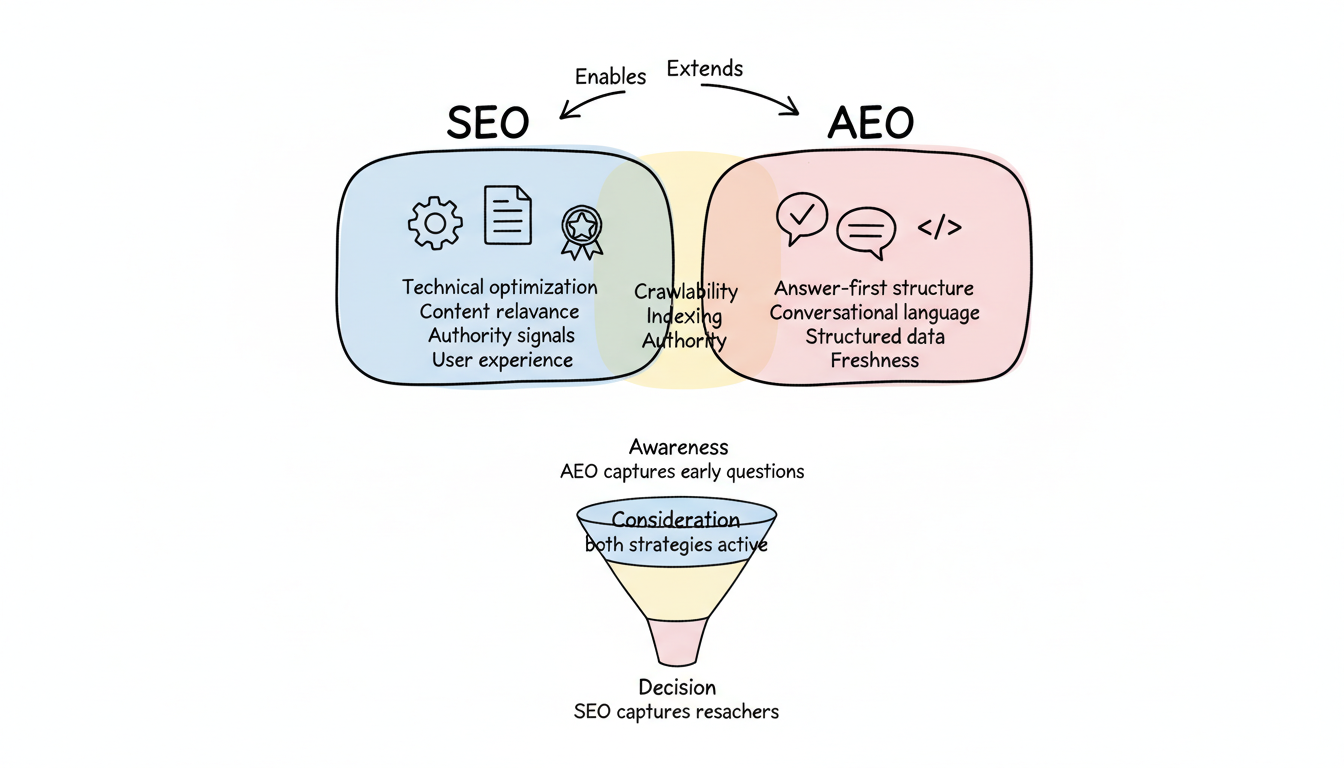
The relationship works like this: SEO brings users to your content. AEO brings your content into the answers users see.
SEO focuses on making pages visible and attractive in traditional search results through:
Technical optimization: Fast loading, mobile-friendly design, clean site architecture, proper indexing.
Content relevance: Keyword targeting, topic coverage, search intent matching, content depth.
Authority signals: Backlinks, domain reputation, brand recognition, E-E-A-T signals.
User experience: Click-through optimization, engagement metrics, bounce rate reduction.
When SEO succeeds, your pages appear prominently when users search relevant terms. Users click through to consume your content directly.
AEO focuses on making content extractable and citable by AI systems through:
Answer-first structure: Direct answers in opening sentences, Q&A formatting, scannable content.
Conversational language: Natural phrasing that matches how people speak, not just how they type.
Structured data: Schema markup that helps AI systems understand content meaning and relationships.
Freshness signals: Recent publication dates, updated content, current information.
When AEO succeeds, AI systems cite your content when generating answers. Users see your information—and potentially your brand—without necessarily visiting your site.
SEO: Users click through to your website to consume content. You control the full experience—design, messaging, conversion paths.
AEO: AI systems extract and present your information directly. Users may never visit your site, but they receive your expertise and potentially your brand mention.
SEO: Rewards comprehensive, in-depth content that covers topics thoroughly. Long-form content with proper headings and internal linking performs well.
AEO: Rewards clear, extractable answers positioned early in content. Q&A structure, concise paragraphs, and answer-first formatting improve citation probability.
SEO: Rankings, organic traffic, click-through rates, time on page, conversions from organic search.
AEO: Citation frequency, share of voice in AI responses, brand mentions in generated answers, indirect traffic from branded searches.
SEO: Competition for finite ranking positions. Only one site can rank #1, and the top 10 dominate clicks.
AEO: Competition for answer inclusion. Multiple sources can be cited in a single AI response, but the most authoritative sources earn primary positioning.
Neither discipline replaces the other. They serve complementary functions in the 2026 search landscape.
AI systems rely on search engine infrastructure to discover and evaluate content. Without strong SEO fundamentals—crawlability, indexing, authority signals—answer engines won't find or trust your content. AEO builds on SEO; it doesn't bypass it.
SEO captures users who want to browse and compare. AEO captures users who want quick answers without clicking. As AI search grows, ignoring AEO means invisible to an expanding user segment.
SEO often captures users further along the buyer journey—those actively researching and comparing options. AEO captures users earlier—those asking initial questions that shape future decisions.
Adding AEO to existing SEO work doesn't require starting over. Layer these tactics onto current content:
Instead of traditional "Introduction / Background / Conclusion" formats, organize content around questions:
This structure serves both humans scanning for answers and AI systems extracting responses.
Include direct answers near the top of sections. Don't bury conclusions after lengthy explanations. AI systems extract early content more reliably.
Mark up question-and-answer content with FAQPage schema. This structured data helps both traditional search (for featured snippets) and AI systems (for answer extraction).
Content updated within the last 13 weeks earns roughly 50% more AI citations than older content. Freshness matters more in AEO than traditional SEO.
This isn't just about tactics. The fundamental shift is relational: brands no longer simply rank and wait for clicks. They must be deemed worthy of citation by systems that decide what users see.
Traditional SEO asks: "How do we rank higher?"
AEO asks: "How do we become the answer?"
Both questions matter. The brands that answer both will dominate visibility in 2026 and beyond.
No. SEO remains foundational for search visibility, but it no longer operates alone. Without an AEO strategy framework layered on top, SEO limits you to rankings and clicks while missing visibility in AI summaries, voice search, and direct-answer experiences.
No. AEO depends on strong SEO fundamentals. If search engines can't properly understand or trust your content, answer engines won't surface it either. AEO extends SEO rather than replacing it.
Start with SEO if you lack fundamentals—crawlability, indexing, basic rankings. Add AEO once your SEO foundation is solid. Most businesses benefit from optimizing both simultaneously using proven AEO optimization guide best practices, since many tactics overlap.
By submitting this form, you agree to our Privacy Policy and Terms & Conditions.