February 19, 2026


FAQ schema markup has become one of the most effective tools for improving visibility in Google AI Overviews. As AI-powered search features dominate informational queries, structured data serves as the bridge between your content and AI systems that need to understand, verify, and cite information. This guide explains how to implement and optimize FAQ schema specifically for AI Overview inclusion.
AI systems like Google's AI Overviews rely heavily on structured data to comprehend content accurately. FAQ schema provides clear, machine-readable question-answer pairs that AI can process without ambiguity.
How FAQ schema helps AI visibility:
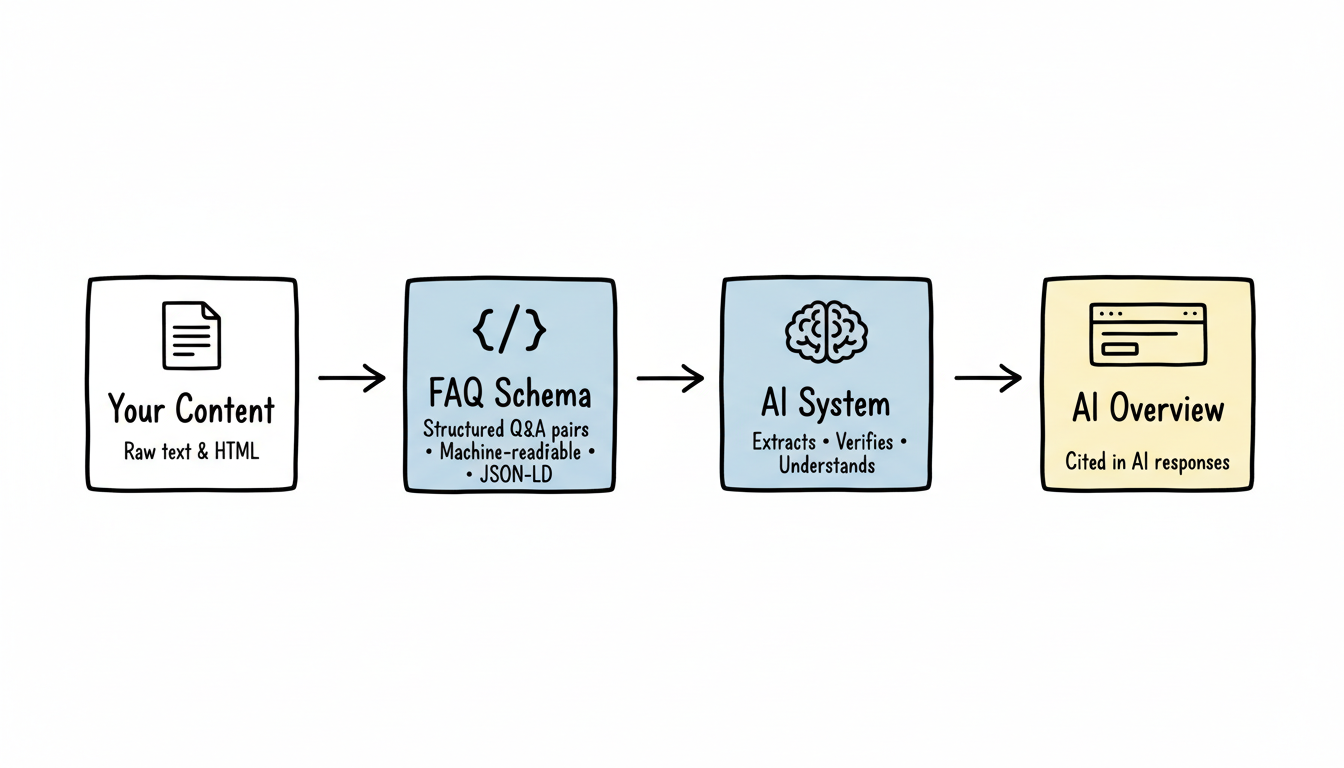
Research shows that pages with comprehensive schema markup are significantly more likely to appear in AI-generated responses. FAQ schema specifically addresses the question-led nature of many AI Overview queries—when users ask questions, AI systems look for structured answers they can confidently cite.
Implementing FAQ schema requires adding JSON-LD code to your pages. Google prefers JSON-LD because it's easy to manage and less likely to cause technical issues.
{
  "@context": "https://schema.org",
  "@type": "FAQPage",
  "mainEntity": [
    {
      "@type": "Question",
      "name": "What is the question text?",
      "acceptedAnswer": {
        "@type": "Answer",
        "text": "The complete answer text goes here."
      }
    }
  ]
}
This structure tells AI systems exactly what questions your page answers and provides the answers in a format machines can process directly.
Where to add FAQ schema:
Technical requirements:
Schema markup alone doesn't guarantee AI Overview inclusion. The content within your FAQ schema must meet quality standards that AI systems recognize, similar to how technical AEO optimization requires both structural and content excellence.
AI systems favor answers that directly address questions without unnecessary preamble. Start each answer with the key information.
Effective answer structure:
Example of optimized FAQ content:
Question: How much does FAQ schema implementation cost?
Poor answer: "There are many factors to consider when thinking about costs..."
Optimized answer: "FAQ schema implementation typically costs $0 for manual implementation or $50-200 per month for automated schema management tools. Manual implementation requires basic HTML knowledge and takes 1-2 hours per page. Automated tools like Schema App or built-in CMS features can generate schema markup automatically across your entire site."
The questions in your FAQ schema should reflect how users actually search. AI Overviews appear for informational queries, so format questions accordingly. Understanding how to optimize for AI search engines helps you align your FAQ content with AI processing patterns.
Question optimization tips:
Beyond basic implementation, several advanced strategies can improve your chances of AI Overview citation.
Group related questions together on topic-specific pages rather than creating one massive FAQ page. This approach:
A page about "SEO pricing" should have FAQ schema covering pricing-related questions specifically, while a separate page addresses implementation questions.
FAQ schema works best when combined with complementary structured data:
Article schema identifies the content type and publication details, helping AI understand context.
Organization schema establishes brand identity and authority signals.
Person schema connects content to expert authors, supporting E-E-A-T evaluation.
Layering these schema types creates a comprehensive structured data profile that AI systems can evaluate holistically, much like how list-based featured snippets for AI overviews leverage multiple structured data signals.
AI systems increasingly prefer current information. FAQ content that references outdated statistics or practices loses citation potential.
Freshness maintenance:
Display update timestamps on FAQ pages to signal freshness to AI crawlers.
Several implementation errors can undermine FAQ schema effectiveness for AI Overviews.
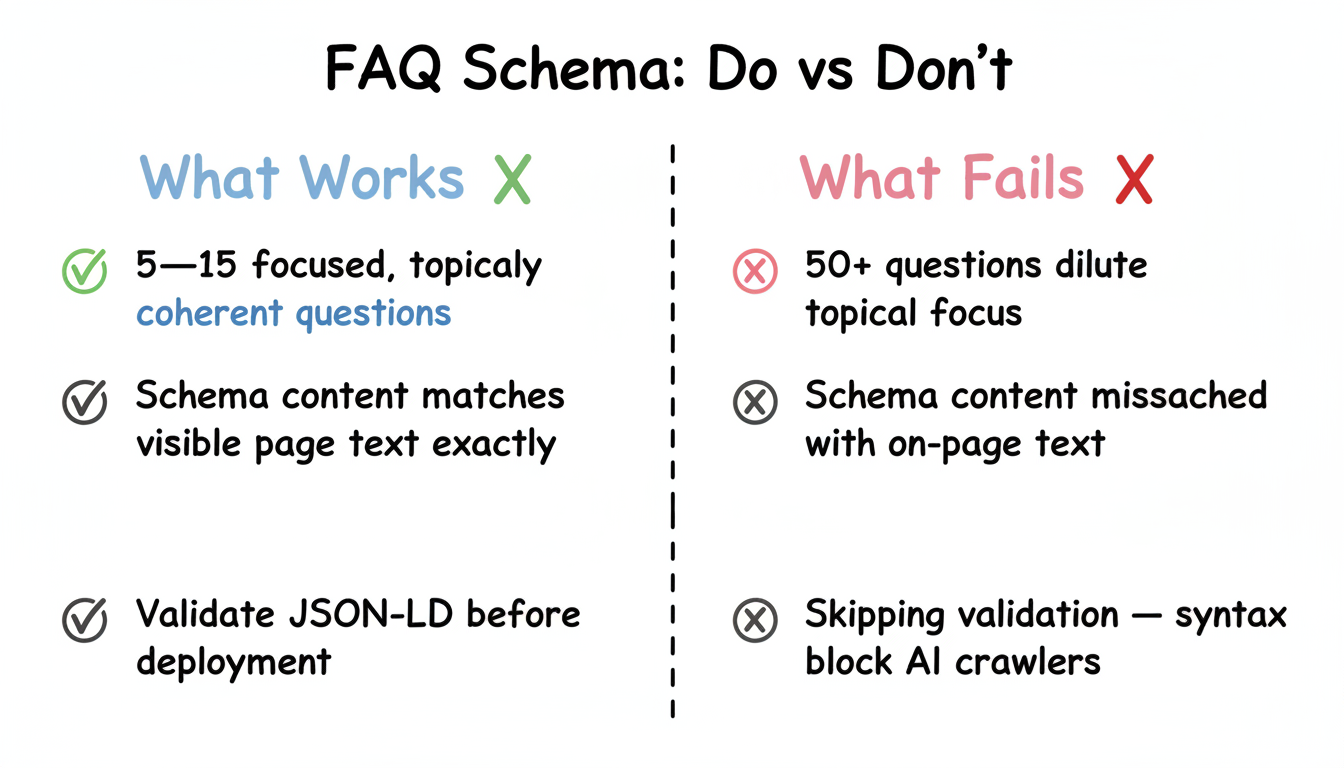
The most damaging mistake is schema content that doesn't match visible page content. AI systems verify schema accuracy by comparing structured data against on-page text. Mismatches signal potential manipulation and reduce trust.
Always ensure:
Pages with 50+ FAQ entries dilute topical focus. AI systems prefer comprehensive coverage of specific topics over superficial coverage of many topics.
Optimal FAQ density:
Schema syntax errors prevent AI systems from processing your structured data. Always validate before deployment.
Validation process:
Track specific metrics to evaluate FAQ schema performance for AI visibility.
Key indicators:
Emerging AI visibility tools from providers like Semrush and Ahrefs offer automated tracking of AI citations, including which structured data types correlate with inclusion.
FAQ schema represents one component of comprehensive AI search optimization. Maximum effectiveness requires integration with:
Content quality: Schema cannot compensate for thin or low-authority content. AI systems evaluate the substance behind structured data.
Technical SEO: Ensure AI crawlers can access your pages. Check robots.txt for GPTBot, ClaudeBot, and PerplexityBot permissions.
Authority building: Backlinks and brand mentions strengthen the trust signals AI systems evaluate alongside structured data, especially when combined with off-page AEO optimization strategies.
FAQ schema accelerates AI understanding of your content but doesn't replace the fundamental quality and authority requirements for AI Overview inclusion.
No. FAQ schema helps AI systems understand your content but doesn't guarantee inclusion. AI Overviews depend on content quality, authority, relevance, and numerous other factors beyond structured data alone.
Most pages perform best with 5-15 well-answered questions focused on a specific topic. Quality and depth matter more than quantity—thoroughly answering 8 questions outperforms superficially addressing 30.
Avoid duplicating FAQ schema across pages. Each page should have unique questions relevant to that page's specific topic. Duplication signals potential manipulation and dilutes topical authority.
By submitting this form, you agree to our Privacy Policy and Terms & Conditions.