February 19, 2026


Google AI Overviews have fundamentally changed the SEO landscape. With AI Overviews appearing in over 25% of US searches and reaching an estimated 2 billion users monthly, the impact on organic traffic can no longer be ignored.
The data tells a clear story: some sites are losing significant traffic while others are gaining by adapting their strategies. This analysis examines the real SEO impact of Google AI Overviews using traffic data, click-through rate studies, and industry-specific case studies.
Google AI Overviews launched in the US in May 2024 and have expanded rapidly:
Timeline:
Current Statistics:
According to Gartner projections, by the end of 2026, 25% of organic search traffic will shift to AI chatbots and voice assistants—a structural change affecting every industry. Understanding the aeo-optimization-timeline helps businesses prepare for these shifts and implement strategies at the right stages.
Multiple studies have quantified the AI Overview impact on organic traffic. The results are significant but nuanced.
Metric | Impact | Source |
Organic CTR decline | 34.5% decrease for #1 rankings | Semrush 10M keyword study |
Overall CTR drop | 61-65% decline when AI Overviews appear | Seer Interactive |
Zero-click searches | 60-65% of queries end without a click | 2026 industry data |
Reported traffic loss | 20-40% for affected sites | WordStream analysis |
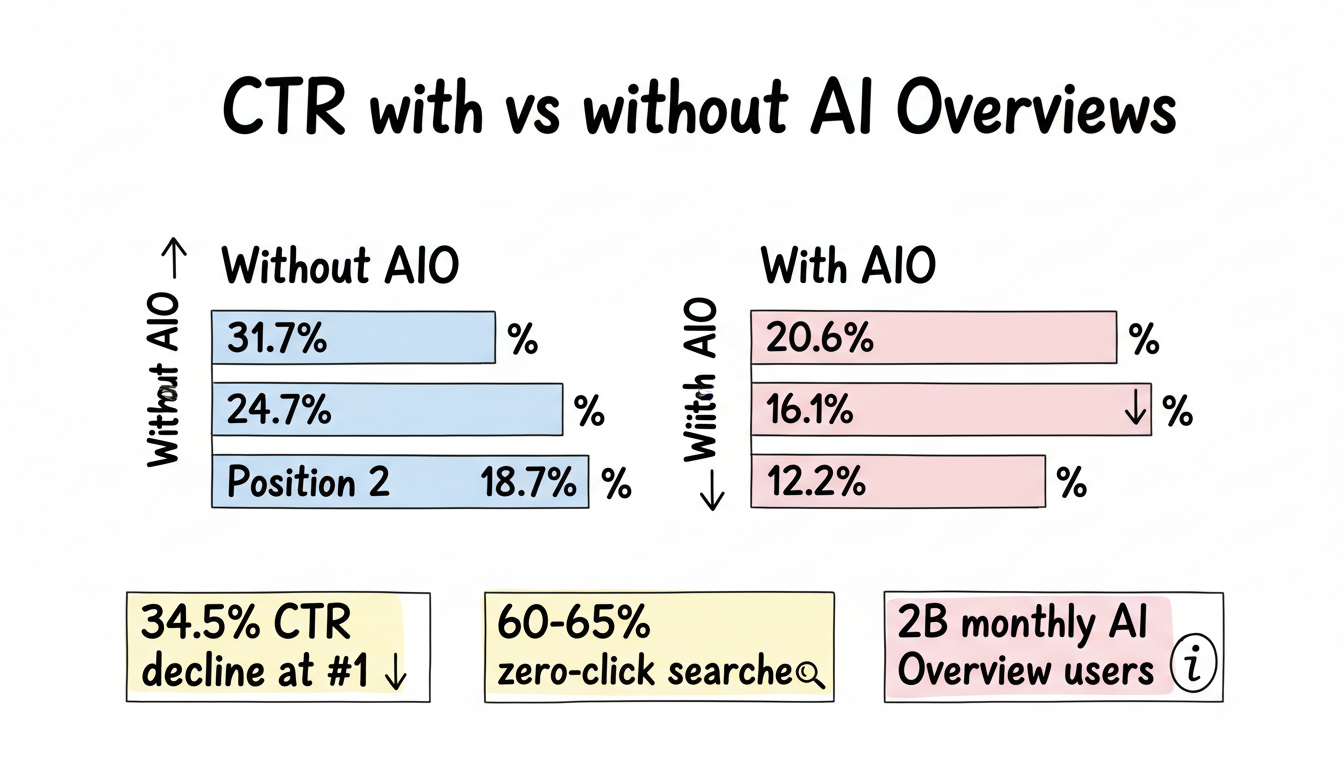
According to the Semrush AI Overviews study analyzing over 10 million keywords, pages ranking #1 experienced an average 34.5% CTR decline when AI Overviews appeared for their target queries.
However, the relationship is more complex than simple traffic loss. The same study found that when tracking identical keywords before and after AI Overview implementation, zero-click rates actually decreased slightly (from 33.75% to 31.53%)—suggesting AI Overviews may be replacing other zero-click features rather than creating entirely new behavior.
AI Overviews consume 42% of desktop screen space and 48% on mobile. This pushes traditional organic results below the fold, directly impacting visibility and click probability. The differences between google-ai-overview-mobile-vs-desktop-differences reveal important optimization considerations for both platforms.
On mobile devices—where 81% of AI Overview queries occur—users often don't scroll past the AI-generated answer at all.
Not all sites experience AI Overviews equally. Understanding the pattern helps inform strategy.
Content publishers relying on informational queries:
Sites with thin or commodity content:
News publishers: According to analysis of the December 2025 core update, major news publishers were heavily impacted, including in Google Discover traffic.
Pages cited within AI Overviews: Sites that earn citations inside AI Overviews can actually see CTR increases of up to 35%. Being the source Google cites provides significant visibility advantage. Understanding ai-search-citations-guide helps optimize for these valuable mentions.
Brands with strong authority signals: Brands mentioned in AI responses experience 91% higher paid CTR—the halo effect extends beyond organic.
Sites optimizing for AI visibility: Early adopters of answer engine optimization report up to 527% year-over-year growth in AI-driven search traffic. Implementing comprehensive aeo-optimization-strategies drives these impressive results.

The CTR impact varies significantly by query type, industry, and whether your site appears in the AI Overview.
Position | CTR Without AIO | CTR With AIO | Change |
Position 1 | ~31.7% | ~20.6% | -34.5% |
Position 2 | ~24.7% | ~16.1% | -34.8% |
Position 3 | ~18.7% | ~12.2% | -34.8% |
When your site is cited in the AI Overview, the dynamic reverses:
WebFX's 2026 benchmarks reveal AI Overview rates by search intent:
Search Intent | AI Overview Rate | Long Query Rate (7+ words) |
Informational | 39.4% | 65.9% |
Commercial | 22.2% | 46.1% |
Transactional | 16.5% | 31.8% |
Navigational | 12.0% | 23.1% |
Strategic Implication: Transactional and navigational content faces lower AI Overview exposure—a potential refuge for click-dependent business models. Leveraging paragraph-featured-snippets-ai-search optimization can help capture visibility in both traditional and AI-driven results.
AI Overview presence varies dramatically by industry, creating different strategic imperatives.
Industry | AI Overview Rate | YoY Change |
Health | 51.6% | +15% |
B2B Technology | 70% | +34% |
Insurance | 63% | +46% |
Entertainment | 37% | +35% |
Finance & Insurance | 32.1% | +12% |
Jobs & Education | 33.0% | +8% |
E-commerce | 4% | -25% |
Good news for online retailers: e-commerce queries rarely get AI Overviews. Only 4% of e-commerce searches trigger AI Overviews in 2026—down from 29% when first rolled out.
Google appears to recognize that product searches require clicking to complete transactions, preserving the commercial SERP structure.
However, e-commerce sites still report a 22% drop in search traffic from AI-generated suggestions in broader informational queries that precede purchases.
The B2B technology sector saw the most dramatic increase in AI Overview presence—from 36% to 70% of SERPs. Companies relying on top-of-funnel informational content need immediate strategy adaptation. Many are turning to mid-tier-ai-seo-software solutions to manage optimization at scale.
Health-related queries face 51.6% AI Overview rates. Medical publishers, wellness sites, and health information providers must prioritize AI citation strategies or face continued traffic erosion.
News sites face both AI Overview competition and broader impacts from Google's December 2025 core update. Sites dropping in traditional rankings also lost AI Overview visibility, creating compounding losses.
Situation: Mid-sized health information site heavily dependent on "symptom" and "treatment" queries.
Impact:
Adaptation:
Result: Stabilized traffic at 72% of pre-AIO levels, with higher conversion rates on remaining traffic.
Situation: SaaS company ranking well for "how to" and comparison queries.
Impact:
Adaptation:
Result: Earned AI Overview citations for 23% of target keywords, recovering and exceeding previous traffic levels. The company also adopted conversational-content-writing-aeo techniques to better align with AI search patterns.
Situation: Online retailer dependent on informational content for top-of-funnel traffic.
Impact:
Adaptation:
Result: Reduced content costs 40%, maintained revenue, improved content ROI.
Visibility now happens in two places:
Success metrics must evolve:
Implementing an ai-search-analytics-dashboard provides comprehensive visibility into performance across both traditional and AI-driven search channels.
Gartner's 2026 prediction—25% of organic traffic shifting to AI—appears to be on track. This isn't temporary disruption but permanent restructuring.
Industries that will adapt fastest:
Industries facing the longest adjustment:
Understanding the searchgpt-vs-chatgpt-search-technical-differences helps businesses prepare for the expanding AI search landscape beyond just Google.
1. Audit Your AI Overview Exposure Identify which of your target keywords trigger AI Overviews using tools like Semrush or Ahrefs. Prioritize defense for high-value, high-exposure keywords. Specialized geo-optimization-tools can help analyze local market variations in AI Overview presence.
2. Analyze Citation Patterns For keywords showing AI Overviews, identify which sources Google cites. Understand the content characteristics that earn citations:
3. Implement Schema Markup Structured data helps Google understand and potentially cite your content. Focus on:
1. Diversify Query Intent Reduce dependence on purely informational queries. Build content targeting:
2. Create Uncopyable Content AI Overviews struggle to replicate:
3. Build Brand Authority Brand mentions in AI responses correlate with existing brand strength. Invest in:
Developing a searchgpt-social-monitoring-reddit-quora-strategy helps establish authority signals across platforms AI search engines monitor.
4. Track New Metrics Expand your KPI dashboard:
Many businesses are implementing searchgpt-citation-tracking-measuring-visibility systems to monitor performance across multiple AI platforms. Those lacking internal expertise often partner with an aeo-agency for specialized support.
Google AI Overviews have permanently changed SEO. The data confirms significant CTR declines (34.5%+ for top rankings), massive zero-click increases (60-65%), and industry-specific impacts ranging from minimal (e-commerce at 4%) to severe (B2B tech at 70%).
But this isn't a story of universal loss. Sites earning AI citations see traffic gains. Brands with strong authority signals benefit from the halo effect. Companies adapting strategies early report growth exceeding pre-AIO levels.
The key is recognizing that SEO now operates on two surfaces: traditional rankings and AI visibility. Success in 2026 requires optimizing for both—and tracking metrics that capture value from AI-influenced journeys, not just direct clicks. Whether you're exploring ai-search-engine-optimization fundamentals or implementing advanced generative-engine-optimization-guide tactics, the time to adapt is now.
By submitting this form, you agree to our Privacy Policy and Terms & Conditions.