February 19, 2026


As AI-powered search transforms how users discover information, a new category of tools has emerged to help brands track and optimize their visibility in generative engines. GEO optimization tools monitor citations, track brand mentions, and provide insights for improving presence across ChatGPT, Perplexity, Google AI Overviews, and other AI platforms.
According to LLMrefs' comprehensive directory, there are now over 200 tools that help optimize for AI search engines. The terminology varies—GEO, AEO, LLMO, AI SEO—but all address the same fundamental need: understanding and improving how brands appear in AI-generated answers.
Traditional SEO tools track rankings on search result pages. GEO tools track something fundamentally different: whether AI systems mention, cite, or recommend your brand when generating responses.
According to Agency Analytics' tool comparison, GEO is the future of search visibility—and a must-have for agencies that want their clients to show up, get cited, and stay relevant in AI-driven search.
What GEO tools measure:
Metric | Purpose | Why It Matters |
Citation frequency | How often AI cites your content | Indicates source trust |
Brand mentions | When AI recommends your brand | Shows recommendation status |
Share of voice | Your visibility vs competitors | Reveals market position |
Citation context | How AI describes your brand | Affects brand perception |
Source attribution | Which pages AI pulls from | Guides optimization focus |
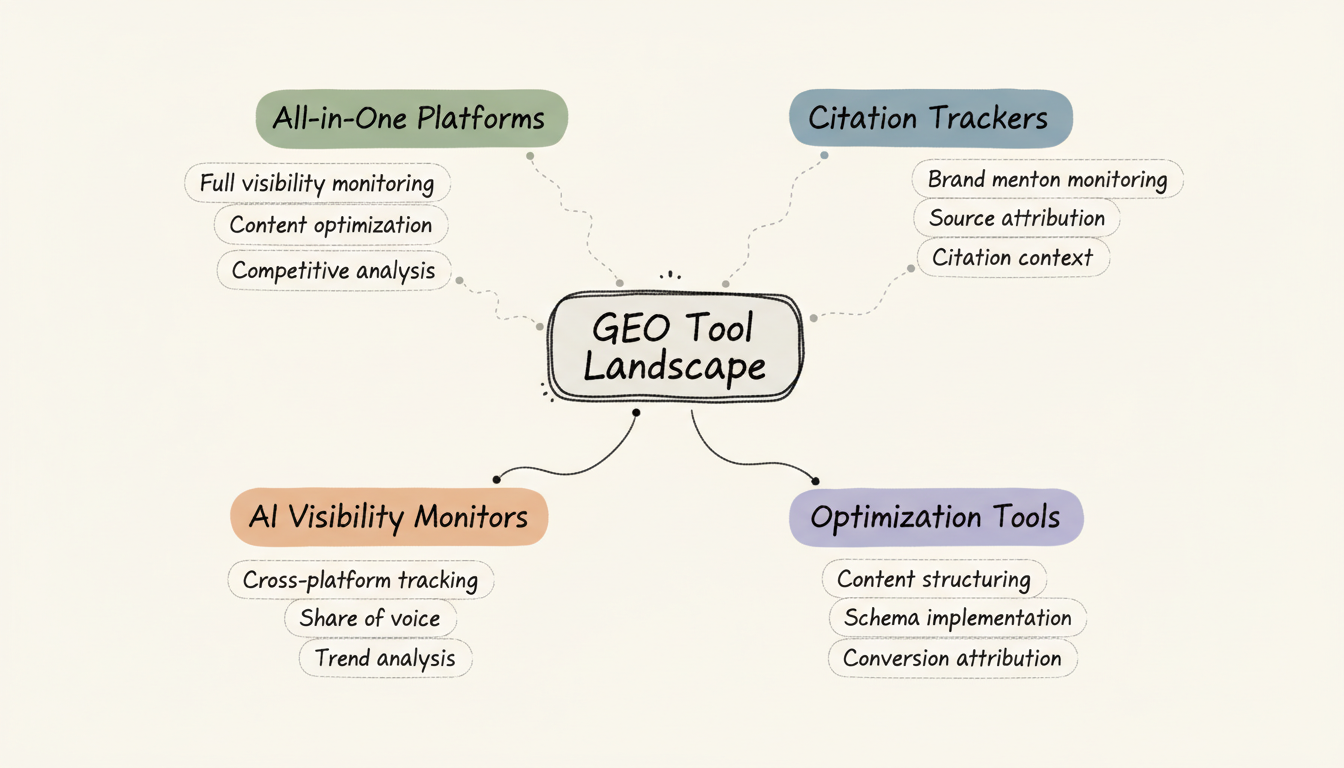
The GEO tool landscape includes several distinct categories, each serving different needs.
According to Bluefish's platform comparison, GEO evaluates four core elements of AI answer quality: the content users actually see when asking questions about a category or brand, rather than just web rankings.
GEO tool categories:
GEO Tool Landscape
├── All-in-One Platforms
│   ├── Full visibility monitoring
│   ├── Content optimization
│   └── Competitive analysis
│
├── Citation Trackers
│   ├── Brand mention monitoring
│   ├── Source attribution
│   └── Citation context analysis
│
├── AI Visibility Monitors
│   ├── Cross-platform tracking
│   ├── Share of voice metrics
│   └── Trend analysis
│
├── Optimization Tools
│   ├── Content structuring
│   ├── Schema implementation
│   └── GEO auditing
│
└── Analytics Integration
    ├── AI referral tracking
    ├── Traffic segmentation
    └── Conversion attribution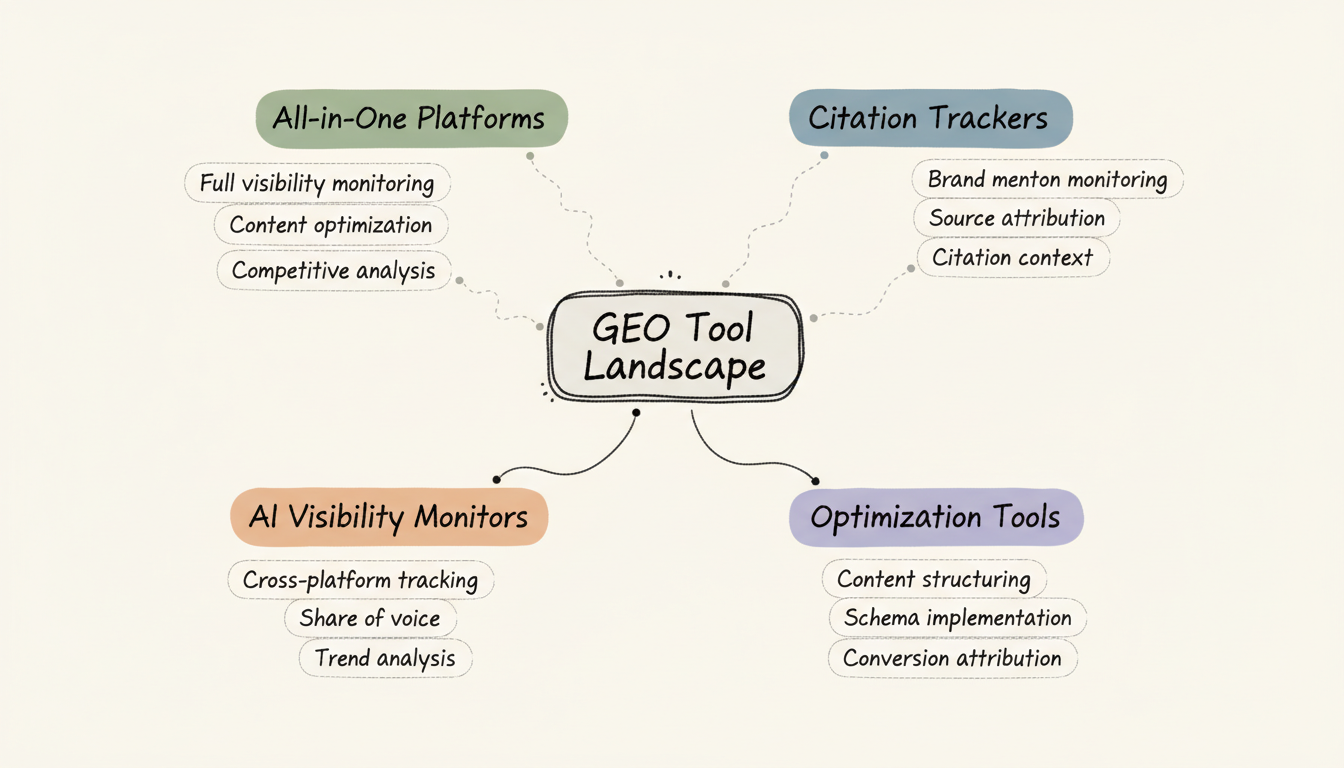
Comprehensive platforms combine monitoring, optimization, and analytics capabilities.
According to Addlly AI's tool guide, brands need modern strategies that target AI visibility directly—traditional SEO tools alone won't address generative engine optimization needs.
Top all-in-one GEO platforms:
Platform | Strengths | Best For |
Bluefish | Enterprise-grade, multi-engine visibility, brand safety | Large organizations |
Addlly AI | Custom AI agents, content automation, GEO auditing | Content-heavy brands |
Semrush AI Toolkit | Integrated with SEO workflows, prompt tracking | Existing Semrush users |
Profound | Enterprise-scale, citation workflows | Multi-brand enterprises |
Writesonic GEO | Tracking + optimization combined | Teams wanting simplicity |
According to Bluefish, enterprise GEO platforms provide real-time multi-engine visibility across ChatGPT, Gemini, Perplexity, Google AI Mode, and Google Summary, with advanced metrics like favorability, sentiment, safety, and accuracy.
Dedicated monitoring tools focus specifically on tracking brand presence across AI platforms.
According to Marketer Milk's AI visibility guide, an AI monitoring tool (also known as an AI visibility tool) is a platform that lets you track how your brand is being recommended by LLMs and AI search engines.
Top AI visibility monitoring tools:
Tool | Key Features | Pricing |
Peec AI | Clean UI, multilingual, visibility scoring | €89-499/month |
Scrunch AI | Cross-platform mentions, crawler logging | $417+/month |
Gauge | Daily monitoring, citation intelligence | Custom pricing |
Otterly.AI | Competitive tracking, multiple LLMs | $29+/month |
AI Product Rankings | Topic mentions, citations | Free tier available |
According to SEO.com's tool comparison, AI visibility tools help measure AI search visibility across industry topics, track citations that guide custom strategy, and monitor competitors in AI responses. Understanding AI search ranking factors becomes critical when evaluating which platforms provide the most actionable insights for improving your brand's visibility across different AI engines.
Specialized tools focus on tracking where and how AI systems cite your content.
According to Omnius's GEO industry report, a new wave of GEO-focused software has entered the market: Narrative BI, VectraRank, and RAGReady for monitoring LLM citations, alongside Semrush's AI Toolkit for prompt testing and brand visibility tracking.
Citation tracking capabilities:
Capability | What It Shows | Business Value |
Citation frequency | How often AI cites you | Content trust level |
Source identification | Which pages AI pulls from | Optimization priorities |
Citation context | How AI frames mentions | Brand perception |
Competitor citations | Who else AI cites | Competitive gaps |
Attribution chains | How sources connect | Authority signals |
According to Agency Analytics, tools like Gauge provide citation intelligence that reveals which sources AI engines lean on, with gap analysis highlighting prompts where your brand should appear but doesn't.
Many established SEO platforms have added GEO capabilities.
According to Omnius, Semrush, one of the early movers, reported $25M in annual recurring revenue from its AI products in Q2 2025, part of a 20% year-over-year revenue increase, demonstrating market demand for integrated GEO capabilities.
SEO platforms with GEO features:
Platform | GEO Features | Integration Benefit |
Semrush AI Toolkit | AI visibility score, prompt tracking | Single platform workflow |
Ahrefs Brand Radar | Real-time mentions, share of voice | Combined backlink + AI data |
Mangools AI Search Watcher | Multi-engine tracking, variance smoothing | Affordable entry point |
MarketMuse | AI-adapted authority analysis | Content optimization sync |
According to LinkedIn analysis by Jinesh Mavani, tracking AI visibility is only half the battle—you also need to optimize for it, which is why integrated platforms that combine monitoring with actionable recommendations prove most valuable.
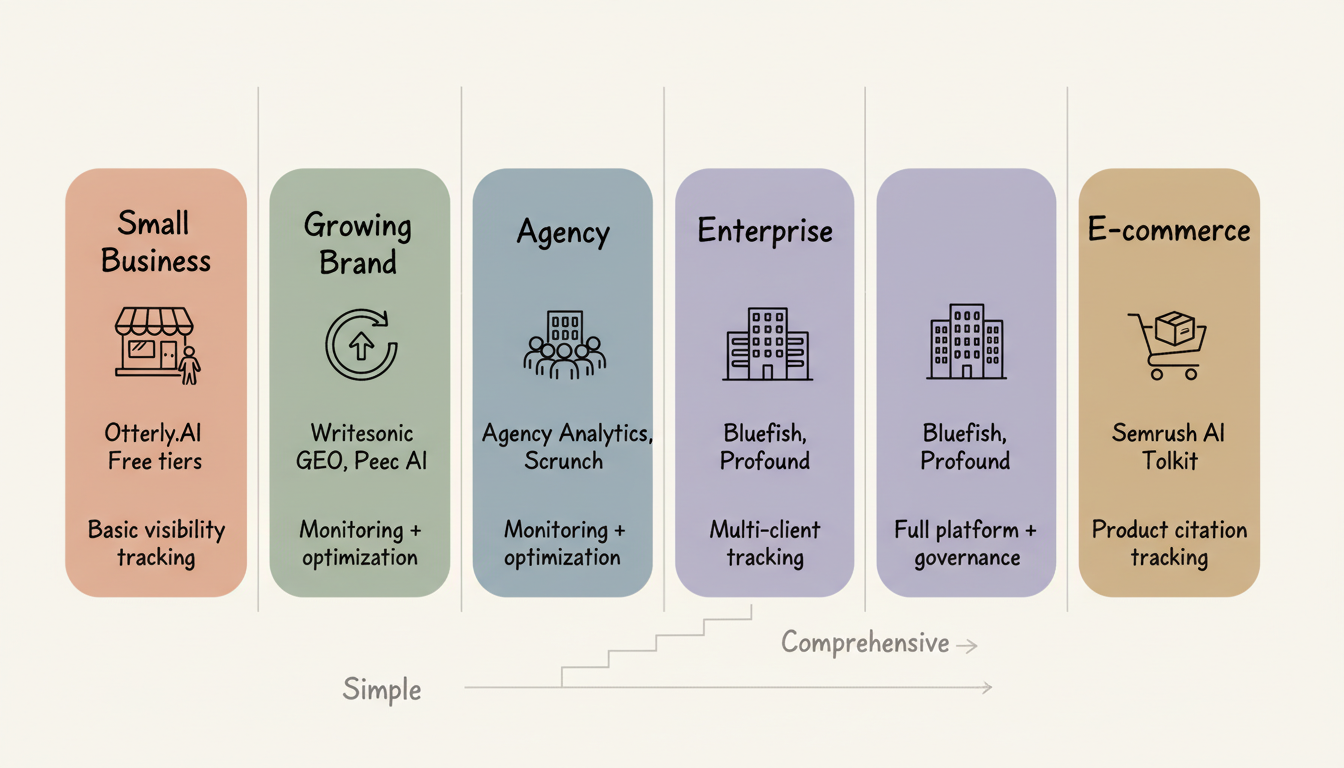
Different organizations need different tool capabilities based on their goals and resources.
According to Measured SEM's agency guide, experts rely on tools that track AI visibility and citation patterns, including AI search monitoring, entity analysis, and structured content platforms. Organizations should also consider competitive AI search benchmarking capabilities when selecting tools to understand their position relative to competitors across multiple AI platforms.
Tool selection by organization type:
Organization Type | Primary Need | Recommended Approach |
Small business | Basic visibility tracking | Otterly.AI, free tiers |
Growing brand | Monitoring + optimization | Writesonic GEO, Peec AI |
Agency | Multi-client tracking | Agency Analytics, Scrunch |
Enterprise | Full platform + governance | Bluefish, Profound |
E-commerce | Product citation tracking | Semrush AI Toolkit |
Key evaluation criteria:
Simply having tools isn't enough—effective implementation requires strategic use.
According to Firebrand Marketing's best practices, when cross-functional marketing teams operate together under a unified GEO strategy, visibility in AI search accelerates.
Implementation best practices:
According to Omnius's report, organizations like Vercel report that ChatGPT referrals now drive about 10% of new user sign-ups—demonstrating measurable business impact from GEO visibility.
ROI measurement framework:
Metric | Measurement | Business Impact |
Citation growth | Tool dashboard | Brand awareness |
AI referral traffic | Analytics segmentation | Lead generation |
Share of voice gains | Competitive tracking | Market position |
Conversion rate | Attribution analysis | Revenue impact |
Optimization efficiency | Time savings | Resource allocation |
Selecting and implementing GEO optimization tools requires understanding the landscape:
According to Agency Analytics, not all AI tools for generative engine optimization are built the same—some dig up insights, others keep content in check, and a few juggle both. Selecting the right combination for your needs determines GEO success.
By submitting this form, you agree to our Privacy Policy and Terms & Conditions.