February 19, 2026


Three acronyms now define digital visibility strategy: SEO, AEO, and GEO. While they share the goal of making brands discoverable, each optimizes for different engines and user behaviors. Understanding the distinctions—and more importantly, how they work together—determines search success in 2026.
According to Within's optimization comparison, GEO and AEO have entered the marketing conversation as labels for how SEO evolves when the "engine" being optimized for isn't just Google anymore. At their core, all these terms aim to achieve the same goal: making your brand or product visible—but the platforms and question types differ.
Each discipline addresses different aspects of how users find information.
According to Broworks' business website guide, SEO focuses on ranking in search engines like Google, GEO ensures AI tools like ChatGPT, Perplexity, or Claude can accurately interpret and reference your content, and AEO structures pages to appear as authoritative answers in voice search and AI summaries.
Core definitions:
Discipline | Primary Focus | Target Platforms |
SEO | Ranking in search results | Google, Bing, traditional search |
AEO | Appearing in direct answers | Featured snippets, voice assistants, PAA |
GEO | Being cited by AI systems | ChatGPT, Perplexity, Gemini, AI Overviews |
According to Lasso Up's 2026 analysis, traditional SEO still fuels discovery, answer engine optimization fuels trust and visibility, and generative engine optimization fuels long-term relevance. Ignoring any one creates blind spots.
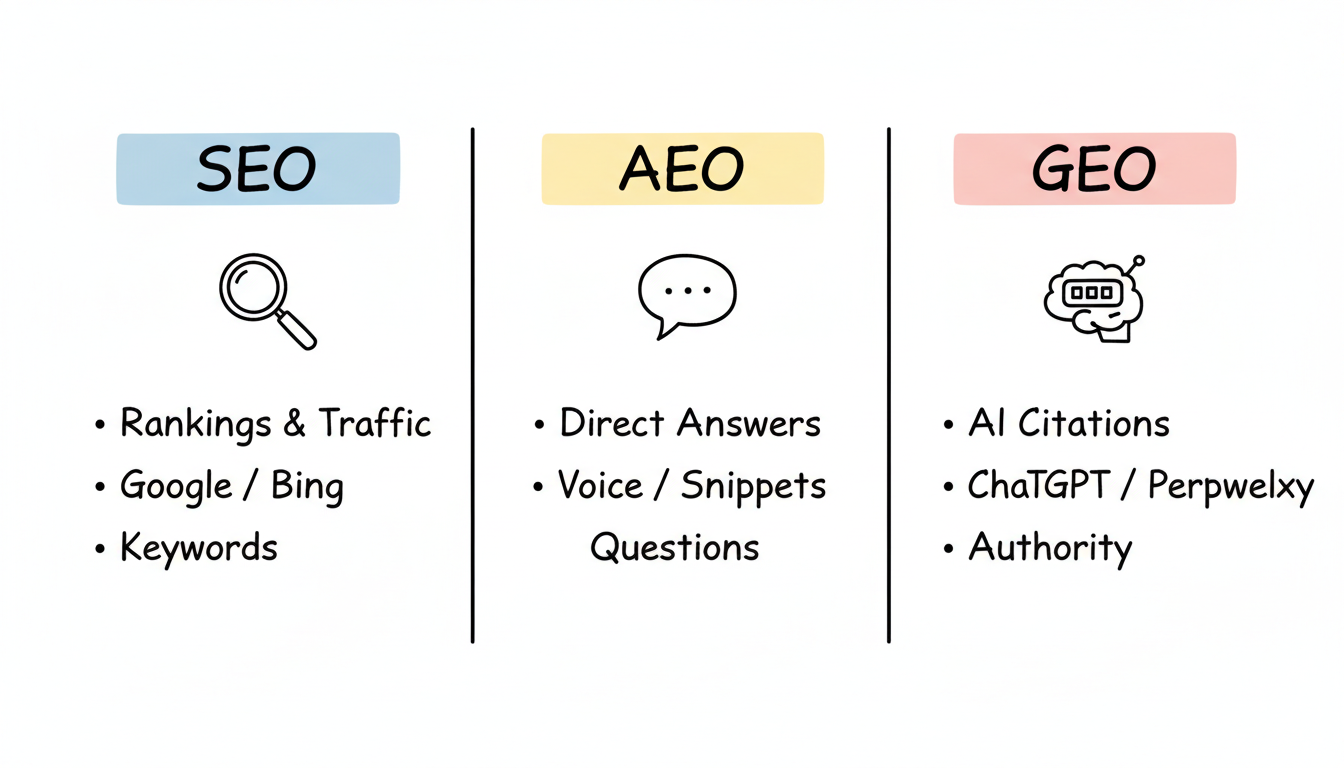
Search engine optimization remains essential for driving website traffic and establishing digital presence.
What SEO optimizes for:
According to ColorWhistle's strategy guide, SEO remains essential in 2026, but AEO and GEO are rewriting the rules. Businesses and creators who embrace all three will not only survive—they'll thrive.
Answer engine optimization focuses on providing direct answers that machines can extract and display.
According to The Ad Firm's optimization guide, AEO earns visibility by supplying clear, structured answers that answer engines can cite directly. These deterministic engines return a single, definitive response to a question.
What AEO optimizes for:
Format | Purpose | Example |
Featured snippets | Position zero visibility | Definition boxes, numbered lists |
Voice search | Conversational queries | "Hey Google" responses |
People Also Ask | Question expansion | Expandable answer boxes |
FAQ schema | Structured answers | Rich results with Q&A |
AEO content characteristics:
Generative engine optimization ensures AI systems recognize, trust, and cite your brand in synthesized responses.
According to LinkedIn analysis by K. Premaswini, SEO earns relevance, AEO earns selection, and GEO earns repetition. AI systems are not searching pages—they are choosing voices. That choice is driven by clarity of thought, consistency of perspective, and proof of real experience.
What GEO optimizes for:
GEO content characteristics:
Understanding the distinctions helps allocate resources appropriately.
According to The Ad Firm's comparison, AEO succeeds when content can stand alone as a single response, while GEO succeeds when content supports interpretation, paraphrasing, and reuse across multiple contexts.
Side-by-side comparison:
Aspect | SEO | AEO | GEO |
Success metric | Rankings, traffic | Snippet capture | AI citations |
Content length | Varies | Short, direct | Comprehensive |
Target engine | Search engines | Answer engines | Generative AI |
User journey | Discovery | Quick answers | Recommendations |
Optimization focus | Keywords | Questions | Authority |
According to Deciding Factor's website guide, SEO equals ranking in search engines while GEO equals being cited and surfaced in AI-driven answers. Both matter, but they require different approaches.
Different business situations call for different emphasis.
According to Lasso Up, most businesses don't need to choose between SEO, AEO, and GEO—they need all three working together. When aligned, your brand stays visible across search engines, answer engines, and the AI systems increasingly shaping decisions.
Prioritization guide:
Prioritize SEO if... | Prioritize AEO if... | Prioritize GEO if... |
Need traffic now | Buyers ask questions first | Want long-term brand dominance |
Sell products/local services | Compete on expertise | High-trust industry |
Revenue depends on clicks | Need voice search visibility | Preparing for AI-driven search |
Competing in traditional channels | Rely on direct answers | Want AI recommendations |
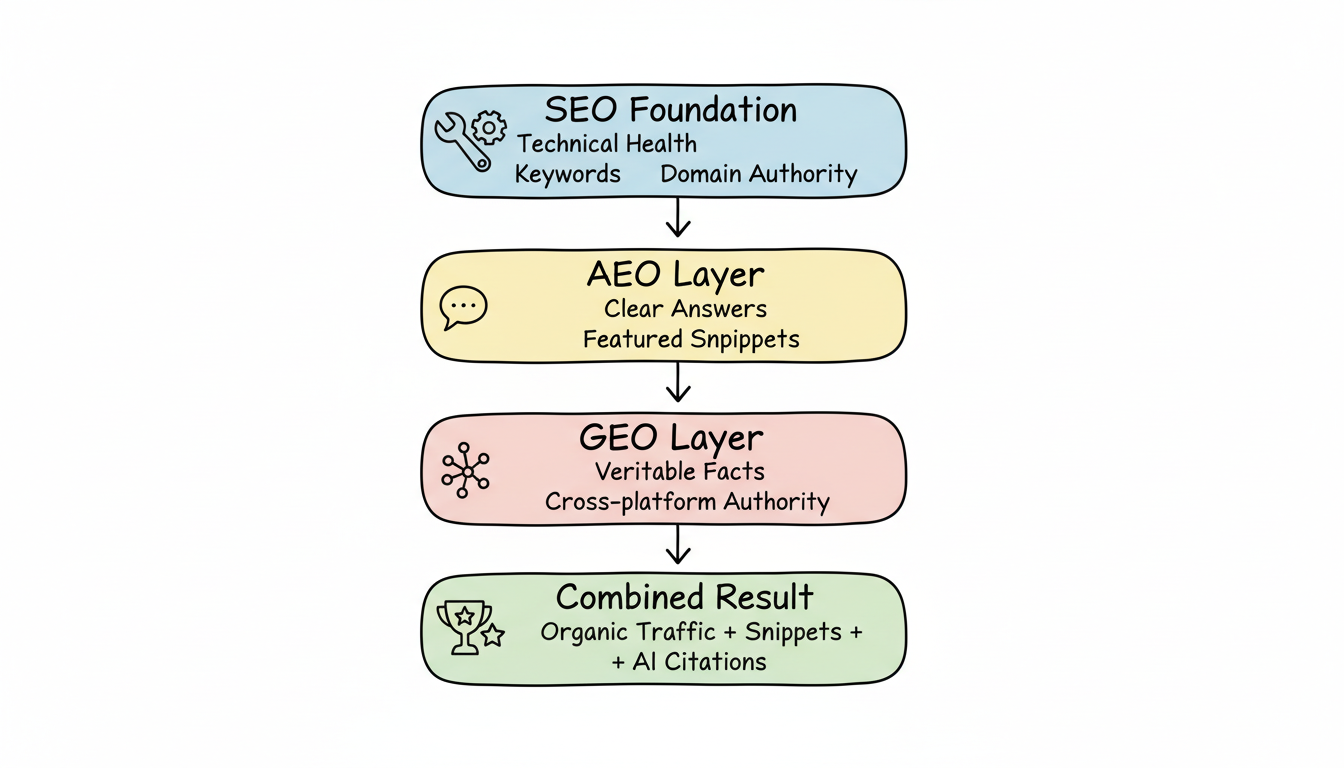
The most effective strategy layers all three disciplines together.
According to Conductor's 2026 AEO/GEO Benchmarks Report, AI isn't replacing search—it's replacing your website as the first place customers engage with your brand. Organizations must measure AI visibility as rigorously as SEO visibility, tracking citations and mentions as core KPIs.
Integration framework:
SEO Foundation (Required)
├── Technical health and crawlability
├── Quality content with keywords
├── Domain authority building
└── User experience optimization
    ↓
AEO Layer (Answer Ready)
├── Clear answers in first lines
├── Question-format headings
├── Structured FAQ sections
└── Schema markup for answers
    ↓
GEO Layer (AI Citable)
├── Comprehensive topic coverage
├── Verifiable facts and sources
├── Consistent brand identity
└── Cross-platform authority signals
    ↓
Combined Result
├── Organic search traffic
├── Featured snippet appearances
└── AI citations and recommendations
According to Search Engine Journal's 2026 report announcement, enterprise SEO leaders have shifted focus to understanding where to invest, which strategies move the needle, and how to prepare as AI continues to reshape search.
Understanding GEO vs AEO vs SEO enables strategic resource allocation:
According to LinkedIn commentary, brands that win will stop asking "How do we rank?" and start asking "Are we the clearest answer? Are we a reliable source? Are we worth repeating?" That mindset change is the real competitive edge going forward.
By submitting this form, you agree to our Privacy Policy and Terms & Conditions.