February 19, 2026


GEO—Generative Engine Optimization—represents more than a new marketing tactic. It signals a fundamental change in how businesses think about visibility. Where SEO asked "how do I rank higher?", GEO asks "how do I become the answer?"
Understanding GEO requires grasping this shift in perspective. The tactics matter, but the mindset matters more.
Traditional search served users a buffet of options. They browsed, clicked, compared. Your job was appearing prominently in that selection.
AI search works differently. Users ask questions and receive synthesized answers. Those answers reference sources—or don't. Your job is becoming one of those referenced sources.
The fundamental question changes:
This isn't wordplay. It reflects genuinely different optimization targets.
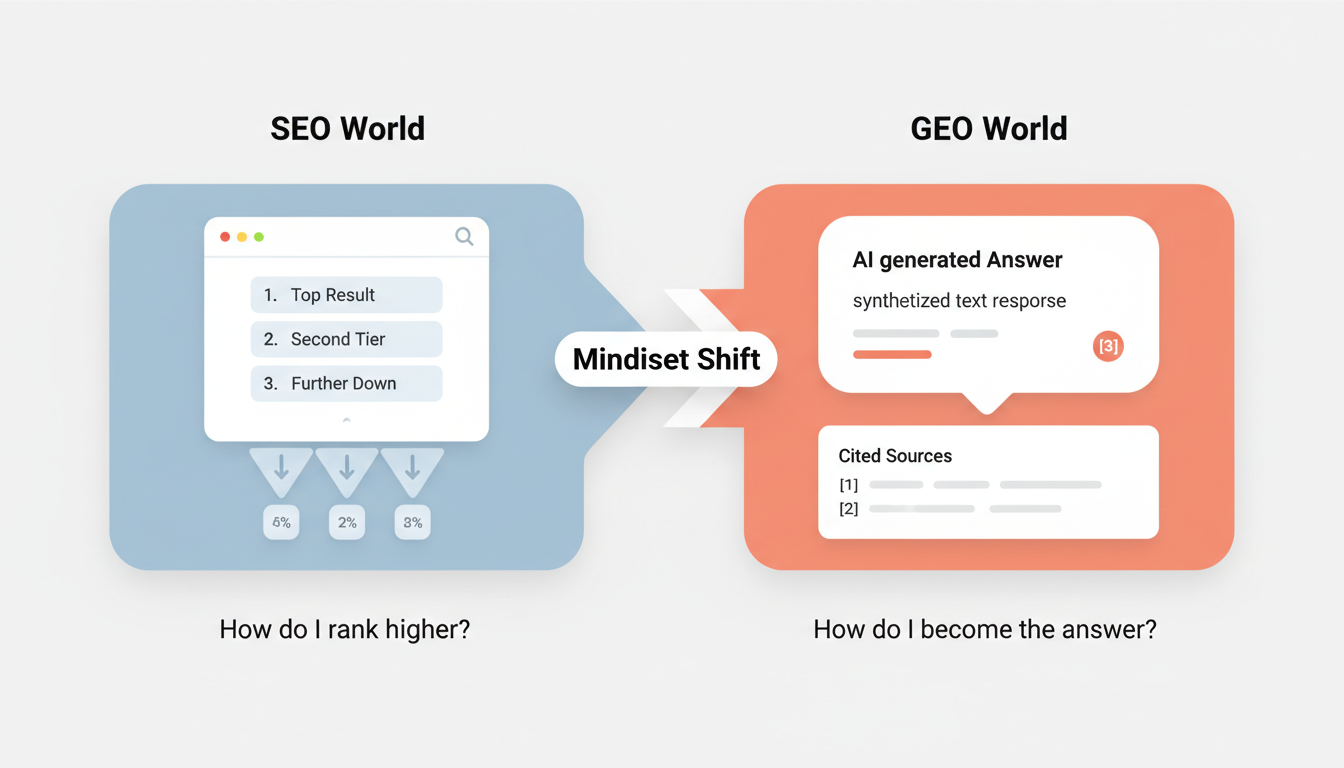
When someone asks ChatGPT "what CRM works best for small consulting firms," they receive a direct answer. The AI names specific products, explains reasoning, and attributes information to sources. Users get answers without clicking through multiple websites.
This changes the visibility equation entirely.
Old equation: Visibility = Rankings × Click-through rate × Pages viewed
New equation: Visibility = Citation frequency × Brand accuracy × User trust
Businesses optimized for the old equation—high rankings driving clicks—may have zero presence in AI answers. Competitors who understand GEO get mentioned. Users form opinions before traditional search even enters the picture.
Understanding GEO means adopting a different mental model for how information flows to users.
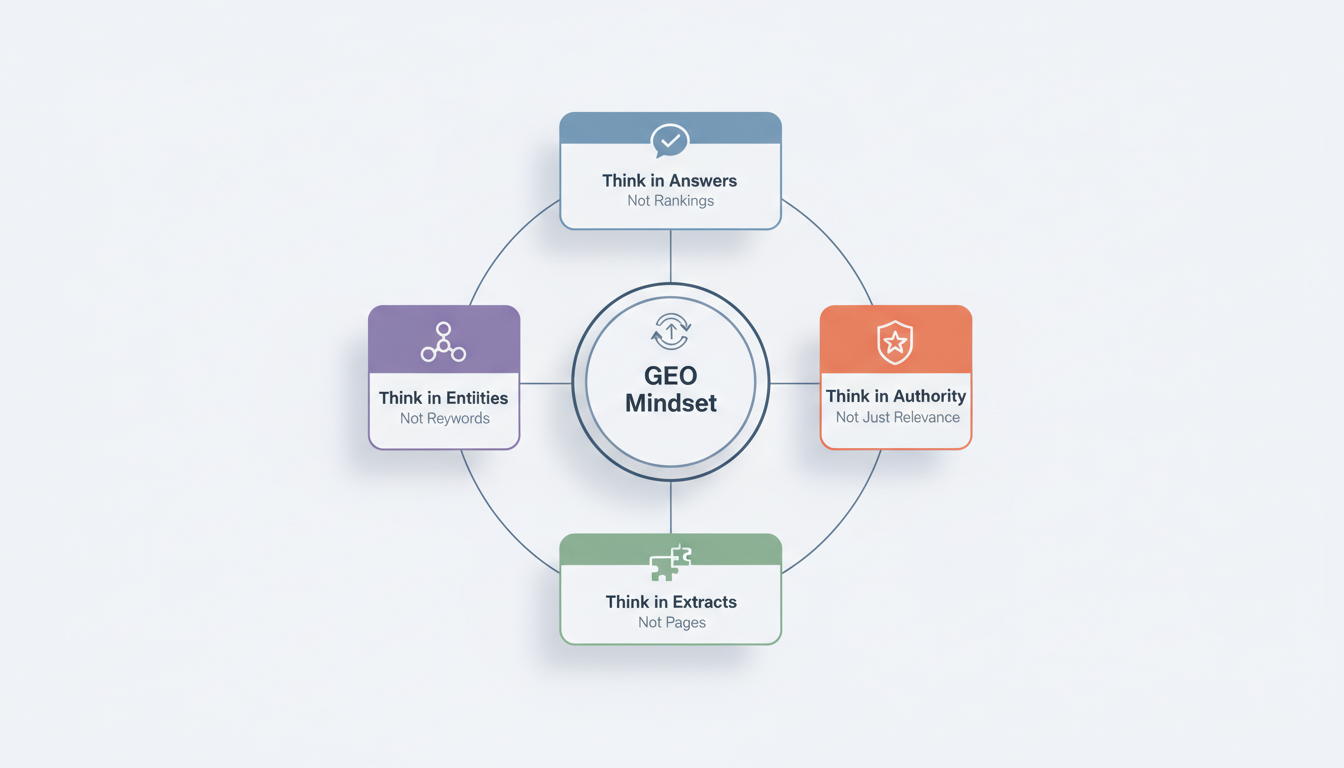
SEO trained marketers to think about rankings—position one, position three, page two. GEO requires thinking about answers instead.
When AI answers a question, what does the ideal response look like? What information gets included? What sources deserve citation? Your content should be designed to answer those questions directly, completely, and authoritatively, much like how question-based headers for AEO structure content to match natural user queries.
Practical shift:
Instead of "we need to rank for 'project management software comparison,'" think "when someone asks 'what project management software works best for remote teams,' what should an accurate answer include, and how can we be cited as the source?"
SEO prioritized relevance—matching user queries with appropriate content. GEO adds an authority layer that determines which relevant sources earn citations.
AI systems don't cite every relevant source. They cite sources they trust. Trust comes from:
Being relevant is necessary but insufficient. You must also be authoritative. Building entity-based SEO and topical authority helps AI systems recognize your brand as a credible source worth citing.
SEO optimized pages as units. GEO optimizes extractable information within pages.
AI systems don't cite entire articles. They extract specific statements, statistics, and explanations. Your content must be structured so individual pieces make sense when pulled from context.
The extraction test:
Can any paragraph from your content be quoted in an AI response and make sense to someone who hasn't read the full article? If not, restructure.
Keywords remain important, but GEO adds emphasis on entities—the people, brands, organizations, and concepts AI systems recognize and track.
AI systems understand that "Slack" and "Slack Technologies" and "@SlackHQ" reference the same entity. They cross-reference information about entities across multiple sources.
GEO entity thinking:
GEO complements rather than replaces established marketing fundamentals.
Pages ranking well in traditional search have higher probability of AI citation. Technical optimization, quality content, and authority signals benefit both SEO and GEO.
Don't abandon SEO for GEO. Build GEO capabilities on solid SEO foundations. Understanding the relationship between generative AI and SEO helps you leverage both approaches effectively.
AI systems evaluate content quality. Thin, inaccurate, or outdated content doesn't earn citations regardless of optimization tactics. GEO amplifies good content; it doesn't rescue bad content.
Understanding what your audience asks and needs remains foundational. GEO changes where those answers get delivered, not what makes answers valuable.
The mindset shift creates opportunity for businesses willing to adapt.
AI search adoption continues accelerating. Businesses establishing GEO presence now benefit as user behavior shifts. Late adopters compete for visibility others already claimed.
GEO rewards authority and accuracy over advertising spend. Businesses with genuine expertise can earn visibility against better-funded competitors by becoming the most credible source AI trusts.
Authority signals build over time. Early GEO investment creates compounding visibility gains. Each citation reinforces authority, increasing future citation probability.
How do you know when GEO matters for your business?
High-opportunity signals:
Lower-opportunity signals:
Most businesses fall somewhere in between. GEO matters, but the degree varies.
Adopting the GEO mindset doesn't require immediate tactical overhaul.
Query ChatGPT, Perplexity, and Google AI Overviews with questions your audience asks. Observe:
This observation builds intuition for what earns AI visibility.
Review your most important content through a GEO lens:
Identify gaps between current content and citation-ready content.
List the questions that matter most for your business—the ones where appearing in AI answers would drive meaningful outcomes. These become GEO priorities.
Rather than overhauling everything, start with priority content. Restructure for extraction. Build authority signals. Monitor results. Expand what works.
GEO is not just new tactics applied to old thinking. It's new thinking about how users find information and how brands earn visibility.
Old thinking: Rank for keywords → Get clicks → Convert visitors
GEO thinking: Answer questions authoritatively → Earn AI citations → Build trust before clicks
This shift isn't optional. As AI search adoption accelerates, brands visible in AI responses capture attention brands limited to traditional rankings miss.
The tactics for earning citations matter. But first, the mindset shift must happen. Understanding why GEO matters enables understanding how to do it well.
By submitting this form, you agree to our Privacy Policy and Terms & Conditions.