February 19, 2026


Last Updated: January 2026
The search landscape has fundamentally shifted. In 2026, over 60% of search engine results pages now feature AI-generated overviews, and millions of users are bypassing traditional search engines entirely in favor of ChatGPT, Perplexity, Claude, and Gemini. If your content strategy still focuses exclusively on traditional SEO, you're optimizing for yesterday's search behavior.
Welcome to the definitive guide on Generative Engine Optimization (GEO)—the discipline of optimizing your content to be discovered, cited, and recommended by AI-powered search engines and large language models.
Generative Engine Optimization (GEO) is the practice of optimizing digital content to maximize visibility and citations within AI-powered search engines and large language models (LLMs). Unlike traditional SEO, which focuses on ranking in a list of blue links, GEO aims to get your content synthesized, quoted, and attributed in AI-generated responses.
The term emerged from groundbreaking research at Princeton University in late 2024, which demonstrated that specific content optimization techniques could increase visibility in AI-generated responses by 30-40%. This research established that AI search engines evaluate content differently than traditional search algorithms.
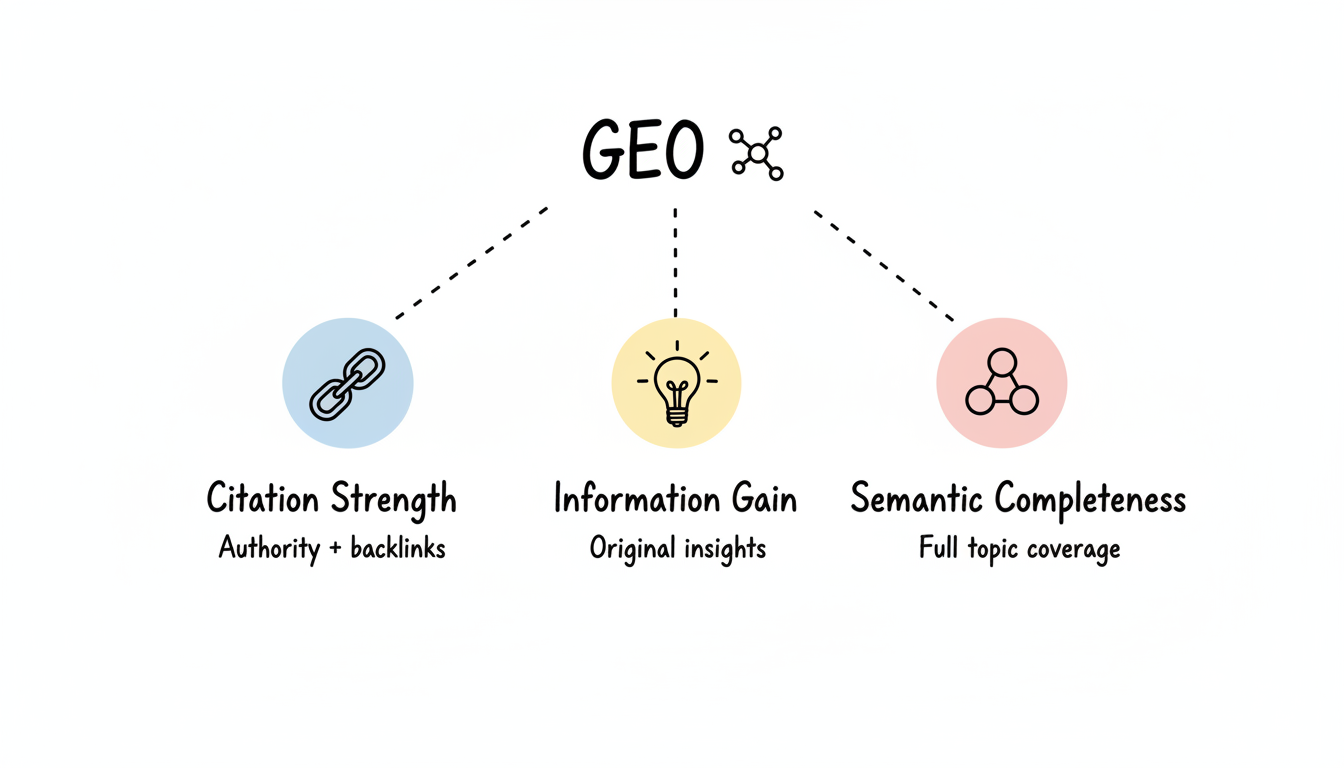
Modern GEO strategy rests on three fundamental pillars:
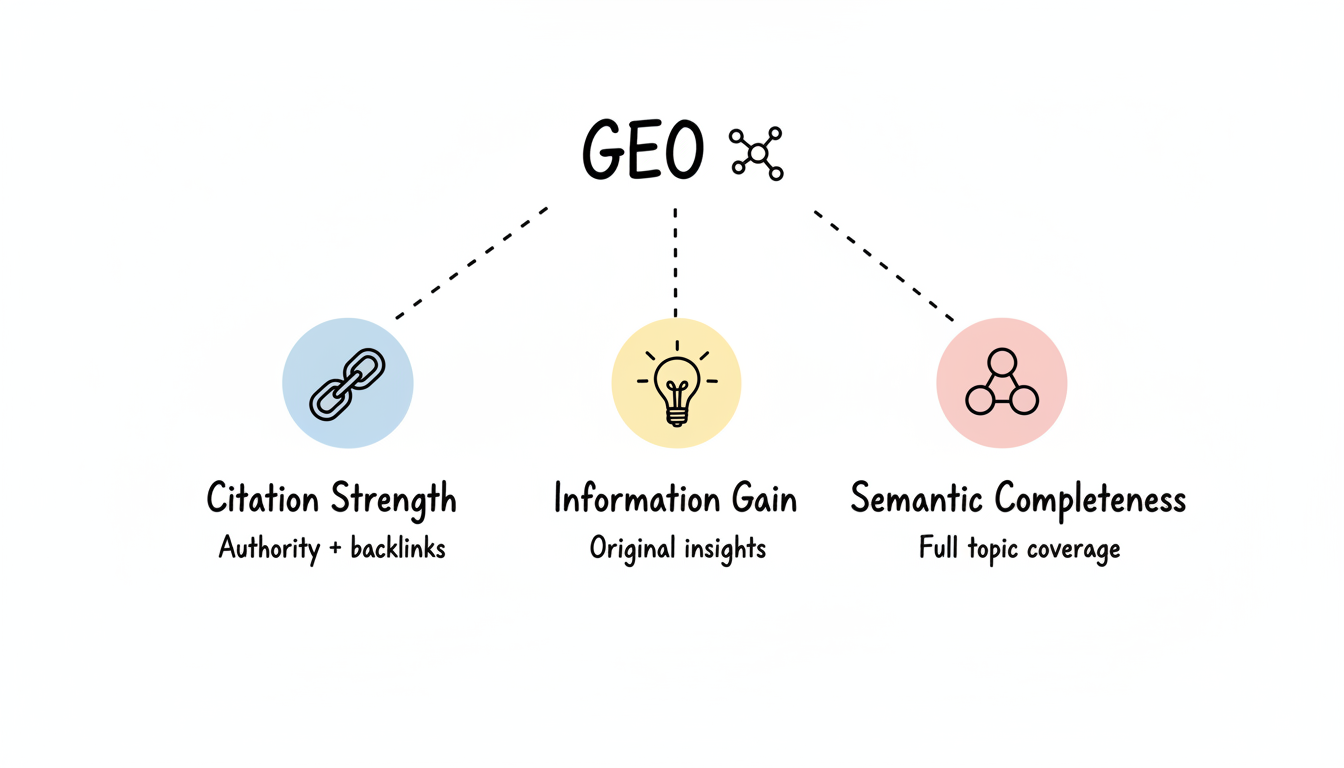
1. Citation Strength AI models are trained to prefer content from authoritative, frequently-cited sources. Building citation strength involves:
2. Information Gain AI systems prioritize content that provides unique insights not found elsewhere. Information gain encompasses:
3. Semantic Completeness LLMs evaluate how thoroughly content addresses a topic and its related concepts. Semantic completeness requires:
"GEO represents the most significant shift in search optimization since mobile-first indexing. Brands that master these three pillars will dominate AI-powered discovery channels." — Search Engine Land, November 2025
Understanding the distinction between GEO and AEO is crucial for developing an effective modern search strategy. While both disciplines share some common principles, their approaches and success metrics differ significantly.
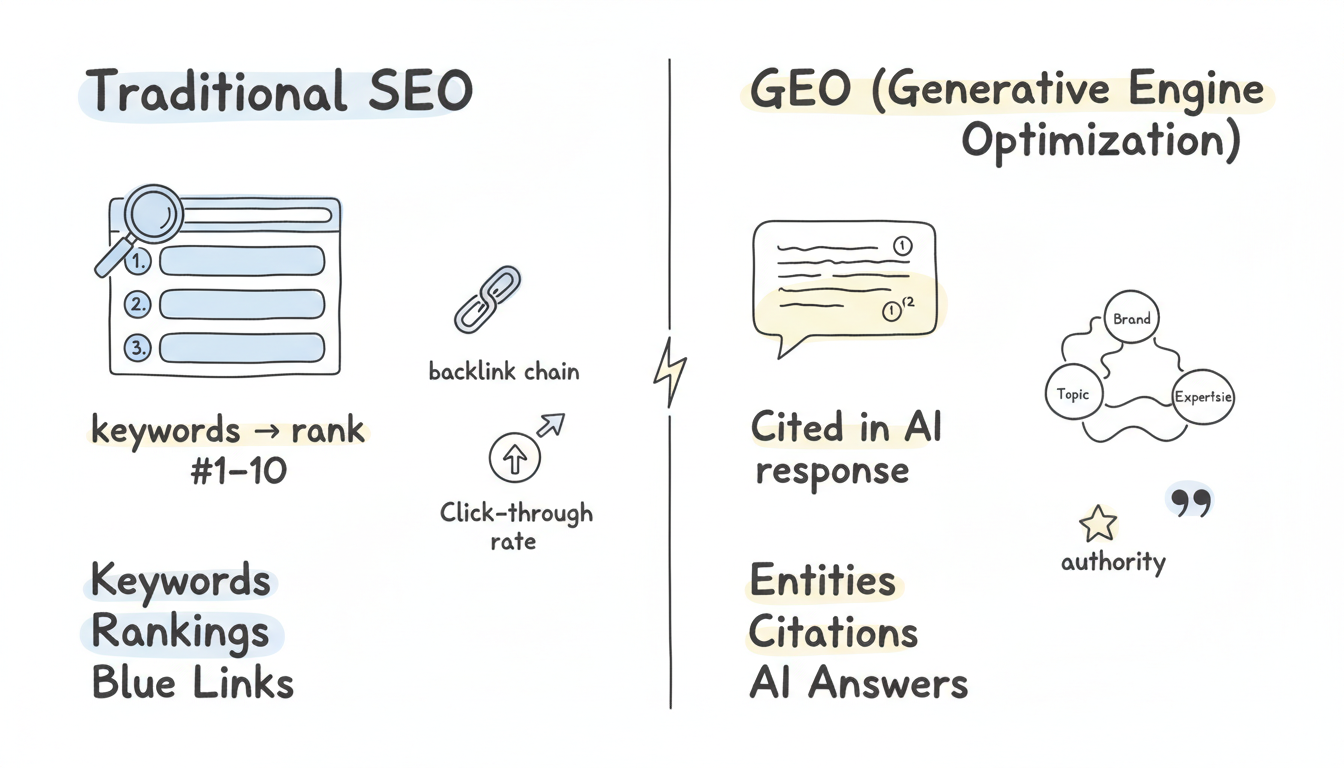
Aspect | Traditional SEO | Generative Engine Optimization |
Primary Goal | Rank in position 1-10 of SERPs | Get cited in AI-generated responses |
Optimization Unit | Keywords | Entities and concepts |
Success Metric | Rankings and click-through rate | Citations, mentions, and referral traffic |
Content Focus | Single keyword targeting | Comprehensive topic coverage |
Link Strategy | Authority and relevance | Citation worthiness |
Technical Focus | Crawlability and speed | Structured data and AI accessibility |
Traditional SEO revolves around keyword optimization—identifying search terms and strategically placing them throughout content. GEO, however, operates on an entity-based model. Understanding how to implement a knowledge graph SEO implementation becomes essential for modern optimization.
Entities are distinct concepts that AI models understand and track: people, organizations, products, locations, and abstract concepts. When you optimize for entities rather than keywords, you're speaking the language that LLMs inherently understand.
Example Transformation:
SEO Approach: "Best reddit ad agency for small business advertising reddit ads campaigns"
GEO Approach: Content that establishes clear entity relationships—connecting your brand to Reddit advertising, demonstrating expertise through case studies, and providing comprehensive coverage of Reddit's advertising ecosystem including Promoted Posts, Reddit Pixel, and Conversation Ads.
In the GEO paradigm, establishing topic authority matters more than ranking for individual keywords. AI models don't simply match queries to keywords—they evaluate which sources demonstrate the deepest understanding of a subject.
This shift requires a fundamental change in content strategy:
While we've highlighted differences, the most successful digital strategies integrate both disciplines. Understanding the AEO vs SEO comparison reveals that GEO is an evolution of SEO rather than a replacement:
Shared Foundations:
Integration Strategies:
The brands winning in 2026 aren't choosing between SEO and GEO—they're building integrated strategies that optimize for both human search behavior and AI-powered discovery channels.
The AI search revolution has accelerated dramatically. As of January 2026, multiple platforms compete for user attention in the generative search space, each with distinct approaches and optimization requirements. Learning how to navigate this evolving landscape through AI search platform comparison helps prioritize your optimization efforts.
Google AI Overviews (formerly SGE) Google's AI Overviews now appear in over 60% of search results, fundamentally changing how users interact with search. Implementing Google AI Overviews optimization strategies has become critical for maintaining visibility. Key statistics:
ChatGPT Search OpenAI's integration of real-time web search into ChatGPT has created a powerful new discovery channel. Understanding ChatGPT Search optimization can unlock significant referral traffic:
Perplexity AI The dedicated AI search engine has carved out significant market share. Our Perplexity AI powered search engine analysis shows:
Microsoft Copilot Bing's AI integration has seen massive growth. Mastering Microsoft Copilot optimization opens enterprise opportunities:
Claude and Gemini Anthropic's Claude and Google's Gemini represent the next frontier:
The emergence of these platforms has fundamentally altered search behavior. Understanding AI search user demographics helps target optimization efforts:
Understanding the scale of AI search helps prioritize optimization efforts. Our cross-platform AI search ROI analysis reveals significant opportunity:
Current Market Penetration (January 2026):
Traffic Distribution Trends: According to industry analysis, AI-referred traffic has grown from virtually zero in early 2024 to representing 5-15% of organic traffic for optimized sites. Early adopters of GEO optimization strategies report even higher percentages, with some seeing 20-30% of qualified leads originating from AI discovery channels.
Projected Growth: Analysts project that by 2028, AI-mediated search will account for 40-50% of all information retrieval activities, fundamentally reshaping how brands approach digital visibility. The window for establishing GEO authority is narrowing as competition intensifies.
Research from multiple sources, including the Princeton GEO study and industry analysis from Semrush and Search Engine Land, has identified the key factors that influence AI citation and visibility. Understanding these LLM optimization best practices ensures your content ranks in AI-generated responses.
AI systems are sophisticated at evaluating source credibility. Key trust signals include:
Author Expertise
Domain Authority
Content Freshness
Understanding Google AI Overview update frequency helps maintain content relevance in AI search results.
The Princeton study found that including statistics, quotes, and citations can increase AI visibility by 30-40%. This aligns with how LLMs are trained—they're designed to prefer and propagate verifiable, authoritative information.
Best Practices:
Example: ❌ "Many businesses see improved results with Reddit advertising." ✅ "Businesses using Reddit advertising report an average 42% lower cost-per-acquisition compared to Facebook ads, according to a 2025 Social Media Examiner study."
AI models understand content through entities and their relationships. Comprehensive entity coverage means leveraging Wikipedia Wikidata knowledge graph connections to establish authority:
Entity Identification
Relationship Mapping
Entity Markup
For brands seeking recognition, understanding how to get Google knowledge panel visibility is crucial.
AI systems are trained to identify and prioritize content that adds new information to a topic. Simply rehashing existing content will not earn citations.
Sources of Information Gain:
Demonstrating Originality:
AI models evaluate how thoroughly content addresses a topic. Surface-level content that only covers basics will be passed over in favor of comprehensive resources. Implementing GEO content optimization techniques ensures semantic completeness.
Achieving Semantic Completeness:
Each AI search platform has distinct characteristics that require tailored optimization approaches. Developing platform-specific tactics through ChatGPT optimization tactics and similar strategies maximizes visibility across all channels.
Google's AI Overviews draw from its existing index but apply different ranking criteria than traditional search. Our Google AI Overview SEO strategy guide provides deeper insights.
Optimization Priorities:
Content Formats That Perform:
Technical Requirements:
For ecommerce businesses, specialized Google AI Overview ecommerce product optimization strategies drive product visibility.
OpenAI's search integration requires content optimized for conversational understanding. Our comprehensive ChatGPT SEO optimization guide covers advanced techniques.
Key Strategies:
Content Characteristics That Earn Citations:
Perplexity's emphasis on source transparency makes citation-worthiness paramount. Comparing Perplexity vs ChatGPT SEO approaches reveals platform-specific nuances.
Optimization Focus:
Structural Preferences:
These advanced models have sophisticated understanding of content quality.
Claude-Specific Considerations:
Gemini-Specific Considerations:
Microsoft Copilot presents unique opportunities for B2B companies. Understanding Microsoft Copilot ROI B2B companies can justify investment in platform-specific optimization. For development teams, Copilot developers GitHub integration creates additional visibility opportunities.
Enterprise users particularly benefit from Microsoft Copilot in Teams visibility optimization, while analyzing Copilot citation patterns reveals what content performs best.
How you structure content significantly impacts its AI visibility. AI models parse content differently than humans, making structural optimization essential. Implementing on-page AEO optimization techniques ensures maximum AI comprehension.
1. Clear Hierarchical Headings Use a logical heading structure that AI can easily parse. The importance of descriptive subheadings AEO boost cannot be overstated:
2. Front-Loaded Key Information AI systems often extract from early paragraphs. Place your most important, citation-worthy content near the beginning of sections.
3. Scannable Formatting
4. FAQ Sections AI systems frequently draw from FAQ content to answer user queries. Include a comprehensive FAQ section with:
Be Explicit, Not Implicit AI models don't infer meaning like humans. State relationships and conclusions explicitly.
❌ "This approach works better." ✅ "This approach delivers 30% higher conversion rates compared to traditional methods because it reduces friction in the user journey."
Use Precise Language Avoid ambiguous pronouns and vague references. Repeat entity names when clarity is important.
❌ "They reported that it increased significantly." ✅ "Semrush reported that websites implementing GEO strategies increased AI visibility by 30-40%."
Provide Context Don't assume AI has context from previous sentences. Each section should be somewhat self-contained.
Include Definitions When introducing concepts, provide clear definitions that AI can extract and cite.
One of the most effective GEO writing techniques is the "answer-first" methodology. This approach, central to ask engine optimization, structures content to immediately provide the answer AI systems are looking for, then expand with supporting detail.
Traditional Writing Structure:
Answer-First GEO Structure:
This structure aligns with how AI systems extract information. When a user asks ChatGPT or Perplexity a question, these systems scan content for direct answers. Content that leads with the answer is more likely to be cited.
Example Transformation:
Traditional: "Reddit has grown significantly as an advertising platform over the past five years. With its unique community structure and engaged user base, many marketers have found success. After analyzing multiple campaigns, we've found that..."
Answer-First: "Reddit advertising typically costs $0.20-$5.00 per click, with an average CPM of $5-$15 depending on targeting. This makes Reddit 40-60% cheaper than Facebook or Instagram for most B2B and niche consumer audiences. Here's why these costs vary and how to optimize your spend..."
Technical optimization ensures AI systems can access, understand, and properly attribute your content. Understanding the AI overview Google SEO technical requirements is essential for implementation.
Structured data helps AI understand content type, authorship, and relationships.
Essential Schema Types:
{
  "@type": "Article",
  "headline": "Your Article Title",
  "author": {
    "@type": "Person",
    "name": "Author Name",
    "url": "https://yoursite.com/author"
  },
  "datePublished": "2026-01-15",
  "dateModified": "2026-01-15"
}As AI systems increasingly crawl the web for training and retrieval, managing AI crawler access becomes important.
robots.txt Considerations:
# Allow major AI crawlers
User-agent: GPTBot
Allow: /

User-agent: Google-Extended
Allow: /

User-agent: Claude-Web
Allow: /

User-agent: PerplexityBot
Allow: /
Note: Blocking AI crawlers may reduce your content's availability in AI-generated responses. Consider your strategy carefully. Some users prefer to block AI Overview extensions at the browser level rather than site-wide.
AI crawlers may not execute JavaScript like modern browsers. Ensure important content is available in initial HTML:
While AI systems aren't users, the sites they prefer to cite typically have good performance:
AI systems place significant weight on content recency, particularly for topics that evolve rapidly. Implementing freshness signals helps maintain AI visibility:
Date Management:
Freshness Best Practices:
Content Decay Prevention:
Internal linking helps AI systems understand content relationships and topic authority:
Strategic Linking Principles:
AI-Friendly Anchor Text: Instead of "click here" or "learn more," use descriptive phrases like "our comprehensive guide to Reddit advertising" or "Reddit ads cost breakdown." This helps AI understand content relationships and context.
Traditional SEO metrics don't fully capture GEO success. Implement measurement frameworks that track AI-specific performance. Establishing proper AI search traffic attribution systems ensures accurate ROI measurement.
1. AI Referral Traffic Track traffic from AI platforms:
2. Brand Mentions in AI Responses Monitor when your brand appears in AI-generated content:
3. Citation Rate Track how often your content is cited vs. competitors:
4. Share of Voice in AI Measure your presence relative to competitors in AI responses for target topics. Conducting regular AEO competitor analysis helps benchmark performance.
Several tools have emerged to help track GEO performance. Reviewing the best generative engine optimization tools and AEO tools helps select the right solution.
Dedicated GEO Tools:
Traditional Tools with GEO Features:
For WordPress users, specialized AEO for WordPress plugins simplify implementation and tracking. Enterprise teams benefit from enterprise AI SEO platforms with advanced analytics.
Understanding Google Search Console AEO integration helps track Google AI Overview performance alongside traditional organic results.
DIY Monitoring:
Measuring GEO presents unique challenges:
Solutions:
Real-world examples demonstrate GEO principles in action. Reviewing detailed AEO case studies across industries provides implementation insights.
Company: Mentimeter (presentation software) Challenge: Increase discovery and conversions from AI search channels
Strategy:
Results:
Key Takeaway: Comprehensive, authoritative content in your niche can drive substantial traffic and conversions from AI channels.
Industry: Consumer electronics retailer Challenge: Compete with major retailers in AI-powered product recommendations
Strategy:
Results:
Key Takeaway: Detailed, structured product content outperforms basic listings in AI recommendations. Specialized Shopify AEO optimization strategies work particularly well for ecommerce platforms.
Industry: Marketing automation software Challenge: Establish thought leadership in AI-powered discovery
Strategy:
Results:
Key Takeaway: Original research and data create sustainable competitive advantages in GEO.
Industry: Multi-location dental practice Challenge: Compete with aggregator sites and national chains in AI-powered local recommendations
Strategy:
Results:
Key Takeaway: Local businesses can compete with larger competitors by providing comprehensive, locally-relevant content that AI systems recognize as authoritative for specific geographic queries.
Learning from failures is as important as studying successes. Here are patterns we've seen undermine GEO efforts:
Mistake 1: Over-Optimization Stuffing content with statistics and quotes without natural integration makes content feel robotic. AI systems are trained on natural language and can detect artificial patterns.
Mistake 2: Neglecting Mobile Over 60% of AI Overview triggers occur on mobile devices. Content that doesn't render well on mobile will be deprioritized.
Mistake 3: Ignoring Existing Content Many brands focus on creating new content while their existing assets need optimization. Often, updating authoritative existing content yields faster results than building from scratch.
Mistake 4: Single-Platform Focus Optimizing only for Google AI Overviews while ignoring ChatGPT and Perplexity leaves visibility gaps. Each platform has growing user bases with different query patterns.
Mistake 5: Expecting Immediate Results GEO, like SEO, requires patience. Understanding the realistic AEO optimization timeline helps set proper expectations. Authority and citation patterns build over time. Brands that expect overnight results often abandon effective strategies prematurely.
The GEO landscape continues to evolve rapidly. Understanding emerging trends through our AI search optimization timeline roadmap helps prepare for what's next.
1. Multimodal Search AI systems are increasingly understanding images, videos, and audio:
2. Agentic AI Search AI agents that take actions on behalf of users will change discovery:
3. Personalized AI Responses AI systems will increasingly personalize based on user context:
4. Real-Time Information AI systems are getting better at accessing current information:
Understanding the relationship between SEO and generative AI and generative AI in SEO helps anticipate future developments.
Short-Term (2026):
Medium-Term (2027-2028):
Long-Term (2029+):
Understanding generative AI search engine optimization principles positions brands for long-term success.
Different industries face unique GEO challenges and opportunities. Exploring what is AEO marketing within your specific vertical reveals industry-specific tactics.
E-Commerce:
B2B/SaaS:
Healthcare:
Financial Services:
Local Services:
Businesses seeking professional help can explore AI search optimization services, AEO audit services, and generative engine optimization agency partnerships.
GEO (Generative Engine Optimization) focuses on getting content cited and referenced by AI-powered search engines like ChatGPT, Perplexity, and Google AI Overviews. SEO (Search Engine Optimization) focuses on ranking in traditional search results. While related, GEO emphasizes entity optimization, citation worthiness, and semantic completeness, whereas SEO focuses on keywords, backlinks, and technical optimization. Understanding what is GEO generative engine optimization clarifies the distinction.
Optimize for AI search by: (1) Creating comprehensive, authoritative content on specific topics, (2) Including statistics, quotes, and citations that AI can reference, (3) Structuring content with clear headings, lists, and tables, (4) Implementing schema markup, (5) Building brand authority through backlinks and mentions, and (6) Providing original research and unique insights. Following answer engine optimization principles ensures content meets AI visibility requirements.
In 2026, prioritize optimization for: Google AI Overviews (largest reach through AI overview website optimization), ChatGPT/SearchGPT (fastest growing), Perplexity AI (research-focused users), and Microsoft Copilot (enterprise users). Each has slightly different optimization requirements, but core GEO principles apply across all platforms.
Measure GEO through: AI referral traffic tracking in analytics, brand mention monitoring across AI platforms, citation tracking in AI-generated responses, branded search volume trends, and competitive share of voice in AI responses. Tools like Scrunch AI, Bluefish, and enterprise solutions from Semrush and Ahrefs can help automate tracking. Understanding the history of AEO provides context for measurement evolution.
No, GEO complements rather than replaces SEO. Traditional SEO remains important for organic search visibility, and many GEO best practices (quality content, technical optimization, authority building) align with SEO. The most effective strategy integrates both disciplines. Understanding AEO SEO GEO relationships clarifies how they work together, and reviewing AEO vs SEO Google official position provides authoritative guidance.
GEO results typically take 2-6 months to manifest, similar to SEO timelines. Building the authority and citation patterns that AI systems recognize requires consistent effort. Quick wins may come from optimizing existing high-authority content, while new sites face longer timelines.
Comprehensive guides, how-to content, comparison articles, FAQ pages, and data-driven research perform well in GEO. AI systems favor content that provides complete answers with supporting evidence. Video content is increasingly important, with YouTube cited in 29.5% of Google AI Overviews.
Generally, no. Blocking AI crawlers reduces your content's availability in AI-generated responses. However, if you have specific concerns about AI training on your content, you may selectively block certain crawlers while allowing others. Consider your business goals carefully before implementing blocks.
E-E-A-T (Experience, Expertise, Authoritativeness, Trustworthiness) is even more important for GEO than traditional SEO. AI systems are trained to prefer credible sources, making author expertise, site authority, and content trustworthiness critical ranking factors in AI responses.
GEO (Generative Engine Optimization) specifically focuses on AI-powered search engines that generate responses. AEO (Answer Engine Optimization) is a broader term that includes optimizing for any system that provides direct answers, including featured snippets and voice assistants. Understanding what is AEO in marketing provides additional context. GEO is essentially the latest evolution of AEO concepts.
Multiple options exist depending on budget and needs. Review comparisons like Frase vs Search Atlas, SEO AI vs Search Atlas, and free vs paid AEO tools to find the right fit. For budget-conscious teams, explore best free AI SEO tools 2026 options. Comprehensive overviews of AEO tools software and best AI SEO tools help inform purchasing decisions.
AEO keyword research differs from traditional keyword research by focusing on question-based queries, conversational phrases, and entity relationships rather than just search volume. Tools and techniques that identify how AI systems interpret queries drive better targeting.
Yes, voice search AEO optimization leverages similar principles to text-based AI search optimization. Natural language patterns, complete answers, and featured snippet optimization all support voice search visibility.
GEO optimization benefits include increased brand visibility in AI-generated responses, higher-quality referral traffic, competitive advantages in emerging channels, and future-proofing against traditional search decline.
This depends on resources and expertise. Understanding search engine optimization using AI capabilities helps decide whether to build in-house capabilities, leverage tools, or partner with a generative engine optimization agency. Many businesses benefit from reviewing AI SEO agency guide 2026 before making decisions. For proposals and scoping, explore AEO services proposal templates.
Before committing to expensive platforms, conduct AI SEO software ROI testing to validate effectiveness for your specific use cases and content types.
Beyond the major platforms, alternatives like Felo AI search and You.com AI search serve niche audiences. Understanding these platforms broadens optimization opportunities.
By submitting this form, you agree to our Privacy Policy and Terms & Conditions.