
February 19, 2026


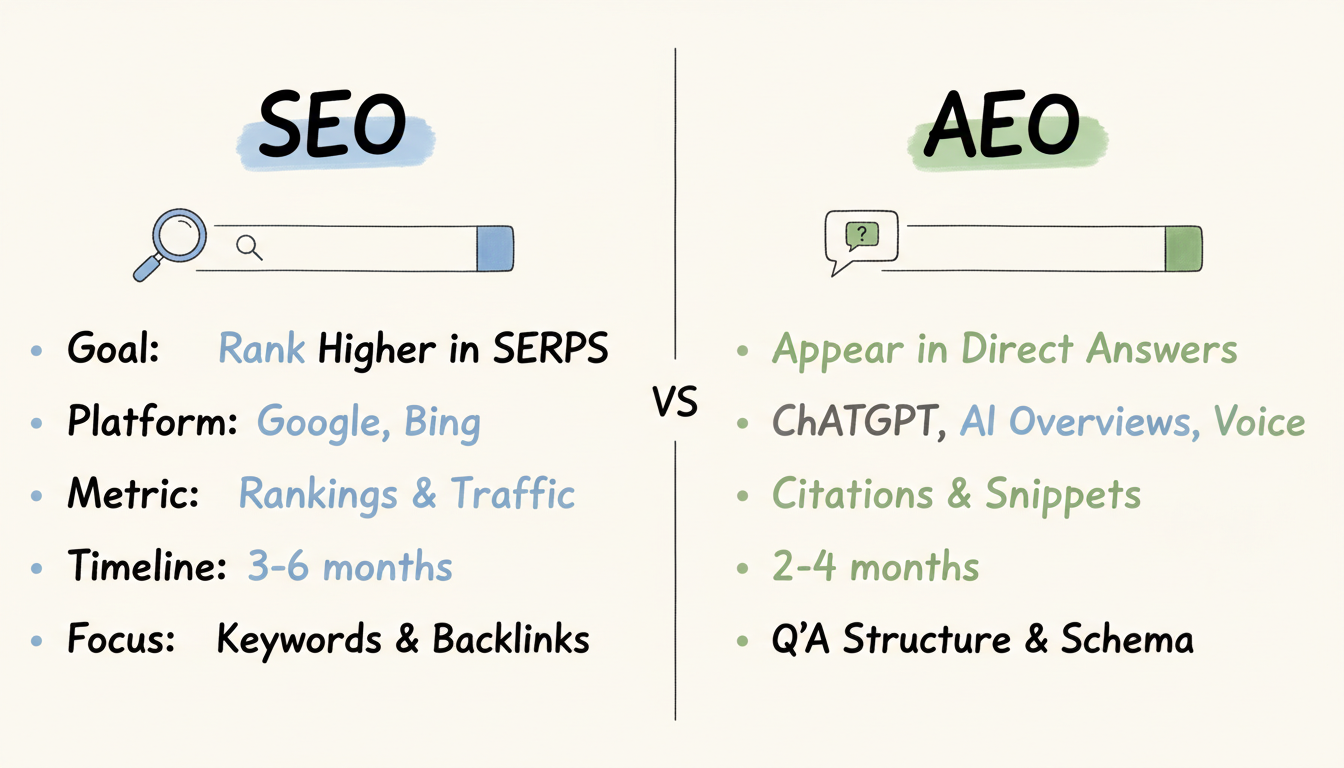
For two decades, digital visibility meant one thing: ranking higher on Google. That mental model no longer holds. In 2026, search is no longer just a competition for page positions—it's a competition for who gets to answer the question.
Answer Engine Optimization (AEO) has emerged as the complementary discipline to traditional SEO, designed to ensure your content appears in AI-generated answers, featured snippets, and voice search results. Understanding how AEO differs from SEO—and when to prioritize each—determines whether your brand stays visible or disappears into algorithmic obscurity.
This guide breaks down the complete comparison between AEO and SEO, including practical strategies for building an integrated approach.
Search behavior has fundamentally shifted. Users increasingly ask questions like:
They expect direct answers, not lists of links to explore. Google's AI Overviews now appear in over 60% of informational queries. ChatGPT handles over 100 million weekly active users asking questions that previously drove Google searches. Perplexity, Claude, and other AI assistants continue capturing query volume.
The result: ranking #1 organically no longer guarantees traffic. If an AI-generated answer satisfies the user's query, they may never click through to your content. Worse, if your competitor's content gets cited in that AI answer while yours doesn't, you've lost visibility at the moment of highest intent.
This evolution doesn't make SEO obsolete. It makes SEO insufficient alone. Enter Answer Engine Optimization.
Search Engine Optimization focuses on improving website visibility in traditional search engine results pages (SERPs). The discipline has evolved over 25+ years but maintains core principles:
Primary Goal: Drive organic traffic by ranking higher for target keywords.
Core Tactics:
Success Metrics:
Typical Timeline: 3-6 months to see meaningful ranking improvements; 6-12 months for competitive keywords.
SEO remains foundational because search engines still process billions of queries daily. Google alone handles over 8.5 billion searches per day. Traditional organic results still drive significant traffic, particularly for transactional and navigational queries.
However, SEO's limitation becomes clear when users don't need to visit a website to get their answer. That's where AEO optimization strategies enter.
Answer Engine Optimization focuses on structuring content to appear in AI-generated answers, featured snippets, and direct response formats. AEO recognizes that modern search increasingly delivers answers rather than links.
Primary Goal: Become the source that AI systems extract and cite when answering user queries.
Core Tactics:
Success Metrics:
Typical Timeline: 2-4 months for featured snippet gains; 3-6 months for consistent AI citations.
The key distinction: SEO brings users to your content, while AEO brings your content into the answers users see. You need both motion paths to compete effectively in 2026. Understanding the fundamental differences between GEO and AEO approaches helps refine your strategy.
Aspect | SEO | AEO |
Primary Goal | Rank higher in SERPs | Appear in direct answers |
Target Platforms | Google, Bing organic results | AI Overviews, ChatGPT, Perplexity, voice assistants |
Content Focus | Comprehensive, keyword-optimized pages | Concise, extractable answers |
Query Types | All query types | Question-based, informational queries |
Keyword Strategy | Volume-based, long-tail variations | Intent-based, conversational phrasing |
Success Metric | Rankings and traffic | Citations and answer presence |
Technical Focus | Site speed, crawlability, mobile | Schema markup, structured data, entity signals |
Link Building | High importance for authority | Moderate; authority matters but differently |
Content Structure | Headers, keywords, internal links | Q&A format, direct answers, bullet points |
User Journey | Click to website required | Answer delivered without click |
Timeline | 3-6 months typical | 2-4 months typical |
Measurement Tools | Google Search Console, rank trackers | AI citation trackers, featured snippet monitors |
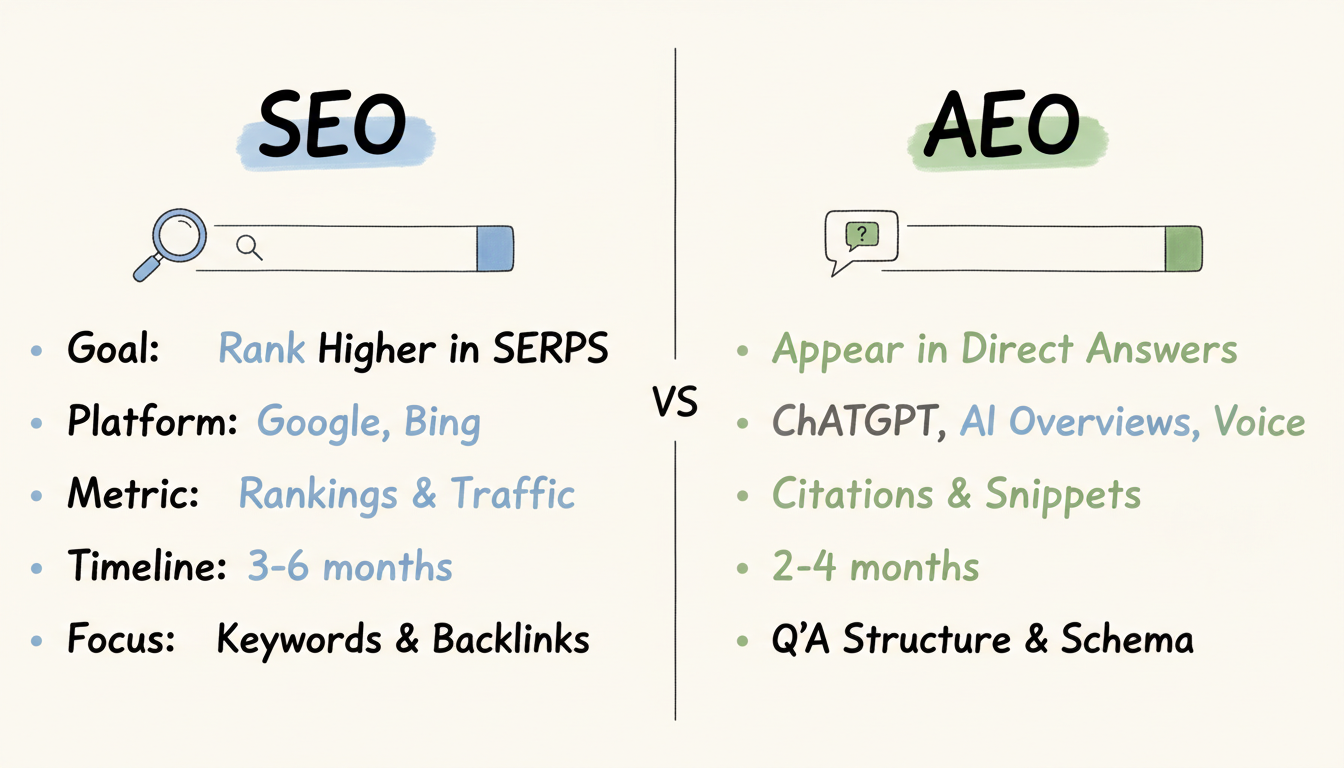
Neither strategy universally outperforms the other. The right choice depends on your goals, audience, and query types you're targeting.
Transactional Queries Dominate Users searching "buy [product]" or "[service] pricing" typically need to visit a website to complete their transaction. SEO drives these high-intent visitors to conversion pages.
Brand Discovery Matters For companies building awareness, ranking for industry terms puts your brand in front of prospects researching solutions. SEO visibility at the top of the funnel feeds your pipeline.
Content Depth Is Your Advantage Long-form guides, detailed comparisons, and comprehensive resources benefit from SEO. Users actively seeking depth will click through to consume your expertise.
Local Business Focus Local SEO remains critical for businesses serving geographic markets. Google Business Profile optimization, local citations, and map pack rankings drive foot traffic and calls.
Informational Queries Are Your Battleground "What is [topic]?" and "How do I [task]?" queries increasingly receive AI-generated answers. AEO ensures your content gets cited as the source.
Voice Search Relevance Voice assistants deliver single answers, not ten blue links. If your audience uses Alexa, Siri, or Google Assistant, voice search optimization determines whether you're the answer.
AI Platform Visibility Users asking ChatGPT or Perplexity for recommendations won't see your website unless those platforms cite you. AEO builds the authority and structure that earns citations.
Featured Snippet Opportunities For queries with clear "position zero" potential, AEO tactics—concise answers, proper formatting, schema markup—directly improve featured snippet capture.
Most businesses benefit from integrated SEO + AEO strategies. SEO builds the foundation—crawlable, authoritative, keyword-relevant content. AEO layers on the optimization that makes that content extractable and citable by answer engines.
Trying to do AEO without SEO fundamentals is like building a house without a foundation. Answer engines rely on traditional search signals (authority, relevance, trust) to determine which sources to cite.
The most effective 2026 search strategies treat SEO and AEO as complementary disciplines, not competing priorities.
Before layering AEO, ensure your SEO basics are solid:
Without these fundamentals, answer engines have no reason to trust or cite your content.
Transform existing SEO content to be more AEO-friendly:
Add Q&A Sections Every comprehensive guide should include explicit question-and-answer formatting. Use the actual questions people ask (check People Also Ask boxes and keyword research tools).
Lead with Direct Answers Don't bury your answer after four paragraphs of introduction. Open sections with concise, quotable answers, then elaborate with supporting detail. This approach aligns with schema markup best practices for AI search visibility.
Implement Schema Markup FAQPage schema, HowTo schema, and Article schema help answer engines understand and extract your content. This isn't optional in 2026—it's table stakes.
Answer engines increasingly understand entities—people, companies, concepts, products—rather than just keywords.
AI platforms cite sources they trust. Building that trust requires:
Many businesses find that working with specialized AEO services accelerates this authority-building process.
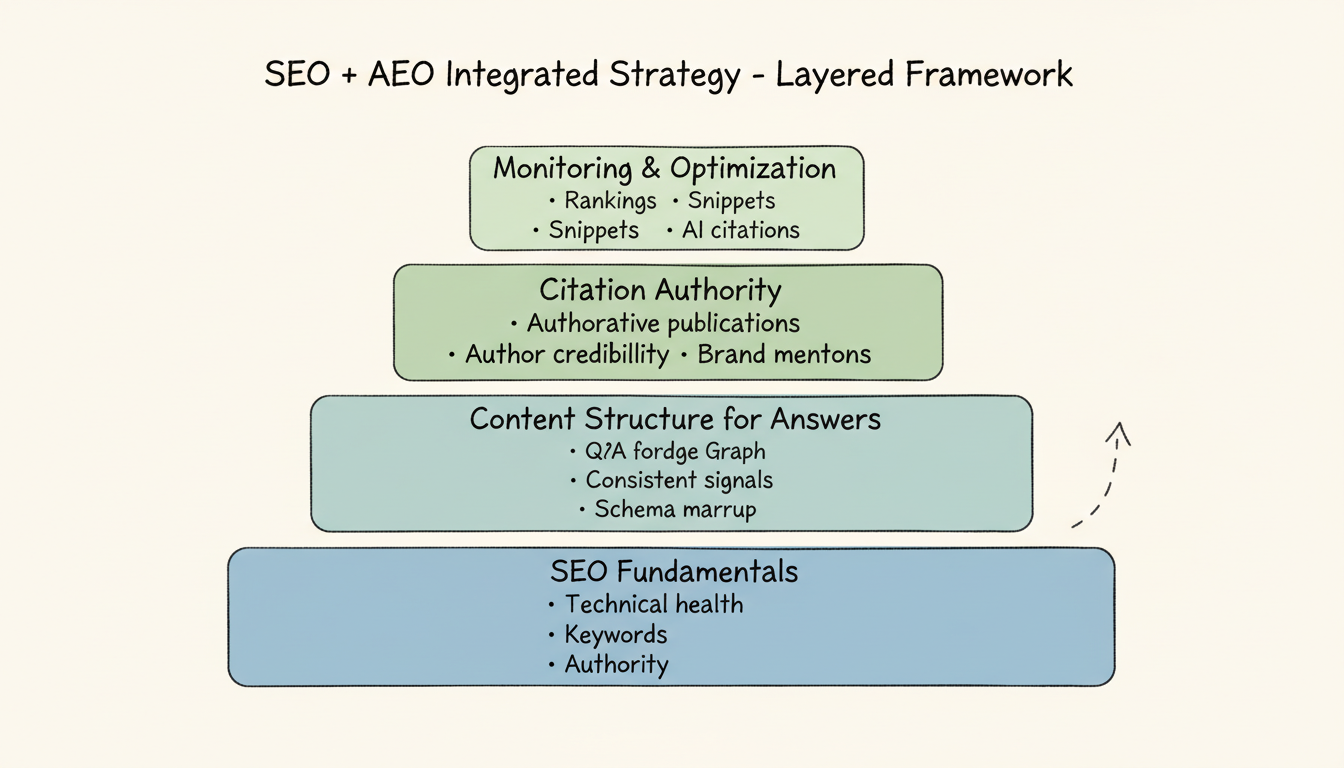
Track performance across both SEO and AEO metrics:
Adjust strategy based on where you're winning and where gaps exist. Consider implementing Google Analytics 4 tracking for AI search to measure comprehensive performance.
For most businesses, budget allocation follows this general framework:
Early-Stage Companies (Limited Budget)
Growth-Stage Companies
Established Brands
Specific Scenarios That Shift Allocation:
High informational query volume in your industry: Increase AEO allocation to 60-70%
E-commerce with transactional focus: Maintain 60-70% SEO allocation
B2B with long consideration cycles: Balance 50/50; both channels influence decisions
Local business: 70% SEO (local SEO specifically) / 30% AEO
These aren't rigid rules. Track performance and reallocate based on which channel delivers better ROI for your specific situation. Startups often benefit from tailored AEO marketing strategies that balance budget constraints with growth objectives.
Understanding realistic timelines prevents frustration and enables proper planning.
Month 1-2: Technical audits, keyword research, content planning, initial optimizations
Month 3-4: Content publication, link building initiation, ranking movement begins
Month 5-6: Meaningful ranking improvements, traffic growth becomes measurable
Month 6-12: Competitive keywords start ranking, compounding traffic gains
SEO is a long game. The investment compounds over time, but patience is required.
Month 1: Schema implementation, content restructuring for Q&A format, baseline tracking
Month 2: Featured snippet targeting, answer optimization, initial snippet captures
Month 3-4: AI citation monitoring shows improvements, voice search testing validates progress
Month 4-6: Consistent featured snippet presence, measurable AI platform citations
AEO typically shows faster initial results because you're optimizing existing content for new formats rather than building authority from scratch. However, sustained AEO success requires the SEO foundation.
When running integrated SEO + AEO:
Month 1-3: SEO fundamentals + AEO quick wins (schema, featured snippets)
Month 4-6: SEO momentum building + AEO expansion to AI platforms
Month 6-12: Both channels delivering measurable traffic and visibility
The most persistent myth in search marketing: "AEO is replacing SEO." Let's address this directly.
Myth 1: SEO Is Dead
Reality: SEO remains the foundation of visibility in traditional search engines. Google processes 8.5+ billion searches daily. Organic traffic still drives significant business results. Without SEO fundamentals, answer engines won't trust or cite your content.
Myth 2: AEO Makes Rankings Irrelevant
Reality: Studies consistently show that sources cited by AI platforms typically rank in top positions for traditional search. The sources ChatGPT cites tend to rank in the top 5 on Google. Understanding how search engine optimization works with AI reveals this correlation.
Myth 3: You Must Choose One or the Other
Reality: AEO builds on SEO, not instead of it. The disciplines share foundational elements (authority, relevance, trust) while differing in tactical execution. Successful strategies layer AEO onto SEO foundations.
Myth 4: AEO Only Matters for Voice Search
Reality: AEO impacts Google's AI Overviews (visible to billions), ChatGPT citations, Perplexity answers, and featured snippets—far beyond voice assistants alone. Optimizing for Google AI Overviews represents just one component of comprehensive AEO.
Myth 5: Small Businesses Don't Need AEO
Reality: Small businesses often benefit most from AEO because featured snippets and AI citations can level the playing field against larger competitors with bigger SEO budgets. A local accounting firm optimizing for "how to file small business taxes" can capture the featured snippet regardless of domain authority.
Myth 6: AEO Requires Completely New Content
Reality: Most AEO success comes from restructuring and optimizing existing content rather than creating new assets. Adding Q&A sections, implementing schema markup, and reformatting answers within current pages often delivers faster results than building from scratch.
The Accurate Frame:
SEO ensures you're visible, crawlable, and competitive. AEO ensures that when someone asks a question—whether to Google, ChatGPT, or their smart speaker—your content provides the answer.
You need both. The question isn't which to choose, but how to balance investment based on your specific situation. Many organizations find value in comparing different AI search platforms to understand where their audience searches for answers.
What does AEO stand for? AEO stands for Answer Engine Optimization. It refers to strategies that help content appear in AI-generated answers, featured snippets, and direct response formats across search engines and AI platforms.
Is AEO the same as GEO? Not exactly. AEO (Answer Engine Optimization) focuses on appearing in direct answers and featured snippets. GEO (Generative Engine Optimization) specifically targets visibility in AI-generated content from large language models like ChatGPT, Claude, and Gemini. The distinctions are covered in detail in our GEO engine optimization guide.
How do I know if I need AEO? If your target audience asks informational questions that AI platforms can answer directly, you need AEO. Check whether AI Overviews appear for your target keywords, monitor if competitors get cited in ChatGPT responses, and assess voice search relevance for your industry.
Can I do AEO without SEO? Not effectively. AEO depends on SEO fundamentals like crawlability, authority, and relevance. Answer engines cite sources they trust—and trust signals come from traditional SEO factors. Build SEO first, then layer AEO optimization.
How long does AEO take to work? Featured snippet improvements often appear within 2-4 months of implementing AEO tactics. AI platform citations take 3-6 months as algorithms recognize your authority and content structure improvements.
What's more important for 2026: SEO or AEO? Both are essential. SEO drives organic traffic through traditional rankings. AEO ensures visibility in AI-generated answers. The optimal balance depends on your industry, audience, and query types, but most businesses need integrated strategies covering both disciplines.
Does AEO require different tools than SEO? Partially. Traditional SEO tools (Search Console, rank trackers, technical auditors) remain relevant. AEO adds AI citation monitoring tools, featured snippet trackers, and voice search testing platforms. Reviews of the best AEO tools can help identify the right stack for your needs.
Should I hire separate teams for SEO and AEO? Not necessarily. The skill sets overlap significantly. Most experienced SEO practitioners can learn AEO tactics quickly since they build on existing knowledge. However, dedicated AEO specialists can accelerate results for organizations prioritizing AI search visibility. If you're considering external support, our guide on how to choose an AEO agency outlines key evaluation criteria.
By submitting this form, you agree to our Privacy Policy and Terms & Conditions.



