
February 19, 2026


GEO optimization delivers specific business benefits that justify investment. Understanding these benefits helps marketers build internal business cases, allocate budgets appropriately, and set realistic expectations for GEO programs.
This analysis examines what GEO actually delivers and how to quantify its value.
GEO captures visibility in AI-generated responses—ChatGPT answers, Perplexity citations, Google AI Overviews. This visibility exists outside traditional search rankings. Organizations without GEO strategies miss this channel entirely; those with GEO capture attention competitors never see.
The fundamental benefit: Access to a growing audience that traditional SEO cannot reach.
AI search users increasingly bypass Google entirely for research queries. They ask ChatGPT for recommendations, request Perplexly for comparisons, rely on AI Overviews for quick answers. Understanding how to use Google AI Overview ensures your brand appears in these interactions.
Hundreds of millions of users now query AI systems weekly. This audience has different characteristics than traditional search users:
Higher intent clarity: AI users often ask specific questions indicating clear needs. "What CRM works best for consulting firms with remote teams" reveals more intent than "best CRM."
Research concentration: AI users often consolidate research that would require multiple Google searches. One AI conversation replaces several traditional search sessions.
Decision influence: AI recommendations carry weight similar to expert referrals. Citation in an AI response influences purchase consideration.
GEO unlocks access to this audience without competing for the same keywords as traditional SEO.
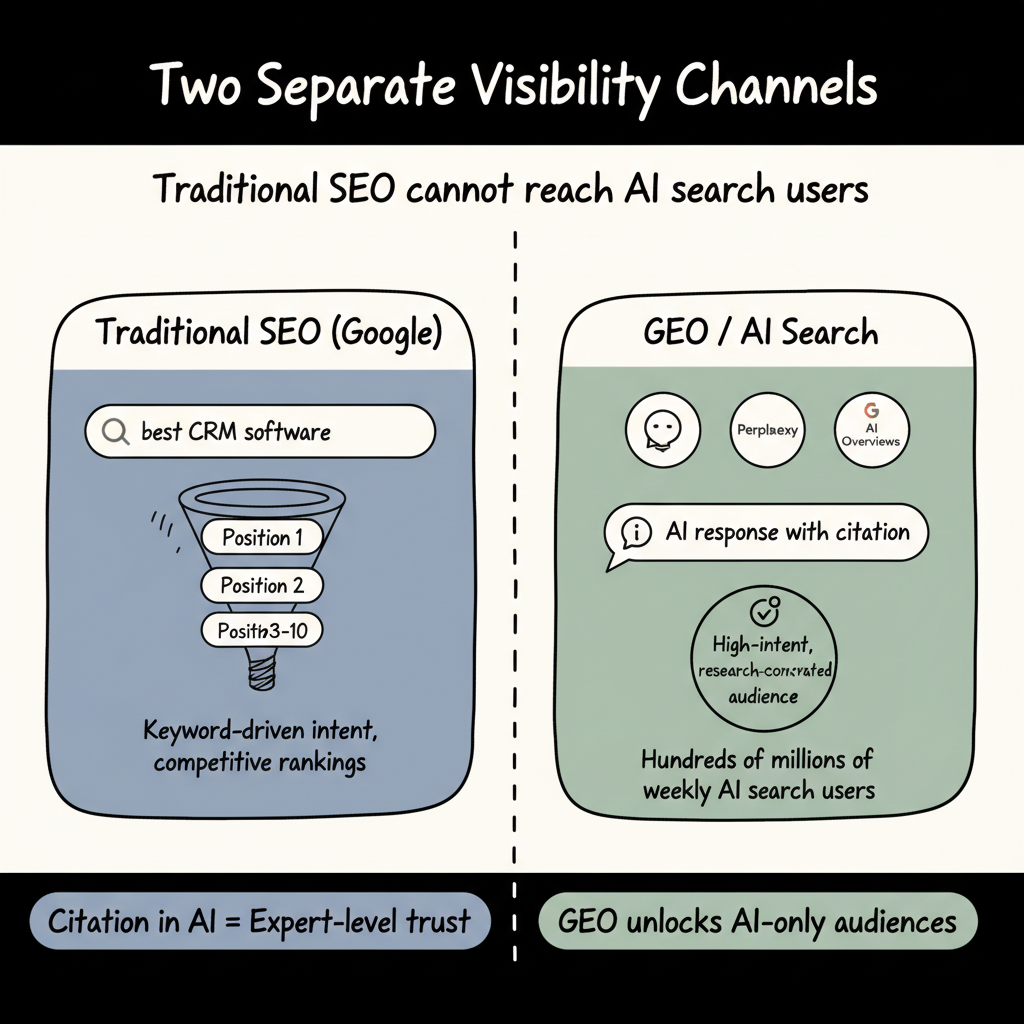
Relying solely on Google rankings creates business risk. Algorithm updates, competitive pressures, and changing user behavior can impact organic traffic significantly. GEO adds visibility channels independent of Google rankings.
Diversification benefit: When Google rankings fluctuate, AI citation visibility may remain stable—or compensate for traditional visibility losses.
Organizations with both strong SEO and GEO presence have more resilient visibility portfolios than those dependent on single channels. Learning how to optimize for AI search engines provides this competitive advantage.
GEO remains an emerging discipline. Most organizations focus on traditional SEO while AI search grows. This creates a window for competitive advantage.
Early-mover benefits:
Organizations investing in GEO now position themselves for advantages that late adopters will struggle to replicate.
AI citation authority compounds over time. Early, consistent citations build recognition that makes future citations more likely. Sources AI systems learn to trust maintain citation preference as queries accumulate.
Compounding effect: Today's GEO investment generates tomorrow's citation advantage. Waiting until competitors establish authority makes catching up harder.
This differs from traditional SEO, where rankings can shift more rapidly. AI systems develop source preferences that persist.
GEO and SEO share foundational requirements. Quality content, technical optimization, authority signals—these investments serve both channels. Organizations already investing in SEO can achieve GEO benefits with incremental additions rather than entirely new programs.
Overlapping elements:
Investment | SEO Benefit | GEO Benefit |
Quality content | Rankings | Citation potential |
Schema markup | Rich snippets | AI extraction |
Authority building | Domain authority | Citation preference |
Technical optimization | Crawlability | AI indexing |
The cost-per-benefit ratio improves when investments serve multiple purposes.
Traditional SEO for competitive keywords requires substantial investment—content production, link building, technical optimization—over extended periods. GEO competition remains less intense for most queries.
Cost comparison: Achieving AI visibility for competitive topics often requires less investment than achieving top-10 rankings for the same keywords.
This efficiency window narrows as GEO adoption increases, making current investment timing favorable.
AI search continues growing while traditional search stabilizes or declines for certain query types. Research queries, comparison shopping, and informational needs increasingly flow through AI platforms.
Projection context: Industry analysis suggests 25-35% of certain search categories will shift to AI platforms. Organizations without GEO presence become invisible to this traffic.
GEO investment prepares organizations for user behavior already shifting. Working with an SEO AI agency can help navigate this transition effectively.
AI search involves multiple platforms—ChatGPT, Perplexity, Claude, Gemini, platform-specific implementations. GEO strategies building citation authority transfer across platforms rather than depending on single-platform algorithms.
Platform benefit: Unlike SEO tactics specific to Google, GEO fundamentals—quality content, authority signals, extractable formatting—work across AI systems.
This reduces platform-specific risk and simplifies ongoing optimization.
AI systems function as trusted information intermediaries. When AI cites your content in response to user questions, the AI's implicit endorsement transfers trust to your brand.
Trust transfer: Users treat AI recommendations similarly to recommendations from knowledgeable friends. Citation in AI responses builds brand trust without direct interaction.
This trust-building mechanism differs from advertising or even organic rankings, where trust must be earned through subsequent interaction.
Without GEO presence, AI systems may mention competitors but not you—or represent your brand inaccurately based on limited information. GEO provides influence over how AI platforms present your brand.
Narrative benefit: Active GEO ensures accurate, favorable brand representation in AI responses. Passive absence means accepting whatever narrative AI systems construct from available sources.
Quantifying GEO benefits requires appropriate metrics:
Track these metrics to demonstrate ROI and guide ongoing investment. Analyzing AI overview impact helps quantify these benefits.
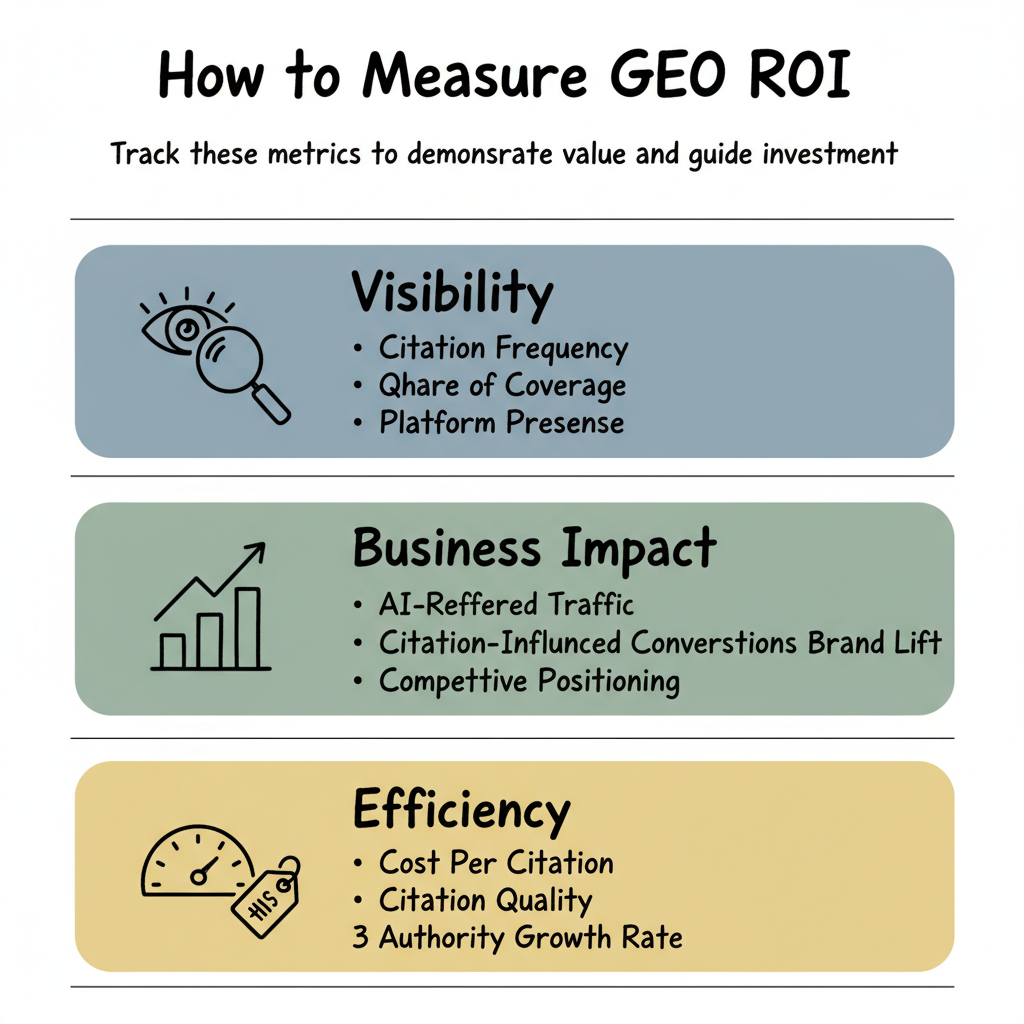
When advocating for GEO investment internally, structure the case around:
Opportunity: Define the AI search audience your organization currently misses
Risk: Explain what competitors gaining AI visibility means for competitive position
Investment: Specify required resources and how they overlap with existing programs
Returns: Project realistic visibility and business impact metrics
Timeline: Set expectations for when benefits materialize (typically 3-6 months for initial results)
Avoid overpromising immediate results. GEO benefits compound over time; the business case should reflect this timeline honestly.
Begin capturing GEO benefits with focused initial steps:
The benefits of GEO optimization justify investment for most organizations competing in information-rich markets. Start now while competition remains manageable.
By submitting this form, you agree to our Privacy Policy and Terms & Conditions.



