February 19, 2026


Traffic metrics tell only part of the AI Overview story. While click-through rate declines dominate headlines, the more critical question for businesses is: what happens to revenue when search journeys change? This analysis examines the full funnel impact—from initial AI impression through final conversion—providing data businesses need to assess real ROI in the AI search era.
Understanding conversion dynamics, not just traffic volume, reveals whether AI Overviews represent a crisis or an opportunity.
Most AI Overview analyses stop at clicks. But clicks are a proxy metric—businesses care about leads, sales, and revenue. The relationship between AI-driven traffic changes and business outcomes is more nuanced than traffic volume suggests.
The traffic-revenue gap:
Metric | What It Measures | Business Relevance |
Impressions | Visibility | Awareness potential |
CTR | Click probability | Traffic volume |
Traffic volume | Visitors | Engagement potential |
Conversion rate | Action completion | Revenue per visitor |
Revenue | Business outcome | Actual business value |
A 40% traffic decline with stable conversion rates and higher lead quality can produce better business outcomes than high-volume, low-quality traffic. Conversely, maintaining traffic volume while conversion rates collapse creates false confidence.
Theory suggests AI Overviews should improve conversion rates for clicks that do occur:
Testing this hypothesis requires measuring conversion performance across AI-influenced and traditional organic traffic, an approach central to modern AI search KPI goal setting.
Accurate measurement requires separating AI-influenced traffic from traditional organic.
Identify AI-mediated sessions:
Traffic Source | Identification Method | Reliability |
Direct AI referral | UTM parameters, referrer | High |
Post-AI organic | Sequential visit pattern | Medium |
AI-influenced | Survey/attribution modeling | Lower |
Traditional organic | Non-AI SERP clicks | Baseline |
Practical segmentation:
AI Overviews complicate traditional last-click attribution.
Attribution challenges:
Journey Stage | Pre-AI Overviews | With AI Overviews |
Awareness | Organic impression | AI Overview impression |
Research | Multiple organic clicks | Zero-click AI consumption |
Consideration | Organic + direct mix | Fewer clicks, higher intent |
Decision | Last-click attribution | Attribution gap |
Recommended models:
Data from multiple industries reveals distinct quality differences between AI-influenced and traditional organic traffic.
Cross-industry engagement data:
Metric | AI Referral Traffic | Traditional Organic | Difference |
Bounce rate | 42% | 55% | -24% |
Pages per session | 3.2 | 2.4 | +33% |
Session duration | 4:12 | 2:48 | +50% |
Return visit rate | 28% | 19% | +47% |
Traffic arriving from AI platforms demonstrates stronger engagement signals. Users who click through AI Overviews have already consumed basic information, arriving with deeper interest.
B2B lead quality comparison:
Quality Metric | AI-Influenced Leads | Traditional Organic | Variance |
MQL rate | 34% | 28% | +21% |
SQL rate | 18% | 14% | +29% |
Sales acceptance | 72% | 61% | +18% |
Average deal size | +15% vs baseline | Baseline | +15% |
Higher qualification rates indicate AI pre-filters informational visitors, delivering more serious prospects. This pattern is especially pronounced for AEO for SaaS companies where product complexity benefits from AI pre-qualification.
E-commerce conversion indicators:
Metric | AI-Adjacent Traffic | Pure Organic | Impact |
Add-to-cart rate | 8.2% | 6.1% | +34% |
Checkout initiation | 4.8% | 3.2% | +50% |
Cart abandonment | 68% | 74% | -8% |
Average order value | +12% vs baseline | Baseline | +12% |
E-commerce sees similar patterns: fewer visitors with higher purchase intent.
Conversion rates vary significantly based on AI exposure level.
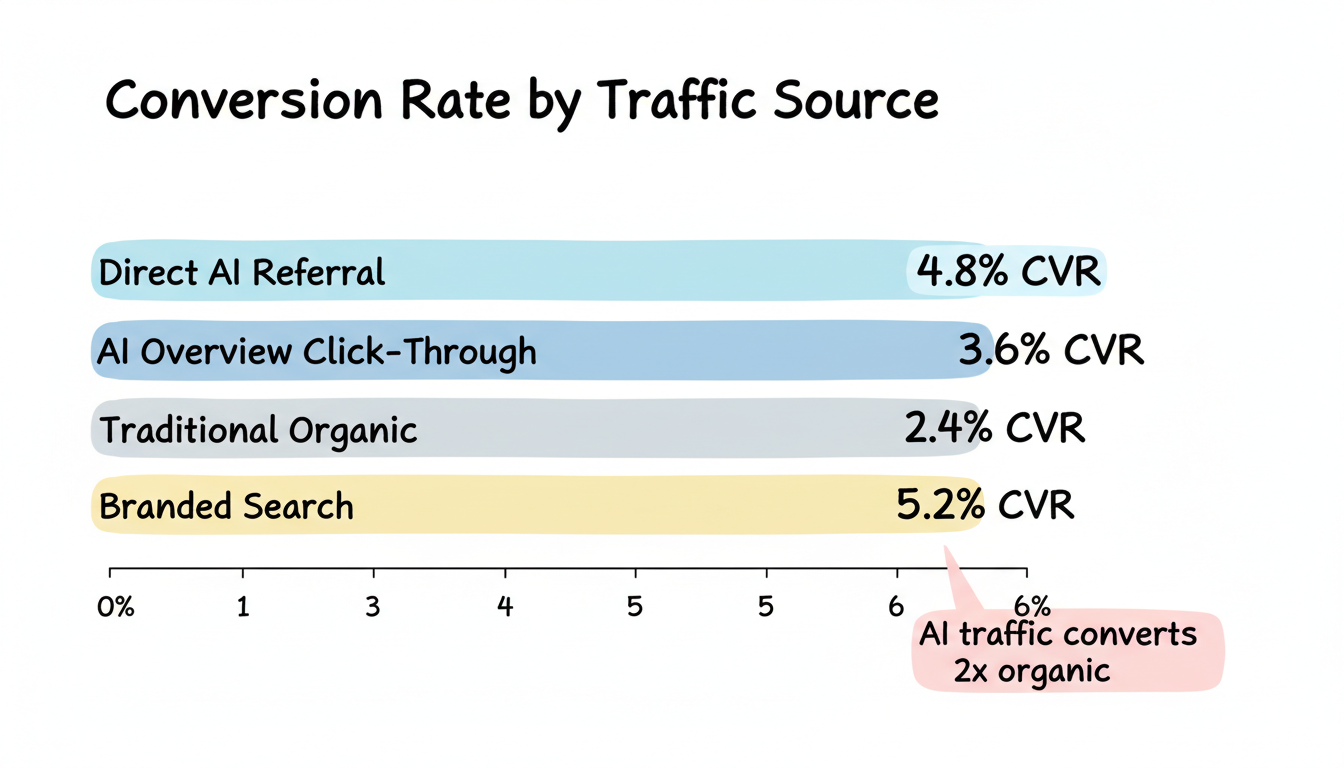
Cross-industry conversion rates (2026 data):
Traffic Type | Average CVR | High Performers | Low Performers |
Direct AI referral | 4.8% | 8.2% | 1.9% |
AI Overview click-through | 3.6% | 6.1% | 1.4% |
Traditional organic | 2.4% | 4.5% | 0.8% |
Branded search | 5.2% | 9.1% | 2.3% |
Direct AI referrals convert at twice the rate of traditional organic—partially offsetting volume declines. Understanding these metrics is critical for cross-platform AI search ROI analysis.
Conversion rate by industry and traffic source:
Industry | AI Referral CVR | Organic CVR | Lift |
B2B SaaS | 5.2% | 2.8% | +86% |
E-commerce | 3.8% | 2.1% | +81% |
Professional services | 6.4% | 3.2% | +100% |
Healthcare (lead gen) | 4.1% | 2.4% | +71% |
Financial services | 3.2% | 1.9% | +68% |
Professional services see the highest lift—complex purchase decisions benefit most from AI pre-qualification.
Beyond final conversions, AI traffic shows distinct micro-conversion patterns:
Micro-conversion comparison:
Action | AI Traffic | Organic Traffic | Variance |
Email signup | 12.3% | 8.1% | +52% |
Content download | 8.7% | 5.4% | +61% |
Demo request | 2.8% | 1.2% | +133% |
Free trial start | 4.2% | 2.1% | +100% |
Chat engagement | 15.6% | 9.2% | +70% |
Higher-intent actions show the largest variance. AI traffic demonstrates willingness to commit, not just browse.
Translating traffic and conversion changes into revenue impact requires understanding the full funnel dynamics outlined in generative engine optimization strategies.
Calculate net AI Overview impact:
Revenue Impact = (Traffic × CVR × Value) Before vs. After

Before AI Overviews:
- Organic Traffic: 100,000 visits
- CVR: 2.4%
- Value: $500
- Revenue: $1,200,000

After AI Overviews:
- Organic Traffic: 65,000 visits (-35%)
- AI Referral Traffic: 8,000 visits (new)
- Organic CVR: 3.2% (improved)
- AI CVR: 4.8%
- Value: $525 (+5% AOV)
- Revenue:
  - Organic: 65,000 × 3.2% × $525 = $1,092,000
  - AI: 8,000 × 4.8% × $525 = $201,600
  - Total: $1,293,600 (+7.8%)
This example shows how conversion rate and value improvements can more than offset traffic declines.
Track revenue contribution by traffic type:
Source | Traffic Share | Revenue Share | Revenue/Visitor |
Direct AI | 8% | 14% | $16.80 |
AI Overview organic | 32% | 38% | $11.40 |
Traditional organic | 42% | 35% | $8.00 |
Branded search | 18% | 13% | $6.90 |
Revenue per visitor reveals true value. AI-influenced traffic contributes disproportionately to revenue despite lower volume. Businesses evaluating in-house vs agency AEO should factor these efficiency gains into their calculations.
Calculate AI visibility ROI:
AI Optimization ROI = (Revenue Attributed to AI Visibility - Investment) / Investment

Example:
- AI optimization investment: $50,000/year
- Incremental AI referral revenue: $180,000
- Improved organic CVR revenue lift: $95,000
- Total attributable revenue: $275,000
- ROI: ($275,000 - $50,000) / $50,000 = 450%
Investment includes AEO/GEO optimization work, schema implementation, content restructuring, and monitoring tools. Organizations considering affordable AEO services should benchmark against these ROI expectations.
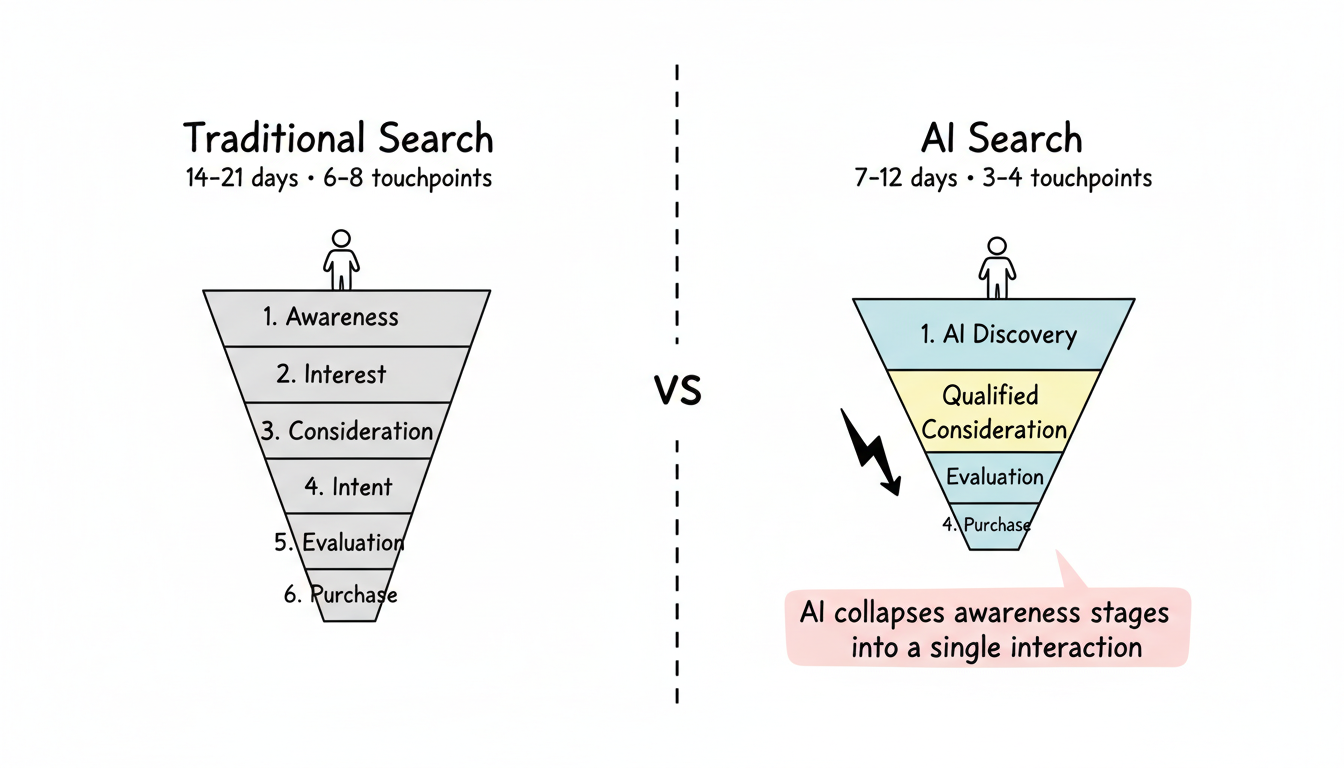
AI Overviews restructure the traditional conversion funnel.
Traditional funnel:
Awareness → Interest → Consideration → Intent → Evaluation → Purchase
(6-8 touchpoints average, 14-21 days B2B)
AI-mediated funnel:
AI Discovery → Qualified Consideration → Evaluation → Purchase
(3-4 touchpoints average, 7-12 days B2B)
AI collapses awareness and interest stages into a single AI interaction. Visitors arriving at your site have already progressed further.
Stage-by-stage conversion rates:
Funnel Stage | Pre-AI | Post-AI | Change |
Awareness → Interest | 15% | N/A (AI-collapsed) | - |
Interest → Consideration | 22% | N/A (AI-collapsed) | - |
AI Discovery → Consideration | N/A | 45% | New |
Consideration → Intent | 28% | 38% | +36% |
Intent → Evaluation | 52% | 61% | +17% |
Evaluation → Purchase | 34% | 41% | +21% |
Each measurable stage shows improved conversion. The "lost" stages happen within AI interactions, not on your site. Implementing FAQ schema for AI Overviews can help capture users at the compressed consideration stage.
Compressed funnels require attribution model updates:
Recommended adjustments:
Attribution Element | Traditional Approach | AI-Adjusted Approach |
First-touch credit | 40% | 25% |
AI interaction credit | 0% | 30% |
Last-touch credit | 40% | 35% |
Assist interactions | 20% | 10% |
Recognize AI as a channel deserving attribution, even when direct tracking isn't possible.
Company profile:
12-month impact analysis:
Metric | Month 1 | Month 12 | Change |
Organic traffic | 45,000 | 31,500 | -30% |
AI referral traffic | 0 | 4,200 | +New |
Total traffic | 45,000 | 35,700 | -21% |
Organic CVR | 1.8% | 2.9% | +61% |
AI CVR | N/A | 5.4% | New |
Demo requests | 810 | 1,141 | +41% |
SQL rate | 28% | 34% | +21% |
Closed revenue | $2.4M | $3.1M | +29% |
Despite 21% traffic decline, revenue increased 29% through improved conversion and lead quality. This company leveraged tactics from the Google AI Overviews optimization playbook to maximize their visibility.
Company profile:
6-month impact analysis:
Metric | Pre-AI | Post-AI | Change |
Organic traffic | 280,000 | 195,000 | -30% |
AI-adjacent traffic | N/A | 42,000 | +New |
CVR (organic) | 2.1% | 2.8% | +33% |
CVR (AI) | N/A | 4.1% | New |
Transactions | 5,880 | 7,182 | +22% |
AOV | $85 | $94 | +11% |
Revenue | $499,800 | $675,108 | +35% |
Higher-intent visitors produced more transactions at higher order values. Their success relied on schema markup alignment with visible content to maintain consistency across AI and traditional search.
Essential tracking elements:
Component | Purpose | Implementation |
AI source tagging | Identify AI referrals | UTM parameters, referrer parsing |
Query-level AI status | Connect queries to AI presence | SERP monitoring tools |
Enhanced ecommerce | Track full purchase journey | GA4 enhanced measurement |
CRM integration | Connect leads to revenue | CRM + GA4 data import |
Attribution modeling | Credit distribution | GA4 data-driven attribution |
Organizations comparing the best generative engine optimization platforms for AI search results should prioritize platforms with robust attribution capabilities.
Monthly AI impact report template:
AI Search Impact Report - [Month]

1. Traffic Composition
   - Total organic: [number]
   - AI referral: [number] ([% of total])
   - AI-affected organic: [number]
   - Traditional organic: [number]

2. Conversion Performance
   - Overall CVR: [%]
   - AI traffic CVR: [%]
   - Traditional CVR: [%]
   - Conversion lift from AI: [%]

3. Revenue Attribution
   - Total attributed revenue: $[amount]
   - AI-attributed revenue: $[amount]
   - Revenue per AI visitor: $[amount]
   - Revenue per traditional visitor: $[amount]

4. Trend Analysis
   - Traffic trend: [improving/declining]
   - CVR trend: [improving/declining]
   - Revenue trend: [improving/declining]
   - Net business impact: [positive/negative/neutral]
Data-driven prioritization:
Finding | Indicated Action | Priority |
High AI CVR, low volume | Increase AI visibility investment | High |
Low AI CVR despite volume | Improve landing page experience | High |
Traffic declining, CVR stable | Focus on AI citation strategy | Medium |
Revenue stable despite traffic drop | Maintain current approach | Low |
Teams can consult the AEO terminology glossary to ensure consistent communication around optimization priorities.
Analyze AI Overview impact through a conversion lens:
The businesses thriving in AI search measure what matters—revenue and conversions, not just clicks. Traffic decline headlines mask the more nuanced reality: AI Overviews can improve business outcomes even as they reduce traffic volume. Understanding AI Overview vs featured snippets performance differences helps businesses allocate optimization resources effectively.
Implement conversion tracking, segment AI-influenced traffic, and let data guide your strategy rather than headline statistics. For ongoing optimization, consider working with a generative engine optimization agency or exploring best AEO services to maximize your AI search performance.
By submitting this form, you agree to our Privacy Policy and Terms & Conditions.