February 19, 2026


A generative engine optimization agency helps brands appear in AI-generated answers across platforms like ChatGPT, Google Gemini, Perplexity, and Claude. As AI search reshapes how users discover information, organizations need specialized partners who understand how to optimize for visibility inside these generative systems.
This guide explains what GEO agencies do, how to evaluate providers, and what results to expect from professional generative engine optimization services.
Generative engine optimization focuses on improving how AI systems perceive, understand, and cite your brand when generating responses to user queries. Unlike traditional SEO where the goal is ranking in search results, GEO aims to become the source AI systems trust and reference.
GEO agencies provide specialized services across several areas:
The foundation of GEO work involves understanding your current position across AI platforms:
Professional GEO agencies use specialized tools designed specifically for AI visibility measurement, going beyond what traditional SEO platforms can provide.
GEO agencies optimize content specifically for how AI systems consume and cite information:
Structural optimization ensures content is organized in ways AI models can easily parse and extract. This includes answer-first formatting, clear hierarchies, and standalone paragraphs that work when quoted in isolation.
Entity consistency maintains uniform brand information across all platforms AI systems reference—your website, LinkedIn profiles, Wikipedia, industry directories, and authoritative publications.
Citation-worthy content development adds statistics, expert quotes, and verifiable data points that give AI systems confidence when citing your content. This approach aligns with proven AI SEO best practices that emphasize creating content designed for machine understanding.
Knowledge graph positioning establishes your brand as a recognized entity with clear relationships to relevant topics and categories.
GEO requires technical work that supports AI understanding:
Proper schema validation for AI search ensures technical implementations meet the standards AI systems expect when extracting structured information.
AI systems evaluate trustworthiness based on signals across the web:
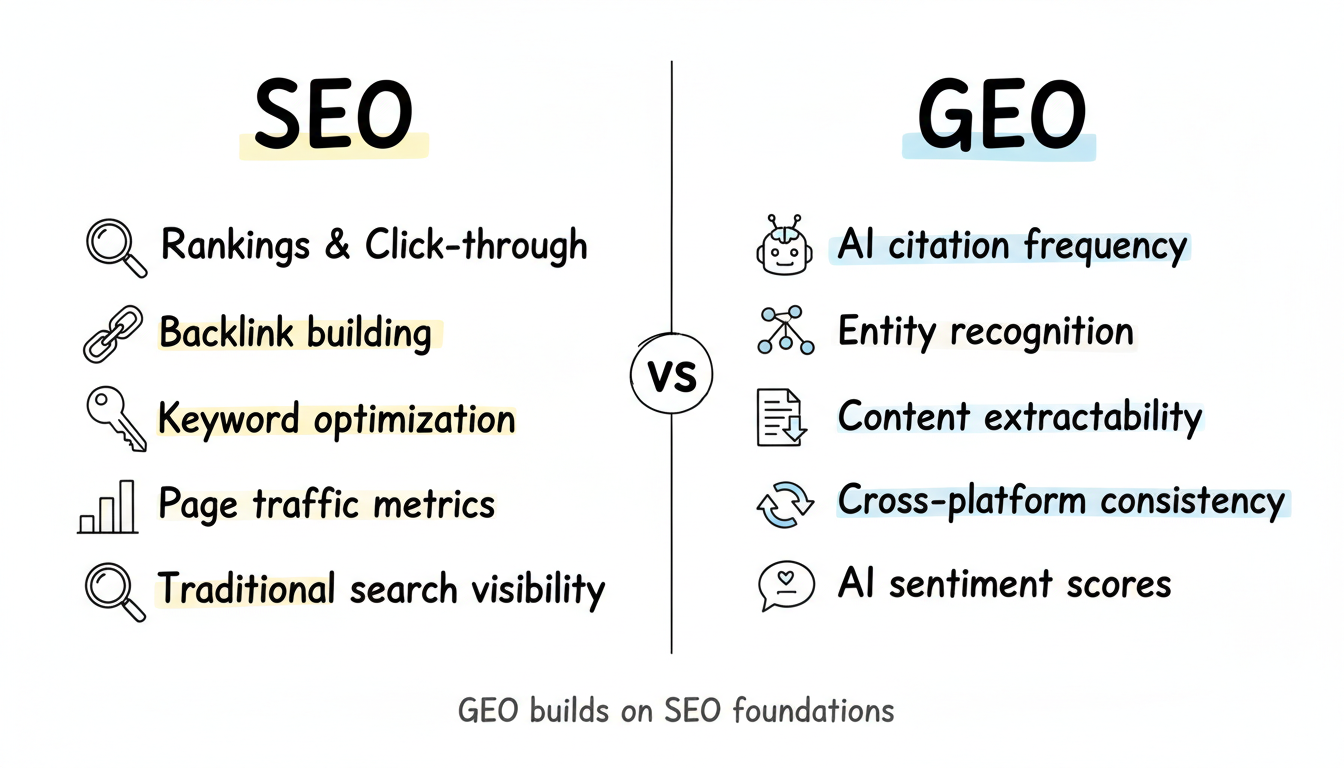
While GEO and SEO share foundations, they optimize for different outcomes and require distinct expertise.
SEO success measures rankings, traffic, and clicks. GEO success measures citation frequency, answer quality, sentiment, and whether AI systems accurately represent your brand. A page might rank first in Google yet never get cited by ChatGPT.
SEO emphasizes backlinks, keyword optimization, and traditional ranking factors. GEO emphasizes entity recognition, content extractability, cross-platform consistency, and the specific signals that influence AI model training and retrieval.
Organizations transitioning from traditional search optimization should develop a clear AEO migration plan that preserves existing SEO value while building AI-specific capabilities.
SEO tracking uses established tools and methodologies developed over decades. GEO tracking requires specialized platforms built specifically for AI visibility measurement—tools that prompt AI systems at scale, analyze response patterns, and track citation attribution.
The best GEO agencies don't abandon SEO—they build on it. Strong traditional search presence creates the authority signals AI systems evaluate. Content that ranks well tends to get cited more frequently. Effective GEO requires solid SEO foundations plus additional optimization layers specific to generative AI.
When selecting a GEO agency, consider these evaluation criteria:
Track record matters. Request case studies showing measurable improvements in AI citations, not just traditional SEO results. Ask for specific examples of brands they've helped appear in ChatGPT, Perplexity, or Google AI Overviews.
Methodology clarity. Effective agencies explain their process—how they audit current AI visibility, prioritize improvements, implement changes, and measure success. Vague promises without clear methods warrant caution.
Multi-platform coverage. The best agencies optimize across ChatGPT, Gemini, Perplexity, Google AI Overviews, and emerging platforms rather than focusing on single AI systems. This includes understanding platform-specific requirements like Perplexity AI search optimization tactics.
Monitoring infrastructure. Ask how they track AI visibility. Manual testing is essential, but agencies should also use specialized tools for systematic monitoring across platforms.
Schema implementation. GEO requires technical skills beyond content strategy. Evaluate whether the agency can handle structured data implementation, not just recommendations.
Integration capabilities. Consider how the agency's work connects with existing marketing systems and workflows.
Clear metrics. Professional agencies define success metrics upfront—citation frequency, sentiment scores, accuracy rates, or share of voice improvements.
Regular reporting. Expect monthly or quarterly reports showing progress against defined metrics, not just activity summaries.
Honest limitations. GEO cannot guarantee specific positions in AI responses or control exactly how AI systems phrase answers. Agencies making unrealistic promises should raise concerns.
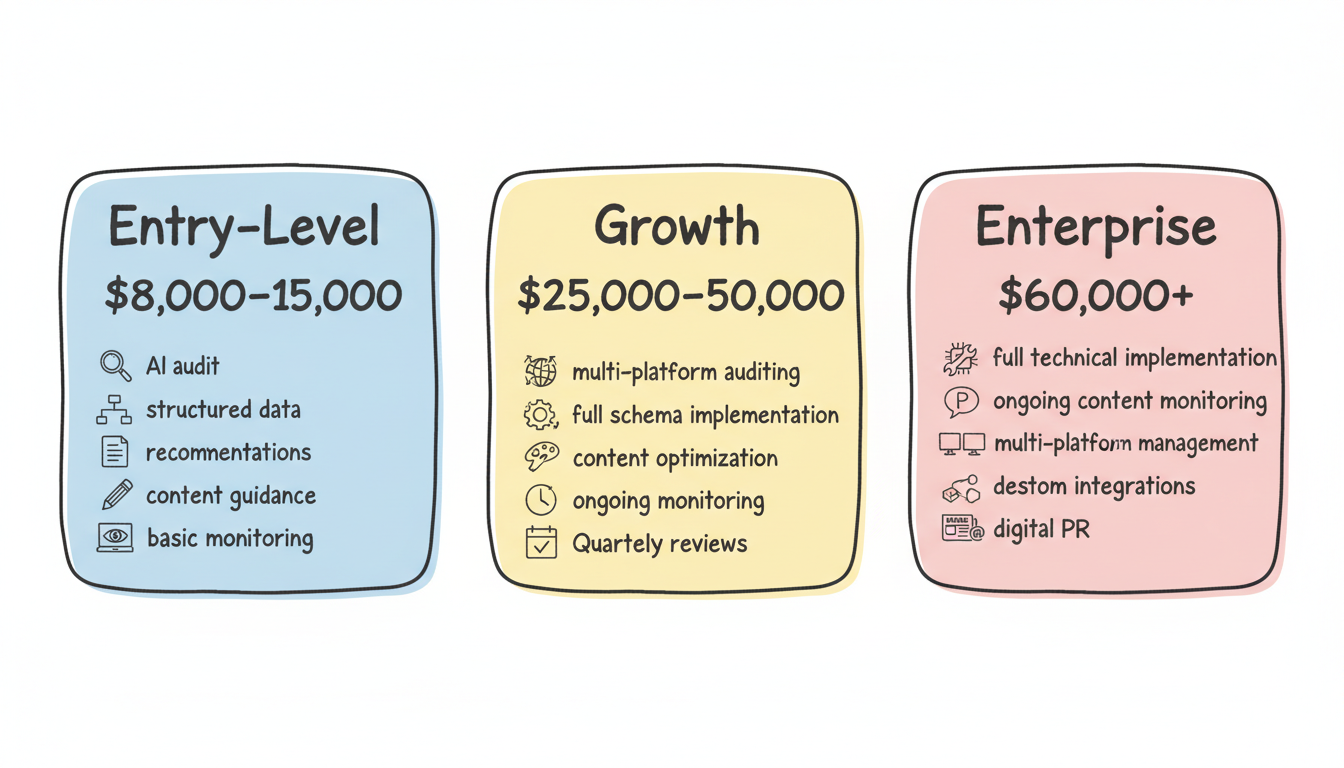
Generative engine optimization services typically follow tiered pricing structures:
Foundation packages typically include:
Best for: Organizations testing GEO or with simpler optimization needs.
Mid-tier packages typically include:
Best for: Growing brands serious about AI visibility improvement.
Enterprise packages typically include:
Best for: Large organizations requiring comprehensive GEO programs.
Set realistic expectations for generative engine optimization:
Technical implementations like schema markup can be completed within weeks. Content optimization typically takes 1-3 months depending on volume. AI visibility improvements vary—some platforms update frequently while others reflect changes over longer periods as models retrain. Plan for 6-12 months to see substantial, measurable impact.
Realistic outcomes from professional GEO services include:
No agency can guarantee:
AI referral traffic currently represents approximately 1% of total web visits for most industries, growing roughly 1% month-over-month. GEO builds long-term visibility rather than overnight traffic spikes.
Consider agency services if you:
Consider in-house if you:
Many organizations adopt hybrid approaches—using agencies for strategy and specialized work while building internal capacity for ongoing optimization.
A generative engine optimization agency helps brands achieve visibility in the growing AI search landscape. Professional GEO services combine AI visibility monitoring, content optimization, technical implementation, and authority building.
What agencies provide: Specialized expertise in optimizing for AI citation, multi-platform monitoring infrastructure, and strategic guidance as AI search evolves.
How to evaluate: Look for demonstrated AI-specific track records, clear methodologies, multi-platform coverage, and transparent reporting tied to measurable outcomes.
What to expect: Plan for 6-12 months to see substantial results. GEO complements rather than replaces traditional SEO, and the best agencies integrate both disciplines.
Organizations investing in GEO agencies position themselves for sustained visibility as AI search continues growing in how users discover and evaluate brands.
A generative engine optimization agency specializes in helping brands appear in AI-generated answers from platforms like ChatGPT, Perplexity, Google Gemini, and Google AI Overviews. Unlike traditional SEO agencies that focus on search rankings, GEO agencies optimize for AI citation—becoming the source these systems trust and reference when users ask questions.
GEO agency pricing varies by scope. Entry-level packages start around $8,000-15,000 for basic audits and recommendations. Growth packages range from $25,000-50,000 for comprehensive optimization. Enterprise programs typically start at $60,000+ for full-scale implementation and ongoing management. Specialized GEO monitoring tools alone can cost $150-500/month.
GEO and SEO serve complementary but distinct purposes. Many SEO agencies have added GEO capabilities, but specialized expertise varies significantly. If your current SEO agency cannot demonstrate specific AI visibility results—actual citation improvements in ChatGPT or Perplexity—you may benefit from a dedicated GEO specialist or an agency that integrates both disciplines deeply.
Technical implementations can be completed within weeks. Visibility improvements vary by platform—some AI systems update frequently while others take months to reflect changes. Plan for 3-6 months to see initial measurable improvements and 6-12 months for comprehensive impact. Unlike SEO, where ranking changes can happen quickly, GEO results often depend on AI model update cycles.
By submitting this form, you agree to our Privacy Policy and Terms & Conditions.