February 19, 2026


Google's search results have evolved dramatically. Featured snippets—those highlighted answer boxes that dominated position zero for years—now share the SERP with AI Overviews, Google's generative AI summaries. Understanding the differences between these two features is essential for SEO strategy in 2026.
This guide explains how each feature works, why they matter differently for traffic and visibility, and how to optimize for both.
Featured snippets extract content directly from a single webpage to answer search queries. According to Search Engine Land's featured snippet guide, featured snippets pull content directly from a single source—you see a block of text or a list, and it's attributed to one specific page. If your content gets featured, you own that snippet.
Featured snippet characteristics:
Common featured snippet formats:
Format | Best For | Example Queries |
Paragraph | Definitions, explanations | "What is..." queries |
List | Steps, rankings, collections | "How to..." queries |
Table | Comparisons, data, specifications | "Best..." or comparison queries |
AI Overviews (formerly Search Generative Experience) use generative AI to synthesize information from multiple sources into original summaries. Unlike featured snippets, they don't excerpt existing content—they create new text based on information gathered across the web.
According to Semrush's AI Overviews study, AI Overviews consolidate knowledge from multiple sources to present a unified answer, turning Google into both a search engine and an answer engine. This shift has fundamentally changed how Google selects AI Overview sources and determines which content appears in these generative summaries.
AI Overview characteristics:
Understanding the distinctions helps inform optimization strategy.
Factor | Featured Snippets | AI Overviews |
Content Source | Single webpage | Multiple webpages |
Content Type | Extracted text | AI-generated synthesis |
Attribution | One prominent link | Multiple citation links |
Query Complexity | Simple, direct questions | Complex, multi-part queries |
User Behavior | Often clicks for context | May satisfy query without clicks |
Appearance Frequency | Declining | Expanding (27-32% of queries) |
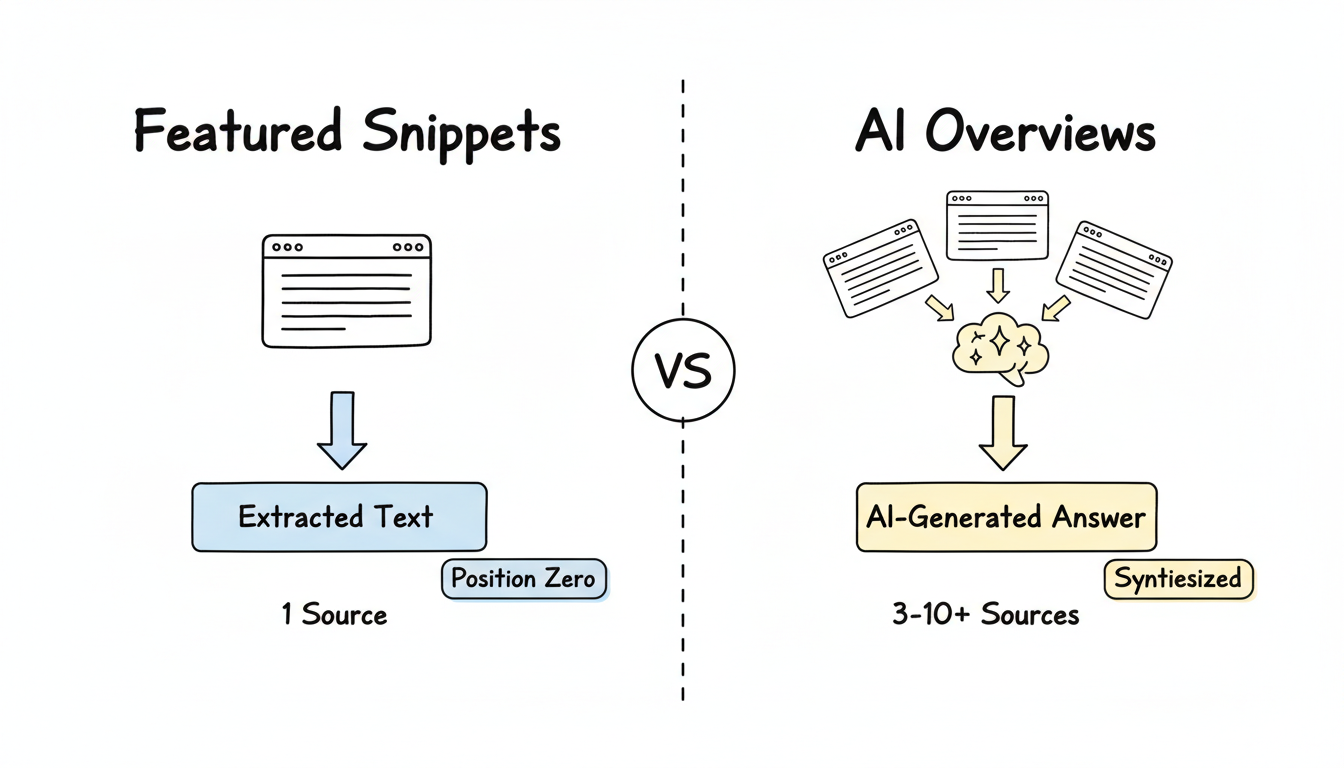
According to Maria Espie Vidal's analysis, with featured snippets, users still rely on the cited page to complete their research—the snippet acts like a preview with the website remaining the destination. AI Overviews shift that dynamic: the answer becomes a blended response with several links that carry less individual weight.
Featured snippet attribution:
AI Overview attribution:
Featured snippets reproduce your exact words. AI Overviews paraphrase and combine information.
According to ALMCORP's AI Overviews analysis, featured snippets extract 1-3 sentences from a single webpage, always linking back to the source. AI Overviews synthesize information from multiple sources—typically 3-10+ websites—to create an original AI-generated response.
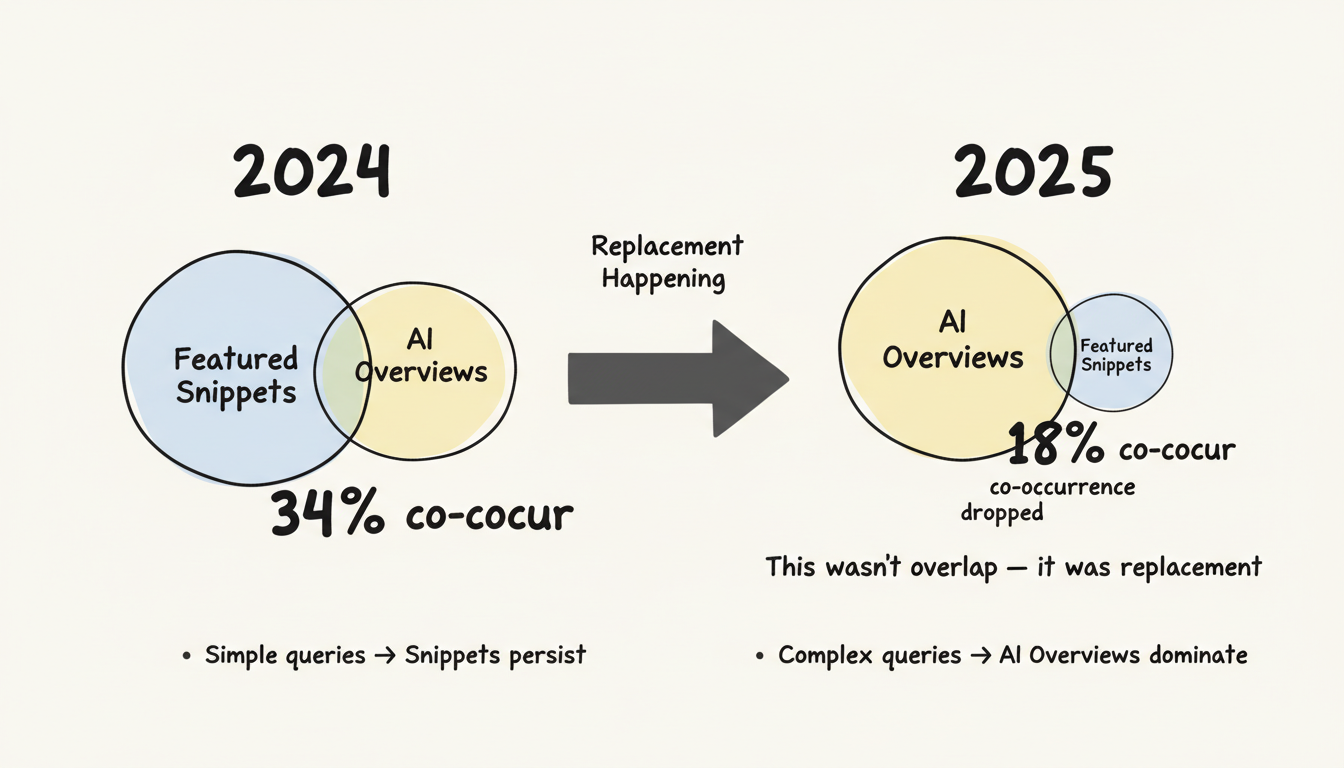
The data suggests AI Overviews are gradually replacing featured snippets for many query types.
According to Medium's analysis of Google's search evolution, by late 2025, Google largely stopped showing featured snippets and AI Overviews together—co-occurrence dropped from 34% to just 18%. The analysis notes: "This wasn't overlap—it was replacement."
Replacement trends:
According to Marketermilk's 2026 SEO trends analysis, we now have AI Overviews instead of featured snippets for many query types, representing one of the major SEO developments of recent years.
Each feature affects traffic differently, and understanding AI Overview CTR data has become critical for forecasting organic traffic impact.
Featured snippets historically captured significant clicks. According to Search Engine Land, in 2022, featured snippets captured 35.1% of all clicks for queries where they appeared—demonstrating the power of position zero placement.
Featured snippet click behavior:
AI Overviews reduce clicks more significantly because they provide comprehensive answers.
According to NoGood's future of search analysis, 60% of searches now end without a click—between AI Overviews dominating Google's SERPs, featured snippets answering questions immediately, and LLM responses providing comprehensive answers.
AI Overview click behavior:
The good news: optimization strategies overlap significantly, and many generative AI SEO software tools now help optimize for both features simultaneously.
According to ClickRank's featured snippet guide, featured snippets are the "seed data" for AI Overviews—if you win the featured snippet, you have a 75% higher chance of being the primary citation in the AI-generated summary.
Featured snippet tactics:
According to Revv Growth's AI Overview ranking guide, the key to AI Overview inclusion is creating content that answers questions directly, is easy to read and scan, and demonstrates expertise—qualities AI systems prioritize.
AI Overview tactics:
According to SEO.com's AI search optimization guide, the featured snippet approach works for both: provide direct, succinct answers without fluff, as both AI engines and users want fast, clear answers rather than digging through paragraphs. Understanding the broader context of GEO vs AEO can help inform your unified optimization strategy.
Combined strategy checklist:
The answer depends on your query targets and goals.
Prioritize featured snippets when:
Prioritize AI Overview optimization when:
Realistically: Optimize for both. Featured snippet wins often translate to AI Overview citations. The underlying principles—clarity, authority, structure, directness—serve both goals.
Understanding AI Overviews vs featured snippets shapes modern SEO strategy:
The strategic response isn't choosing between them—it's building content that serves both while preparing for an increasingly AI-mediated search landscape.
By submitting this form, you agree to our Privacy Policy and Terms & Conditions.