February 19, 2026


The AI search landscape has introduced new terminology that confuses even experienced marketers. GEO and AEO sound similar and overlap significantly—but they target different mechanisms of AI-powered search. Understanding the distinction helps you allocate optimization efforts effectively.
This guide clarifies what each term means, where they differ, and how they work together.
AEO focuses on optimizing content to appear in answer engines—systems that provide direct answers to user queries rather than lists of links.
Answer engines include:
AEO emerged from the shift toward zero-click searches. When Google started displaying answers directly in search results, optimizing for those answer boxes became a distinct discipline.
AEO goal: Get your content selected as the source for direct answers.
GEO focuses on optimizing content to be cited by generative AI systems—LLMs that synthesize responses from multiple sources rather than displaying a single answer. Understanding what is generative engine optimization GEO helps clarify how these systems evaluate and select content for citation.
Generative engines include:
GEO addresses the unique challenge of earning citations when AI generates novel responses by combining information from various sources.
GEO goal: Get your content cited as a source in AI-generated responses.
While both disciplines optimize for AI-powered search, they differ in important ways.
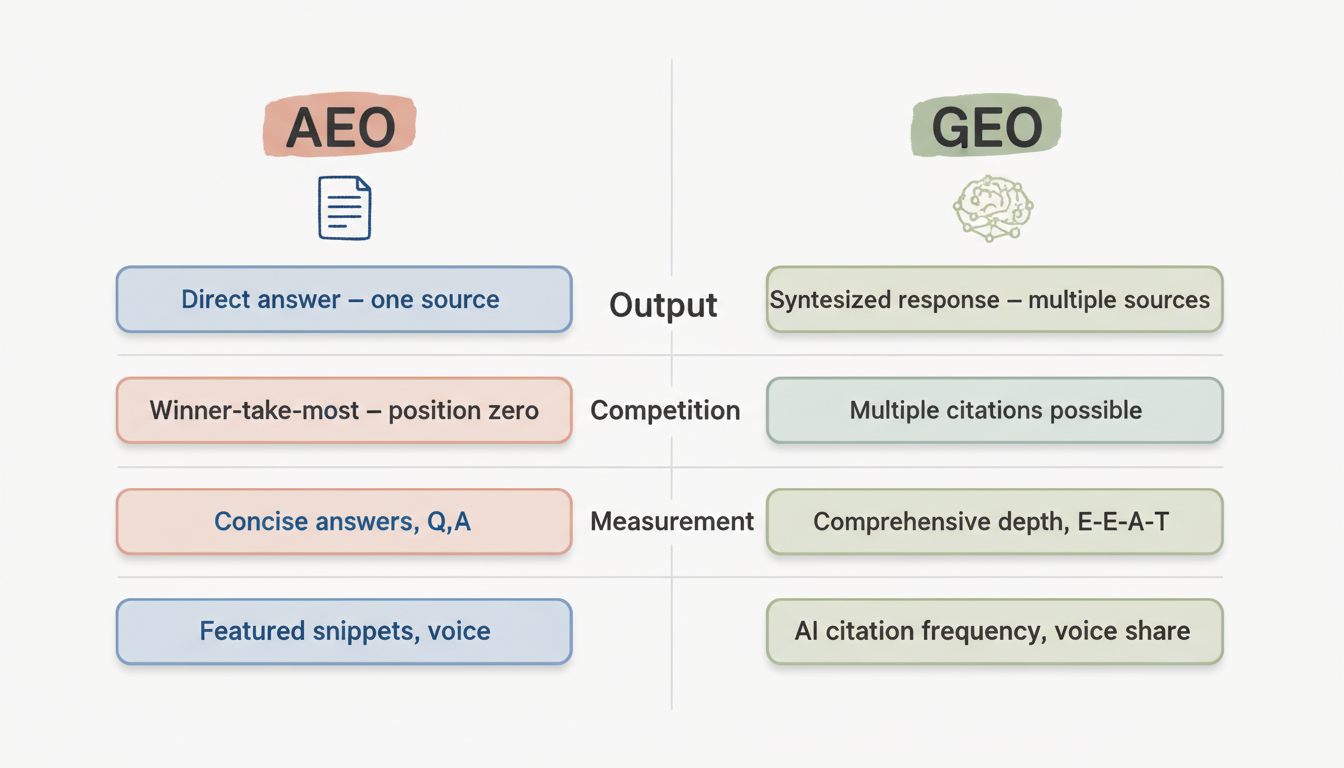
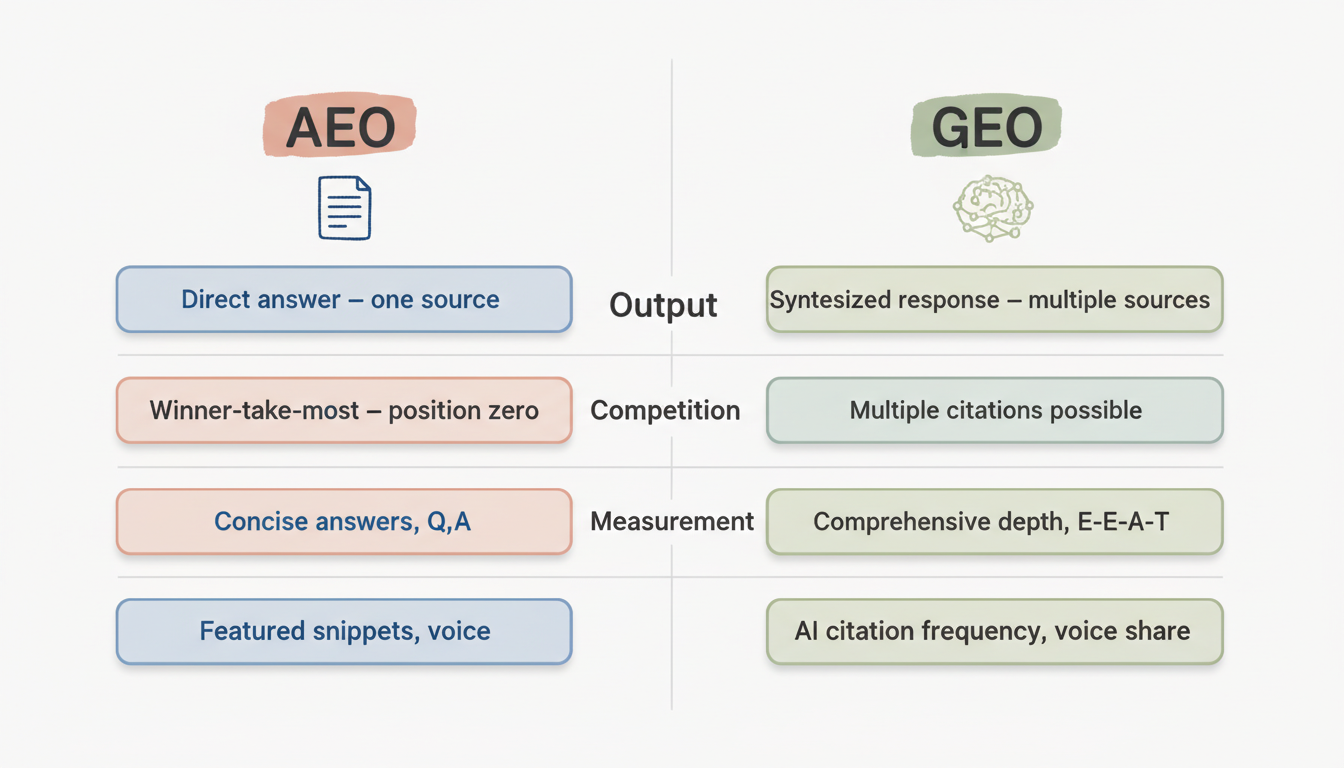
AEO targets: Direct answers displayed prominently in search results. One source typically gets selected as "the" answer.
GEO targets: Synthesized responses where AI combines information from multiple sources, potentially citing several in a single response.
AEO: Winner-take-most. Featured snippets display one answer. Being position zero means your competitor isn't there.
GEO: Multiple sources can be cited in the same response. AI might reference your content alongside competitors when synthesizing comprehensive answers. This makes understanding cross-platform AI search ROI essential for measuring success across different AI systems.
AEO emphasizes:
GEO emphasizes:
AEO metrics:
GEO metrics:
Despite differences, GEO and AEO share significant common ground.
Both disciplines benefit from:
Structured content – Clear headings, logical organization, and extractable paragraphs work for both answer selection and AI citation.
Authority signals – E-E-A-T matters whether Google selects your featured snippet or ChatGPT cites your expertise.
Factual accuracy – Both answer engines and generative AI prioritize accurate, trustworthy sources.
Technical optimization – Schema markup, fast loading, and crawler access benefit all AI systems. Implementing a free AI SEO tech stack can help establish this foundation without major budget investment.
Some platforms blur the distinction entirely. Perplexity functions as both an answer engine (providing direct responses) and a generative engine (synthesizing from multiple sources). Google AI Overviews combine answer-engine display with generative synthesis.
Optimizing for these hybrid platforms requires both AEO and GEO thinking.
Prioritize AEO when:
AEO tactics include:
Prioritize GEO when:
GEO tactics include:
Most organizations should pursue both. A unified strategy recognizes that:
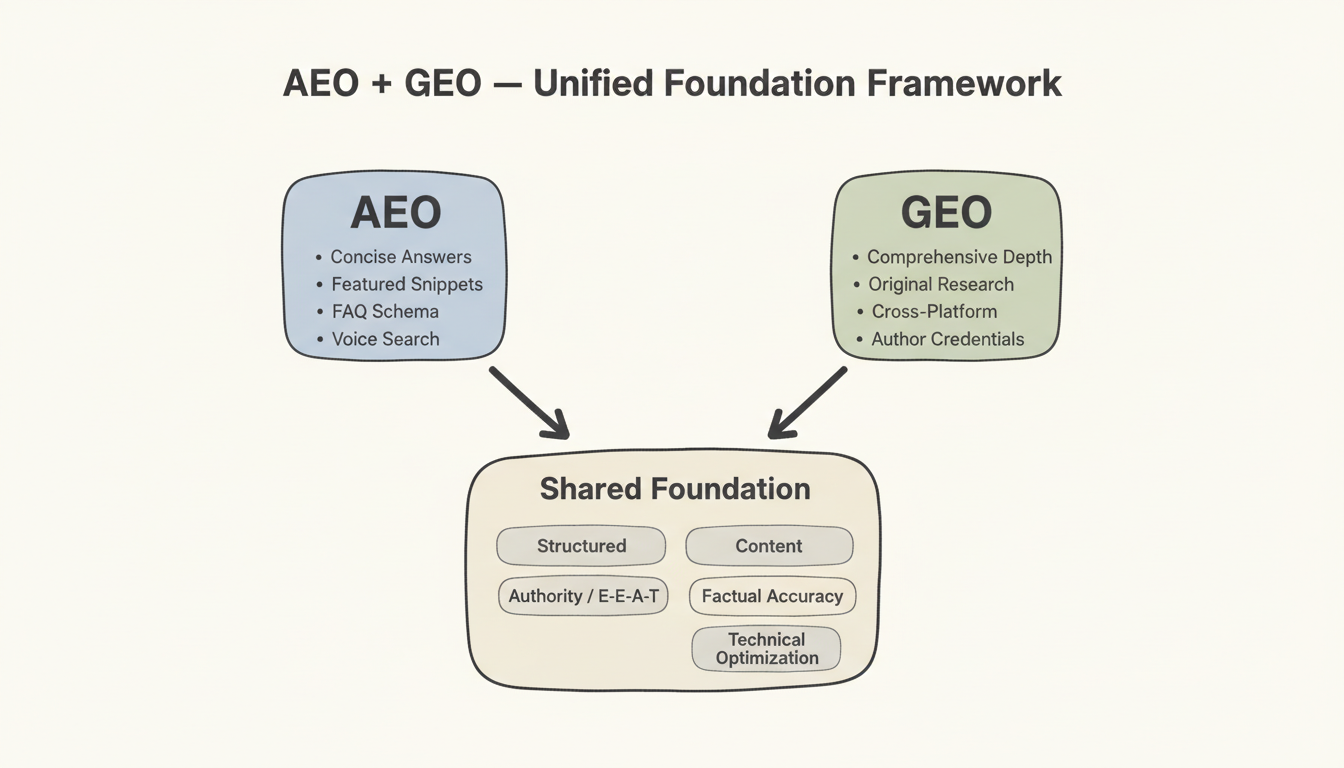
Industry practitioners use GEO and AEO inconsistently. Some use them interchangeably. Others treat AEO as a subset of GEO, or vice versa. For a comprehensive comparison of these approaches, see our guide on GEO vs SEO vs AI.
Practical guidance: Don't get caught up in terminology debates. Focus on the underlying questions:
The tactics matter more than the labels.
As AI search evolves, the GEO/AEO distinction may blur further. Generative engines increasingly provide direct answers. Answer engines increasingly use generative synthesis.
Emerging pattern: All AI-powered search systems benefit from:
Optimize for these fundamentals, and terminology differences become less relevant.
AEO optimizes for answer engines that select and display direct answers—featured snippets, voice responses, answer boxes.
GEO optimizes for generative engines that synthesize responses from multiple sources—ChatGPT, Claude, Perplexity.
In practice: Both benefit from similar fundamentals. Authoritative, well-structured content optimized for AI comprehension works across both paradigms. Focus on quality and structure rather than optimizing separately for each term.
Both matter, with relative importance depending on your audience. If your audience uses ChatGPT and Perplexity primarily, GEO deserves more focus. If they rely on Google search with AI Overviews, AEO may be more relevant. Most businesses benefit from a combined approach.
Yes. Well-structured, authoritative content performs across both contexts. The key is combining concise, extractable answers (AEO strength) with comprehensive depth and authority signals (GEO strength).
By submitting this form, you agree to our Privacy Policy and Terms & Conditions.