February 19, 2026


Search has fundamentally changed. Users no longer browse through pages of links—they ask AI systems like ChatGPT, Perplexity, and Google AI Overviews for direct answers. Generative Engine Optimization (GEO) is the practice of structuring content so these AI systems find, understand, and cite your brand when generating responses.
According to Superlines' GEO guide, GEO makes your brand visible and citable in AI-generated answers. Instead of only chasing rankings in traditional search, GEO structures your content and presence across trusted sources so AI assistants can reliably reuse, attribute, and cite you.
Generative Engine Optimization is the process of optimizing content so it can be understood, cited, and surfaced by AI-powered search engines and chatbots. Unlike traditional SEO, which focuses on ranking pages in search results, GEO focuses on getting your content selected as the source AI uses when generating answers.
According to Siege Media's comprehensive GEO guide, generative engine optimization is the practice of making your content easier for AI systems—like ChatGPT, Claude, Gemini, and Perplexity—to find, interpret, and surface in response to user queries.
Core concept:
The scale of AI search has become impossible to ignore. According to Superlines, OpenAI's July 2025 research shows 700 million people now use AI assistants weekly, sending an estimated 18 billion messages. This demonstrates why inclusion in AI answers has become critical for brand visibility.
According to PR News Online's 2026 analysis, GEO emerged as a critical counterpart to traditional SEO, with 67% of organizations worldwide adopting large language models for operations and 63% of marketers prioritizing generative AI search engine optimization in their content strategies.
Key statistics:
Metric | Data Point | Source |
Weekly AI users | 700 million | OpenAI (2025) |
Weekly AI messages | 18 billion+ | OpenAI (2025) |
Marketers prioritizing GEO | 63% | PR News Online |
Organizations using LLMs | 67% | PR News Online |
According to StubGroup's GEO guide, GEO is the practice of structuring content to increase citation probability in AI-generated responses. Research from Princeton, Georgia Tech, and the Allen Institute tested nine optimization methods across thousands of content samples.
The research findings:
How AI systems select sources:
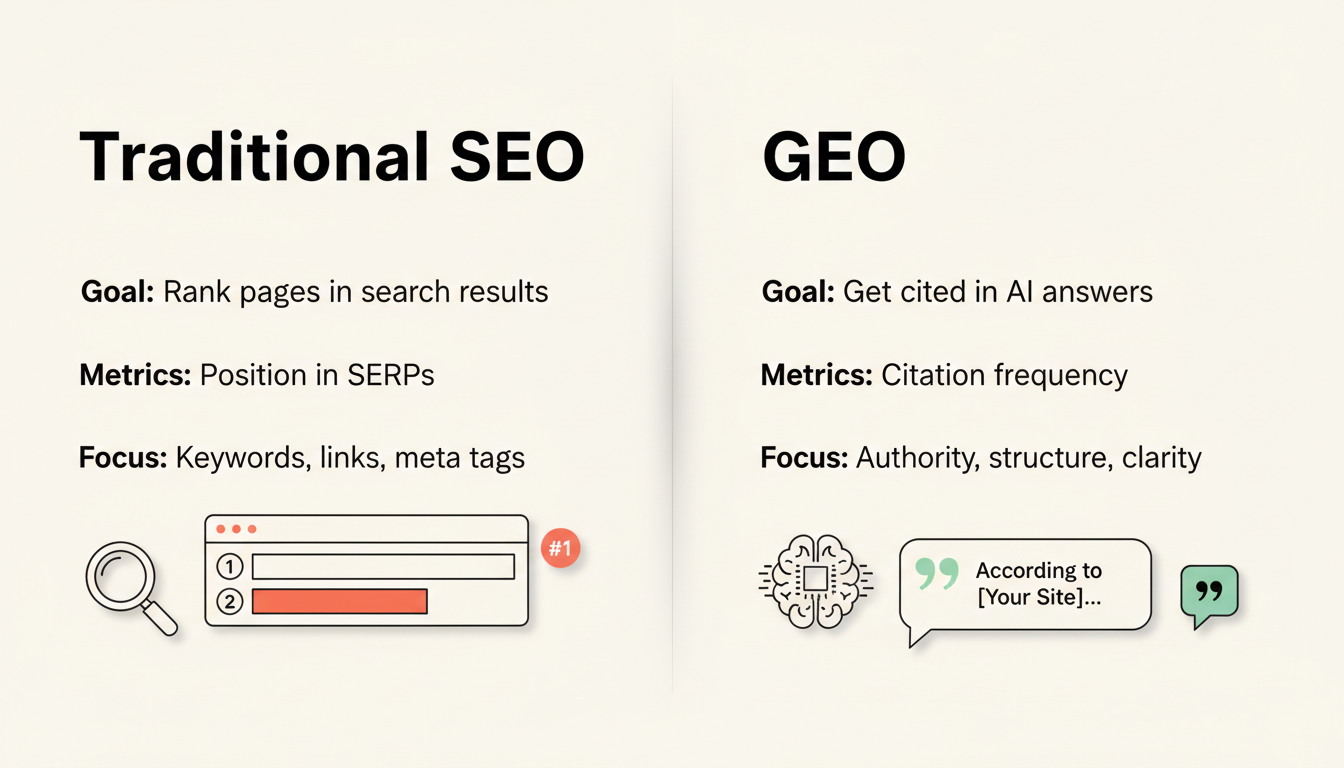
According to SEO.com's GEO vs SEO analysis, the fundamental difference lies in what you're optimizing for: SEO optimizes for rankings while GEO optimizes for citations.
Aspect | Traditional SEO | GEO |
Primary goal | Rank in search results | Get cited in AI answers |
Success metric | Position in SERPs | Citation frequency |
User journey | Click through to website | May receive answer directly |
Competition | Multiple ranked results | Single synthesized answer |
Optimization focus | Keywords, links, meta tags | Authority, structure, clarity |
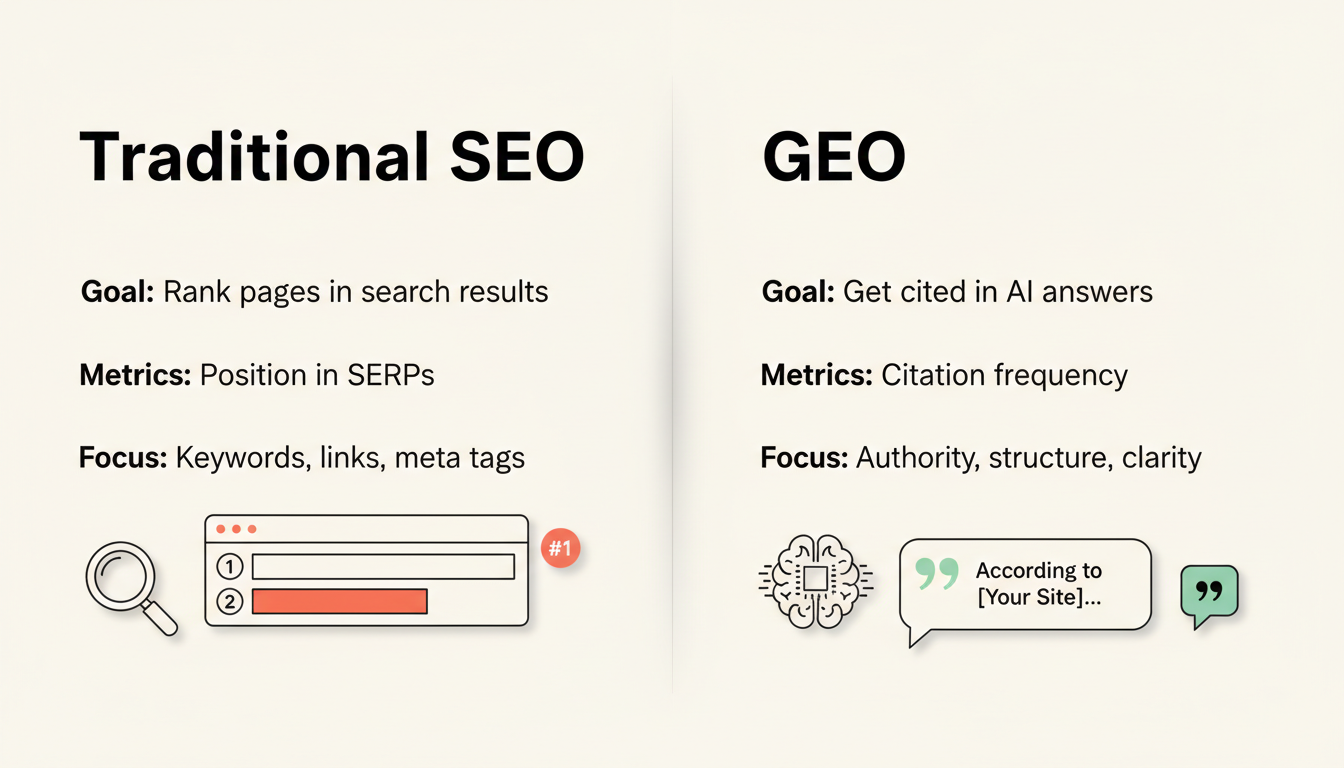
According to Siege Media, traditional SEO focuses on getting your page to rank higher on Google by targeting keywords, building links, and optimizing meta tags. GEO is about making sure your content gets noticed and quoted by AI-powered systems. Understanding how AI SEO works helps bridge the gap between these two optimization approaches.
According to StubGroup, GEO doesn't replace SEO but works on top of it. Generative AI engines rely on the same technical foundations: clean site structure, fast load times, mobile optimization, accessible content, proper indexing, and logical information architecture.
How they work together:
According to Firebrand Marketing's GEO best practices guide, effective GEO fits into a broader cross-functional strategy including SEO, content marketing, PR, and social media—all designed to drive brand visibility in AI search results.
According to Deciding Factor's GEO guide, GEO emphasizes structured data, conversational content, and authoritative signals that help large language models pull accurate information into AI-generated answers.
Format content so AI systems can easily extract and understand information:
Build credibility that AI systems can verify:
Ensure AI crawlers can access your content:
Implementing schema validation and testing for AI search ensures your structured data is correctly formatted and accessible to generative engines.
According to SEO.com's GEO trends analysis, 2026 emphasizes topic targeting over keyword targeting. Building comprehensive coverage of subject areas signals expertise to AI systems.
According to LinkedIn's GEO explainer, when someone asks ChatGPT a question in your domain, the AI either mentions your brand or it doesn't. GEO is about showing up in those responses as the trusted source.
Implementation framework:
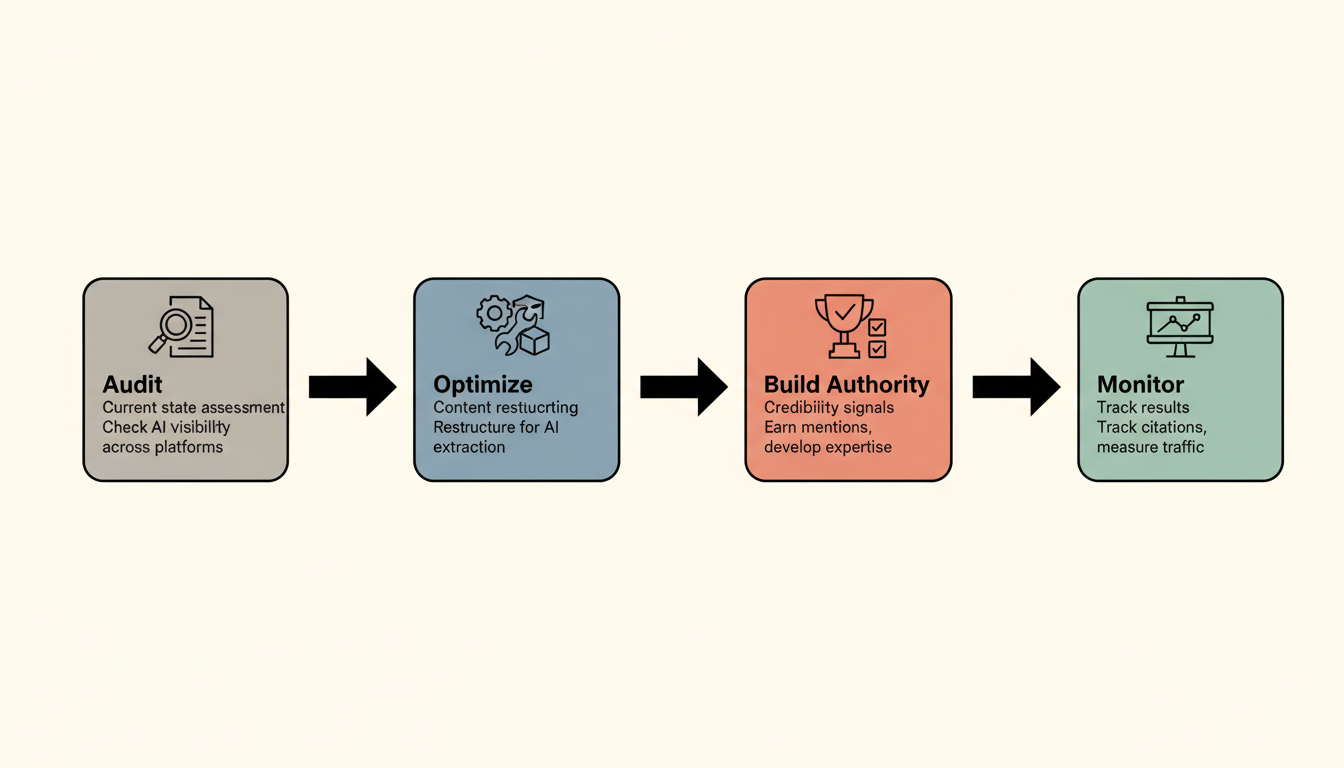
Phase 1: Audit
Phase 2: Optimize
Phase 3: Build Authority
Phase 4: Monitor
According to Conductor's 2026 AEO/GEO Benchmarks Report, organizations must measure AI visibility as rigorously as SEO visibility—tracking citations and mentions as core KPIs. Many organizations seek AEO services consultation to establish proper measurement frameworks.
Key GEO metrics:
Metric | What It Measures |
Citation frequency | How often AI mentions your brand |
Citation accuracy | Whether AI represents your brand correctly |
Share of voice | Your visibility vs. competitors in AI responses |
AI referral traffic | Visitors coming from AI platforms |
Brand mention sentiment | Tone of AI-generated brand mentions |
According to PR News Online, brands can boost brand citations in AI search by over 150% through GEO strategies.
According to LinkedIn's GEO analysis, GEO is strategic PR applied to AI platforms. What AI looks for when deciding who to cite—external validation, credible sources mentioning you, expert positioning, authoritative backlinks, consistent presence in trusted publications—is what PR has always built.
PR-driven GEO tactics:
Understanding GEO is essential for 2026 visibility:
According to Superlines, businesses that adopt GEO early secure long-term visibility, while late movers risk invisibility in AI-powered search. The shift from ranking for keywords to being cited as a source represents the next evolution in search marketing.
By submitting this form, you agree to our Privacy Policy and Terms & Conditions.