February 19, 2026


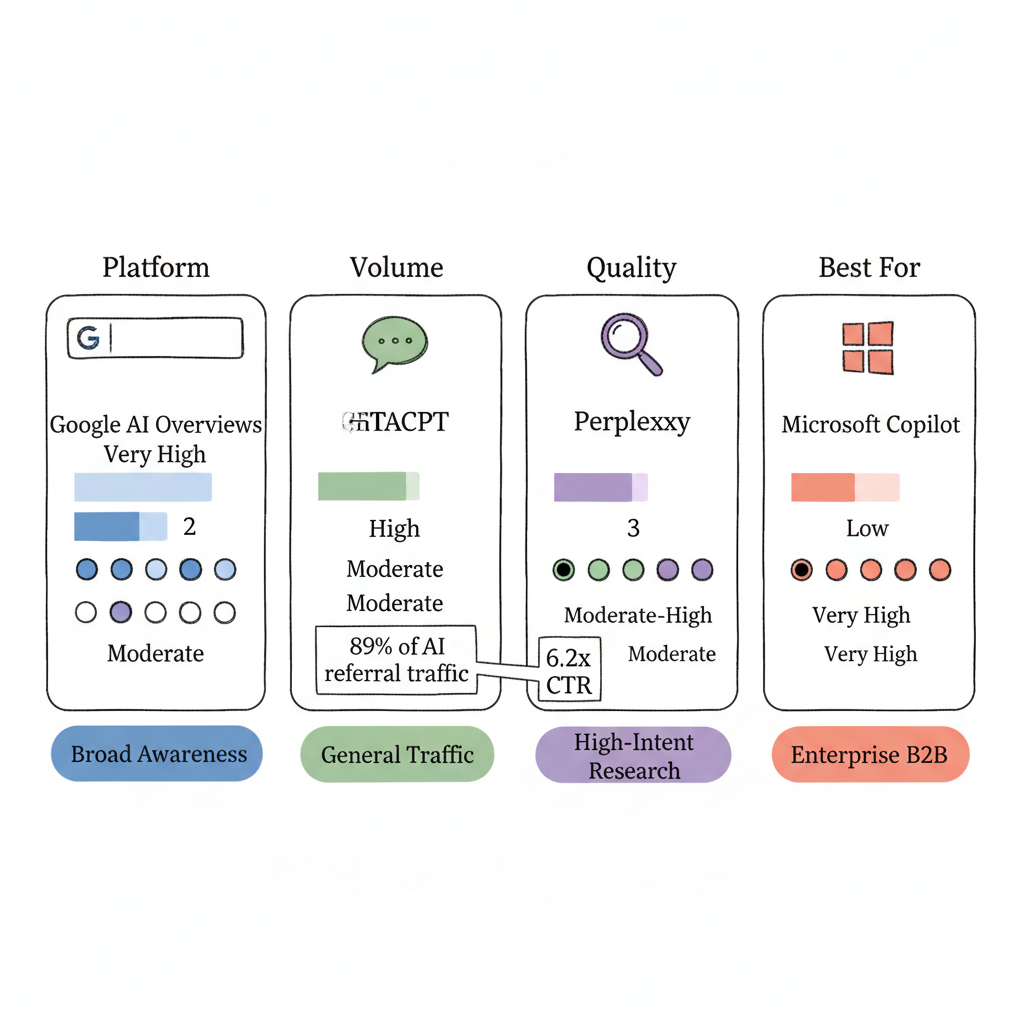
AI search platforms deliver vastly different ROI profiles. ChatGPT drives 89% of measured AI referral traffic. Perplexity users are 6.2x more likely to click citations. Google AI Overviews reach the largest audience but create the most click competition. Understanding these dynamics enables strategic resource allocation that maximizes returns across your AI search portfolio.
This guide provides a comprehensive framework for calculating AI search ROI by platform, helping you determine where to invest for optimal returns.
Before analyzing ROI, understanding the current market landscape establishes context for investment decisions.
ChatGPT: 800+ million weekly active users as of late 2025, making it the dominant AI discovery platform. When AI search traffic clicks through to websites, 89% comes from ChatGPT—representing the largest potential traffic source but also the most competitive environment. The Perplexity vs ChatGPT SEO comparison reveals significant differences in how these platforms drive traffic.
Google AI Overviews: Appears on a growing percentage of Google searches, reaching billions of users daily. However, AI Overviews have dramatically changed click behavior—CTR drops from 15% to approximately 8% when overviews appear, with only 1% of users clicking source links within the overview. Understanding the Google AI Overview update frequency helps predict visibility changes.
Perplexity: Smaller user base but exceptional engagement. With a Referral Efficiency Index of 6.2x, Perplexity users click citations far more frequently than users on any other AI platform, making it disproportionately valuable for traffic generation.
Microsoft Copilot: Integrated into Windows, Office, and Bing, reaching millions of enterprise users. Particularly valuable for B2B brands targeting professional audiences who use Microsoft's ecosystem. The Microsoft Copilot vs Bing AI analysis shows how these platforms complement each other.
AI search optimization investments fall into three categories:
Time Investment: Content creation, optimization, and monitoring hours Budget Investment: Tools, platforms, agencies, and paid strategies Resource Investment: Team expertise, technology infrastructure, and cross-department coordination
Each platform requires different investment mixes, affecting ROI calculations significantly. Organizations implementing generative AI for SEO strategies must allocate resources across multiple channels.
ROI calculation for AI search requires platform-specific metrics that account for traffic quality, conversion rates, and attribution complexity.
AI Search ROI = (Revenue from AI Referrals - Investment Cost) / Investment Cost × 100This simple formula becomes complex in practice because:
Google AI Overviews:
Optimizing your Google AI Overviews logo can improve brand recognition even when users don't click through.
ChatGPT:
Perplexity:
Microsoft Copilot:
Resource allocation differs significantly across platforms, affecting ROI calculations. Professional answer engine optimization services can help streamline multi-platform strategies.
Time Investment: High
Budget Investment: Moderate to High
Resource Investment: High
Total Monthly Investment Range: $5,000-$20,000 for serious optimization
Time Investment: Moderate to High
Budget Investment: Moderate
Resource Investment: Moderate
Total Monthly Investment Range: $3,000-$12,000
Using specialized answer engine optimization tools can reduce manual effort across platforms.
Time Investment: Moderate
Budget Investment: Low to Moderate
Resource Investment: Low to Moderate
Total Monthly Investment Range: $1,500-$5,000
Developing a comprehensive Perplexity AI optimization strategy delivers high returns relative to investment.
Time Investment: Moderate
Budget Investment: Low to Moderate
Resource Investment: Low
Total Monthly Investment Range: $1,500-$5,000
Not all AI referral traffic delivers equal value. Understanding quality differences informs ROI-optimized allocation. Recent AI-powered search engine statistics reveal dramatic differences in user behavior across platforms.
Google AI Overviews:
ChatGPT:
Perplexity:
Microsoft Copilot:
Platform | Volume | Quality Index | Best For |
Google AI Overviews | Very High | Moderate | Broad awareness, brand visibility |
ChatGPT | High | Moderate-High | General traffic, brand mentions |
Perplexity | Moderate | Very High | Research traffic, high-intent users |
Copilot | Low | Very High | Enterprise B2B, professional services |
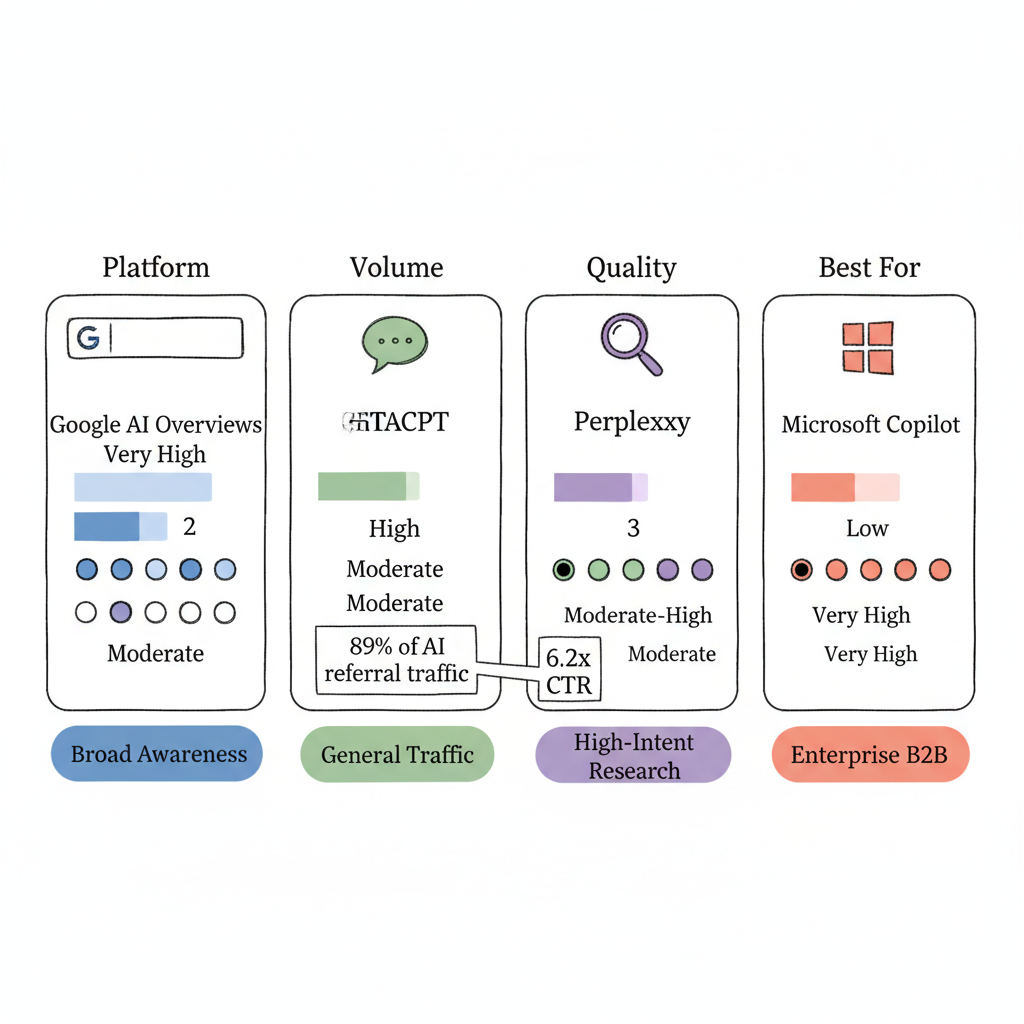
The AI search platform market share comparison 2026 provides context for these volume differences.
AI search traffic converts differently than traditional organic traffic.
Research indicates AI-sourced traffic often converts at significantly higher rates than traditional search. Users arriving from AI recommendations have received an implicit endorsement from the AI system, creating trust that accelerates conversion.
Observed patterns:
Recommendation context: Being cited as a "best" option converts better than neutral mentions Query intent alignment: Commercial and transactional query visibility drives higher conversion Landing page optimization: AI traffic often arrives at specific pages; optimization matters User journey stage: AI users often arrive further down the funnel
Accurate attribution enables precise ROI calculation.
UTM tracking: Add UTM parameters to trackable referrals Platform analytics: Monitor native referral reports in Google Analytics/similar First-touch attribution: Credit AI platforms for users who first discover you there Multi-touch attribution: Assign partial credit based on journey contribution
Brand search lift: Correlate AI visibility with increases in branded search volume Direct traffic correlation: Monitor direct traffic changes alongside AI visibility improvements Survey-based attribution: Ask converting customers how they discovered you Controlled experiments: Compare periods of high/low AI visibility to measure impact
Business Model | Recommended Attribution |
E-commerce (short cycle) | Last-touch or time-decay |
SaaS (medium cycle) | Multi-touch with position weighting |
Enterprise B2B (long cycle) | Multi-touch with first-touch emphasis |
Brand awareness | Reach and frequency metrics |
ROI Profile:
Best ROI scenarios:
ROI calculation example:
Monthly investment: $10,000
AI Overview citations: 500 high-intent queries
Estimated exposure: 50,000 monthly impressions
Click-through: 500 clicks (1%)
Conversion rate: 4%
Conversions: 20
Average order value: $1,000
Revenue: $20,000
ROI: ($20,000 - $10,000) / $10,000 = 100%
Reviewing AI Overview case studies helps calibrate ROI expectations.
ROI Profile:
Best ROI scenarios:
ROI Profile:
Best ROI scenarios:
ROI advantage: Lower competition and higher click rates mean faster break-even despite smaller audience.
ROI Profile:
Best ROI scenarios:
Implementing targeted B2B AEO marketing strategies maximizes Copilot ROI.
Optimal AI search ROI requires portfolio thinking, not single-platform focus. Following an AI search optimization timeline roadmap helps coordinate multi-platform efforts.
Conservative Portfolio (Lower risk, stable returns):
Aggressive Portfolio (Higher risk, higher potential returns):
B2B Specialized Portfolio:
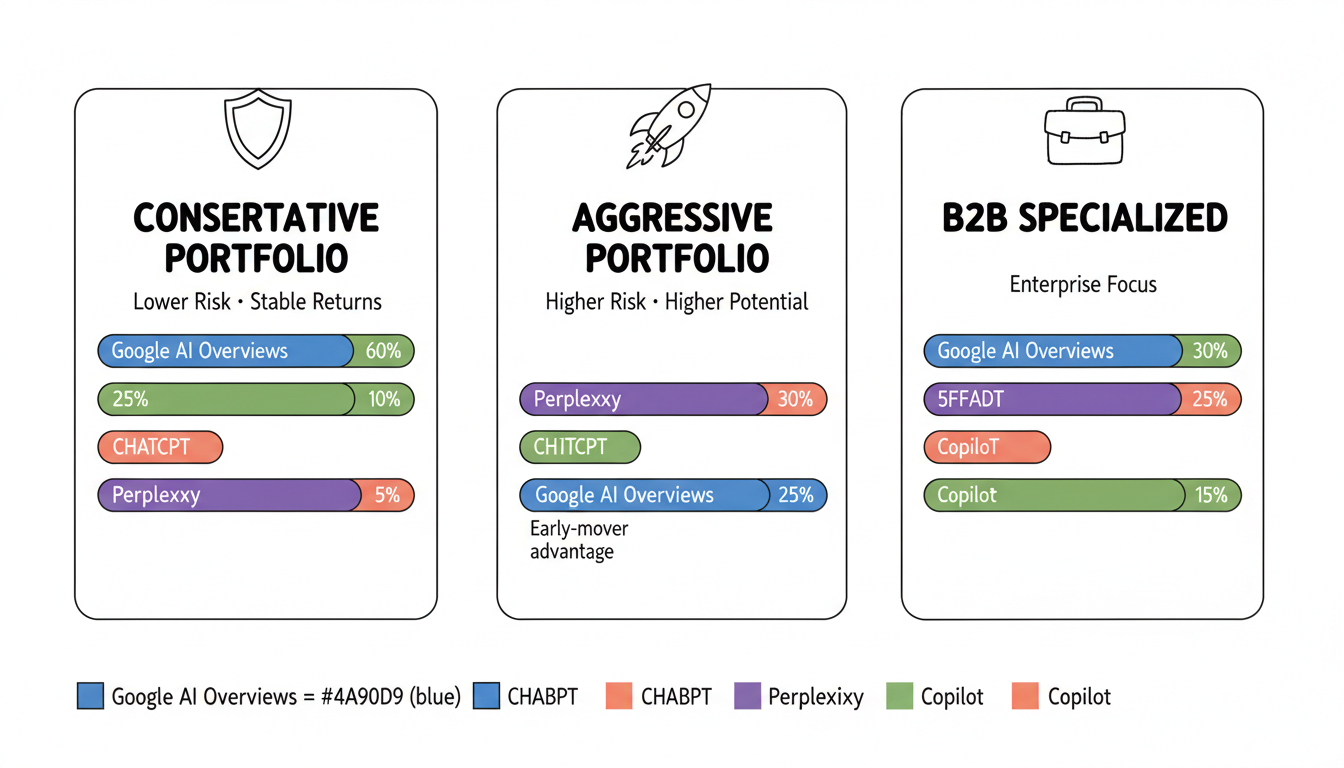
Review and adjust allocation when:
Structure your analysis using this framework. Leveraging AI SEO software can reduce operational costs while improving results.
Category | Low Estimate | High Estimate |
AI tracking tools | $100 | $1,500 |
Content optimization | $2,000 | $8,000 |
Agency services | $0 | $15,000 |
Internal team time | $1,500 | $6,000 |
Total | $3,600 | $30,500 |
Category | Measurement Method |
Direct revenue | Platform referral tracking |
Brand search lift | Branded query volume change |
Competitive displacement | Share of AI citations |
Customer acquisition cost reduction | CAC trend analysis |
Break-Even Point = Total Investment / (Revenue Per AI-Sourced Customer × Monthly AI Customers)It depends on your business model. Perplexity typically delivers fastest ROI due to lower competition and higher click rates. Google AI Overviews offers highest potential scale for established brands. ChatGPT provides volume for consumer-focused businesses. Copilot serves B2B enterprises effectively.
Initial visibility improvements appear within 4-8 weeks. Revenue impact typically becomes measurable at 3-6 months. Full ROI realization often takes 6-12 months as optimized content gets indexed and AI systems incorporate it into response patterns.
No. Allocate based on your target audience, business model, and competitive position. B2B companies should weight toward Perplexity and Copilot. Consumer brands should emphasize ChatGPT and Google AI Overviews. Adjust based on measured results.
Supplement click-based metrics with brand health indicators: branded search volume, direct traffic trends, survey-based attribution, and correlation analysis between AI visibility and business outcomes.
By submitting this form, you agree to our Privacy Policy and Terms & Conditions.