
February 19, 2026


Generative AI has moved from novelty to necessity in SEO workflows. The teams producing competitive content at scale aren't choosing between AI and human expertise—they're combining both strategically. Understanding which AI tools solve which problems determines whether generative AI accelerates your SEO or creates expensive noise.
This guide covers the practical applications, tool categories, and workflows that deliver measurable SEO results.
AI excels at specific SEO tasks while struggling with others. Knowing the difference prevents wasted effort.
High-impact AI applications:
Where AI falls short:
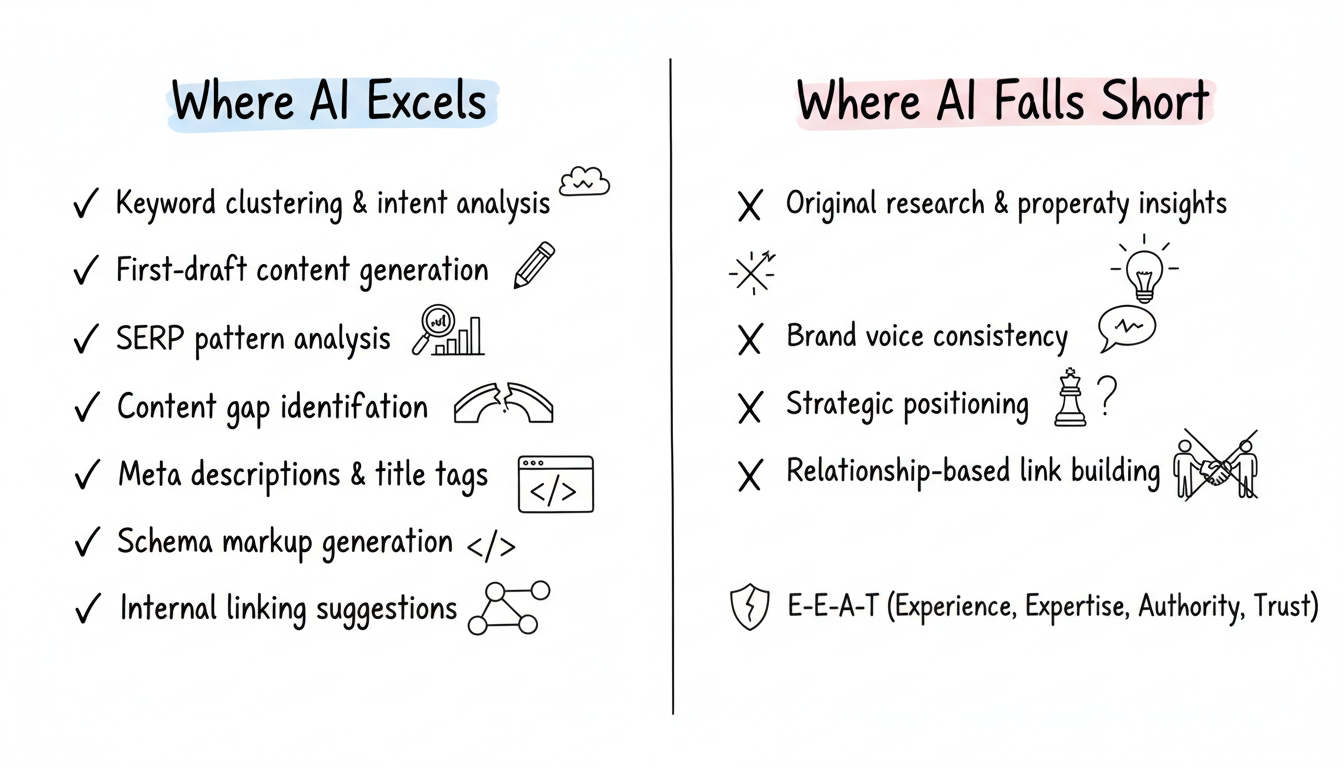
The most effective workflows use AI for scale and efficiency while preserving human judgment for strategy and quality. When implementing schema markup knowledge graph strategies, AI tools can generate the technical markup while humans ensure the semantic relationships accurately represent business expertise.
Tools like Jasper, Copy.ai, and Writer produce draft content from prompts and outlines. Pricing ranges from $49-199/month depending on output volume.
Best practices for content generation:
Content generation tools reduce time-to-draft but don't eliminate the need for human expertise. Teams report 40-60% time savings on first drafts while increasing editing investment.
Clearscope, Surfer, MarketMuse, and Frase analyze top-ranking content to recommend optimization improvements. These tools identify missing topics, suggest word counts, and score content against competitors.
How optimization tools work:
They scrape top-ranking pages for target keywords, identify common topics and entities, then score your content against that baseline. Higher scores correlate with better rankings—but correlation isn't causation.
Pricing ranges:
Use optimization scores as guidance, not gospel. Content that rigidly follows optimization recommendations often reads unnaturally. Balance optimization suggestions with readability and user value.
Semrush, Ahrefs, and Moz have integrated AI features into their platforms. These include AI writing assistants, automated content briefs, and predictive ranking analysis.
Semrush AI features:
Advantages of integrated platforms:
Data flows between features—keyword research informs content briefs, which guide AI writing, which optimization tools score. The workflow stays within one system.
Considerations:
Enterprise pricing ($139-449/month) may exceed what smaller teams need. Standalone tools often provide deeper functionality in specific areas. For teams evaluating aeo software guide options, understanding how AI tools integrate with answer engine optimization becomes critical.
Niche tools solve specific problems:
NeuralText: Combines keyword clustering, SERP analysis, and content generation in one workflow. Strong for content planning and brief creation.
Writesonic: Focuses on marketing copy including product descriptions, landing pages, and ad copy alongside blog content.
Outranking: Emphasizes SEO-first content with built-in optimization throughout the writing process.
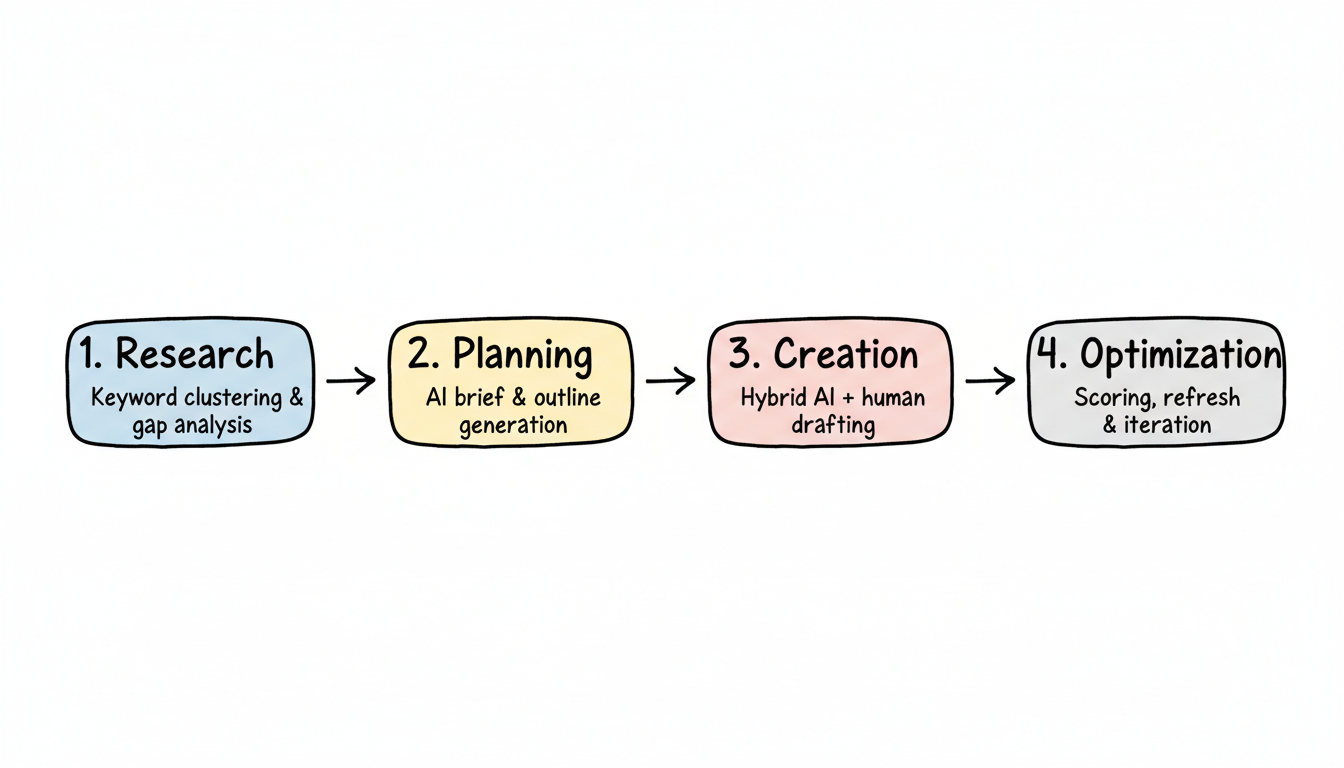
AI accelerates keyword research and competitive analysis without replacing strategic thinking.
AI-assisted keyword research workflow:
AI tools can cluster thousands of keywords in minutes—work that took hours manually. The strategic decisions about which clusters to pursue remain human. Understanding how answer engines work helps inform which keyword clusters deserve priority in an AI-first search landscape.
AI generates content briefs and outlines from research data.
Effective AI brief generation:
Review and refine AI-generated briefs before writing. AI captures patterns from existing content but may miss emerging angles or unique positioning opportunities.
AI accelerates drafting while humans ensure quality and originality.
Hybrid creation workflow:
This workflow produces more content faster while maintaining quality standards. Teams report 2-3x output increases with equivalent or better ranking performance. When creating content structured for AI citations, implementing qapage schema ai content techniques helps maximize visibility in answer engines.
AI tools score and suggest improvements to existing content.
Content refresh workflow:
Regular content optimization often delivers better ROI than new content creation. AI tools identify improvement opportunities across hundreds of pages simultaneously.
Not every team needs enterprise tools. A functional AI SEO workflow is possible for under $100/month.
Minimum viable AI SEO stack:
Mid-tier stack (~$150/month):
Enterprise stack ($300+/month):
Match investment to content volume and competitive intensity. Teams publishing 4-8 pieces monthly may not need enterprise tools.
AI-generated content without human enhancement underperforms. Search engines increasingly detect and devalue thin AI content. Human editing isn't optional—it's where quality happens.
Content scoring tools measure similarity to existing top-rankers. Achieving 100% optimization scores often produces generic content that reads like everything else. Use scores as input, not targets.
AI can't demonstrate experience, expertise, authoritativeness, or trustworthiness—humans must. Content in YMYL (Your Money Your Life) categories especially requires human expertise and oversight.
AI tools execute tactics efficiently. Strategy—what to optimize, for whom, and why—remains human work. Teams that automate tactics without clear strategy produce high volumes of low-impact content.
AI tools amplify existing SEO capability. Teams without SEO fundamentals find AI produces plausible-sounding but strategically misguided content. Build SEO knowledge first, then accelerate with AI.
Track these metrics to evaluate AI tool ROI:
Efficiency metrics:
Quality metrics:
Business metrics:
Compare AI-assisted content performance against baseline. Effective AI workflows should improve efficiency metrics without sacrificing quality metrics.
By submitting this form, you agree to our Privacy Policy and Terms & Conditions.



