February 19, 2026


Answer Engine Optimization requires new measurement capabilities that traditional SEO tools weren't designed to provide. When AI systems like ChatGPT, Perplexity, and Google AI Overviews generate responses, you need specialized software to track citations, measure visibility, and optimize content for AI comprehension.
This guide covers the AEO software landscape in 2026—from AI visibility tracking platforms to content optimization tools—helping you build the right tech stack for AI search success.
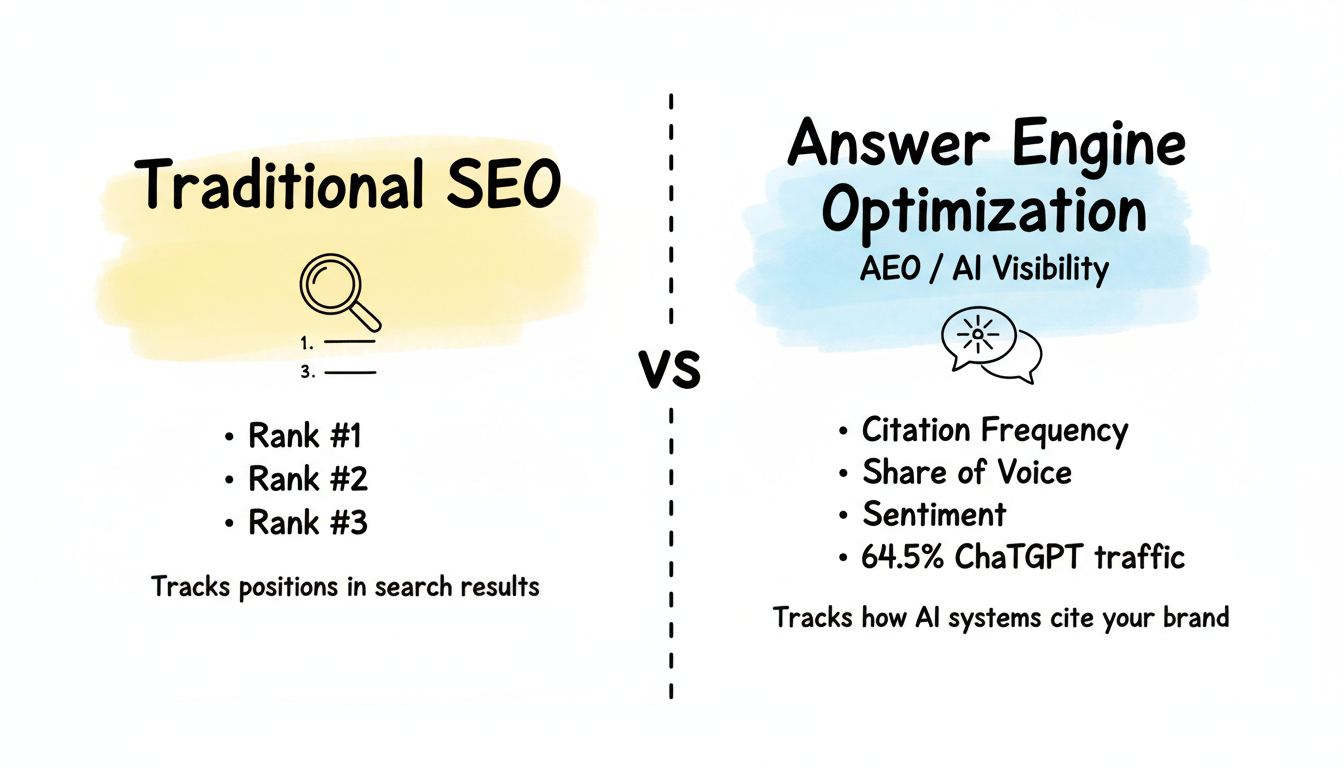
AEO software differs fundamentally from traditional SEO tools. While SEO platforms track rankings in search results, AEO tools analyze how AI systems generate answers and what influences visibility in those contexts.
Modern AEO platforms provide several essential functions:
AI visibility tracking – Monitor how frequently your brand appears in AI-generated responses across ChatGPT, Perplexity, Claude, Google AI Overviews, and Gemini.
Citation analysis – Track which of your pages get cited, in what context, and how citation patterns change over time.
Prompt-level monitoring – See exactly which user prompts trigger mentions of your brand versus competitors.
Sentiment tracking – Understand whether AI systems present your brand positively, neutrally, or negatively.
Competitive benchmarking – Compare your AI visibility against competitors for specific topics and queries.
Traditional SEO tools track rankings—position 1, 2, 3 in search results. AI visibility works differently. Your brand might appear in ChatGPT's response without any "ranking" to measure. AI systems synthesize information from multiple sources, cite selectively, and generate unique responses for each query.
This requires new metrics: citation frequency, mention accuracy, share of voice in AI responses, and sentiment analysis. Purpose-built AEO software addresses these measurement challenges.
The AEO software market has evolved into distinct categories serving different needs.
These platforms run automated queries across multiple AI engines and track brand mentions over time.
Key players:
These tools run queries on LLM chatbots instead of you, maintaining records of how often and in what contexts your brand gets referenced. Most track ChatGPT, Perplexity, Claude, Google Gemini, and Google AI Overviews.
These platforms help optimize content specifically for AI comprehension and citation likelihood.
Key capabilities:
Tools like Surfer SEO have added AI-specific features, while newer platforms like Goodie AI and Quattr focus specifically on GEO optimization and AEO content optimization.
Some platforms specialize in alerting when AI mentions change or competitors gain visibility.
Peec AI focuses on tracking brand mention activity across AI answer engines with prompt-level visibility and competitor comparison. Otterly AI provides citation tracking with brand mention accuracy monitoring.
These tools help teams respond quickly when AI visibility shifts—whether gaining new citations or losing ground to competitors.
Large organizations require platforms that integrate AEO with existing marketing operations.
Conductor supports answer engine optimization alongside traditional SEO, tracking brand visibility across AI search engines while unifying content creation, monitoring, and analytics. Semrush AI Toolkit extends the familiar SEO platform with AI visibility tracking across ChatGPT, Google AI, Gemini, and Perplexity.
Enterprise platforms prioritize integration, compliance, and team collaboration over standalone functionality.
When selecting AEO tools, consider these evaluation criteria.
Not all tools track all AI engines. Verify coverage for:
Platform | Priority Level | Notes |
ChatGPT | Essential | 64.5% of AI search traffic |
Google AI Overviews | Essential | Appears on 39%+ of queries |
Perplexity | High | Research-focused audience |
Claude | Medium | Growing professional usage |
Gemini | Medium | Google ecosystem integration |
Some tools track 3-4 engines, others track 10+. Choose based on where your audience actually searches.
AI visibility data quality varies significantly. Some platforms run queries infrequently or with limited prompt variation, missing how responses change across contexts.
Look for:
Tracking visibility means little without optimization guidance. Evaluate whether platforms provide:
The best tools connect visibility data to action—not just dashboards showing what happened, but guidance on what to do next.
AEO tools should fit existing workflows. Consider:
Standalone tools create data silos. Integrated platforms enable unified visibility strategies.
The right tool combination depends on your resources and priorities.
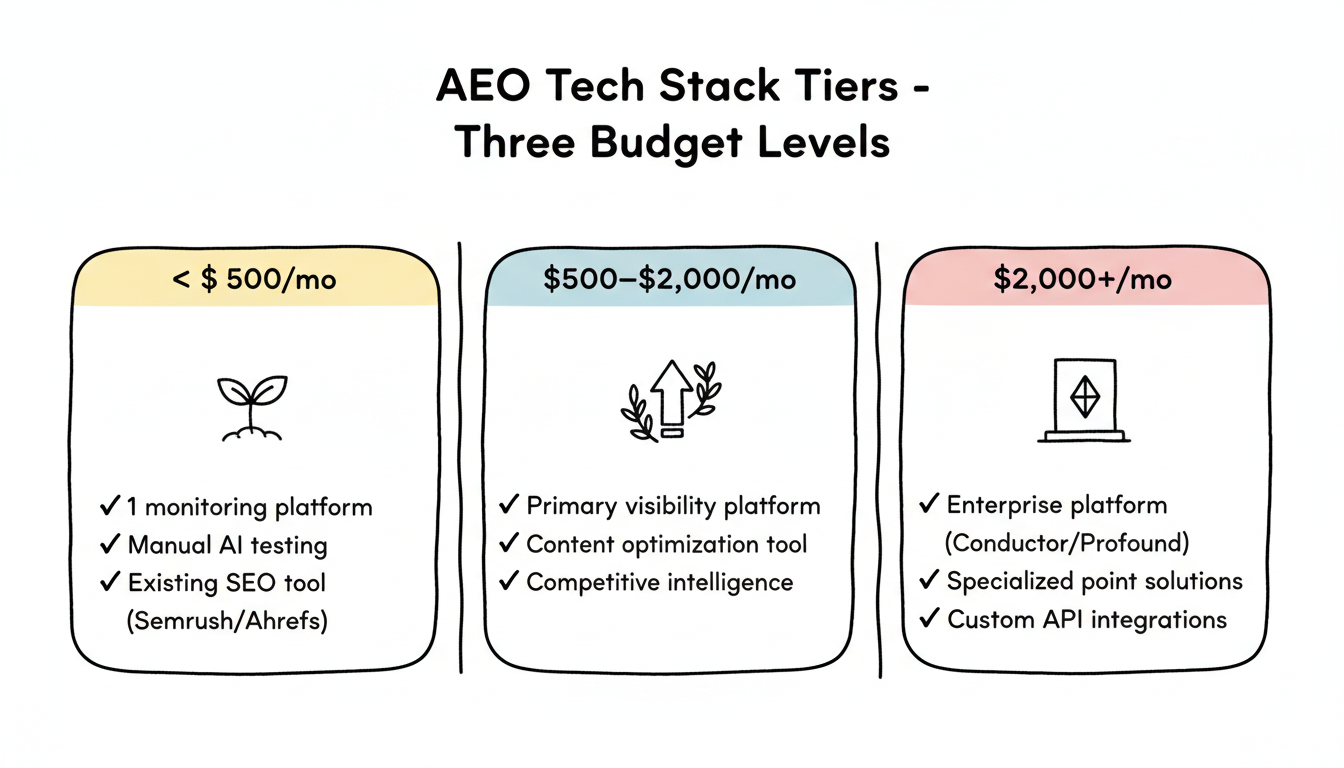
For teams beginning AEO optimization:
Visibility tracking: Choose one monitoring platform (SE Visible, Scrunch AI, or Otterly AI) for baseline measurement.
Manual testing: Supplement with direct queries to AI platforms to understand response patterns.
Traditional SEO tool: Leverage existing Semrush or Ahrefs investment—both have added AI visibility features.
This approach provides essential measurement without significant new investment.
For teams scaling AEO efforts:
Primary visibility platform: One comprehensive tool with multi-engine coverage and historical data.
Content optimization: Add a platform focused on AI-optimized content creation and analysis.
Competitive intelligence: Tools providing detailed competitor visibility comparison.
This combination enables both measurement and optimization execution.
For organizations with mature AI visibility programs:
Enterprise platform: Conductor, Profound, or similar platforms with compliance, team features, and integration capabilities.
Specialized tools: Point solutions for specific needs (deep Reddit analysis, voice search optimization, etc.).
Custom integrations: API connections linking AEO data to business intelligence systems.
Enterprise stacks prioritize scale, governance, and cross-functional visibility.
AEO tool pricing varies significantly:
Many tools offer free trials or freemium tiers for initial evaluation. Test before committing to annual contracts.
Research indicates most companies spend $500-2000/month on best AEO tools but see minimal results because they don't know how to act on the data. Tools alone don't create AI visibility—they measure it.
Before investing in sophisticated software, ensure your team has:
Tools amplify strategy—they don't replace it.
The AEO software market evolves rapidly. Watch for:
AI-generated optimization suggestions – Platforms using AI to analyze what makes content get cited and recommending specific changes.
Predictive visibility – Tools forecasting which content will earn citations before publishing.
Real-time monitoring – Instant alerts when AI response patterns change.
Cross-platform attribution – Connecting AI visibility to business outcomes like leads and revenue.
Today's leading tools may be displaced by better solutions within months. Stay flexible.
Not every organization needs expensive platforms immediately.
Direct queries to ChatGPT, Perplexity, and Claude cost nothing and provide immediate visibility insights. Systematic manual testing—tracking which queries surface your brand and competitors—builds baseline understanding.
Several platforms offer free tiers with limited functionality:
These provide starting points before investing in comprehensive solutions.
If you already pay for Semrush, Ahrefs, or similar platforms, explore their AI visibility features before adding new tools. These integrations may provide adequate functionality without incremental cost.
Begin with these steps:
AEO software provides essential measurement infrastructure for answer engine optimization. But tools follow strategy—invest in optimization fundamentals before scaling software investment.
Yes, for comprehensive AI visibility measurement. Traditional SEO tools track rankings in search results—they don't measure AI citation frequency, sentiment, or share of voice in generated responses. Most major SEO platforms now include AI visibility features, so check your existing tools first.
Start with free trials and freemium tiers to understand your needs. Effective AEO programs typically spend $500-2000/month on tools, though enterprise organizations invest significantly more. Tools only deliver value when paired with optimization strategy.
By submitting this form, you agree to our Privacy Policy and Terms & Conditions.