
February 19, 2026


The AI search landscape has transformed dramatically. What was once ChatGPT's near-monopoly has evolved into a competitive ecosystem where Google Gemini, Perplexity, Claude, and emerging platforms now capture meaningful market share.
For businesses optimizing their digital presence, understanding these statistics isn't optional—it's essential for strategic planning. This comprehensive guide presents the latest 2026 data on AI search market share, user adoption, and the trends reshaping how people discover information online.
AI search adoption has reached unprecedented scale in 2026. According to Netguru's AI adoption research, the global AI user base now exceeds 378 million people, with 64 million new users added since 2024 alone—the largest year-over-year jump ever recorded.
Key adoption metrics for 2026:
Metric | Value | Source |
Global AI tool users | 378 million | Netguru |
Weekly ChatGPT active users | 800 million | Similarweb |
Daily ChatGPT prompts processed | 2.5 billion | Omnius GEO Report |
US adults using AI daily | ~20% | Netguru |
Enterprise AI adoption rate | 78% | Netguru |
The enterprise adoption story is equally compelling. According to Netguru, 78% of organizations now use AI in at least one business function, up from 55% just one year earlier. Generative AI usage specifically jumped from 33% in 2023 to 71% in 2024.
Perhaps most significant for marketers: according to the Omnius GEO Industry Report, AI marketing spend is projected to grow from $20.4 billion in 2024 to $82.2 billion by 2030, representing a compound annual growth rate of approximately 25%. Understanding generative engine optimization strategies is becoming crucial for capturing this growing market.
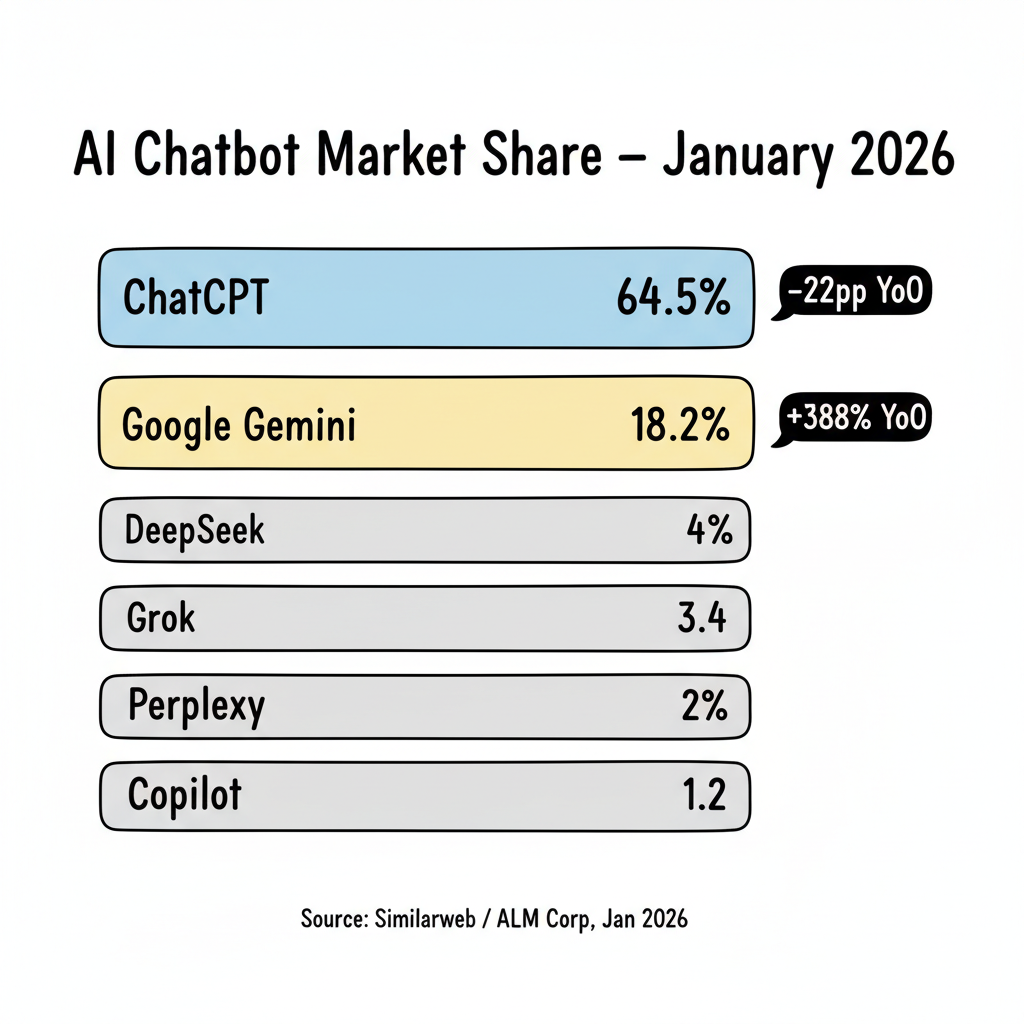
The AI chatbot market has undergone radical redistribution in early 2026. According to Similarweb data analyzed by ALM Corp, ChatGPT's traffic share dropped from 86.7% in January 2025 to 64.5% in January 2026—a staggering 22.2 percentage point decline.
AI Chatbot Market Share (January 2026):
Platform | Market Share | YoY Growth | Monthly Active Users |
ChatGPT | 64.5-68% | -19.2pp | 800M weekly |
Google Gemini | 18.2-21.5% | +237-388% | 650M monthly |
DeepSeek | 3.7-4% | Strong | N/A |
Grok (X.AI) | 2.9-3.4% | Moderate | N/A |
Perplexity | 2.0% | +370% | N/A |
Claude | 2.0% | +190% | N/A |
Microsoft Copilot | 1.1-1.2% | Stable | N/A |
According to Vertu's market analysis, Perplexity has demonstrated the most impressive growth trajectory at 370% year-over-year by positioning itself as an AI-first search engine rather than a general chatbot. Claude from Anthropic also showed strong growth at 190% year-over-year, with projected 2025 revenue of $2.2 billion.
The key takeaway: while ChatGPT remains dominant, the trajectory clearly favors competitors. Brands implementing search engine optimization using ai can no longer optimize for a single AI platform.
AI search adoption varies significantly by age group and use case. According to First Page Sage's market share report, younger demographics are substantially more likely to use AI search tools.
Google vs ChatGPT Usage by Age Group (2025):
Age Group | Google Share | ChatGPT Share |
13-24 | 74% | 17% |
25-44 | 80% | 13% |
45-64 | 86% | 8% |
65+ | 89% | 5% |
This demographic divide presents both opportunities and challenges. Brands targeting younger audiences must prioritize AI search optimization, while those serving older demographics can maintain focus on traditional search while gradually expanding AI presence.
Regional adoption patterns also differ substantially. According to the Omnius GEO Report:
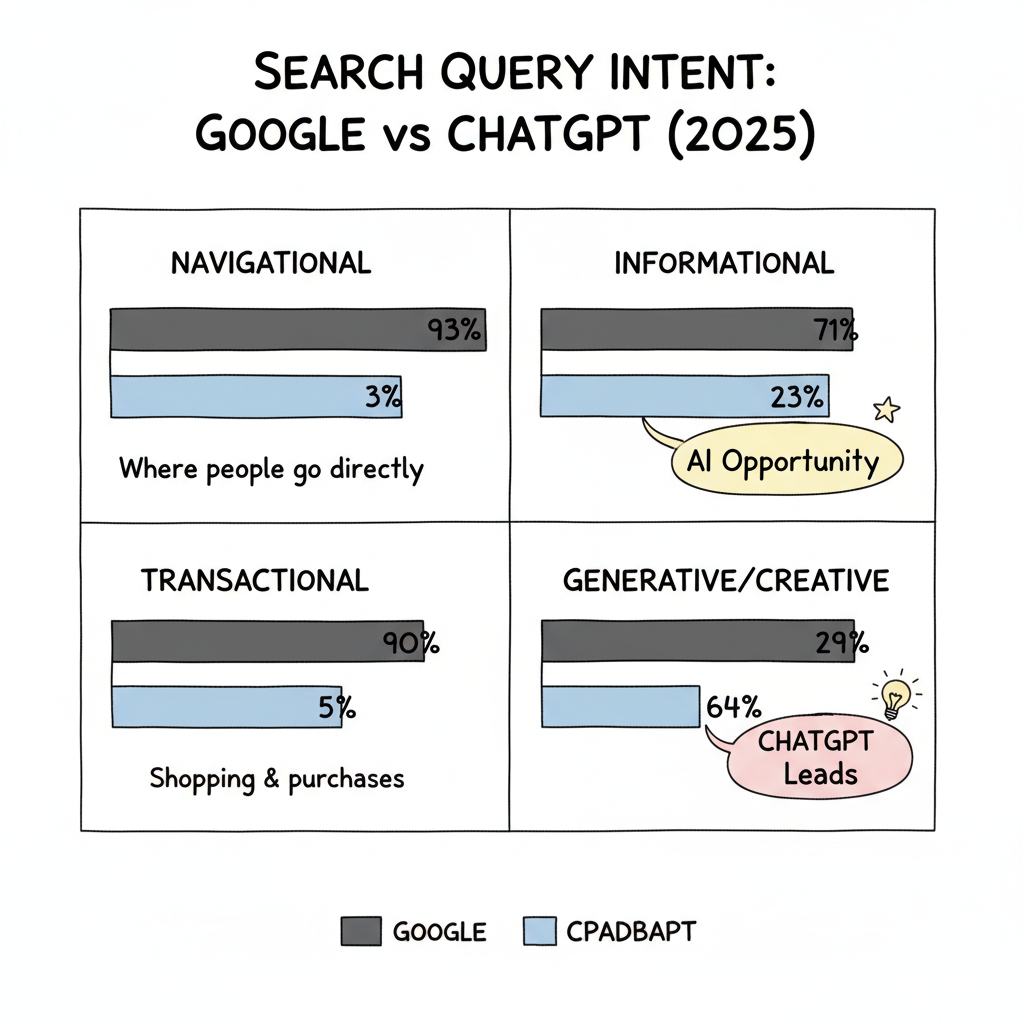
AI search platforms are capturing different types of queries compared to traditional search engines. According to First Page Sage, user intent dramatically affects platform choice.
Market Share by User Intent (2025):
Intent Category | Google Share | ChatGPT Share |
Navigational | 93% | 3% |
Informational | 71% | 23% |
Transactional | 90% | 5% |
Generative/Creative | 29% | 64% |
This data reveals critical strategic insights:
For what is geo in search engine optimization strategy, this means prioritizing informational and educational content that AI search users are actively seeking.
Despite rapid AI search growth, Google maintains overwhelming dominance in overall digital queries. According to First Page Sage's analysis:
Google vs ChatGPT Overall Comparison (Q4 2025):
Platform | Monthly Active Users | Share of Digital Queries | Avg Session Duration |
Google Search | 5 billion | 77.9% | 6m 12s |
ChatGPT | 858 million | 17.1% | 13m 09s |
Other (Bing, Perplexity) | 580 million | 5.8% | 4m 33s |
The session duration difference is significant: ChatGPT users spend more than double the time per session compared to Google users, indicating deeper engagement with AI-generated responses.
AI referral traffic growth tells another story. According to Digiday's analysis:
According to the Conductor AEO/GEO Benchmarks Report, 87.4% of all AI referral traffic across key industries comes from ChatGPT—but this dominance is shifting. Implementing aeo-seo-geo strategies helps businesses capture traffic across multiple platforms.
AI search adoption varies dramatically by industry. Healthcare leads all sectors according to Netguru's research, with a 36.8% compound annual growth rate in AI adoption.
AI Referral Traffic by Industry (from Conductor Report):
Industry | ChatGPT Share | Notable Other Platforms |
Average (all industries) | 87.4% | Perplexity (varies) |
Utilities | 79% | Gemini (21%) |
Financials | 95% | Copilot (5%) |
Technology | ~85% | Perplexity (growing) |
According to DemandSage's SEO statistics:
Before implementing AI search optimization across your organization, conducting an aeo-marketing-audit can identify the highest-impact opportunities for your specific industry.
Understanding which sources AI platforms cite is critical for optimization strategy. According to Superlines' research, ChatGPT relies heavily on Wikipedia for factual information, while Google Gemini pulls from a broader mix including YouTube.
Key citation insights:
According to Yoast's 2025 SEO wrap-up, citations have replaced visits as success signals for many top-of-funnel queries. Brand mentions now play a larger role in AI-driven citation behavior than links alone. Implementing perplexity-optimization-multi-source-citation techniques can dramatically improve your content's citation rate.
Google AI Overviews statistics provide additional context. According to WordStream:
Understanding how google selects ai overview sources is essential for earning these prominent placements.
The data points toward continued fragmentation and growth. According to Xenoss's AI trends analysis:
Predictions for 2026-2027:
According to the Omnius GEO Report, GenAI search ad spending in the US will roughly double between 2025 and 2026, reaching over $25 billion by 2029.
According to SparkToro's marketing predictions, aggregate corporate AI spend will increase by 30%+ over 2025's approximately $37 billion, though consumer AI adoption growth rates may slow.
The Mindrift AI trends report notes that 2026 marks the transition from AI experiments to real adoption, with AI agents, smarter search tools, and embedded AI features driving the next wave. Organizations should focus on ai-search-content-structure to prepare their content libraries for this evolution.
Based on the 2026 statistics, here are the strategic imperatives:
Following generative-engine-optimization-best-practices and using the right aeo-tools-complete-guide will help you stay ahead of competitors in this rapidly evolving landscape.
As of January 2026, ChatGPT holds approximately 64.5-68% of the AI chatbot market, while Google Gemini has surged to 18.2-21.5%. This represents a dramatic shift from January 2025 when ChatGPT held over 86% market share.
According to multiple sources, ChatGPT has 800 million weekly active users and processes 2.5 billion prompts daily. The total global AI tool user base exceeds 378 million people, with approximately 20% of US adults using AI tools daily.
Perplexity AI demonstrated 370% year-over-year growth, making it the fastest-growing AI search platform by percentage. However, in absolute terms, Google Gemini's growth from 5.7% to 21.5% market share (approximately 388% increase) represents the largest competitive shift.
Google still processes 77.9% of all digital queries compared to ChatGPT's 17.1%. However, AI referral traffic is growing rapidly—Gemini referrals grew 388% year-over-year while ChatGPT referrals grew 52%.
By submitting this form, you agree to our Privacy Policy and Terms & Conditions.



