February 19, 2026


Getting cited by AI systems isn't random. Brands appearing consistently in ChatGPT, Perplexity, and Google AI Overviews follow specific strategies that make their content citation-worthy. Understanding these strategies—and implementing them systematically—determines whether AI platforms include you in their synthesized responses.
This guide covers the core GEO strategies that drive AI visibility, organized by implementation priority and expected impact.
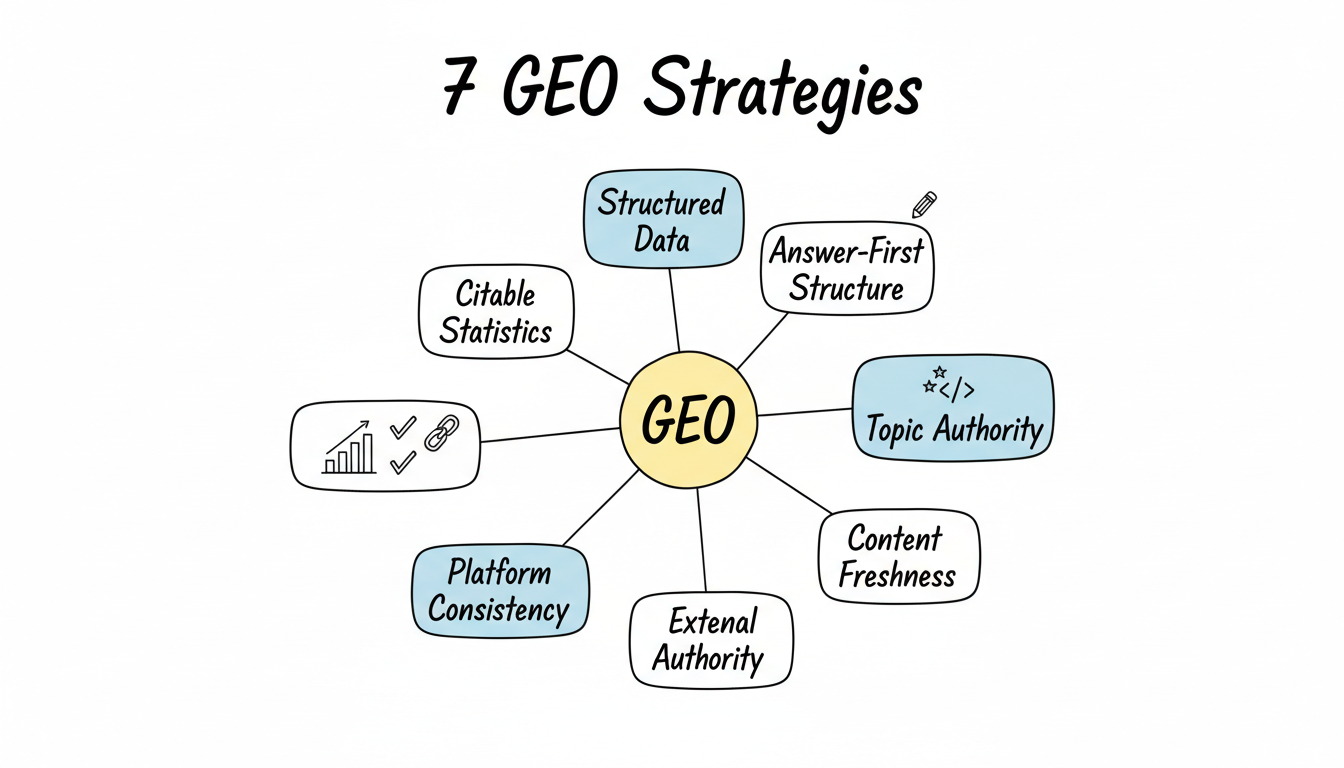
AI systems extract information from content. The easier you make extraction, the more likely you earn citations.
The answer-first approach:
Place direct answers immediately after headers—within the first 50-100 words of each section. AI systems scan for clear, quotable responses they can attribute to sources. Content that buries answers in lengthy introductions gets skipped.
Implementation:
Example transformation:
Before: "When considering the various factors that influence social media marketing success, many businesses find themselves wondering about optimal posting frequency. Research across multiple studies has shown that..."
After: "Post on Instagram 3-5 times per week for optimal engagement. This frequency balances visibility with audience fatigue, based on engagement data across 10,000+ business accounts."
The second version gives AI something to cite. The first requires parsing to find the actual answer.
Schema markup contributes approximately 10% to how AI systems rank and understand content. Proper implementation helps AI platforms correctly identify your organization, authors, and content relationships.
Priority schemas for GEO:
Organization Schema: Defines your brand entity—name, logo, social profiles, founding date. AI systems use this to understand who you are.
Person Schema: Establishes author expertise. Include credentials, affiliations, and expertise areas. AI systems evaluate author authority when deciding citation worthiness.
Article Schema: Marks up content metadata—publish date, update date, headline, description. Helps AI understand content freshness and topic.
FAQ Schema: Explicitly structures question-answer pairs AI can directly extract. High-value for voice search and featured snippet capture.
Implementation priority:
Test implementation with Google's Rich Results Test to ensure proper formatting.
AI systems prefer citing sources that demonstrate comprehensive expertise on topics—not one-off articles that happen to mention a keyword.
Building topic authority:
Create interconnected content covering all aspects of your expertise areas. AI systems recognize patterns: brands with 15 articles on a topic appear more authoritative than brands with one.
Implementation approach:
The authority threshold:
Research suggests brands need quality scores of 0.75+ (on a 0-1 scale) to consistently earn top citation placements. Quality scores reflect depth, accuracy, freshness, and external validation. Many organizations partner with AEO agency services to reach these thresholds faster through systematic content development.
Building topic authority takes time. Plan 6-12 months of consistent content development before expecting significant AI citation improvements.
AI platforms weigh recency when selecting sources. Perplexity, in particular, favors content updated within 2-3 days for time-sensitive queries.
Freshness strategies:
Regular update schedules: Establish systematic refresh cycles for priority content. Update statistics, add recent examples, refine recommendations based on platform changes.
Freshness signals: Ensure update dates appear in metadata and on-page. AI systems look for last-modified signals when evaluating recency.
Evergreen with updates: Structure content to remain useful long-term while incorporating fresh data. "Best practices for 2026" can be updated quarterly without rewriting entirely.
Implementation priority:
AI systems don't evaluate content in isolation. They cross-reference your brand against external sources to assess trustworthiness.
Authority signal sources:
Backlinks from trusted domains: Links from authoritative sites (.edu, major publications, industry leaders) signal credibility AI systems recognize.
Third-party mentions: When other reputable sources mention your brand positively, AI systems note the validation. PR and thought leadership investment pays GEO dividends.
Platform presence: Visibility on platforms AI systems trust—Reddit discussions, LinkedIn thought leadership, industry forums—reinforces brand authority.
Wikipedia and knowledge graphs: Brand presence in Wikipedia (where warranted) and Google Knowledge Graph significantly impacts AI entity recognition. A comprehensive knowledge graph optimization checklist can help ensure your brand signals reach AI platforms consistently.
Building external authority:
AI systems verify information across sources. Inconsistent brand information creates confusion that reduces citation likelihood.
Consistency requirements:
Audit checklist:
Any inconsistency—different phone numbers, varying company descriptions, conflicting credentials—undermines the trust signals AI systems look for.
AI systems love citing specific data points. Original research, surveys, and proprietary data give AI something concrete to attribute.
Creating citable statistics:
Formatting for citation:
"78% of B2B buyers research solutions in AI platforms before contacting sales" is citable. "A significant majority of B2B buyers use AI" is not.
Specific numbers with clear methodology earn citations. Vague assertions don't.
Businesses with complex technical requirements may benefit from exploring search engine optimization using AI tools to accelerate this phase.
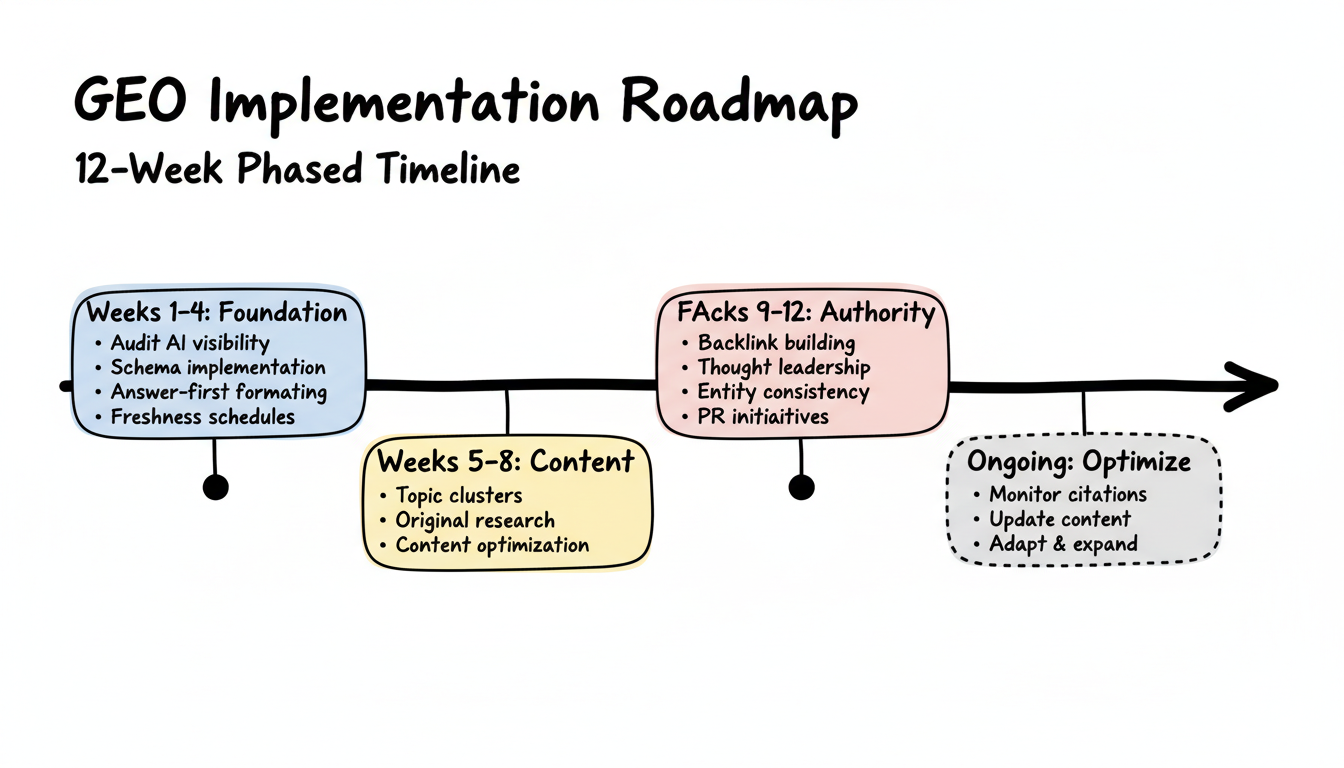
For organizations needing to accelerate implementation, a generative engine optimization tool can automate citation tracking and content optimization workflows.
Track these metrics to evaluate GEO strategy performance:
Citation metrics:
Traffic metrics:
Authority metrics:
ChatGPT, Perplexity, and Google AI Overviews have different behaviors. Strategies optimized for one may underperform on others. Build broad authority that translates across platforms.
GEO extends SEO—it doesn't replace it. Strong SEO fundamentals improve AI visibility. Abandoning traditional optimization weakens your GEO foundation.
GEO authority compounds over time. Brands that invest consistently see accelerating returns. Short-term thinking limits GEO potential.
By submitting this form, you agree to our Privacy Policy and Terms & Conditions.