February 19, 2026


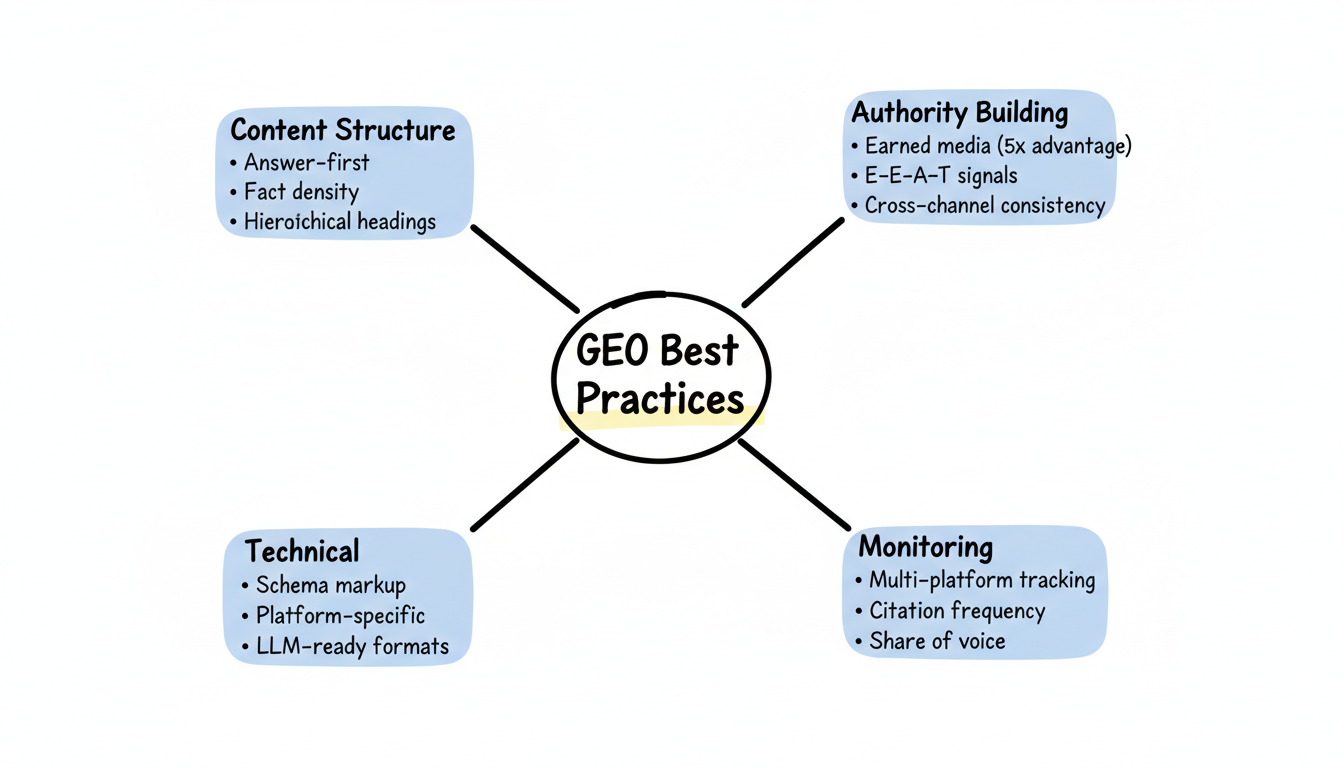
As AI-powered search transforms discovery, brands need specific, actionable tactics—not generic optimization advice. Generative engine optimization best practices combine content structure, authority signals, technical implementation, and cross-channel coordination to maximize citation probability across ChatGPT, Perplexity, Google AI Overviews, and other AI engines.
According to Stub Group's GEO research, Princeton, Georgia Tech, and the Allen Institute tested nine optimization methods across thousands of content samples, finding that adding authoritative citations, statistics, and improving content fluency increased visibility scores above 40 from a baseline of 19.3—representing performance gains exceeding 100%.
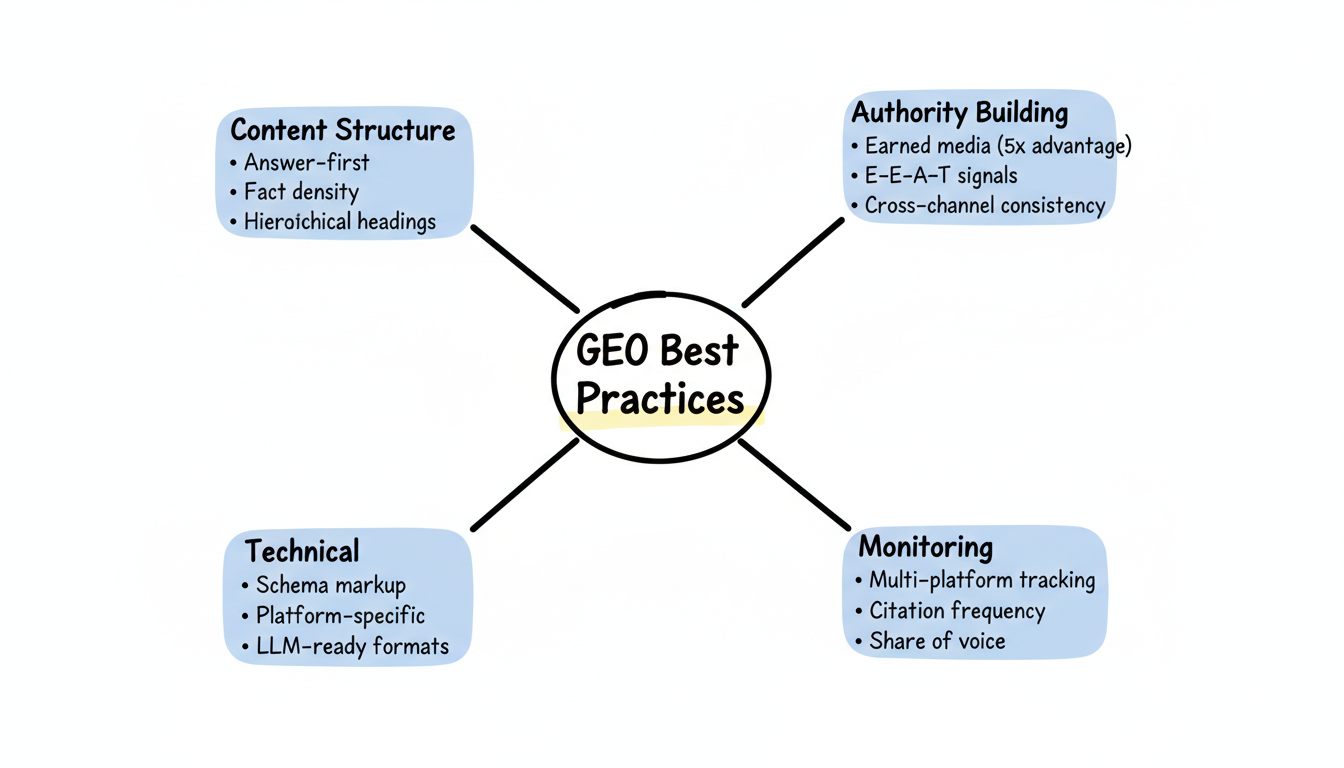
AI engines evaluate the first 40-60 words most heavily when determining citation worthiness. Place direct answers at the beginning of sections rather than building to conclusions.
According to Authority Tech's GEO checklist, content should lead with direct answers in the first 40-60 words of key pages, with H2 headers structured as complete mini-answers that AI can extract verbatim.
Answer-first formatting:
Element | Best Practice | Why It Works |
Opening sentences | Direct, factual answers | AI prioritizes early content |
H2 headers | Complete mini-answers | Extractable standalone content |
First paragraph | Cover who, what, why | Addresses query intent immediately |
Statistics | Include in first 100 words | Authority markers for source evaluation |
Fact-dense content earns more citations than general statements. AI systems verify claims against multiple sources—specific, verifiable data passes these checks.
According to Authority Tech, optimal statistics density is 1 data point per 150-200 words, with external citations to authoritative sources signaling quality and building trust.
Statistics integration tactics:
AI engines parse content more effectively when it follows clear logical organization. Proper heading hierarchy helps AI understand content relationships.
According to Hypertxt's GEO guide, AI engines parse content better when it follows a logical hierarchy using H1, H2, and H3 headings to organize information systematically.
Structural organization:
H1: Main Topic Answer
├── H2: Subtopic 1 (Complete Answer)
│   ├── H3: Supporting Detail
│   └── H3: Supporting Detail
├── H2: Subtopic 2 (Complete Answer)
│   ├── H3: Supporting Detail
│   └── H3: Supporting Detail
└── H2: Summary/Key TakeawaysOptimization alone doesn't earn citations—earned media creates the authority signals AI systems evaluate when selecting sources. This is where understanding what an answer engine looks for becomes critical.
According to Authority Tech, earned media provides a 5x citation advantage over content optimization alone, making PR-driven GEO the most effective strategy. You can't optimize your way into AI citations without authoritative sources citing you first.
Earned media priorities:
Source Type | Citation Impact | Priority |
Industry publications | High | 1 |
News outlets | High | 2 |
Expert profiles | Medium-High | 3 |
Industry directories | Medium | 4 |
Social mentions | Low-Medium | 5 |
Experience, Expertise, Authoritativeness, and Trustworthiness signals help AI systems evaluate source credibility.
According to Authority Tech's checklist, E-E-A-T signals should include author bios, credentials, expert quotes, and authority markers like certifications, data volumes, and client counts in the first 100 words.
E-E-A-T implementation:
AI systems cross-reference brand information across multiple sources. Consistent messaging strengthens authority signals, particularly when implementing a comprehensive AEO marketing strategy framework.
According to Firebrand Marketing's GEO best practices, this coordinated effort—what they call Multiplier Marketing—produces a stronger, more consistent signal across the web, making it easier for LLMs to identify your brand as an authority.
Cross-channel alignment:
Structured data helps AI engines understand content context and improves citation probability.
According to LinkedIn's GEO content checklist, Article schema is the minimum requirement, with FAQ schema added where applicable to help search engines categorize content correctly.
Schema implementation priorities:
Schema Type | Use Case | Priority |
Organization | Company pages | Critical |
Article | Blog posts | Critical |
FAQ | Q&A content | High |
HowTo | Tutorial content | High |
Product | Product pages | High |
Person | Author pages | Medium |
Different AI engines have different source preferences and behaviors. Optimization should account for platform-specific patterns, including specialized approaches like Gemini AI search optimization.
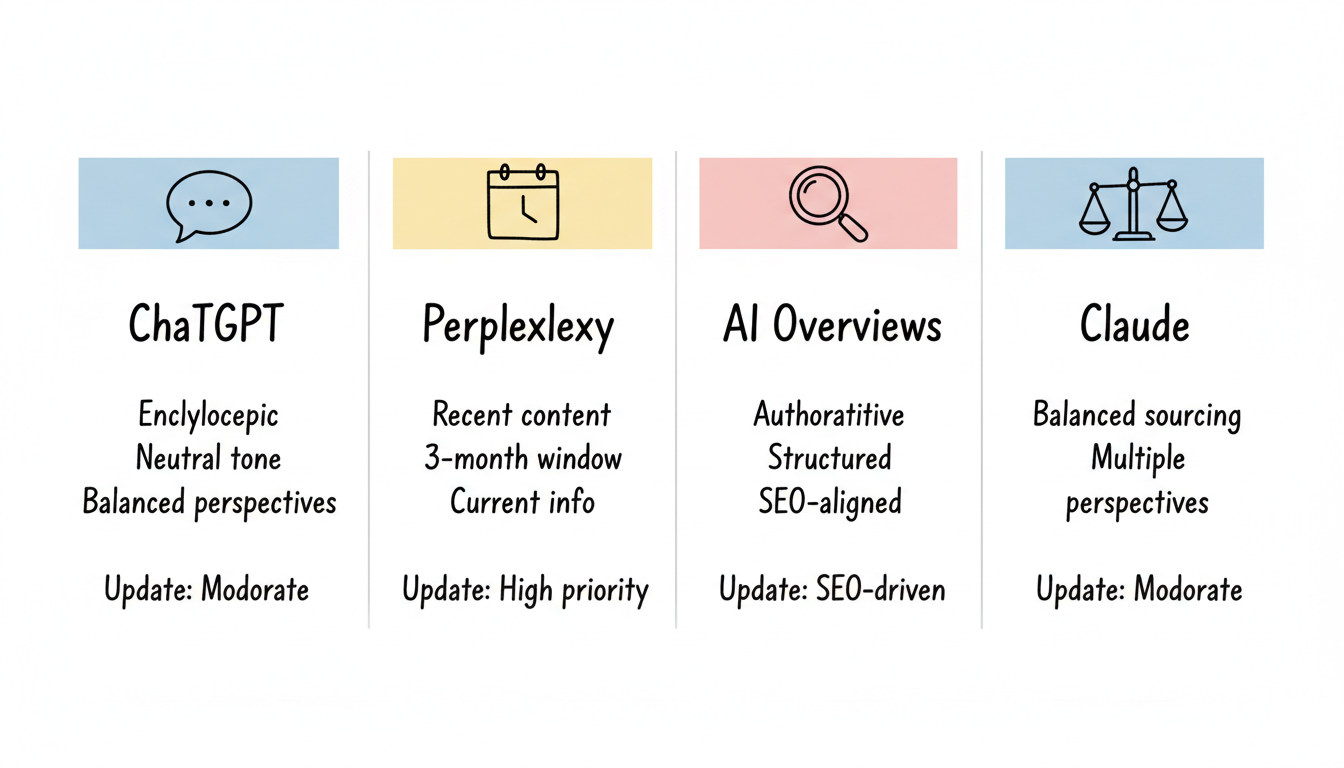
According to Authority Tech, ChatGPT prefers encyclopedic, neutral content with balanced perspectives, Perplexity rewards recent content (prioritizing updates within a 3-month window), and Google AI Overviews prioritize existing top-10 rankings and domain authority.
Platform-specific optimization:
Platform | Content Preference | Update Priority |
ChatGPT | Neutral, encyclopedic | Moderate |
Perplexity | Recent, current | High (3-month window) |
AI Overviews | Authoritative, structured | SEO-aligned |
Claude | Balanced sourcing | Moderate |
Certain content formats parse more easily for AI extraction and citation.
According to Firebrand Marketing, LLM-ready content includes FAQs, comparisons, listicles, checklists, and case studies using modular sections to help generative engines parse content.
High-performance content formats:
Checking a single AI platform doesn't provide complete visibility picture. Brands must monitor presence across all major engines, including emerging platforms like SearchGPT where SearchGPT citation tracking and measuring visibility becomes essential.
According to PR News Online's GEO guide, organizations should assess presence across ChatGPT, Claude, Gemini, and Perplexity since each engine returns different answers, highlights different competitors, and updates at different rates.
Monitoring framework:
Metric | What to Track | Frequency |
Citation frequency | Brand mentions in AI responses | Weekly |
Citation accuracy | Correctness of AI brand info | Bi-weekly |
Share of voice | Visibility vs competitors | Monthly |
Source attribution | Which content earns citations | Weekly |
Sentiment | Tone of AI mentions | Monthly |
Following a phased approach ensures systematic GEO implementation without overwhelming resources.
According to Vertu's GEO implementation guide, Phase 1 (months 1-3) should focus on conducting comprehensive AI visibility audits, building question inventories, and optimizing the top 20 existing pages with answer-first structures and schema.
Phased implementation:
Phase 1: Foundation (Months 1-3)
Phase 2: Optimization (Months 4-6)
Phase 3: Acceleration (Months 7-12)
According to Stub Group, citation-ready formatting includes keeping primary headers under 60 characters, including numbers in headlines (as AI engines prioritize statistical claims), and placing authority markers in the first 100 words.
Mistakes that undermine GEO:
Generative engine optimization best practices require systematic implementation:
According to Firebrand Marketing, the most effective GEO strategies focus on structured content, consistent topic authority, PR-driven credibility, social reinforcement, and cross-channel alignment. Together, these practices help LLMs understand, trust, and reference your brand across AI search experiences.
By submitting this form, you agree to our Privacy Policy and Terms & Conditions.